The Four Pillars of Investing: Lessons for Building a Winning Portfolio
William J. Bernstein
 English
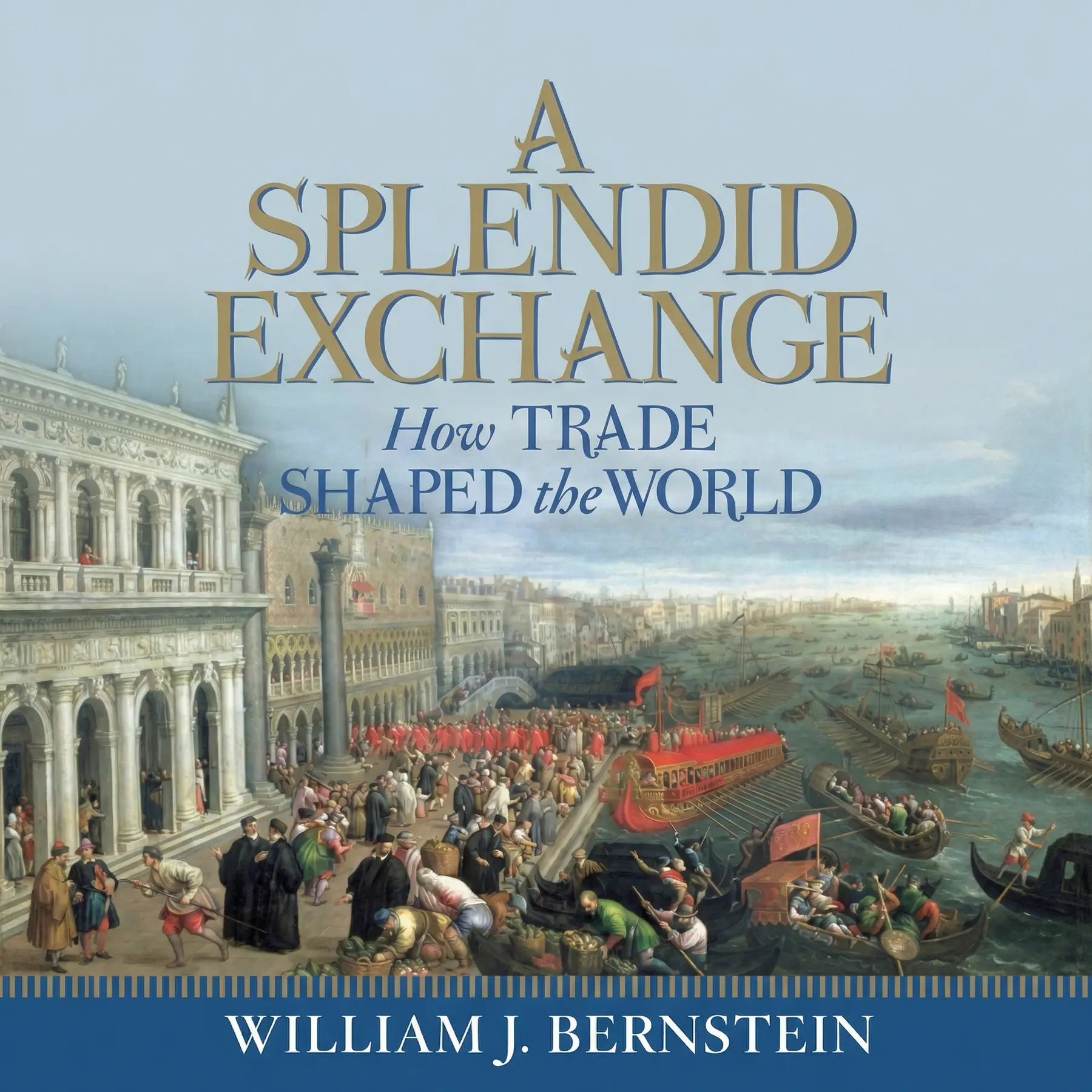
Follows world trade from Mesopotamian obsidian to postwar container ships. It shows why open trade has repeatedly beaten tariffs, how better transport moved power between nations, and why today's lopsided gains threaten the system.

1 min 03 sec
Most of us fill a shopping cart with fruit from Peru and shirts from Bangladesh without a thought, and few could explain how the world came to work this way. In A Splendid Exchange, neurologist and financial writer William J. Bernstein traces that system back to flakes of obsidian found in a Greek cave, carried there more than 12,000 years ago, most likely from Mesopotamia.
His argument holds across every era he covers. Trade grows wherever someone finds a cheaper, faster way to move goods. The nations that control that flow become the great powers. And open trade has paid off better than walls built against it, even though its rewards have never been fairly shared.
Camels, caravels, refrigerated ships and tariff laws all serve that one story. Follow it, and today’s arguments about tariffs, supply chains and stalled wages start to look like the newest round of a very old contest, one where history has already run many of the experiments.
1 min 50 sec
The fertile land called the cradle of civilization had grain, fish and wool in abundance. Yet it could not build a boat or a house on its own, and that weakness started something far bigger.
1 min 52 sec
For centuries the donkey carried the ancient world’s goods. Then desert tribes tried a different animal, and the luxuries of Arabia began reaching places that had never seen them, all the way to China.
1 min 54 sec
Medieval Europeans paid a fortune for cinnamon without knowing where it grew. What they also did not know was what their purchases were paid with, or what was riding along with the cargo.
1 min 53 sec
Ancient scholars had already worked out that sailing west to Asia was a bad bet. One explorer sailed anyway, and his mistake rewrote the map of world commerce.
2 min 10 sec
In 1721, wearing the wrong shirt in England could cost you a fine. The idea behind that law shaped an empire, and it keeps coming back whenever trade is described as a contest.
2 min 01 sec
Cheap steamships and refrigerated holds brought prices in distant cities almost level. American producers felt the squeeze and asked for protection, and what they got helped turn a downturn into a disaster.
1 min 50 sec
After 1945, moving a factory abroad to save a little on T-shirts became plain good sense in America. It made the country rich, and it also produced a problem that now threatens the whole arrangement.
1 min 15 sec
A Splendid Exchange works like one long experiment, repeated over thousands of years. Each time someone found a cheaper way to move goods, a camel, a caravel, a steamship or a refrigerated hold, trade expanded and power drifted toward whoever controlled the flow. Each time a nation tried to lock its wealth behind fines and tariffs, from the five-pound penalty for imported cotton to Smoot-Hawley, the results were poor. And every era’s gains carried costs paid by someone far down the chain: Balkan captives, plague-struck Venetians, workers whose wages have not moved in a generation.
That history gives you a sharper way to read the news. When a tariff is sold as protection, recall the brief boom after Fordney-McCumber and the retaliation that followed it. When a product’s origin is just a vague guess, ask what the chain behind it might be hiding, as the medieval spice buyers never did. And when someone praises globalization without any doubts, remember that Bernstein, a defender of free trade, still insists it has to be refined.
The exchange has always been splendid for someone. The real question is how many people it includes.
Fruit from Peru, televisions from Japan, shirts from Bangladesh: global trade is so ordinary now that few people stop to ask how it came about, or what it costs. William J. Bernstein answers by going back thousands of years, to volcanic glass carried across the ancient world and to the Persian Gulf ports where commerce first took off. His history follows one recurring pattern. A land lacks something, and a route opens to supply it. A better carrier, whether camel, caravel, steamship or refrigerated hold, speeds that route up, and power moves toward whoever controls it. Along the way the same routes carried slaves and the Black Death, and governments repeatedly tried to hold back imports with fines and tariffs, most disastrously with the Smoot-Hawley Act, which helped make the Great Depression worse. Readers get a clear account of how trade shaped empires, from Holland's cheap credit to England's East India Company. They also get a balanced verdict. Free trade has produced more growth than protectionism, Bernstein argues, but ordinary Western workers have seen their pay stall for a generation, and closing that gap is now in everyone's interest.
Professionals and investors who want historical context for today's tariff and supply chain debates.
Students of economics or history looking for one clear story of how trade shaped empires.
Readers uneasy about globalization who want a balanced view of its winners and losers.
William J. Bernstein, born in 1948, is an American neurologist whose research covers modern portfolio theory. He has written books for individual investors who manage their own portfolios, including The Four Pillars of Investing, as well as works of history. A Splendid Exchange was shortlisted for the 2008 Financial Times and Goldman Sachs business book award and named a book of the year by The Economist. His articles have appeared in Morningstar, Money Magazine and The Wall Street Journal, and in 2017 the CFA Institute gave him its James Vertin Award for financial research.
William J. Bernstein
Listeners find this volume to be deeply researched and expertly composed, with one listener pointing out the detailed endnotes provided for additional study. Furthermore, the work offers a robust account of international commerce, with one listener emphasizing its comprehensive coverage from beginning to now. Also, the storytelling is captivating, with one listener calling it an "immensely enjoyable walk through history," and the author's prose is lucid and easy to digest.
This book is essentially a biography of the world, told through the lens of commerce and human desire. Bernstein manages to bridge the gap between ancient Sumerian clay tablets and modern-day WTO protests with a fluid, engaging narrative style that never feels like a slog. I was particularly struck by how the author treats the spice trade not just as a business venture, but as a high-stakes drama filled with audacity and occasional barbarity. The research here is clearly exhaustive, yet the prose remains accessible to someone who isn't an economics major. It’s rare to find a historian who can explain the Stolper-Samuelson theorem and the cultural impact of silk with equal clarity. If you enjoy sprawling histories that connect the dots across centuries and continents, this is a must-read for your collection.
Show moreAs a history buff, I really appreciated how the author connects the dots between ancient trade hubs and the rise of Islamic civilization. Bernstein gives Ibn Battuta more coverage than Marco Polo, which was a refreshing change of pace from the typical Eurocentric narratives found in many textbooks. The book is an immensely enjoyable walk through history that reveals how our craving for things like tea, calico, and opium literally redrew the borders of empires. The narrative remains incredibly clear despite the massive scope of the subject matter. I finished the book feeling like I’d just taken a masterclass in world history. Every page is packed with interesting tidbits that keep you turning to the next chapter. It’s a brilliant melding of economic theory and human drama that I’ll likely revisit again.
Show moreI’ve been fascinated by global markets for years, yet I still found myself constantly highlighting new facts in these pages. This is a splendidly written history that manages to be both academic and incredibly readable at the same time. The way Bernstein explains the transition from the pre-modern world of luxury goods to our modern era of mass-market globalization is nothing short of masterly. He doesn't shy away from the blood-soaked reality of how trade was often forced upon people, yet he still highlights the undeniable benefits that exchange has brought to civilization. The storytelling is vivid, the pacing is generally excellent, and the insights into how protectionism has cycled through history are very timely. This belongs on the shelf of anyone interested in how the world actually works behind the scenes.
Show moreWow. I feel like I just took an epic journey through time. From the very first exchanges of obsidian in the Stone Age to the digital transactions of today, Bernstein captures the relentless human urge to truck and barter. The book is thoroughly researched, as evidenced by the extensive bibliography and notes. I especially liked the focus on the Indian Ocean trade, which is often overlooked in Western history books. The prose is elegant and the author’s ability to weave together disparate events into a cohesive story is impressive. It’s one of those rare books that actually changes how you look at the world around you. After reading this, you’ll never look at a piece of clothing or a spice rack the same way again. A truly magnificent achievement in historical writing.
Show moreEver wonder how a simple bag of peppercorns once held the power to launch entire navies? This book answers that and so much more by tracing the evolution of trade from the very beginning. The truth is, I expected something a bit drier, but Bernstein’s storytelling is surprisingly cinematic, especially during the sections on the Silk Road and the Portuguese exploration. He doesn't sugarcoat the cruelty of colonialism or the devastating spread of the bubonic plague along trade routes. My only real gripe is that the ending felt a little rushed compared to the meticulously detailed earlier chapters. Still, the maps and figures included are excellent visual aids that help clarify some of the more complex economic shifts. It definitely makes you rethink your morning coffee and where it actually comes from.
Show morePicked this up after seeing it recommended for fans of 'Guns, Germs, and Steel' and it did not disappoint. Bernstein has a knack for making even the most technical aspects of trade history feel relevant to a modern reader. I spent hours diving into the extensive endnotes, which are a goldmine for anyone looking to do further research on their own. The chapter on the 'disease of trade' was a particular highlight, showing how interconnected our world has always been, for better and for worse. Sentence lengths vary, keeping the pace brisk. Look, it’s a dense read that requires focus, but the payoff is a much deeper understanding of how global markets shaped the map of the world we see today. It is truly an informative survey of human ambition.
Show moreFinally finished this 400-page beast, and while it's a commitment, the sheer volume of research is staggering. Bernstein does a creditable job of remaining neutral for most of the narrative, examining both the courage of explorers and the cruelty of the companies they worked for. The section on the Dutch and English East India Companies was eye-opening, illustrating how corporate power functioned centuries ago. I loved the inclusion of detailed maps; they really helped me visualize the shifting trade routes over time. Frankly, some of the economic models discussed in the later chapters were a bit over my head, but the author explains them well enough for a layman to grasp the basic concepts. It’s an epic journey through time that rewards patient readers with a very sophisticated worldview.
Show moreWhile I don't always agree with Bernstein's unwavering defense of free trade, the historical sections are undeniably brilliant. He provides a comprehensive survey of how trade built civilization from the ground up. I was particularly fascinated by the discussion of how different countries viewed mercantilism and how those cultural differences influenced their economic success or failure. The book is well-written with a good dose of humor to leaven the more tragic episodes of history. Personally, I think the author downplays the benefits that protective barriers have provided to developing nations in the past, but his arguments are always intelligent and worth considering. It is a thought-provoking read that forces you to examine your own biases about how the global economy should function. Definitely worth the time for the history alone.
Show moreNot what I expected, particularly in the latter half of the volume. While the historical sections on the Indian Ocean and the incense trade were absolutely fascinating, I found the author’s stance on modern globalization to be a bit one-sided. He acknowledges the losers of free trade—those whose jobs vanish overnight—but then offers little more than a metaphorical shrug as a solution. It felt as if he spent 300 pages building a brilliant historical case only to end with a policy prescription that boils down to 'stay the course.' To be fair, the writing is top-notch and the research is clearly deep, but the transition from historian to advocate at the end didn't quite land for me. It’s a solid history book, but perhaps not the definitive word on where we should go from here.
Show moreGotta say, I have mixed feelings about this one. On one hand, the historical depth is incredible and the writing style is very accessible for such a heavy topic. On the other hand, I struggled to stay engaged during some of the more data-heavy sections. It took me months to get through because I kept putting it down for something more fast-paced. When it's good, it's great—like the parts about the silk trade and the origins of coffee. But when it gets into the weeds of 19th-century tariff debates, it becomes a bit of a slog. It’s clearly a well-researched project, and I respect the effort that went into it. However, if you aren't already very interested in economic history, you might find your attention span tested by the sheer density of the information.
Show moreIt is a history of world trade, from obsidian carried to a Greek cave more than 12,000 years ago to the free trade era after World War II. Bernstein shows that trade grows wherever goods can be moved more cheaply, that nations controlling trade became superpowers, and that open trade has outperformed protectionism, though it has also produced serious inequality.
Bernstein describes how cheap shipping brought prices together, shrinking the meat price gap between Liverpool and Chicago from 93 percent in 1870 to 16 percent in 1913. American producers wanted protection, leading to the Fordney-McCumber Tariff in 1922 and then Smoot-Hawley, which pushed average duties near 60 percent. Europe retaliated, and economists now see Smoot-Hawley as a main trigger of the Depression.
Mercantilism treated trade as zero-sum and measured wealth in gold and silver, so England discouraged imports, even fining people for wearing imported cotton in 1721. Henry Martyn, Adam Smith and David Ricardo argued otherwise. Ricardo’s comparative advantage says a nation should make what it produces efficiently and import the rest, an idea that spread through Europe in the nineteenth century.
No. Bernstein argues free-trading nations grew faster in the twentieth century and that open trade can raise developing countries into world powers. But low-skilled workers in developed countries have gained little, and average Western pay has been flat for a generation while executive pay soared. He sees this gap as a source of unrest and wants it closed soon.
It suits readers who want to understand today’s debates about tariffs, globalization and inequality through their history. Investors and business people get context for how transport and trade policy move markets. Students get a single narrative linking Mesopotamia, the spice trade, the age of exploration, the East India companies and the postwar global economy.





Yanis Varoufakis



Ben Macintyre


AUDIO SUMMARY AVAILABLE
Get the key ideas from A Splendid Exchange by William J. Bernstein, plus 5,000+ more nonfiction titles.