

Adults in The Room: My Battle With Europe’s Deep Establishment
Yanis Varoufakis
 English
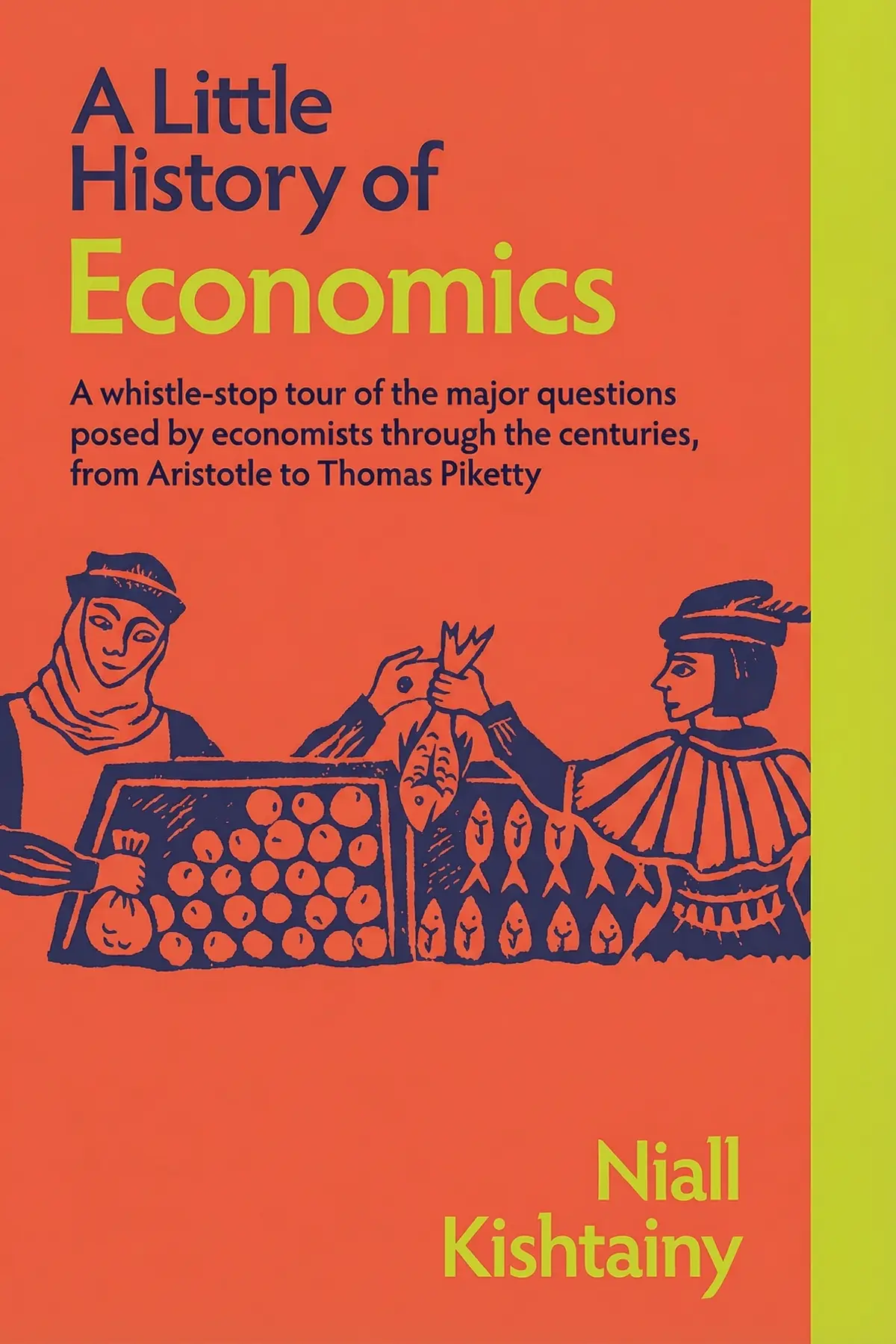
A short history of economic ideas from Aristotle to Piketty. It shows that each idea answered a real crisis, and it gives you the old arguments behind today's fights over markets, government and inequality.
1 min 06 sec
Economic news can sound like a private code: stimulus, inflation, bubbles, inequality. In A Little History of Economics, Niall Kishtainy shows that each of those words began as someone’s answer to a real struggle, from Aristotle’s distrust of moneylenders to a housing crash in 2007 that dragged down the whole world economy. The word itself joins two ancient Greek terms, one for house and one for law, and for the Greeks it meant managing a household well.
Kishtainy stretches it to a far bigger question: why Britain can give its young people modern buildings, teachers and books while Burkina Faso cannot. Nobody fully knows, he admits, but economists are the ones asking. His throughline is that economic ideas are tools forged in particular crises, and that two arguments keep returning: who gets the wealth, and how much the government should steer. Follow those two threads from ancient Greece to today and you will start to hear which old quarrel each headline is replaying.
1 min 44 sec
A Greek philosopher found something deeply wrong with an olive farmer who grew olives just to sell them. His unease shaped centuries of religious teaching, until merchants in two Italian cities changed the rules of the game.
1 min 40 sec
Splitting a chair into separate tasks makes chairs cheaper for everyone. So why does the same arrangement leave some people bored at the bench and others getting steadily richer? The first great economists saw both sides.
1 min 53 sec
A stockbroker was mocked in Parliament for a proposal Britain later adopted. A teacher of future colonial officers blamed the poor for their poverty. And one German thinker predicted capitalism would bury itself.
1 min 54 sec
Soviet officials decided the color of cars, and millions died in a famine. In America, the rich showed off marble mansions until the money vanished. Between the two disasters, economists split over who should hold the wheel.
1 min 51 sec
Government control lifted South Korea and held back Ghana. Tax cuts worked in the 1960s and then seemed to stop working. The evidence kept moving, and so did economists’ faith in the state.
1 min 51 sec
One trader earned a billion pounds while shaking a central bank. Neighbors bought internet shares because neighbors were buying. A nearly forgotten economist had already described how the story would end.
1 min 48 sec
A boy who witnessed religious violence grew up to change how the United Nations counts progress. His work, and that of feminist economists, exposed a blind spot in the profession itself.
1 min 22 sec
Kishtainy’s history ends where the word began, in the household. The Greeks named economics after running a home, and his final pages return to the cooking, cleaning and caring that official figures still leave out. In between, each famous idea turns out to be a reply to a specific struggle: Ricardo facing costly bread, Keynes facing 13 million jobless Americans, Minsky explaining why easy credit ends in collapse. Economics, in his view, is a tool much like money itself, for understanding why people, classes and countries end up so far apart, and how that distance might shrink.
That makes the old debates useful. When a politician says tax cuts or new spending will fix everything, you can hear Kennedy, Friedman and Buchanan arguing in the background, and you can ask who gains and who pays. When everyone around you is buying the same asset with borrowed money, remember Minsky. And when you measure how well people are doing, count what they are able to do, including the work that never earns a wage.
The question Kishtainy started with, why young people in Britain have books and teachers and those in Burkina Faso do not, still has no full answer. Knowing how earlier thinkers tried to answer it is how anyone joins the search.
Economic headlines about interest rates, stimulus spending, bubbles and inequality can feel like a code written for experts. Niall Kishtainy argues that every one of these ideas started as an answer to a real problem: merchants who wanted to lend money, factories that made a few people rich, a Depression that left a quarter of American workers without jobs, a housing crash that pulled down the world economy. He follows those answers from ancient Greece to the present. Along the way come Aristotle and Aquinas, Adam Smith and Karl Marx, Keynes and Hayek, Friedman and Minsky, Amartya Sen and Thomas Piketty. Two arguments keep returning. One is who should get the wealth an economy produces. The other is how far the government should guide the economy and how far markets should run it. Readers get a clear map of economic thought that any listener can follow. They also get a set of questions to ask of any policy, boom or political promise: who gains, who pays, and which old debate is being replayed.
Professionals who follow economic news but feel lost in debates about markets and government.
Students starting economics, politics or history who want the big ideas in order.
Curious readers worried about inequality and financial crashes who want to know where the arguments came from.
Niall Kishtainy believes that the economic ideas of the past, and the real struggles that produced them, help explain the world we live in now. He is especially interested in the stories people tell themselves about the economy and why those stories matter. He writes vividly, so that any reader can follow him. A Little History of Economics was published by Yale University Press in March 2017.
Listeners find the work engaging and accessible, offering an excellent introduction to economic principles and their historical development. They value the way it simplifies intricate topics, with one listener highlighting that jargon and terminology are defined before use. The content is considered insightful for its explanations of major economic theorists' ideas, and one listener points out how it effectively places these theories within their contextual space and time. Listeners view the material as straightforward and perfect for newcomers, with one listener noting it is particularly good for high school students.
Finally got around to reading this gem and it’s easily one of the best introductory texts on my shelf. Instead of a 'routine' academic slog, Kishtainy delivers a vibrant timeline of thinkers that feels more like a series of interconnected biographies than a textbook. The system he uses to link periods and people makes the information incredibly sticky; I can actually remember who said what and why they said it weeks later. To be fair, it’s definitely for beginners—pros might find it a bit light—but for the rest of us, it’s a masterclass in clarity. The author remains relatively neutral throughout, which I appreciated.
Show moreAs a high school teacher, I’m constantly looking for resources that can make complex global systems feel relevant to a teenager’s life. This book is a goldmine. It puts theories into contextual space and time, showing students that economic ideas didn't just appear out of nowhere; they were reactions to real-world problems like famine, war, or industrialization. The language is simple without being condescending, and the author does a brilliant job of defining jargon right when you need it. It’s the kind of book that turns a 'boring' subject into something my students actually want to discuss in class. Truly an insightful guide for beginners.
Show moreWow, I actually feel smarter after finishing this, and for once, the financial news doesn't look like gibberish. This book serves as a perfect bridge for anyone who dropped economics in school because it felt too dry. Kishtainy defines every bit of terminology before he uses it, which saved me from constant Googling. The way he traces the evolution of money and credit makes you realize how fragile and weird our current system actually is. It’s concise, punchy, and moves at a great pace without ever feeling like it's talking down to the reader. It is genuinely entertaining for such a heavy subject.
Show moreThis book acts like a GPS for the history of ideas, and I've already bought a second copy to keep as a reference. What makes it special is the pallet of thinkers Kishtainy brings to the table—you get the heavy hitters like Keynes, but also forgotten voices that shaped how we view poverty and welfare. It’s a vastly different approach than most summaries; the focus is on the narrative of the idea itself. If you're struggling to make sense of the current economic mélange we're living in, this is an absolute must-read. It’s beautifully rendered, remarkably informative, and surprisingly deep for a 'little' history.
Show moreEconomics always felt like a fortress I couldn't breach, guarded by mountains of confusing charts and dry terminology. But this book? It's the total opposite. The author breaks down the history of trade and the development of modern markets into bite-sized stories that actually stick in your brain. I finally understand the difference between the various schools of thought without feeling like my head is going to explode. The narrative is tight, the tone is welcoming, and the chapters are short enough to read one or two before bed. It's easily the most accessible overview of the 'dismal science' I've ever encountered.
Show moreEver wonder why the world's wealth is distributed so unevenly or why some nations flourish while others stagnate? Kishtainy doesn’t just give you the 'what,' he places every theory into a specific historical context. I particularly loved the discussion on the trade-off between equality and efficiency. It challenged my assumption that high taxes inevitably lead to a sluggish economy by pointing toward the success of Northern European welfare states. The writing is incredibly clear, stripping away the gatekeeping jargon that usually makes finance books so inaccessible. Each chapter is like a miniature lesson that connects the dots between Adam Smith’s invisible hand and the complex digital markets of today.
Show moreKishtainy manages a difficult feat here: keeping things neutral while explaining why economics isn't quite the 'hard science' it wants to be. As someone with a background in physics, I often find economic models a bit flimsy because they lack the predictive power of physical laws. However, this book beautifully illustrates that economics is actually a way of thinking about human relationships and resource scarcity rather than just a set of math equations. The author explores how different schools of thought all tried to 'hack' the human experience. It’s a fascinating synthesis that doesn’t take sides, which is rare in this field. Highly recommended for those who prefer logic over dogma.
Show moreThe structure is solid, providing a chronological map of how we went from ancient barter to modern high-frequency trading. However, I noticed an odd recurring habit where the author specifies the Jewish heritage of certain economists but doesn't do the same for others. It felt like an unnecessary detail that didn't add much to the actual economic theory being discussed. Beyond that, the content is engaging and the short chapters make it easy to digest during a commute. It’s a decent entry-level text, but that specific stylistic choice left me a bit confused about the intended narrative purpose.
Show morePersonally, I found the later chapters a bit rushed compared to the deep dives into the classical era. While the book claims to cover everything up to our current 2020 model, the sections on modern behavioral economics and recent financial crises felt like they were flying at 100 miles per hour. I would have appreciated a bit more depth on how these new ideas are being implemented right now. That said, it’s still a fantastic primer. It's helpful if you want a broad map of the field, but you'll definitely need a more specialized book if you want to understand the nuances of the 21st-century economy.
Show moreNot what I expected based on the hype from my colleagues. If you have even a basic undergraduate degree in social sciences, you might find this frustratingly thin on actual data. The author prioritizes storytelling over rigorous analysis, which is great for a casual reader but feels a bit hollow for anyone wanting to sink their teeth into the 'why' behind the 'what.' It’s a breezy read, certainly, but it glosses over the systemic failures of certain models in favor of keeping the tone light and entertaining. Frankly, I wanted more grit and less polish.
Show moreNiall Kishtainy tells the story of economic thought from Aristotle in ancient Greece to modern thinkers like Amartya Sen and Thomas Piketty. He shows that each major idea came from a real problem of its time, such as the rise of merchants, factory inequality, the Great Depression or the 2007 crash. Two questions run through the whole history: who gets the wealth, and how much the government should guide the economy.
It suits readers with no background in economics who want to understand the ideas behind today’s headlines. Students get the main thinkers in a clear order, from Adam Smith and Karl Marx to Keynes, Hayek and Friedman. Professionals get context for debates about taxes, government spending, financial bubbles and inequality, told through stories rather than formulas.
Kishtainy shows the balance swinging back and forth. Soviet central planning ended in a famine that killed some 30 million people, while state-linked firms helped South Korea grow. Keynes argued governments must spend to end slumps, and Kennedy’s 1960s tax cuts seemed to prove him right. Friedman later blamed such policies for inflation, and Thatcher and Reagan followed him. After the 2007 crash, governments returned to Keynes-style spending.
Kishtainy leans on Hyman Minsky, who argued that capitalism becomes unstable as it develops. Good times make borrowers and banks bolder, until banks lend to people who can barely repay, betting prices will keep rising. When borrowers default and sell, prices fall and the economy shrinks. The book traces this through the 1990s internet bubble, which wiped out $2 trillion, and the US housing collapse of 2007.
The book gives you questions to ask. Of any policy, ask who gains and who pays, as Ricardo did with Britain’s grain laws. Of any political promise, remember Buchanan’s warning that politicians spend on what keeps them popular. In a boom, watch for Minsky’s sign of easy credit and copycat buying. And when you judge progress, follow Sen by counting what people are able to do, including unpaid work.
Yanis Varoufakis


Andrew Ross Sorkin

Ha-Joon Chang


William J. Bernstein



AUDIO SUMMARY AVAILABLE
Get the key ideas from A Little History of Economics by Niall Kishtainy, plus 5,000+ more nonfiction titles.









