
14 min 11 sec
Available in: English
Overworked and Overwhelmed: The Mindfulness Alternative
By Scott Eblin
Shows overstretched professionals why a 24/7 work culture keeps their stress response running, and how small daily practices like breathing, movement, routines, friendships and gratitude can calm it inside a crowded schedule.
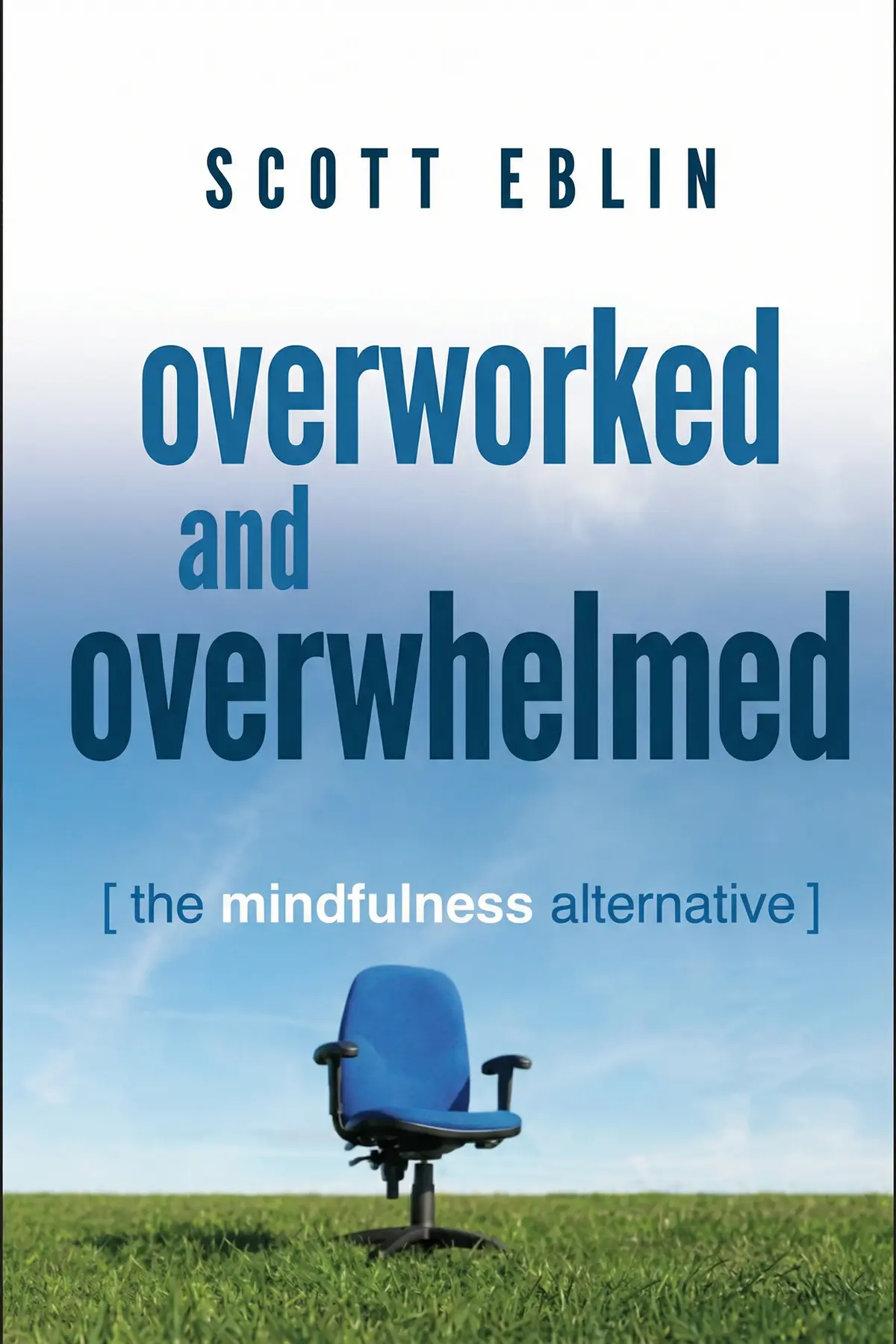
Table of Content
1. Introduction
1 min 08 sec
If your phone brings your boss home every night and your evenings end in exhaustion, your body may be treating the workday as a physical attack. In Overworked and Overwhelmed, executive coach Scott Eblin explains that a tense meeting or an impossible deadline can set off the same fight-or-flight reaction as a stranger jumping out at you with a weapon. Hours of that, he warns, leave your system soaked in stress hormones.
His alternative is mindfulness, understood broadly and practically. Eblin’s case is that you do not need to quit your job or wait for burnout to force a change. Small, repeatable habits of breath, rhythm, movement, attention and connection can switch the alarm off and let you show up fully. The examples come from executives and the people Eblin has coached, from a hotel chief who rises at five to a manager whose team signals him with three fingers. By the end, you will hold a handful of practices that fit inside a crowded day, and a clear sense of which one to try first.
2. Understand why your workday never switches off
1 min 37 sec
A financial crash and one new gadget reshaped the working week within a few years. The figures on hours worked, stress reported and doctor visits that followed are hard to ignore once you see them together.
3. Calm your body's alarm with ten deep breaths
1 min 43 sec
Your brain reacts to a hostile inbox much as it reacts to a stranger with a knife. Eblin traces that chain step by step and points to a practice that may reshape part of the brain itself.
4. Set a daily rhythm that runs on autopilot
2 min 04 sec
A hotel chief who starts at dawn and a vice president who gave up on fixed evenings both found steadier days. A washroom door and three raised fingers show how habits can carry part of the load.
5. Move your body to clear out stress hormones
1 min 45 sec
Most people wait for burnout or illness before changing anything. A year-long study of professionals suggests a far gentler place to start, and the best choice has more to do with pleasure than with fitness.
6. Quiet a racing mind without leaving your desk
1 min 32 sec
You cannot walk out of a tense meeting to go running, yet your mind still needs a release. Two mental habits, one hidden in your morning shower and one aimed at your next big presentation, offer it.
7. Keep friends close to lower the pressure
1 min 38 sec
Introverts and extroverts keep friendships alive in opposite ways, and both can work. One Gallup figure about friends at the office makes a strong case for lingering near the main exit at lunchtime.
8. Small reminders that turn your mind to gratitude
1 min 38 sec
A Buddha statue, a still moment in bed and a wall of colorful art have something in common. Several senior leaders rely on them to steady themselves when the pressure is at its peak.
9. Conclusion
1 min 06 sec
Eblin’s book adds up to a simple reframe: the overload you feel is your body defending itself against an attack that never ends, and that defense can be stood down in small, ordinary ways. None of his tools asks you to quit, move or wait for a sabbatical. They ask for ten breaths, a phone left by the washing machine, a walk you actually like, a shower you pay attention to, a friend you call back.
The hardest part is the beginning, when a new routine still feels like effort. Eblin’s practical answer is a coaching partner, someone on the same path who checks in by phone now and then or meets you at the gym, so following through no longer rests on you alone. Find that person, then pick the practice that fits your week. If mornings are yours, follow Nassetta and claim an early hour to think. If your days are unpredictable, borrow Crystal Cooper’s flexibility and fit what matters into the gaps.
A 24/7 workplace will keep sounding the alarm. What changes is how quickly you can switch it off.
About this book
What is this book about?
Work no longer ends when you leave the office. Staff cuts after the 2008 crash left fewer people doing more, and smartphones put work in every pocket at every hour. Scott Eblin, an executive coach and former Fortune 500 executive, argues that the result is a body stuck in fight-or-flight mode, reacting to a hard boss or an impossible deadline the way it would react to a physical attack. His alternative is mindfulness in a broad, practical sense. Instead of waiting for burnout to force a change, Eblin offers modest habits that fit a busy day: ten deep breaths, a morning rhythm, routines built on cue and reward, enjoyable exercise, attention to ordinary moments, friendships inside and outside work, and visual reminders of what you value. The examples come from executives and the people Eblin has coached, from Hilton's chief executive rising at five to a project leader whose team flashed three fingers at him. Readers get a set of small, specific practices and a clear reason to start one this week.
Book Information
Who it's for
Professionals near burnout
Professionals who answer work email late at night and feel close to burnout.
Managers and team leads
Managers and team leads looking for simple stress habits they can model and share with their teams.
Stuck in demanding jobs
Anyone who knows stress is hurting their health but cannot step away from a demanding job.
About the Author
Scott Eblin
Scott Eblin is a former Fortune 500 executive who now coaches senior and rising leaders at well-known organizations, and he co-founded the Eblin Group, a leadership development firm. He graduated with honors from Davidson College, earned a master's degree in public administration at Harvard University and holds a leadership coaching certificate from Georgetown University, where he has taught on the program faculty. In 2021 Global Gurus listed him among the 30 best coaches worldwide. He is also a Registered Yoga Teacher and the author of The Next Level.
Ratings & Reviews
Ratings at a glance
What people think
Listeners find the work packed with actionable tips and simple to grasp, with one listener observing how it converts solid research into practical strategies. The prose is well-received, and listeners enjoy the various anecdotes shared by others throughout the book. They appreciate the flow, with one listener pointing out its alignment with current research, and describe the experience as soothing, with one mentioning how it brings joy to personal and professional lives.
Top reviews
Nathan
Scott Eblin has managed to distill complex organizational research into a series of incredibly manageable and sustainable daily habits. I found the pacing of the book to be its greatest strength, as it doesn't demand you change your whole life in one afternoon. Instead, it invites you to look at your physical and relational health through a more intentional lens. The real-life stories included throughout the chapters provide a sense of community, making you feel less alone in your professional struggles. By following the simple routines suggested, I have noticed a significant shift in my stress levels and overall joy. It is a refreshing read that prioritizes the human element in a high-pressure work world where we often feel like machines.
Show moreKwan
Finally got around to reading Eblin’s follow-up to The Next Level, and I think it’s just as valuable for today’s leaders. The way he bridges the gap between high-performance expectations and personal well-being is truly masterful. Every chapter is filled with practical actions that you can implement immediately, which makes the overwhelmed part of the title feel much more manageable. Not gonna lie, I was skeptical about the Life GPS at first, but it really helps you visualize what success looks like outside of just hitting targets. The writing is clear and the pace is perfect for a busy professional who can only spare ten minutes a day to read. This is a must-have for your professional library.
Show moreBrooklyn
As someone who has struggled to maintain a work-life balance for years, I found the practical strategies in this book to be quite refreshing. The emphasis on intentionality across all domains of life—home, work, and community—really resonated with my current situation. Eblin writes with a clarity that makes even the most difficult mindfulness concepts feel like professional tools. I particularly enjoyed the segments on relational health, as we often forget how our stress impacts those around us. My only minor complaint is that the book can feel a bit repetitive toward the very end. Still, it’s a great resource to keep on the shelf for those days when everything feels like it's spinning out of control and you need a reset.
Show moreZoe
Ever wonder why we feel so drained even when we haven't done much physically demanding work throughout the day? This book explores that intersection of mental and spiritual exhaustion with practical, easy-to-understand strategies that actually make sense. Personally, I appreciated how the author converted solid scientific research into actionable steps rather than just lecturing the reader on productivity. The Life GPS model is a useful tool for anyone needing to recalibrate their personal and professional boundaries. While some of the advice on mindfulness feels repetitive if you've read other self-help books, the way Eblin frames it within executive coaching makes it feel more real. It’s a solid guide for getting your life back on track when things get chaotic.
Show moreNoi
After hearing several colleagues recommend this, I decided to dive in to see if it lived up to the hype. I was pleasantly surprised by how relaxing the tone of the book is, which is ironic considering the title. Eblin’s background as an executive coach shines through in the way he structures his arguments, focusing on high-impact routines that nourish the soul. The focus on the four key domains—physical, mental, relational, and spiritual—ensures a holistic approach that most business books ignore. I wouldn't say every chapter was a hit, but the specific stories from other professionals helped ground the theory in reality. It’s a helpful companion for anyone navigating a post-recession work environment where expectations are constantly shifting.
Show moreKob
Picked this up during a particularly grueling month at the office and found it to be a very grounding experience. The book doesn't just tell you to work less, because we all know that isn't always an option in today’s economy. Instead, it teaches you how to show up as the best version of yourself despite the chaos. I really liked the section on creating simple routines that actually stick, as most of my previous attempts at wellness have failed. To be fair, some of the spiritual advice felt a bit vague for my personal taste. However, the overall message of being intentional and aware is something I really needed to hear right now to stay sane.
Show moreTanawan
The Life GPS model is the centerpiece of this work, and it definitely offers a clear roadmap for anyone feeling adrift in their career. However, I can't help but feel that a lot of these recommendations are things we already know we should be doing. Go for a walk, breathe deeply, and spend time with your family—it’s all very sensible, but is it enough to fix a systemic problem? Look, the writing style is accessible and the pacing is quite good for a business book. It just didn't blow me away with any eureka moments that I hadn't encountered in a dozen other podcasts or articles. It’s a nice reminder, but maybe not a life-changer for everyone in the workforce.
Show moreMax
To be fair, the arguments presented here are well-reasoned and backed by what feels like genuine concern for the reader's well-being. But let’s be real: how many people who are truly overworked have the mental energy to read two hundred pages on how to breathe? It’s a bit of a catch-22 situation. The book is easy to understand and the stories are engaging, but the newness of the insight is fairly low for the average reader. If you need a gentle nudge to prioritize your health, this is a great choice. If you’re looking for a deep dive into organizational psychology or complex behavioral change, you might find it a bit too simplistic for your needs.
Show moreNum
This book feels like a collection of common sense that most professionals already possess but simply fail to implement regularly. While Eblin is clearly an experienced executive coach, I found the "Life GPS" framework a bit too elementary for a two-hundred-page commitment. Truth is, if you have ever heard of mindful breathing or basic time management, you won’t find much groundbreaking material here. It’s a breadth-first approach that skirts over the surface of deep-seated cultural burnout issues without offering a truly radical solution. Some might find the stories relatable, but for me, it felt like a preaching-to-the-choir scenario that lacked the firepower needed for a lifestyle overhaul. While it is not necessarily bad advice, the content feels far too basic for the modern professional.
Show moreOoi
Not what I expected given the glowing recommendations found on the back cover of the book. Frankly, the main firepower behind the entire project is just mindful breathing, which felt a little lightweight for a full-length publication. I was looking for more rigorous strategies to handle a toxic workload, but instead, I got a lot of common sense anecdotes. If you are brand new to the concept of mindfulness, this might be a five-star read for your specific situation. For the rest of us who have been trying to manage stress for years, it feels like a very light-touch approach. It is a quick read, at least, and the chapters are short enough to digest during a busy morning commute.
Show moreQuestions about this book
What is the main idea of Overworked and Overwhelmed by Scott Eblin?
Eblin argues that staff cuts after 2008 and always-on smartphones have pushed professionals into constant stress, which triggers the body’s fight-or-flight response at a desk for hours on end. His alternative is mindfulness in a practical sense: small, repeatable habits such as deep breathing, a supportive daily rhythm, routines, enjoyable exercise, attention to the present, friendships and gratitude that calm the stress response without leaving your job.
What is a quick way to reduce stress at work according to Scott Eblin?
The fastest tool Eblin offers is breathing: take ten deep breaths, then pause. For a stronger effect he suggests meditation, pointing to a 2000 study by Herbert Benson of Harvard Medical School indicating that regular practice might shrink the amygdala, which is the brain region that handles emotion. When you cannot leave your desk, he also suggests focusing fully on ordinary sensations to bring your mind back to the present.
How does exercise help with work stress in Overworked and Overwhelmed?
Eblin gives two reasons. Rhythmic movement like walking, cycling, dancing or yoga clears stress hormones such as adrenaline and cortisol from the body, and focusing on your body interrupts obsessive, stressed thinking. He cites a Wall Street Journal report on a one-year study in which professionals who used a treadmill regularly felt less stress, interacted more with colleagues and were more productive. His key advice is to choose exercise you enjoy.
How can I apply the ideas from Overworked and Overwhelmed?
Start with one practice. Attach a small routine to a cue you already meet daily, as Patricia did by charging her phone in the washroom when she came home. Build a morning rhythm, try ten deep breaths before replying to a stressful email, call an old friend, or put an object on your desk that reminds you what you value. Eblin also suggests finding a coaching partner to keep you on track.
Featured in

Readers also enjoyed

Aflame: Learning from Silence
Pico Iyer

A Bigger Prize: How We Can Do Better Than the Competition
Margaret Heffernan


A New Earth: Awakening to Your Life’s Purpose
Eckhart Tolle
Aware: The Science and Practice of Presence
Daniel Siegel
Be Here Now
Ram Dass
AUDIO SUMMARY AVAILABLE
Listen to Overworked and Overwhelmed in 15 minutes
Get the key ideas from Overworked and Overwhelmed by Scott Eblin, plus 5,000+ more nonfiction titles.
- 5,000+ titles
- Listen as much as you want
- 7-day free trial
- Cancel anytime









