
12 min 56 sec
Available in: English
The Next Level: What Insiders Know About Executive Success
By Scott Eblin
Shows newly promoted leaders why the expertise that got them ahead can hold them back. It explains how to shift toward careful communication, real delegation, growing people and building allies across the whole organization.
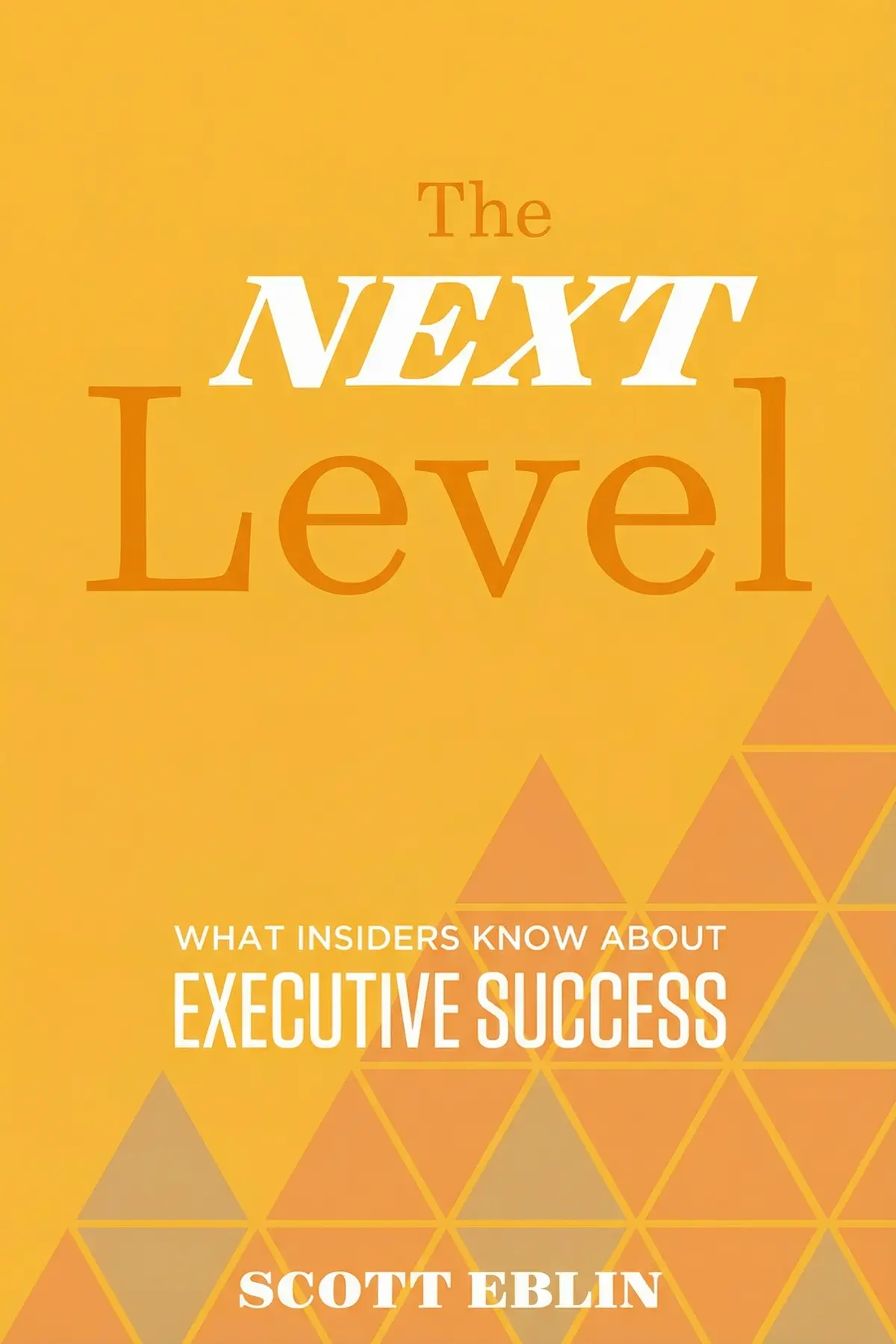
Table of Content
1. Introduction
56 sec
A big promotion often comes with a private doubt about whether you really belong at the new level. In The Next Level, executive coach Scott Eblin, a former Fortune 500 executive himself, argues that the doubt has a real cause. The skills that earned the promotion can start working against you once you arrive. He calls this trap the expertise paradox.
His way out is a set of deliberate shifts, and none of them requires a new personality. At the top, your value moves from what you personally know to how well you enable others: how you speak, what you delegate, whom you develop and whom you connect. Each shift keeps who you are and changes what you contribute. Along the way the book offers a sticky note that stops you from talking too much, two short frameworks for delegating and developing people, and a single question that tells you when stepping in really helps.
2. Trade being the expert for being the conductor
1 min 56 sec
The strengths that made you the obvious choice for promotion are often the first things to trip you up afterward. Eblin explains why, and what kind of confidence the new role actually asks for.
3. Learn to handle the weight your words now carry
1 min 45 sec
A new executive shared a passing thought over lunch and watched three teams change course within days. Her story shows how much your words weigh after a promotion, even when you feel exactly the same.
4. Say less, and make each message land
1 min 44 sec
Most leaders try to fix their communication by adding more of it. Eblin points the other way, starting with a single word on a sticky note and ending with why stories beat strategy documents.
5. Set the destination and let the team steer
1 min 48 sec
A marketing director fought the urge to push her team back to her proven method. What they built instead surprised her, and it shows exactly where a leader’s value moves after delegation.
6. Grow people who can outperform you
1 min 50 sec
One new manager rewrites every report and slows her whole team down. Another stops doing the work and gets results she could never reach alone. Eblin explains the difference, with a four-part check for honest conversations.
7. Build allies across every level of your organization
1 min 55 sec
Most leaders manage down and report up, and stop there. Eblin argues the biggest gains hide in the diagonal moves, and two department heads show how a little listening turned colleagues into partners.
8. Conclusion
1 min 02 sec
A senior role changes very little about who you are and a great deal about what your presence does. Madison’s lunchtime idea moved three teams. Sarah’s restraint produced a campaign she could not have designed herself. Eblin’s case is that executive success starts with accepting that reach and then using it on purpose: speaking with care, handing over methods, growing people and linking your team to the rest of the organization. The expertise that got you promoted will not carry you further, though you keep your authentic self as you lead.
The first changes are small enough to start tomorrow. Put a WAIT note where you will see it in your next meeting, and let it decide whether you speak. Before you take back a piece of delegated work, ask whether the whole group will be better off for it. And book a few conversations with peer executives whose only purpose is to learn what they are struggling with.
None of this asks you to become someone else. It asks you to notice that the room now listens to you, and to give it something worth hearing.
About this book
What is this book about?
A promotion to a senior role feels like a reward, yet many new executives quietly wonder whether they are suited to it. Scott Eblin argues that the worry points to something real. The technical strength that made someone a star performer can become a trap once they lead, a problem he calls the expertise paradox. Eblin's answer is a set of shifts that change what a leader contributes without changing who they are. He shows why a casual remark from an executive can redirect whole teams. He explains how to communicate less and better, and why leaders should define what needs doing while leaving the method to their people. He also covers developing team members until they outperform you and building relationships up, down, sideways and diagonally across the organization. The book is full of practical tools: a sticky note that prompts you to listen, the four Ps for delegating, the GAPS model for honest talks about performance and fit, and a single question for deciding when to step in. Readers get a clear picture of what the next level demands and concrete ways to meet it with confidence.
Book Information
Who it's for
Newly promoted leaders
Newly promoted managers and executives who feel unsure the skills that got them here still apply.
Top performers now leading
Star individual contributors stepping into their first leadership role who struggle to let go of the work.
Developing rising talent
Team leads and coaches who prepare rising talent for senior positions.
About the Author
Scott Eblin
Scott Eblin is a former Fortune 500 executive who now coaches senior and rising leaders at well-known organizations, and he co-founded the Eblin Group, a leadership development firm. He holds a master's degree in public administration from Harvard University and a leadership coaching certificate from Georgetown University, where he has also taught on the program faculty. In 2021, Global Gurus named him one of the 30 best coaches in the world. He is also the author of Overworked and Overwhelmed and a Registered Yoga Teacher.
Ratings & Reviews
Ratings at a glance
What people think
Listeners consider this work an indispensable manual for middle managers moving into executive positions, providing hands-on techniques for shifting from personal performance to wide-ranging leadership. They value the concrete tips on "picking up" fresh habits while discarding obsolete ones, as one listener describes the text as a "wise" asset for preventing professional blunders during a career advancement. Furthermore, listeners find the provided resources, such as the Executive Success Plan and situational handbooks, useful for their practical implementation. They also observe that even though the second edition contains some repetitive material for those revisiting the book, the fundamental ideas continue to be extremely pertinent for concentrating on high-level corporate objectives.
Top reviews
Sirichai
The transition from a high-performing manager to a strategic executive is a minefield that most people navigate blindly. Scott Eblin nails the 'pick up and let go' philosophy by highlighting that the very skills that earned you a promotion might be the ones holding you back now. I found the nine sets of behaviors incredibly practical because they don't just focus on what to do, but what to stop doing. Operating from a base of confidence is essential, and this book provides the mental framework to achieve that clarity. It is not just about professional development; it is about personal evolution. If you feel like you are running on empty while trying to prove your worth, read this. It will save you from making those career-stalling mistakes that claim 40% of new executives.
Show moreHunter
Finally, a roadmap that doesn't just tell you to 'work harder' but actually explains how to work differently. Eblin’s concept of 'custom-fit' communication versus the 'one-size-fits-all' approach we often use as managers was a massive 'aha' moment for me. The book challenges you to leave behind the safety of your technical expertise to embrace the ambiguity of true leadership. I loved the emphasis on taking care of yourself physically and mentally to avoid executive burnout. It’s reminiscent of Marshall Goldsmith’s work but feels more tactical and grounded in the day-to-day realities of corporate life. I have already started implementing the nine habits, and the shift in how my peers perceive me is already noticeable. This is mandatory reading for anyone with an eye on the C-suite.
Show moreMaksim
Look, if you're drowning in tactical work while your title says 'Director' or 'VP', you need to stop and read this immediately. This book is essentially a manual on how to stop being a 'doer' and start being a 'leader.' The distinction between picking up new strategic habits and letting go of comfortable technical ones is handled with great nuance. I listened to it on Audible first and then bought a hard copy just so I could dog-ear the 'Situation Solutions Guide.' It is readable, practical, and written by someone who clearly knows the inside of a Fortune 500 boardroom. It’s the kind of book you don’t just read once; you keep it on your desk as a reference for years.
Show moreTum
The Executive Success Plan (ESP) included in the appendix is worth the price of the book alone. It provides a concrete framework for navigating the 'uncharted terrain' of high-level leadership. I especially liked how Eblin breaks down the need to move away from 'one-size-fits-all' management. His background as an HR executive shines through in the practical, real-world examples he provides. This isn't just theory; it's a handbook for avoiding the pitfalls that lead to the high failure rate of new executives. By focusing on the broader mission rather than individual ego, Eblin shows you how to lead with clarity and purpose. I’ve recommended this to my entire leadership team because the concepts of delegation and strategic choice are universal.
Show moreWissanu
Picked this up on a recommendation from my mentor during my last promotion cycle. Truth is, moving into a senior role is daunting, and Eblin’s approach to expanding your view—looking left, right, and diagonally—is a game-changer for anyone used to just looking at their direct reports. The Executive Success Plan (ESP) is the highlight of the book for me; it provides a structured way to gather feedback that actually leads to change. My only minor complaint is that the second edition feels a bit repetitive in the middle sections if you’ve already read his blog or the first edition. Still, the new situational guides make it a much more robust reference than most leadership fluff on the market. It is definitely worth the shelf space for a rising leader.
Show moreMia
Does your company actually help you grow, or are you just expected to figure out the executive suite on your own? After years of being the 'go-to' person for technical fixes, I felt lost in my new role until I found this book. Eblin’s insistence on looking 'left and right' rather than just 'up and down' changed my entire perspective on stakeholder management. The situational guide in Appendix B is a lifesaver for those moments when you feel like you’re failing and need a quick fix. My only gripe is that the content can feel a bit repetitive if you are an avid reader of leadership literature. However, the structured approach to shedding old habits is exactly what I needed to stop running on empty.
Show moreLaor
Scott Eblin takes the baton from Marshall Goldsmith and provides a much more tactical 'how-to' guide for the corporate ladder. The central theme—that what got you here won't get you there—is explored through very specific behaviors that are easy to identify but hard to change. I appreciated the focus on group missions over individual agendas, which is where most new VPs stumble. However, a real conundrum remains: you can change your leadership style, but if your company culture doesn't evolve with you, it's an uphill battle. The book doesn't quite solve that organizational hurdle, but it gives you the personal tools to survive it. It is a wise volume to run through before your next big career jump.
Show moreMethinee
As someone who recently moved into a Senior VP role, I found the concept of 'custom-fit' communication particularly enlightening. We often fall into the trap of thinking one style fits every situation, but Eblin proves why that is a career-killer. The book is jam-packed with routines that help you focus on the big picture instead of getting bogged down in the weeds of your department. While the second edition adds some great updated info, it’s mostly the same core message, so don’t expect a total overhaul if you own the original. The real value lies in the appendices and the Executive Success Plan. It’s a pragmatic, no-nonsense guide that feels very relevant in today's fast-paced corporate environment. Highly recommended for the transition phase.
Show moreTanawan
To be fair, the advice here is solid, but the execution felt a bit dry for my taste. While it’s marketed as a guide for anyone moving up, this really targets the VP level and above rather than middle management. If you’re a first-time supervisor, you might find the talk about board meetings and enterprise-wide strategy a bit alienating. I struggled with the linear flow at times, as it felt more like a collection of great blog posts stitched together rather than a single cohesive narrative. It's useful, sure, but expect to do a lot of work to translate these high-level concepts into your daily grind. It's a good book, just not the revolutionary experience I was expecting based on the hype.
Show moreJune
Ever wonder if these leadership books are just stating the obvious in a fancy new package? Frankly, Eblin has some great points, but I found the 'nine habits' to be a bit recycled from other popular management texts. It’s a useful volume for executives who are struggling, but if you’ve spent a lot of time in leadership seminars, you might find yourself skimming. The idea of 'picking up and letting go' is solid, yet the book could have been fifty pages shorter without losing much impact. It’s certainly not groundbreaking, though the focus on diagonal networking was a nice touch. It is a decent read for a plane ride, but don't expect it to change your life overnight.
Show moreQuestions about this book
What is the main idea of The Next Level by Scott Eblin?
Eblin argues that the skills that win a promotion often hold leaders back afterward, a problem he calls the expertise paradox. At the executive level, your value shifts from personal expertise to enabling others. That means handling your amplified voice with care, communicating less but more clearly, delegating outcomes instead of methods, developing your people and building relationships across every level of the organization, while staying true to who you are.
What is the expertise paradox?
It is Eblin’s name for the trap where the technical strengths that earned a promotion start working against a new leader. A manager who keeps doing tasks he should delegate, because his identity rests on being the one who fixes things, is a typical case. The cure is to treat yourself as a conductor who enables others and to accept making decisions with incomplete information.
What are the four Ps of delegation in The Next Level?
The four Ps help leaders focus on what needs doing and leave the how to their team. Purpose defines why the group exists. Picture describes what success looks like. Plan sets the route to get there. Parts assigns who does which piece. Eblin pairs this with a test for stepping in: only get involved if the result will be better for the whole group.
How does the GAPS model work?
GAPS stands for Goals, Abilities, Perceptions and Standards. A leader first learns a team member’s goals through open career talks, then assesses their abilities through reviews and results, then hears their own perceptions of their role, which often differ from reality. Finally everything is compared with the standards the role requires, revealing development needs or a poor fit early enough to act.
How can I apply The Next Level as a new executive?
Start with small habits from the book. Keep a sticky note with the word WAIT in view during meetings to prompt listening. Before important conversations, decide the one point people should leave with. Let team members present directly to senior leaders. And run a listening tour of peer executives to learn their challenges, which opens the door to useful partnerships.
Readers also enjoyed


A Bigger Prize: How We Can Do Better Than the Competition
Margaret Heffernan





A Year with Peter Drucker: 52 Weeks of Coaching for Leadership Effectiveness
Joseph A. Maciariello


60 Seconds & You’re Hired!
Robin Ryan

AUDIO SUMMARY AVAILABLE
Listen to The Next Level in 15 minutes
Get the key ideas from The Next Level by Scott Eblin, plus 5,000+ more nonfiction titles.
- 5,000+ titles
- Listen as much as you want
- 7-day free trial
- Cancel anytime









