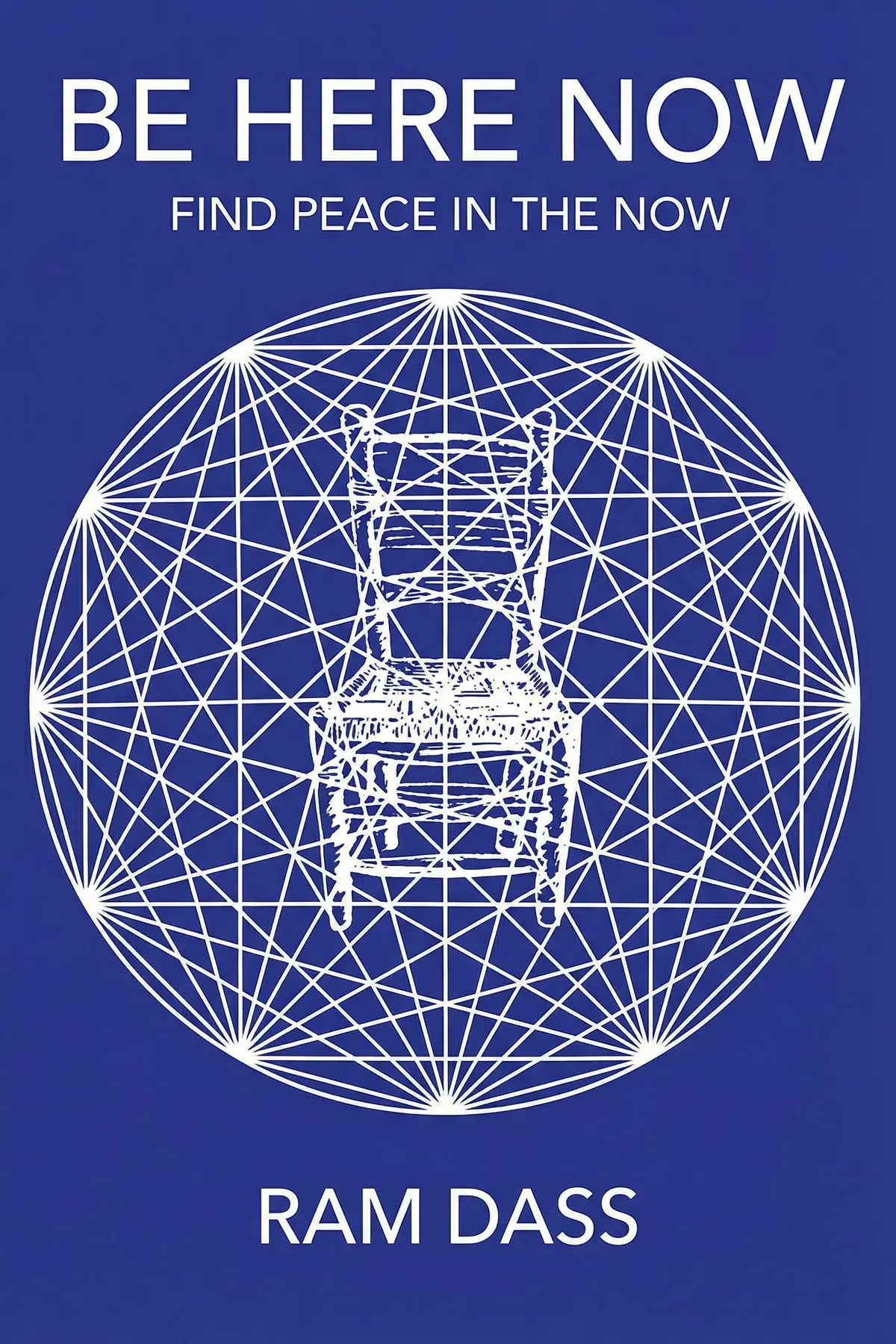
Table of Content
1. Introduction
49 sec
If a full calendar and a growing bank balance still leave you asking whether this is all there is, Ram Dass asked the same question with far more to show for it. In Be Here Now, the former Harvard psychologist once known as Richard Alpert argues that the peace we chase through achievement is already inside us, and can only be found in the present moment. In 1961 he had a professorship, an apartment, a car, a motorcycle and a small plane, and he still felt something was missing.
His search ran through psychedelic drugs, a dismissal from Harvard and a meeting with a guru in India. What he brought back is the idea this whole listen follows: suffering comes from clinging to the ego and its wants, and freedom comes from letting go of that grip while living fully here, now.
2. When success and highs fall short, look deeper
1 min 47 sec
A Harvard professor with his own plane still felt that something was missing. The experiences that first seemed to answer his question carried a hidden cost, and it explains why chasing the next win rarely settles anyone.
3. Let one real teacher open a skeptical mind
1 min 53 sec
A doubtful American psychologist sat with a guru who seemed to know things about his family that nobody had told him. What happened next turned a skeptic into a student and set the course of his life.
4. Ease suffering by loosening the ego's grip
1 min 52 sec
Much of everyday stress traces back to one habit of mind that feels completely natural. Ram Dass gives it a two-word Sanskrit map, and it points to a kind of freedom that does not depend on circumstances.
5. Keep your work and drop the attachment
1 min 39 sec
Most people assume a spiritual life means giving up the job, the home and the plans. Ram Dass describes a potter at his wheel to show a very different arrangement, one that fits inside an ordinary week.
6. Calm your mind with a daily breathing exercise
1 min 41 sec
Breath and thought are tied together more tightly than most people notice. A curled tongue, an empty stomach and a slowly rising count of breaths make up a routine that takes only minutes each morning.
7. Use a mantra to move past busy thoughts
1 min 53 sec
Telling the mind to stop thinking rarely works for long. Ram Dass suggests the opposite move, choosing one thought and repeating it, and he describes how a single name can travel from the tongue to the heart.
8. Conclusion
1 min 12 sec
Ram Dass started with everything a career can offer and an aching sense that it was not enough. The highs of psychedelics came closer, then always fell away. What lasted came from another direction: a teacher who seemed to see straight into him, a period of yoga and breath work, and the plain instruction to stop living somewhere other than here.
Be Here Now asks for less upheaval than its reputation suggests. You keep your job, your home and your people. What you give up is the belief that any of them is who you are, along with the idea that peace waits on the far side of the next achievement.
The book supports a small start. Tomorrow, before breakfast, sit upright and take five Sheetali breaths, adding one each day. When a task begins to feel like a verdict on you, remember the potter, who keeps shaping clay without claiming to be its maker. And choose one word, perhaps Rama, to repeat on a morning walk until it seems to repeat itself.
None of this requires going anywhere. The professor with the plane traveled all the way to India to learn that the place he was looking for had been right where he stood the whole time.
About this book
What is this book about?
A good job, a nice home and a few prized possessions can still leave a person wondering whether there should be more. Ram Dass felt exactly that as a Harvard psychologist in the early 1960s. His search for an answer took him through psychedelic experiments, the loss of his post and a trip to India, where he met the guru Neem Karoli Baba. Be Here Now shares what he learned there. Suffering, he argues, grows from attachment to the ego and to things that cannot last, and from the illusion that we are separate from one another. The way out is not a retreat from ordinary life. It is doing your work and caring for your people without identifying with any of it, and being fully present, here and now. The book also gives beginners somewhere to start. Readers learn a breathing exercise called Sheetali, with a clear daily routine, and a step-by-step way to work with a mantra such as Rama or Om namah shivaya until repetition settles the mind.
Book Information
Who it's for
Professionals sensing something missing
Professionals who have reached their goals and still feel a nagging sense that something is missing.
Stressed or restless
People dealing with stress or restlessness who want a simple breathing and mantra routine to start.
Curious about Eastern spirituality
Curious readers drawn to yoga and Eastern spirituality who want an accessible first introduction.
About the Author
Ram Dass
Ram Dass was born Richard Alpert and researched the effects of psychedelic drugs at Harvard University alongside Timothy Leary until Harvard dismissed him in 1963. In 1967 he went to India and became a disciple of the Hindu guru Neem Karoli Baba, who gave him his new name. His 1971 best-seller Be Here Now helped popularize yoga and Eastern spiritual practice in the West. He co-founded the Seva Foundation and the Hanuman Foundation, taught and wrote for decades, kept teaching after a 1997 stroke, and died on Maui, Hawaii, in 2019.
Ratings & Reviews
Ratings at a glance

What people think
Listeners regard this book as a permanent masterpiece of spiritual insight that strengthens curiosity about Eastern philosophy and offers amazing artwork. The winding nature of the writing gets positive marks, and listeners value the way it lowers anxiety and settles racing thoughts. Though many see it as an essential guide for seekers, some find it a tough read.
Top reviews
Chamlong
Picked this up during a particularly turbulent month, and the visual layout alone did wonders for my racing thoughts. The middle section, printed on those iconic brown paper bag pages, forces you to slow down and actually experience the words rather than just skimming them. Truth be told, Alpert’s transition from a high-strung Harvard professor to a centered spiritual seeker is both hilarious and deeply moving. I found the metaphors about emotions being like waves in a vast ocean to be a perfect tool for my own anxiety. Some might find the psychedelic history a bit much, but it provides necessary context for his eventually finding a 'natural' high. This is less of a book and more of a manual for staying grounded when the world feels like it is spinning out of control. It is a timeless masterpiece of spiritual guidance that I will keep on my nightstand forever.
Show moreAir
Wow. This isn't just a book; it's a doorway into a different way of perceiving reality. The artwork is fantastic and deeply impactful, creating a sensory experience that standard text just cannot replicate. I particularly loved the concept that we are all 'hollow bamboos' for the divine to flow through, even if it sounds a bit far out at first. It helped me realize that my constant planning for the future was actually a form of self-inflicted suffering. Ram Dass writes with a raw honesty about his own neuroses and failures, which makes his eventual peace feel attainable rather than just some distant dream. The way he describes the guru relationship in India is fascinating, even for a skeptic like me. If you are a spiritual seeker looking to deepen your interest in Eastern philosophy, this is the definitive starting point. Just be ready to have your rational mind challenged at every turn.
Show morePriya
Ever wonder what happens when a neurotic academic loses his mind to find his soul? Ram Dass provides the answer in this beautifully chaotic guide to consciousness. I found it at the exact moment I needed it, which I suppose is the whole point of the 'here and now' philosophy. The visual explanations are so much more effective than a standard self-help book because they bypass the analytical brain and go straight to the heart. I’ve started using the meditation techniques from the cookbook section, and the change in my daily stress levels is noticeable. It teaches you that you don't have to 'get high' when you can simply learn to 'be high' through presence. This book is a must-read for anyone feeling trapped by their own thoughts. It is a profound, life-altering experience that stays with you long after the final page.
Show morePat
After hearing so much about the counterculture movement, I finally delved into this winding, illustrated journey. It is truly a timeless masterpiece. The way Ram Dass describes his encounter with Maharaj-ji in India is soul-stirring and makes you question the limits of the rational mind. I loved the emphasis on how we can 'God-ify' even the most mundane tasks, like emptying the garbage or doing the dishes. The artwork is just fantastic; I find myself flipping to random pages just to look at the designs when I need a moment of peace. It has significantly deepened my interest in Eastern spirituality without feeling like a boring textbook. While some of the 'hippie' language is a bit silly, the core truth of the book—that we are all part of the same energy—is handled with such grace and beauty. This is a life-changing piece of literature.
Show morePensri
The chapter on his transformation in India is where the book really finds its heartbeat. Watching a brilliant, neurotic Harvard professor get completely humbled by a guy in a blanket is exactly the kind of story I needed. Ram Dass doesn't just preach; he shares his own messy process of waking up. The visual format makes the concepts of Hinduism and Buddhism feel accessible rather than academic. I’ve found that my 'is-ness' has improved just by keeping the mantra of the title in my head during stressful work meetings. You've got to go at the rate you can go, and this book respects that journey. It is a profound exploration of consciousness that manages to be both deep and lighthearted at the same time. This is the ultimate guide for anyone who wants to stop overthinking and start living.
Show moreRome
Is it possible to be both enlightened and a bit frustrating? This book suggests so. The 'Cookbook for a Sacred Life' at the end is full of practical, if occasionally extreme, advice on how to live an enlightened lifestyle through yoga and meditation. I struggled with the sections suggesting we should give up all worldly desires, especially the bit about avoiding spicy food—life is too short for bland meals! However, the core message of 'is-ness' and being present really resonated with my current state of mind. The winding prose can be difficult to navigate at times, yet it possesses a strange, hypnotic rhythm that eventually settles your ego. While the 1970s hippie lingo is dated, the psychological principles beneath the surface are surprisingly robust. It’s a groovy trip that actually has some intellectual weight to it if you’re willing to look past the incense smoke.
Show moreTum
Finally got around to reading this classic, and I was struck by the raw honesty of Richard Alpert’s descent from Harvard prestige into spiritual 'is-ness.' The first section, detailing his life before India, is genuinely compelling and often very funny. He doesn't shy away from his 'corrupt' or 'impure' thoughts, which makes his transformation feel more human. My only real gripe is that some of the hand-drawn sections are physically difficult to read, which can be annoying when you're trying to stay in the flow. Look, some of the advice is definitely 'far out' and leans into that cult-ish hippie vibe that doesn't always translate to a 9-to-5 life. But the underlying message about decreasing anxiety by surrendering the need to control everything is solid. It’s a winding, trippy journey that requires a total suspension of disbelief, but the payoff for your mental health is worth the effort.
Show moreKanchana
Not what I expected, but exactly what I needed. The prose is winding and the style is definitely unconventional. One moment you're reading about Timothy Leary and LSD, and the next you're looking at a drawing of a lotus flower. It works, though. It actually works. This book helped me realize that my fear of death was really just a 'brittleness of the ego,' which was a massive perspective shift for me. I do think he oversimplifies some things, especially the idea that we can always be in a state of bliss. To be fair, being a 'normal' human involves a lot of emotions that aren't just calm waves. Still, the artwork and the message of radical acceptance are incredibly powerful tools for anyone struggling with a racing mind. It’s a strange, beautiful relic of the sixties that still feels surprisingly relevant today.
Show moreLek
To be fair, the 'hippie' language can be a bit thick at times, bordering on the pretentious. I found myself rolling my eyes at words like 'groovy' and 'astral trip' peppered throughout the spiritual lessons. However, if you can push past the 1971 lingo, there is some serious wisdom here. The idea that we are 'doers' who need to step back from the 'drama' of life is a great way to view modern stress. It isn't always easy to read, and some of the black-and-white views on 'purity' felt a bit rigid for my taste. But the overall impact was positive. It helped me quiet my internal monologue and focus on the physical sensations of the present. Not a perfect book by any means, but it’s a very cool, thought-provoking piece of history that offers genuine comfort for those with heavy hearts.
Show moreRung
Let's be real: this reads like the incoherent scribblings of someone who spent way too much time experimenting with LSD in the 60s. While I appreciate the historical significance of Richard Alpert's journey, the delivery is often condescending and lacks any real empathy for people living in the modern world. He makes these grand claims about how parents having jobs 'destroys the family union,' which is just delusional and insulting to working families. The book is heavily male-dominated, with almost zero mention of female spiritual influences, making it feel very narrow and dated. Many of the 'wisdom bombs' are just recycled platitudes that offer zero explanation of how to actually achieve the calm center he keeps bragging about. It’s a collection of mindless drivel that appeals mostly to the stoned or the hopelessly naive. I was not impressed, and frankly, I was happy to finally be done with it.
Show moreQuestions about this book
What is the main idea of Be Here Now by Ram Dass?
Ram Dass argues that suffering grows from attachment to the ego and to things that cannot last, and from the illusion that we are separate. Peace is already inside each person and is found by looking inward and living fully in the present moment. He describes how he arrived at this outlook: after his involvement with psychedelics cost him his job at Harvard, he traveled to India and turned to what a guru there taught him.
What does From Bindu to Ojas mean in Be Here Now?
Bindu is a point of individual consciousness, the small self built around me and mine. Ojas refers to the vital energy, or strength, that keeps a spiritual practice going. Ram Dass uses the phrase to describe a passage from a life centered on the ego and material desires toward higher awareness, unity with the divine, and a life of service, love and compassion.
How do you do the Sheetali breathing exercise?
Practice on an empty stomach, ideally on waking or at sunset before dinner. Sit upright with head, neck and chest aligned and the belly slightly drawn in. Stretch the tongue out, curl it into a U and breathe deeply in through the mouth. Pull the tongue back and exhale through the nose, keeping attention between the eyebrows. Start with five breaths a day and add one daily up to 50.
How does Ram Dass suggest practicing a mantra?
Using the name Rama as an example, he suggests first reflecting on its meaning, then repeating it silently, then saying it aloud as if speaking with the inner voice. With repetition the mantra seems to move from the tongue into the mind and eventually the heart. Repeat it on waking, on walks and in spare moments, and treat yourself as a passive instrument the mantra works through.
Do you have to give up your normal life to follow Be Here Now?
No. Ram Dass says you do not need to live like a monk on a mountain or change your life completely. You keep working and living as before, but without identifying with what you do. His example is a potter who keeps making pots while remembering he is not really the maker. The aim is to see through the ego and stay present.
Featured in
Readers also enjoyed

Aflame: Learning from Silence
Pico Iyer


A Force for Good: The Dalai Lama's Vision for Our World
Daniel Goleman


A Return to Love: Reflections on the Principles of a Course in Miracles
Marianne Williamson

Abundance: The Inner Path to Wealth
Deepak Chopra

Alcoholics Anonymous
Alcoholics Anonymous World Services

A New Earth: Awakening to Your Life’s Purpose
Eckhart Tolle

AUDIO SUMMARY AVAILABLE
Listen to Be Here Now in 15 minutes
Get the key ideas from Be Here Now by Ram Dass, plus 5,000+ more nonfiction titles.
- 5,000+ titles
- Listen as much as you want
- 7-day free trial
- Cancel anytime