
15 min 08 sec
Available in: English
Aware: The Science and Practice of Presence
Shows how training your attention through simple meditation practices pulls you off autopilot, eases worry about how others see you, loosens cravings and benefits the heart, the immune system and your relationships.
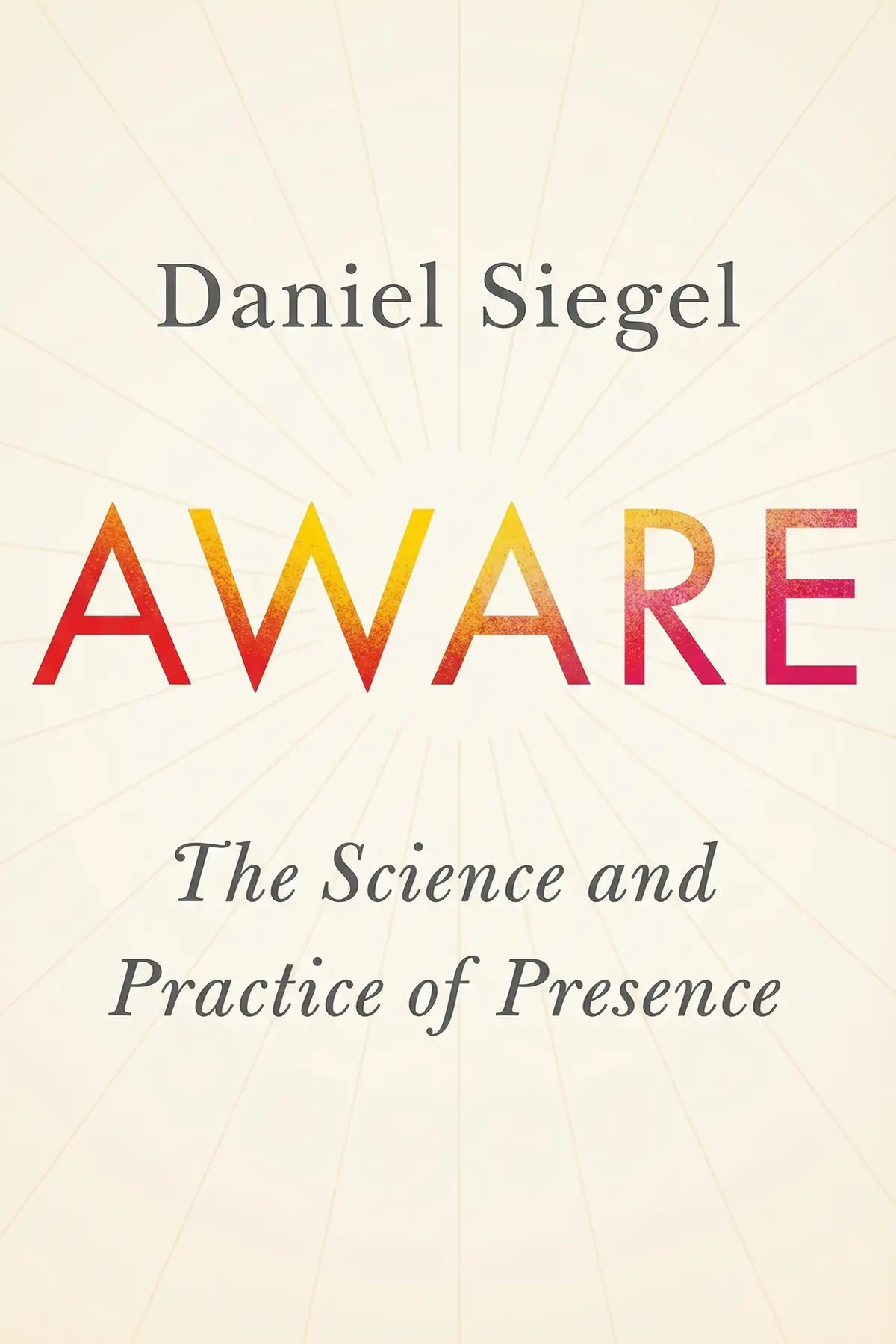
Table of Content
1. Introduction
1 min 04 sec
Many of us spend whole days on autopilot, doing chores, scrolling and replaying old worries, and Daniel Siegel argues that the habit costs more than we think. In Aware, the child psychiatrist and UCLA clinical professor makes the case that meditation strengthens the immune system, steadies the heart and gives people better control over their impulses.
His central claim is that attention can be trained. A mind that learns to focus, to stay open and to hold kind intentions becomes less trapped inside itself. And because brain and body form one system, that training reaches well beyond the head, into health, relationships and the cravings that keep pulling at us.
The practical rewards are concrete. There is a simple picture for steering attention, a half-hour exercise that moves through every sense, and a reason to prefer compassion over empathy. There is also one honest question that loosens the grip of a habit you keep returning to.
2. Step off autopilot and notice your choices
1 min 36 sec
An ordinary morning can pass without you registering a single detail. That mental shortcut saves energy, but Siegel shows where the drifting mind tends to land, and what it quietly costs you in missed decisions.
3. Steer your attention and gain self-control
1 min 38 sec
A struggling primary school pupil found a way to stop himself before lashing out at classmates. The picture his teacher used is simple enough for a child, and it works just as well in a tense meeting.
4. Three skills that make up a mindful mind
1 min 35 sec
Mindfulness can sound like a vague state you either reach or miss. Siegel splits it into separate abilities, each with its own simple exercise, so you can start with whichever one comes most easily.
5. A half-hour practice for feeling more connected
1 min 45 sec
Most of the day, sounds, sensations, thoughts and relationships blur into one stream. A thirty-minute exercise pulls them apart one at a time, and its final step reaches past your own body entirely.
6. Bring your body into your practice
1 min 27 sec
For centuries the brain was pictured as the control room giving orders to the body. A neurologist’s look at the history of life suggests the relationship runs the other way, and that you carry more than one brain.
7. Quiet the worry about whether people like you
1 min 31 sec
Sit on the sofa with nothing to do and the mind often turns to how others judge you. Siegel locates that loop in a specific part of the brain, and explains why it once kept us alive.
8. Turn empathy into compassion and feel better
1 min 39 sec
Feeling someone else’s pain sounds like the kindest thing you can do. Siegel argues that stopping there can leave you more miserable, and that one further step changes the outcome for both of you.
9. Break a craving by separating wants from needs
1 min 30 sec
The second piece of chocolate never tastes as good as the first, yet it is the one we reach for. Siegel explains why pleasures fade with use and which simple distinction weakens their hold.
10. Conclusion
1 min 23 sec
Siegel’s argument ends where monks and yogis began long ago and where scientists have recently arrived: brain and body are so closely connected that caring for one cares for the other. A calmer mind shows up in immune function, in the heart and in how we age. A trained arrow of attention shows up in a boy who learns to pause before lashing out, in a colleague finally greeted, in a friend whose birthday is remembered.
He also warns against taking all of this too solemnly. Compassion covers joy as well as suffering, helping people laugh as much as easing their pain, and you can only share a joy you already know. So he encourages jokes and making others laugh, and cautions against withdrawing from the world in the name of serious practice. He cites the Dalai Lama, who leads spiritually yet has a great sense of humor, and who believes laughter is important since the world contains so much suffering.
Start small. Give a few minutes a day to the breath or to listening without judging. When the worry loop starts on a quiet evening, turn the arrow toward someone who could use your help. And when a craving rises, ask whether it is a need. Practiced this way, awareness becomes the most social thing you do alone.
About this book
What is this book about?
Most days run on autopilot. People move through chores, scroll through feeds and replay their worries, and they rarely notice what is in front of them. Daniel Siegel, a child psychiatrist and UCLA clinical professor, argues that this way of living costs more than it seems, and that the fix is training awareness itself. Siegel builds his case on research into meditation and mindfulness, including links to stronger immune function, healthier hearts and an enzyme that slows aging. He gives readers a simple picture for steering attention, three skills that make up a mindful mind, and a half-hour exercise that moves through the senses, the body, thoughts and relationships. He also argues that the brain serves the body, explains why idle moments fill up with social worry, and separates empathy from the compassion that actually helps. Readers come away with practices they can start the same day. There is a way to pause before reacting, a way to turn feeling for someone into helping them, and a question that weakens the pull of chocolate, wine or social media.
Book Information
Who it's for
Professionals on autopilot
Busy professionals who feel they live on autopilot and want a simple, science-informed way to start meditating.
Self-conscious worriers
Worriers who replay what others think of them and want to turn attention outward.
Parents and educators
Teachers and parents looking for a picture of attention children can use to control impulses.
About the Author
Daniel Siegel
Daniel J. Siegel is a child psychiatrist and a graduate of Harvard Medical School who trained at UCLA in pediatrics and in child, adolescent and adult psychiatry. He is a clinical professor of psychiatry at the UCLA School of Medicine, co-founded the Mindful Awareness Research Center as a co-director, and leads the Mindsight Institute. He was the founding editor of the Norton Professional Series on Interpersonal Neurobiology. His books include the New York Times bestseller Brainstorm and Mindsight, and with Tina Payne Bryson he wrote The Whole-Brain Child and No-Drama Discipline.
Ratings & Reviews
Ratings at a glance
What people think
Listeners feel the book is well worth its price and appreciate the practical methods for meditation, with one listener noting it can transform lives if fully absorbed. Moreover, the information quality receives high marks, with one listener highlighting the fact-based approach that includes the latest neuroscience. However, listeners disagree on the writing style; some find it well-written, whereas others view it as overly technical. The work also draws mixed reviews regarding readability, with some finding it easy to understand and others finding it hard to follow from the start.
Top reviews
Arthit
Finally got around to Siegel’s "Aware" and it’s genuinely life-altering if you have the patience for it. This isn't your standard "sit and breathe" guide; it’s a deep dive into how our minds can actually restructure our biology. I was fascinated by the discussion on telomerase and how focused attention can essentially slow down the aging process at a cellular level. To be fair, the prose gets thick with academic jargon, especially when he starts blending quantum mechanics with mindfulness. However, the Wheel of Awareness tool is practical enough to implement immediately once you cut through the dense theory. If you want a fact-based approach that connects the dots between neuroscience and presence, this is well worth the price. It’s a rare book that manages to be both a clinical resource and a spiritual roadmap.
Show moreBrahim
Ever wonder how your mind can actually change the physical health of your body? This book provides a rigorous, scientific answer that is nothing short of revolutionary. Siegel’s research into how the Wheel practice affects brainwaves is fascinating, showing that we can consciously create a more integrated state of being. Personally, I found the section on empathy and altruistic love to be the most moving part of the entire work. It’s not just about sitting in silence; it’s about building a larger "container" for our experiences to handle the suffering of others without burning out. While some might find it a bit technical, the information quality is top-notch and provides a solid foundation for anyone serious about mental health.
Show moreJan
Daniel Siegel has a way of making complex brain science feel deeply personal and relevant to everyday life. This book is a gift for anyone who wants to understand how to cultivate presence and emotional resilience in the face of stress. I especially loved the visual of the Wheel; it makes it so much easier to categorize mental activities and return to a state of balance. Gotta say, seeing the measurable biological benefits—like improved cholesterol and heart function—convinced me to finally stick to a daily practice. It’s a dense read, but every chapter contains some nugget of wisdom that makes you rethink how you view your own consciousness. Highly recommended for those who want the "hard science" behind the "soft" world of meditation.
Show morePranee
As someone who appreciates the intersection of science and spirituality, I found this to be an incredibly insightful read. Siegel explains neuroplasticity in a way that makes you realize you truly have the power to rewire your brain for better health. The concept that "where attention goes, neural firing flows" is such a powerful takeaway for anyone struggling with anxiety or trauma. I gotta say, the middle section on quantum theory and probability distribution was a bit of a slog and required a second read to really grasp. But the practical benefits—like improved immune function and emotional resilience—make the effort worthwhile. It’s an essential text for the modern world, though I’d recommend it for those who already have some background in mindfulness.
Show moreNiphon
Picked this up after hearing a lot about the Mindsight Institute, and I think it’s a solid addition to the mindfulness genre. The book is backed by serious studies and patient testimonies, which makes the claims about curing trauma and depression feel grounded in reality. Siegel does a great job explaining the "Hub" of the wheel as a place of pure awareness that exists regardless of our mental activity. Not gonna lie, some parts are hard to follow from the beginning, especially when he dives into the mathematics of probability. However, the audio guides available on his website are a perfect companion to the text. It’s a bit of an "upgrade" book for those who have already read the basics and want to know the "why" behind the practice.
Show moreArnav
Honestly, the depth of research in this volume is impressive, even if the pacing is a bit slow. Dr. Siegel connects the dots between the mind and the body with a level of precision you don't usually see in mainstream meditation books. I especially appreciated the breakdown of how neural integration facilitates adaptive behavior and self-regulation. In my experience, the chapters on the visual of the 'Hub' help ground the more abstract scientific concepts. It is certainly a heavier read than his earlier titles, but for a person who wants the actual data to back up their spiritual practice, it is indispensable. I would recommend the physical copy over the audio, as you will likely want to take notes on the complex diagrams.
Show moreDarawan
Truth is, I have mixed feelings about "Aware." On one hand, the science-based approach to meditation is refreshing and helps validate why these practices actually work for the brain. The "Wheel of Awareness" is a helpful visual for expanding consciousness beyond just the five senses. On the other hand, the book is incredibly heavy on the theory side, which makes the readability suffer significantly. Look, I’m interested in neuroscience, but do we really need 400 pages to explain a meditation technique? I felt like the same points were being hammered home repeatedly without adding much new value after the first hundred pages. It’s a good reference for the library, but not something I’d want to read cover-to-cover again.
Show moreSupaporn
In my experience, this is a book of two halves: brilliant insights buried under a mountain of repetitive academic filler. There is definitely a life-changing tool here in the Wheel of Awareness, and the focus on integration is a game-changer for understanding mental health. But frankly, the writing style is so clunky in places that it’s hard to stay motivated. I appreciated the facts about epigenetics and telomerase, yet I found myself skimming the excessive research details just to get to the "how-to" parts. It’s a high-quality information source, but it lacks the readability of some of Siegel’s other works. If you’re willing to put in the work, you’ll get a lot out of it, but don’t expect an easy weekend read.
Show moreSuvannee
The audiobook version is impossibly boring to listen to, making it hard to stay engaged for more than ten minutes at a time. I was looking for a straightforward how-to on meditation, but instead, I found myself drowning in excessive details about research protocols and brain regions. Frankly, it feels like it was written more for academics than for someone looking to reduce daily stress. I’ve practiced yoga and centering prayer for years, yet I still found the "Wheel of Awareness" descriptions overly complicated. It might be a better experience as a physical book where you can skim the dryer, more technical chapters to find the actual practice instructions. Unless you have a PhD in neuroscience, you might find the 400 pages of data a bit much.
Show moreWatcharee
A major disappointment considering how much I enjoyed Siegel’s previous work on the whole-brain child. I preordered this with high hopes, but what I encountered was an extraordinary amount of unnecessary detail that lacked clear clinical application. To be fair, the author is clearly brilliant, but the writing style is so dense and repetitive that it becomes a chore to finish. I ended up skipping most of the middle chapters just to find the actual meditation steps, which turned out to be less revolutionary than the marketing suggested. If you’re a beginner, look for something more accessible like Jon Kabat-Zinn. This felt more like a textbook than a guide for personal growth, and I simply couldn't get into the flow of it.
Show moreQuestions about this book
What is the main idea of Aware by Daniel Siegel?
Siegel argues that attention can be trained, and that meditation pulls the mind off autopilot and out of self-absorption. He breaks mindfulness into focused attention, open awareness and kind intention. Because he sees brain and body as one system, he links this training to stronger immunity, a healthier heart, better self-control, more compassion toward others and less power for cravings.
What is the hub and circle model of attention in Aware?
Siegel asks you to picture a central hub called awareness, surrounded by a wide circle containing everything going on around you. An arrow called focus points from the hub to one spot in the circle. Meditation means learning to control that arrow, aiming it at something in the circle or turning it back to the hub to become more self-aware. A primary school pupil named Billy used it to stop himself lashing out.
What is the difference between empathy and compassion according to Siegel?
Drawing on religious traditions, Siegel describes compassion as three steps: identifying with someone’s suffering, asking how you could help and then acting to relieve it. Empathy is only the first step. Stopping there, he warns, just adds suffering to the empathetic person. Going on to help reduces suffering for everyone, and research he cites links compassion meditation to less stress and inflammation.
How can meditation help break an addiction?
Siegel explains that craving comes from the brain’s dopamine reward system, and that rewards weaken the more we indulge, which pushes us to consume more. He reports studies showing meditation helps people see the difference between what they need and what they merely want. Once that difference is clear, the reward from something like a glass of wine shrinks, and getting hooked becomes less likely.
How do I start practicing the ideas in Aware?
Begin with one of the three practices: mindful breathing, listening to sounds without judging them, or sending kind thoughts to others. For a fuller session, set aside thirty minutes to move through each sense, then each part of the body, then your passing thoughts, and finish by connecting mentally with the people in your life. Siegel also encourages humor, so practice does not become a way of withdrawing.
Readers also enjoyed
A New Earth: Awakening to Your Life’s Purpose
Eckhart Tolle

Aflame: Learning from Silence
Pico Iyer
Be Here Now
Ram Dass
AUDIO SUMMARY AVAILABLE
Listen to Aware in 15 minutes
Get the key ideas from Aware by Daniel Siegel, plus 5,000+ more nonfiction titles.
- 5,000+ titles
- Listen as much as you want
- 7-day free trial
- Cancel anytime









