
14 min 03 sec
Available in: English
You’re About to Make a Terrible Mistake!: How Biases Distort Decision-Making – and What You Can Do To Fight Them
Shows why capable leaders keep making the same costly strategic mistakes, and how to redesign the way decisions are debated and judged so that confirmation bias, overconfidence and gut instinct do less damage.
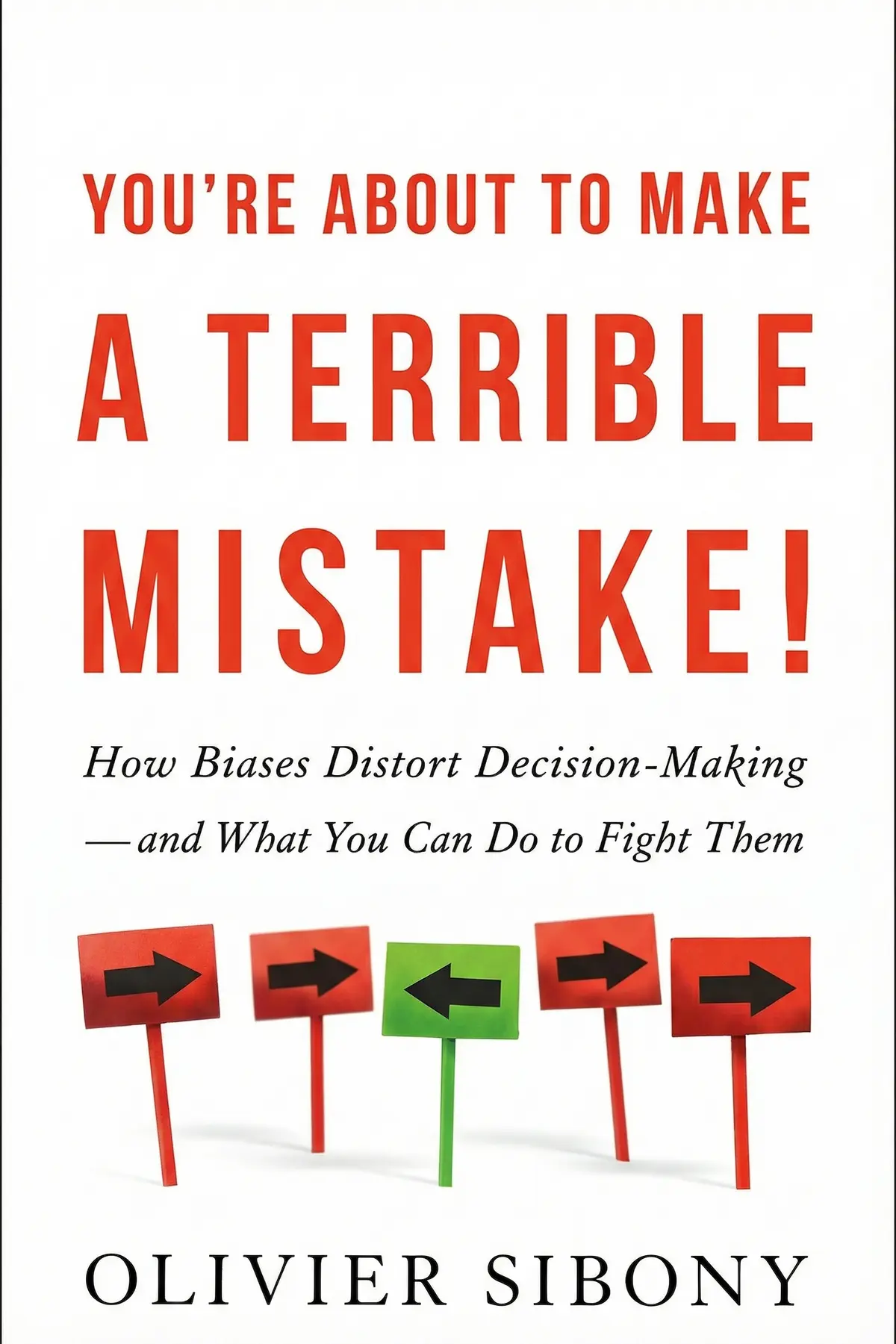
Table of Content
1. Introduction
1 min 02 sec
Most leaders trust their gut on big calls, and most of those calls land little better than a coin toss. When about 2,000 executives were surveyed, only 28 percent said their company made good strategic decisions, and roughly 60 percent said bad ones came about as often as good ones. In You’re About to Make a Terrible Mistake!, strategy professor and former McKinsey senior partner Olivier Sibony explains why smart people keep falling into the same traps.
His answer is that bias can’t be removed from any single mind, yet its damage can be shrunk by changing how decisions are made. The leader’s real job is to act as a decision architect, someone who designs how choices are framed, challenged and judged. A fake oil-sniffing plane, a $1.7 billion iced tea purchase and a rejected offer from a young Netflix show the traps at work. After them come tests for when instinct is safe, and ways to run meetings so bias weakens before the money is spent.
2. Know when your gut deserves a vote
2 min 04 sec
Quaker Oats followed one hit acquisition with a second that lost most of its value in three years. The executive behind it was experienced, so what went wrong says more about the situation than about him.
3. Catch yourself chasing the story you want
1 min 47 sec
A French oil company, France’s prime minister and president, and later a famous Wall Street bank all believed in the same impossible machine. They were not stupid, and the reason they fell for it applies to every boardroom.
4. Feeling certain is your cue to get nervous
2 min 07 sec
In 2000, a struggling startup offered half of itself to the market leader for a modest price and was sent away. Twenty years later the numbers were almost unbelievable, and a simple quiz explains how such misjudgments happen.
5. Study failures to see what really drives success
2 min 01 sec
Copying a famous company’s leader or signature feature feels like a shortcut to its results. A bakery that delivers cookies shows why that shortcut so often leads nowhere, and where better lessons are hiding.
6. Build a better process and beat analysis six to one
1 min 59 sec
Companies often have stricter rules for buying office supplies than for billion-dollar bets. A study of more than a thousand investments measured what that gap costs, and the spreadsheet came out a distant third.
7. Meetings that argue well and decide better
1 min 53 sec
A chef testing new dishes can ask a doting grandmother or a hard-to-please critic. The choice sounds trivial, yet it reveals why so many company meetings approve bad plans without anyone objecting.
8. Conclusion
1 min 10 sec
Thirty years and an ocean apart, French officials and California investors fell for the same oil-sniffing plane. Strategic triumphs tend to be one of a kind, but strategic mistakes repeat, because they grow from the same human habits: trusting a gut that has never practiced, hunting for facts that flatter a hope, feeling surer than the evidence allows and crediting a hero for a team’s work. No amount of intelligence switches those habits off, least of all under time pressure. What changes the outcome is the setting in which the choice gets made.
That moves the leader’s job toward designing the room where decisions happen. Before letting intuition speak, ask whether the situation is predictable and well rehearsed. Write the decision criteria down early and keep coming back to them as the debate shifts. Invite the people most likely to disagree, give them time, and treat your favorite proposal as the one most in need of a challenge.
The men behind the oil-sniffing plane never had to fool a process. They only had to fool people who wanted to believe.
About this book
What is this book about?
Executives rarely trust their own companies' big decisions. In one survey, fewer than a third rated their firm's strategic choices as good. Olivier Sibony, a strategy professor who spent 25 years at McKinsey, sets out to explain why intelligent, experienced people keep making errors that look obvious in hindsight. His answer is that individual bias is close to impossible to remove, especially under time pressure. Leaders believe stories they want to be true, feel far more certain than the evidence allows, credit a single hero for a team's success and trust instincts formed in settings that never repeat. Sibony follows these traps through vivid business cases: a fake oil-detecting plane that cost a French company about a billion francs, the Snapple purchase that became bankers' shorthand for a disastrous deal, and Blockbuster's refusal to buy part of a young Netflix. The practical promise is a shift in the leader's role, from lone decider to decision architect. Readers learn when intuition can be trusted, why process outweighed analysis in a study of more than a thousand investments, and how to run meetings, choose participants and set criteria so that bias loses its grip.
Book Information
Who it's for
Executives and founders
Executives and founders weighing acquisitions, partnerships or big investments on instinct.
Team leads facing groupthink
Team leads whose meetings rubber-stamp plans instead of testing them.
Wanting defenses against bias
Strategy, finance and consulting professionals who want practical defenses against confirmation bias and overconfidence.
About the Author
Olivier Sibony
Olivier Sibony is a professor of strategy at HEC Paris and an Associate Fellow of Saïd Business School at Oxford University, where his research examines how biases shape strategic decisions. Before teaching, he spent 25 years at McKinsey & Company in France and the US, rising to Senior Partner and helping lead its Global Strategy Practice. He holds a PhD from Université Paris-Dauphine, co-wrote Noise with Daniel Kahneman and Cass R. Sunstein, and advises senior leaders on decision-making.
Noise: A Flaw in Human Judgment
Daniel Kahneman
Ratings & Reviews
Ratings at a glance
What people think
Listeners find this book to be a productive and systematic resource for implementing behavioral science within strategic business frameworks. They value the author’s talent for turning intricate research into a functional "decision architecture," and one listener highlights that the "topic in 30 seconds" summaries are particularly beneficial for reinforcing the material. Additionally, many listeners appreciate the thorough set of 40 actionable techniques designed to address cognitive biases during group collaborations. While perspectives differ regarding the book’s uniqueness for those already well-versed in the subject, they also note that the abundance of practical examples ensures the concepts are remarkably clear. The text is further commended for its high information density and the way it expertly merges academic studies with hands-on leadership experience.
Top reviews
Udom
The 'topic in 30 seconds' summaries at the end of each chapter are a total game-changer for someone with a busy schedule. This book doesn't just list our flaws; it provides a literal toolkit of 40 techniques to actually do something about them. I particularly enjoyed the sections on 'pre-mortems' and the 'vanishing options test,' which we’ve already started experimenting with in our weekly meetings. Sibony’s background as a strategy professor shines through in how he organizes the information—it's incredibly logical and builds momentum as you read. Some might find the business-heavy focus a bit narrow, but for me, that specificity made the advice feel more tangible. It’s rare to find a book that balances academic rigor with such clear, actionable professional advice. This is definitely staying on my desk as a frequent reference.
Show moreSun
Ever wonder why smart people in expensive suits make such disastrously bad calls? Sibony pulls back the curtain on the corporate decision-making process to reveal a mess of ego and cognitive shortcuts. He argues convincingly that our intuition is often our own worst enemy when the stakes are high. By framing the solution as 'behavioral strategy,' he gives leaders a way to fight bias without needing to become psychologists. The example of the 'petrol-sniffing airplane' was particularly memorable and perfectly illustrated how logic can fail even the experts. My only gripe is that it can feel a bit repetitive if you read it cover-to-cover in one sitting. Still, the depth of research is impressive and the checklists are worth the price of admission alone. It’s a sharp, necessary look at how we think.
Show moreEarn
Look, if you manage people or run a department, this should be mandatory reading for your entire team. We often assume that bad decisions come from bad intentions or lack of data, but Sibony proves it's usually just bad process. The book is incredibly well-organized and serves as a masterclass in applying behavioral science to the workplace. I found the section on 'cognitive diversity' particularly enlightening in today’s environment. It’s not just about having different people in the room; it’s about creating a culture where they actually feel safe to speak up. The tone is professional yet accessible, making it easy to share specific chapters with colleagues. While it lacks the narrative flair of a Malcolm Gladwell book, it more than makes up for it with sheer utility. This is a must-read for any serious professional.
Show morePop
Finally got around to reading this, and the 'decision architecture' framework is exactly what my organization needed. It’s one thing to know that anchoring bias exists, but it’s another thing entirely to know how to 're-anchor' a negotiation. The 40 techniques are worth keeping on a laminated sheet during any major project planning phase. Sibony’s prose is clear and he has a knack for explaining abstract concepts through vivid, real-world examples. I loved the emphasis on learning from both failures and successes—it's a nuanced view that most management books miss. The information density is high, so I had to take my time with it, but the effort was well worth it. This is a powerful, practical guide that turns psychological theory into a competitive advantage. Highly recommended for anyone in a leadership position.
Show moreGun
After years of trying to 'fix' my own brain, Sibony’s core message hit me like a ton of bricks: you simply can’t. We are all hardwired for bias, and no amount of self-awareness is going to magically erase the heuristics that lead us astray. The shift here from individual improvement to 'decision architecture' in a group setting is the book's greatest strength. I loved the focus on how organizations can build systems that naturally filter out bad logic before a project goes off the rails. While the McKinsey-style corporate examples might feel a bit distant if you aren’t in a boardroom, the logic remains impeccable. It's a refreshing, if slightly humbling, reminder that we need each other to stay rational. The writing is punchy and direct. It avoids the typical academic fluff found in similar titles. It’s easily one of the most practical guides I’ve found on the subject.
Show morePracha
Picked this up on a whim and was pleasantly surprised by how Sibony distills complex strategy into something usable. Most books on cognitive bias stop at telling you that you're biased, which isn't actually very helpful in the real world. This book goes the extra mile by explaining how to design a process that accounts for those flaws. The 'decision architecture' concept is brilliant and feels like the missing link between theory and practice. I especially liked the bit about using 'devil’s advocates' and 'red teams' to stress-test ideas before they are approved. It’s a dense read, packed with information, yet it never feels like a slog because the pacing is so deliberate. If you’re tired of the same old management platitudes, give this one a shot. It’s a thoughtful, evidence-based approach to leadership.
Show moreJames
To be fair, the first few chapters felt like a retread of every other behavioral economics book I’ve purchased since 2010. I almost put it down because I didn't think I needed another lecture on anchoring or confirmation bias. However, once I reached the section on the 40 specific techniques, I was hooked. Sibony moves past the 'what' and 'why' to give us a very comprehensive 'how' that is missing from many academic texts. The way he clusters these biases into situational threats is much more intuitive than just learning a list of definitions. It’s not a perfect book—some of the analogies feel a bit recycled—but the practical application of 'nudge' theory to corporate strategy is excellent. It’s a solid four-star read for anyone who actually has to make decisions for a living.
Show morePiyanart
Is this a solid introduction to behavioral strategy? Absolutely. However, if you have already spent time with the works of Kahneman, Thaler, or Ariely, you might experience a bit of déjà vu. The truth is that much of the foundational research presented here is well-trodden ground in the world of behavioral economics. Sibony does a fantastic job of synthesizing these ideas, but I was searching for more novel theories. I did appreciate the 'topic in 30 seconds' summaries, which made the high information density much easier to digest. It’s a very easy read with simplified explanations that don't talk down to the reader. It is worth picking up if you want a consolidated refresher, but don't expect a revolution in thought. I’d recommend it primarily to those new to the genre or managers looking for a quick reference guide.
Show moreOm
In my experience, books written by consultants tend to be a bit dry, but Sibony manages to keep things engaging with some truly fascinating case studies. He does a great job of meshing academic research with the messy reality of business. I appreciated the honesty regarding the fact that individuals can’t really self-correct their biases. It’s a bit of a bitter pill to swallow, but it makes the later chapters on organizational design much more impactful. My main complaint is that the book leans so heavily on the work of Kahneman that it sometimes feels like a very long appendix to 'Thinking, Fast and Slow.' If you haven't read that one, this will be a five-star experience. If you have, it’s more of a useful supplemental guide on how to apply those theories in a boardroom.
Show moreHannah
Frankly, I found the heavy emphasis on C-suite problems quite alienating for the average reader. While I understand that Sibony comes from a McKinsey background, the examples were almost exclusively about multi-million dollar investments and corporate mergers. I was hoping for more advice on personal decision-making, but the author is adamant that you can't really fix your own biases solo. This makes the first half of the book somewhat depressing and the second half largely irrelevant if you don't manage a large team. To be fair, the writing style is clear and the organization is top-notch. It just wasn't the book I thought it was going to be. If you aren't a senior manager or a strategy consultant, you might find yourself skimming large sections. It’s a well-constructed manual for a very specific type of person.
Show moreQuestions about this book
What is the main idea of You’re About to Make a Terrible Mistake!?
Olivier Sibony argues that bias cannot be removed from individual decision makers, especially in complex organizations and under time pressure. Its effects can be reduced, though, by changing how decisions are made. He urges leaders to become decision architects who design how options are presented, debated and judged, rather than relying on gut instinct, and he shows how biases like confirmation bias and overconfidence led to costly failures at Elf Aquitaine, Quaker Oats and Blockbuster.
When can you trust your intuition in business, according to Sibony?
Drawing on psychologists Daniel Kahneman and Gary Klein, Sibony names two conditions. The environment must be high-validity, with fairly predictable causes and effects, as in poker, and you must have long practice in that same unchanging setting. Most strategic decisions fail both tests. He cites Philip E. Tetlock’s 20-year study of 82,361 expert predictions, which were less accurate than random answers.
What does a Snapple mean in business?
Investment bankers use the term for a disastrous acquisition. In 1994 Quaker Oats chief executive William Smithburg bought Snapple for $1.7 billion, reasoning that an iced tea could repeat the success of Gatorade. Three years later Quaker sold it for a fifth of the price. Sibony presents the deal as an example of trusting intuition in a setting where it could not be reliable.
How can teams make better strategic decisions?
Sibony cites a 2010 study of 1,048 investment decisions, where teamwork combined with process accounted for 53 percent of the variation in returns, while analysis accounted for just 8 percent. He recommends bringing in people from different professional backgrounds, allowing enough time for disagreement, separating discussion meetings from decision meetings, treating the investment case as guilty until proven innocent, and setting decision criteria well before the final call.
Readers also enjoyed




A Year with Peter Drucker: 52 Weeks of Coaching for Leadership Effectiveness
Joseph A. Maciariello




Acting with Power: Why We Are More Powerful Than We Believe
Deborah Gruenfeld

59 Seconds: Change Your Life in Under a Minute
Richard Wiseman

All In: How Great Leaders Build Unstoppable Teams
Mike Michalowicz
AUDIO SUMMARY AVAILABLE
Listen to You’re About to Make a Terrible Mistake! in 15 minutes
Get the key ideas from You’re About to Make a Terrible Mistake! by Olivier Sibony, plus 5,000+ more nonfiction titles.
- 5,000+ titles
- Listen as much as you want
- 7-day free trial
- Cancel anytime









