
13 min 34 sec
Available in: English
 ไทย
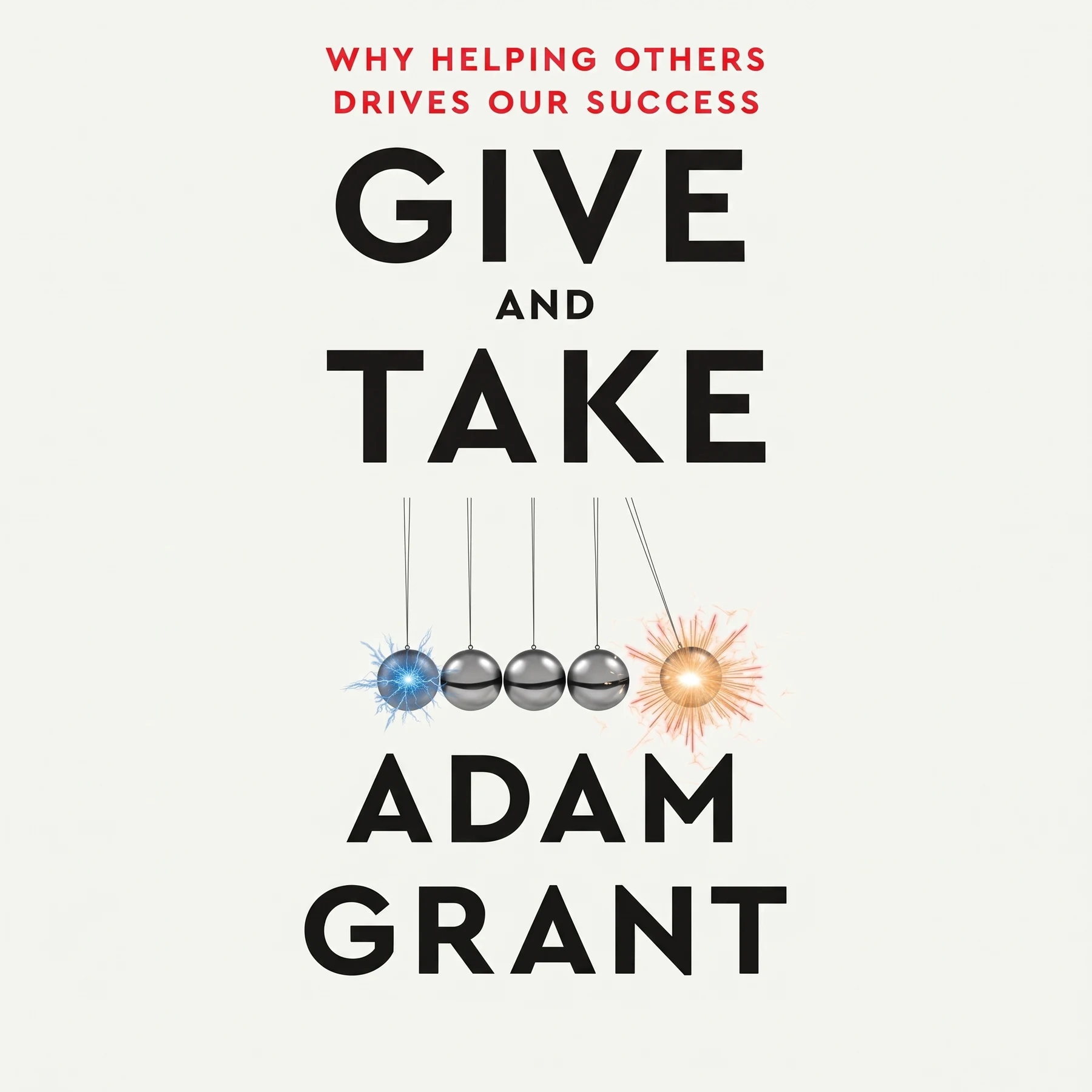
EnglishไทยGive and Take: Why Helping Others Drives Our Success
By Adam Grant
Shows why generous people often rise to the top at work, why takers end up paying for their selfishness, and how to give in ways that build reputation and influence without burning out.
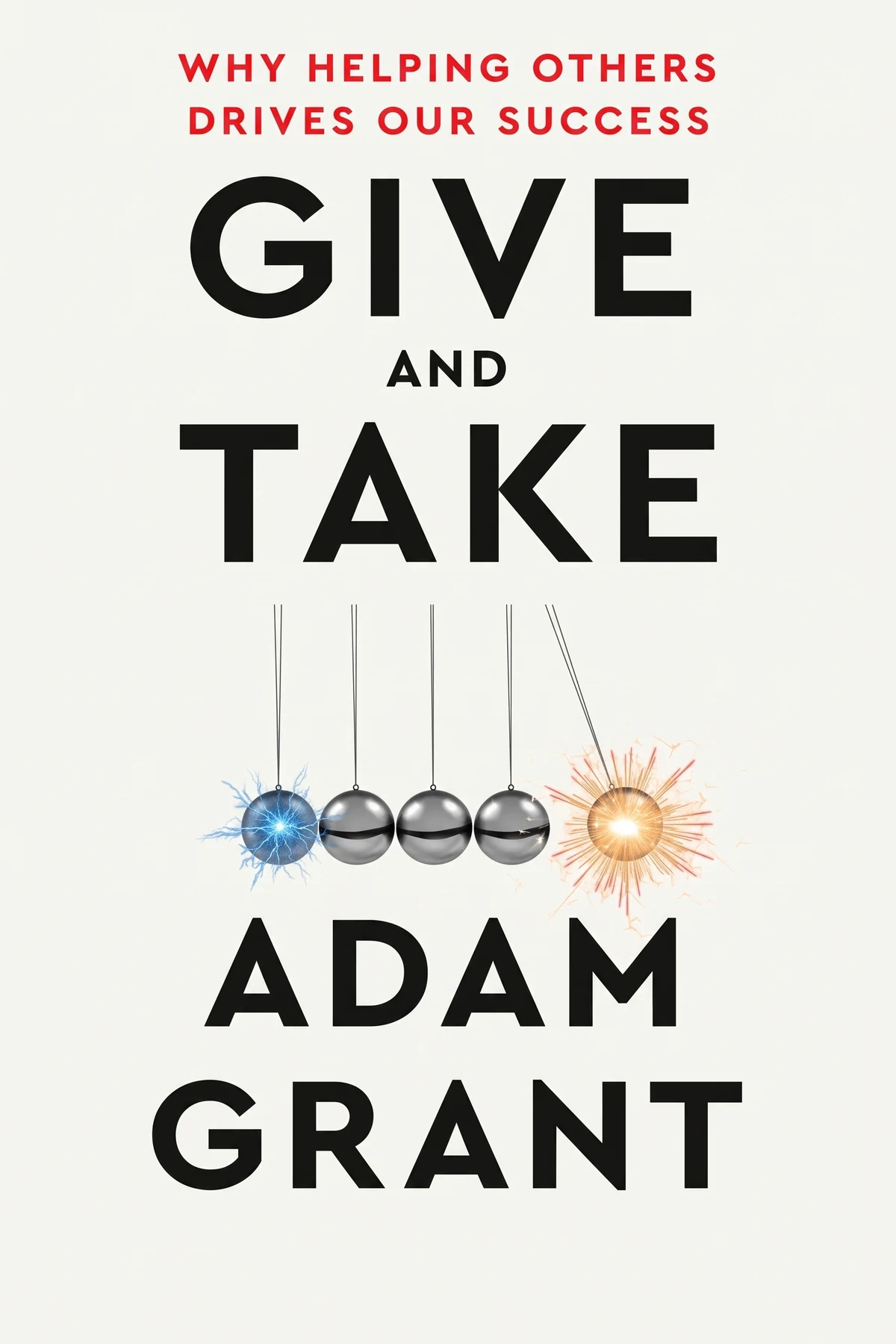
Table of Content
1. Introduction
58 sec
If you help colleagues freely, you may worry it makes you the person who gets passed over while others grab the credit. In Give and Take, Wharton organizational psychologist Adam Grant argues that generous people often climb to the very top, as long as they give in the right way. He sorts everyone into three styles. Takers try to get more than they give, matchers insist on even trades, and givers offer more than they receive.
Grant’s case is that the style you bring to each exchange shapes your reputation, your network and your influence over years, and that givers who guard their energy end up winning alongside the people they help. The stories range from Abraham Lincoln stepping aside in a senate race to an optician who sells more glasses by asking questions. Afterward you will recognize each style in your own office and know how to give generously without being used.
2. Tell a taker from a giver at work
1 min 38 sec
A powerful chief executive and a basketball legend share one view of the world, and an Emmy-winning comedy writer holds the opposite one. The difference shows up in the smallest words people use every day.
3. Notice how the room changes what you give
1 min 39 sec
Soccer fans passing an injured runner behaved very differently depending on a single detail of his clothing. The experiment hints that your generosity is far less fixed than you think, and that others can shape it.
4. Grabbing the credit costs you later, so share it
1 min 40 sec
One man helped defeat polio, and another designed some of the most admired buildings of his age. Both were left out of something they wanted, and the reason had little to do with their talent.
5. Back the shared goal and rise faster
1 min 33 sec
A future president walked away from a race he might have won, and a young consultant gave away a tool that could have made him indispensable. Both moves looked like losses at the time.
6. Grow networks and talent that pay you back
1 min 58 sec
Calling someone you have not spoken to in five years usually feels awkward. For some people it is easy, and the same habit lets them spot future stars that everyone else has already dismissed.
7. Persuade more people with questions and advice requests
1 min 40 sec
The best salesperson at a large eyewear chain hardly sells at all, and a young scientist won an extraordinary perk from her employer without making a single demand. Their method runs against most career advice.
8. Keep giving without burning out or being used
1 min 33 sec
An exhausted teacher recovered by taking on more work, and a rule from mathematical biology shows how to deal with people who exploit kindness. Both findings upset the obvious advice to simply give less.
9. Conclusion
55 sec
Grant’s book turns success into a question of how you trade, and over a long career the trade shows. Takers can win for a while, as Kenneth Lay and Frank Lloyd Wright did, but stories travel and the taker tax comes due. Matchers stay even. The givers who rise furthest, like Lincoln, Geller and Rifkin, are those whose help made others stronger and who kept enough energy and judgment to continue.
That leaves something to practice this week. At your next team success, name the people behind it. Share one useful thing before anyone asks for it. When you need help, ask for advice instead of making demands. And with the person who only takes, mirror their behavior while leaving room for an occasional kindness.
Takers fight over a fixed pie. Grant’s givers make the pie larger, and they end up with a share of what they helped create.
About this book
What is this book about?
Many people suspect that helping colleagues freely is a quick way to be overlooked, while the pushy and self-promoting collect the rewards. Adam Grant, an organizational psychologist at the Wharton School, argues that the picture is more surprising. He sorts people into three styles: takers who try to get more than they give, matchers who insist on even trades, and givers who offer more than they receive. Grant shows that takers often pay a hidden price when stories about them spread, as happened to Jonas Salk and Frank Lloyd Wright. Givers, from Abraham Lincoln to a young consultant at Deloitte, can climb to powerful positions because their focus on the group builds goodwill, lasting networks and loyal talent. He also explains why asking questions can persuade better than forceful talk. The book does not ask readers to give endlessly. It shows how givers avoid burnout by seeing the impact of their help, and how a strategy called generous tit for tat protects them from people who only take. Readers get a way to recognize each style around them and practical habits for giving that lift both others and themselves.
Book Information
Who it's for
Professionals who help freely
Professionals who help colleagues freely and worry they are being overlooked or used.
Leaders wanting shared credit
Managers and team leads who want a team that shares knowledge and credit.
Hoping to build influence
Young employees and salespeople looking for a way to build influence without self-promotion.
About the Author
Adam Grant
Adam Grant is an American organizational psychologist who teaches at the University of Pennsylvania's Wharton School, where his research covers motivation, generosity, creativity and potential. He is a number one New York Times bestselling author whose books include Give and Take, Originals and Think Again, and he hosts the WorkLife podcast. Grant earned his BA at Harvard and his PhD at the University of Michigan. Before academia, he competed as a junior Olympic springboard diver and performed as a magician.

Ratings & Reviews
Ratings at a glance
What people think
Listeners find this title to be a vital resource for business majors, offering well-supported insights that blend authentic anecdotes and personal history with academic theory. The narrative is engaging, and listeners value the actionable tips for enhancing their quality of life. Furthermore, the work is intellectually stimulating; one listener highlighted how it opened their mind to fresh possibilities, while another listener notes it provided clarity regarding their own generous instincts.
Top reviews
Gung
Finally got around to reading this after seeing Grant's TED talk, and it really shifts your perspective on professional success. Not gonna lie, I used to think that you had to be a bit of a shark to get ahead in a competitive industry. This book proves that 'otherish' givers—those who help others but also look out for their own interests—actually end up at the top of the heap. The stories about Adam Rifkin and the power of dormant ties were particularly eye-opening for me. It’s a rare business book that offers a roadmap for being both successful and a decent human being simultaneously. Highly recommended for anyone who feels like they’re constantly being taken advantage of at work.
Show moreNuk
Wow, it’s rare to find a business book that actually makes you want to be a better person instead of just a richer one. Gotta say, the chapter on 'bloomers' and the self-fulfilling prophecy of teacher expectations was incredibly moving and applicable to leadership. It’s fascinating how givers see potential in everyone and how that investment eventually pays off in ways matchers can't replicate. The writing is engaging and flows much faster than your typical academic text. I’ve recommended this to my entire management team because we need more 'reciprocity rings' and less internal competition. It’s a thought-provoking read that genuinely expanded my mind to new possibilities in networking.
Show morePornpimon
Adam Grant has essentially written the modern-day version of 'How to Win Friends and Influence People,' but with actual data to back it up. In my experience, the most successful people I know are the ones who are constantly connecting others without asking for anything in return. Seeing that behavior validated by research was incredibly satisfying and gave me the confidence to keep being helpful. The examples of Freecycle and the power of community norms were especially inspiring. It’s a book that celebrates the best of human nature while providing a shield against those who might try to exploit it. If everyone read this, our work cultures would be significantly healthier and more productive.
Show moreDome
As someone who has always felt like a bit of a pushover in corporate settings, this was a revelation. Personally, I found the distinction between being a 'selfless' giver and an 'otherish' giver to be the most practical takeaway. Grant explains that you don't have to be a doormat to be a kind person; you just need better boundaries. The concept of the 'giver sandwich'—where givers occupy both the bottom and the top of the success ladder—makes so much sense. I’ve already started implementing the 'five-minute favor' rule in my daily workflow. It’s a solid, well-researched guide that helps you understand your own nature without feeling like you need to change your entire personality.
Show moreJun
Ever wonder why the loudest person in the meeting usually gets their way but rarely stays at the top? Look, this book explains that dynamic perfectly by contrasting 'takers' like Ken Lay with genuine 'givers' like David Hornik. I loved the practical tips on how to spot a faker by looking at their LinkedIn recommendations or their use of 'I' versus 'we' in interviews. It’s a must-read for business majors who want to understand the long-term impact of reputation. My only complaint is that it gets a bit repetitive toward the middle. However, the overall message is powerful enough to overlook the occasional fluff. It’s definitely changed how I approach new professional introductions.
Show morePalm
The advice on avoiding burnout is worth the price of the book alone. No doubt, many givers end up exhausted because they don't know how to say no to takers. Grant’s exploration of the sunk-cost fallacy and ego threat was brilliant, especially regarding how takers often double down on bad decisions to save face. I appreciated the practical strategies for protecting your time while still being a helpful resource for your colleagues. The writing style is entertaining and weaves real-life stories with theory in a way that keeps you turning pages. It’s a great tool for anyone in a high-pressure job that involves a lot of emotional labor and collaboration.
Show moreSomchai
Picked this up on a recommendation from a mentor and found it to be a thought-provoking read that challenged my cynical views. Grant weaves real-life stories with psychological theory in a way that remains entertaining throughout. I’ll admit that I found the distinction between 'selfless' and 'otherish' givers particularly useful for my own career development. It explains why some people get exploited while others thrive. While some parts felt a bit repetitive, the practical advice for building a reciprocity-based network is something I can actually use. This is a solid read for anyone starting out in business who wants to maintain their integrity while climbing the ladder.
Show moreNarumon
While I appreciate the optimistic message Grant promotes, I found the heavy reliance on anecdotes a bit frustrating. The author spends a lot of time painting givers as the ultimate victors, but some of the supporting research feels outdated. I wasn't entirely convinced by using LinkedIn connection counts as a primary measure for genuine human connectivity. Truth is, the book feels like it’s bending over backward to prove a point rather than conducting a rigorous investigation. It's a nice sentiment, but the methodology occasionally left me wanting more. I still think it's worth a read for the core idea, just take the 'science' with a grain of salt.
Show moreMia
This book sits in that weird space between rigorous social science and pop psychology. Frankly, it feels a bit like Grant decided on his conclusion first and then cherry-picked the data to support it. The categorization of humans into three static groups—givers, takers, and matchers—is a bit too simplistic for my taste. People are far more complex and context-dependent than this framework suggests. That said, the ideas about avoiding burnout by 'chunking' your giving were quite helpful. I also enjoyed the section on how seeking advice can be a powerful form of influence. It’s a decent read with some good insights, but don't expect a foolproof scientific formula for life.
Show moreWittaya
The premise that being generous leads to wealth feels incredibly out of touch with the reality of many marginalized groups. Grant writes from a position of massive privilege, and most of his examples involve well-off professionals helping other elite individuals. To be fair, he includes one story about a teacher in Philadelphia, but it feels like a token gesture in a book otherwise designed for the C-suite. He also largely ignores how gender socialization makes the 'giver' role an expectation for women rather than a strategic choice. For those of us in social work or non-profits, this feels like business-bro philosophy wrapped in a thin layer of altruism. It’s a very narrow perspective on kindness.
Show moreQuestions about this book
What is the main idea of Give and Take by Adam Grant?
Grant argues that people trade help in three styles: takers try to get more than they give, matchers want even exchanges and givers offer more than they receive. Takers often pay a reputational price he calls the taker tax, while givers who serve a shared goal and protect their energy can rise to the top, building trust, strong networks and loyal talent along the way.
What is the difference between givers, takers and matchers?
Takers see life as competition and help others only when it benefits them, like Kenneth Lay at Enron. Givers share time, knowledge and credit without tracking returns, like Simpsons writer George Meyer. Matchers, the most common group, aim for fair trades: they repay favors quickly and expect the same in return. Grant also shows that people shift between styles depending on the group around them.
What is powerless communication in Give and Take?
Powerless communication means focusing on the other person by asking questions and seeking advice instead of speaking forcefully. Grant argues it persuades better because it lowers resistance. Optician Kildare Escoto became the top seller at LensCrafters by asking about customers’ needs, and a scientist called Annie won use of her company’s private jet simply by asking her HR manager what they would do.
How can givers avoid burnout and being taken advantage of?
Grant reports that burnout eases when givers can see the impact of their help, even if they spend more time giving, as teacher Conrey Callahan found when she started a mentoring program. To deal with takers, he recommends generous tit for tat: match their behavior most of the time, but occasionally offer a kind gesture anyway, keeping control while leaving room for improvement.
Who should read Give and Take?
It suits people who help others at work and wonder whether it is hurting their careers, managers who want teams that share knowledge and credit, and anyone trying to build influence without aggressive self-promotion. Its lessons are concrete: name the people behind a success, share useful tools freely, stay in touch with dormant contacts and ask for advice when you need something.
Readers also enjoyed




59 Seconds: Change Your Life in Under a Minute
Richard Wiseman



60 Seconds & You’re Hired!
Robin Ryan



A Liberated Mind: How to Pivot Toward What Matters
Steven C. Hayes
AUDIO SUMMARY AVAILABLE
Listen to Give and Take in 15 minutes
Get the key ideas from Give and Take by Adam Grant, plus 5,000+ more nonfiction titles.
- 5,000+ titles
- Listen as much as you want
- 7-day free trial
- Cancel anytime









