
13 min 12 sec
Available in: English
Flipnosis: The Art of Split-Second Persuasion
By Kevin Dutton
Explains how the fastest persuasion works on instinctive shortcuts in the mind. It gives a five-part recipe for winning tense moments and shows how to spot the con men, framers and crowds trying to sway you.
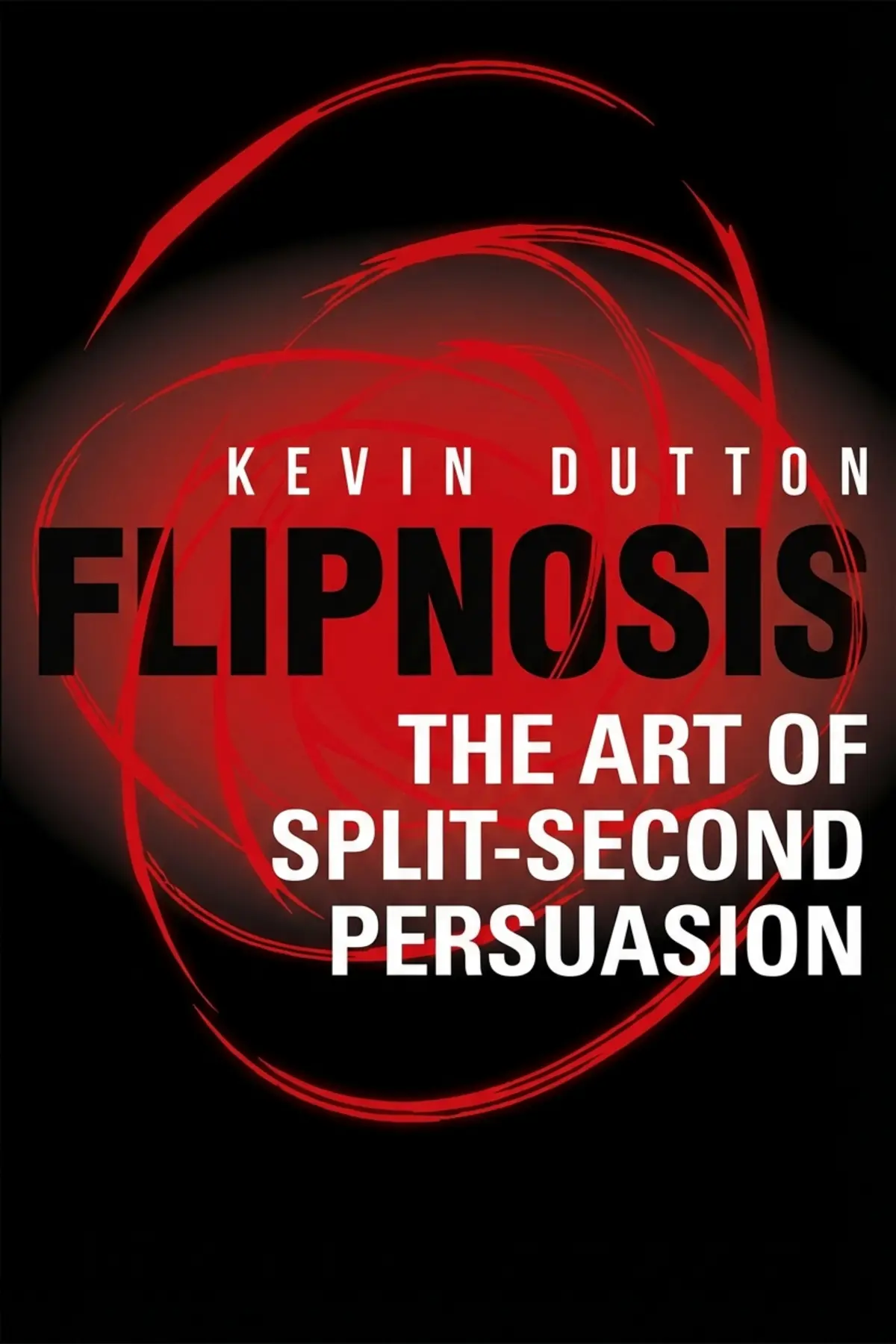
Table of Content
1. Introduction
56 sec
Other people try to persuade us around 400 times a day, far more than the 20 or 30 most of us would guess. In Flipnosis, British psychologist Kevin Dutton points out that people guess they face 20 or 30 persuasion attempts a day, when the real number is closer to 400. He argues that this flood is not a problem. It keeps society running, because the alternative is coercion. Picture the man handing out flyers at the bus station beating you up for refusing one.
Dutton’s subject is the fastest kind of influence, and his case is that it works by skipping careful thought and pressing on shortcuts built into every mind. Learn those shortcuts and you can defuse a crisis in seconds. You can also see when someone else is pressing on yours. You will meet a Job Centre worker nobody attacks, a con man who calls himself a scientist, and a police officer who saves a life by taking off his jacket.
2. Calm a hostile person with one small signal
2 min 10 sec
Staff at one office kept quitting after threats and flying fire extinguishers, yet one man sat unprotected for years without a scratch. His method came from the same place as a cat’s purr and a spider’s web.
3. Guard the three blind spots con men target
2 min 10 sec
A self-described psychopath treats the human brain as his laboratory and sees the same three weak points in everyone. Once you know where he aims, a fake price tag and a busy phone line look very different.
4. Spot how framing changes what people judge
2 min 12 sec
A car slides on oil and hits a parked vehicle. Change one detail that had nothing to do with the crash, and people suddenly assign more blame. Lawyers, marketers and politicians know exactly how to use that.
5. Stand firm when the whole room is wrong
2 min 18 sec
Ordinary people have followed a group into mass death and terror, and in a simple test most people deny what their own eyes tell them. Dutton explains the pull, and why nobody is fully immune.
6. A five-part recipe for winning the moment
2 min 11 sec
A man stands on a tenth-floor window ledge, and the usual calm words are not working. A police officer’s strange choice of clothing shows the five ingredients behind fast, effective persuasion.
7. Conclusion
1 min 15 sec
Flipnosis adds up to a skill with two edges. The same shortcuts that let Marco calm a furious visitor let Keith Barrett run his long cons, and the same pull of the group that keeps a dinner party polite led more than 900 people to their deaths. Dutton’s view is that nobody gets to opt out of persuasion. You meet hundreds of attempts a day, and the alternative is force. What you can choose is whether to understand it.
That understanding works in both directions. For defense, notice when you are overloaded, when a price or a label is doing your tasting, when a motive has been attached to the facts, or when you agree mainly because everyone near you agrees. Knowing the tricks gives you partial protection against people who want you to adopt their beliefs or join causes you would never pick on your own. When it is your turn to persuade, bring SPICE to the moments that matter. Say it simply, speak to what the other person wants, surprise them once, show confidence and find the shared human note. Dutton also urges using these skills for good, since people often need only a little encouragement to do a lot.
Sometimes the most persuasive person in the room is the one sitting on his hands.
About this book
What is this book about?
Every day, by Kevin Dutton's estimate, someone tries to persuade you about 400 times. Most of it slips past unnoticed. Dutton, a British psychologist, argues that this steady pressure is no sign of a broken society. It keeps society working, because the alternative to persuasion is force. His interest is the quickest kind of influence, the kind that changes a mind in a split second. He looks for it in unexpected places. There is a Job Centre worker whom angry visitors never attack, and a psychopathic con man who maps the mind's blind spots. Lawyers frame the facts for juries, and cult leaders and extremists turn whole groups toward disaster. A police officer talks a man down from a ledge by taking off his jacket. Each case shows persuasion running on built-in shortcuts that skip careful thought. Out of these cases Dutton constructs SPICE, a formula with five parts: simplicity, then perceived self-interest, then incongruity, then confidence, and finally empathy. Readers get a recipe for persuading when seconds count, and a working defense against people who use the same tricks for worse ends.
Book Information
Who it's for
Managers, staff and negotiators
Managers, front-line staff and negotiators who face tense people and need to calm them fast.
Professionals pitching ideas
Professionals who pitch ideas and want a simple recipe for persuading in seconds.
Worried about being swayed
Anyone worried about being swayed by marketers, slick talkers or group pressure.
About the Author
Kevin Dutton
Kevin Dutton, born in 1967, is a British psychologist and writer who specializes in the study of psychopathy and also researches persuasion. He has been a researcher in the Department of Experimental Psychology at the University of Oxford and a member of the Oxford Centre for Emotions and Affective Neuroscience research group. He has published in scientific journals and spoken at conferences around the world. His other books include The Wisdom of Psychopaths.
Ratings & Reviews
Ratings at a glance

What people think
Listeners find the book offers great perspectives, with one listener mentioning its basis in scientific research. Feedback regarding the prose is divided; while some find it effectively written, others disagree. The pacing draws criticism for being disjointed, and both the narrative length and visual components elicit varied reactions. Readability is another point of contention, as one listener describes the material as easy to digest and follow, yet another finds the text hard to get through.
Top reviews
Arnav
Picked this up because I loved 'The Good Psychopath's Guide' and I wasn't disappointed by the raw data here. Dutton is a master at taking the 'scary' topic of manipulation and showing how it’s actually a neutral tool used by everyone from saints to sinners. The chapter on the arsonist who saves people from burning buildings really stuck with me—it perfectly illustrates the thin line between a predator and a hero. I found the book easy to absorb, despite some of the more complex biological sections. Not gonna lie, I’ve already started noticing the SPICE principles in the advertisements I see every day. It’s like having a curtain pulled back on the world of social engineering. If you go into it with an open mind and a desire to learn about the human condition rather than just 'hacks,' you'll love it.
Show moreNitaya
Finally got around to finishing this, and my view on social interaction has shifted slightly. What I loved most was the scientific rigor behind the stories. Unlike a lot of self-help gurus, Dutton actually knows his stuff and provides the research to back up his claims. The book is a bit of a rollercoaster—one minute you're learning about the amygdala, and the next you're in a high-security prison. This variety kept it fresh for me, even when the pacing slowed down. It's not a light read, but it's a rewarding one for those who want to understand the 'instant' nature of persuasion. I found the writing to be sharp and often funny. It's easily one of the better books on influence I've encountered in years, even if it doesn't hold your hand through the application process.
Show moreWyatt
Truth is, most books on influence are just fluff, but this is backed by real clinical insight and fascinating field work. I was hooked from the first chapter. The way Dutton explains the intersection of psychopathy and persuasion is brilliant and, quite frankly, a little bit terrifying. It’s a deep dive into how our evolution has left us vulnerable to specific types of 'flips.' I didn't find the case studies disjointed at all; rather, they felt like pieces of a larger puzzle about how the human brain functions under pressure. The readability is excellent, and I finished it much faster than I expected. It’s a must-read for anyone in sales, law, or just anyone who wants to understand the hidden currents of daily life. This isn't just a book; it's a toolkit for understanding the world.
Show moreChokdee
The SPICE acronym alone makes this worth the price of admission for anyone interested in communication. I've read a lot of these types of books, and while this one isn't the most 'practical' in terms of exercises, the insights are top-tier. Kevin Dutton has a way of making complex neurological concepts accessible, even if he gets a bit sidetracked by his own anecdotes. The stories about the psychopathic arsonist and the master con artists are genuinely gripping. You start to see how these 'persuasion ninjas' operate in the real world, which makes you much more aware of when it's happening to you. My only gripe is that the book is a bit long-winded in places. Some chapters felt like they were retreading old ground just to fill pages. Still, it’s a fascinating deep dive into the darker corners of the human mind.
Show moreMuk
Dr. Dutton has a surprisingly snappy prose style for a university fellow, which kept me engaged through some of the more technical bits. I wasn't entirely persuaded by every single case study, but the overall exploration of 'flipnosis' is compelling. It’s not just about lying or tricking people; it’s about the fundamental way our brains process influence. The book is heavily based on scientific research, which I appreciate in a genre often filled with pseudoscience. To be fair, the pacing is a bit hit-or-miss, and some sections definitely flow better than others. I found myself highlighting a lot of the sections on incongruity and how it breaks down people’s mental barriers. It’s a thoughtful look at influence that requires you to engage your brain rather than just follow a list of tips. Not a perfect book, but definitely a smart one.
Show moreWoravit
Ever wonder why some people can talk their way out of anything? This book attempts to answer that by looking at everything from the behavior of predators in the wild to the high-stakes world of elite hostage negotiators. It’s an exciting tour through the mind, and Dutton's writing is surprisingly glamorous and energetic. I didn't find it to be a 'how-to' guide, but rather a series of observations on the mechanics of charm and pressure. Frankly, I think the people complaining about the lack of instructions are missing the point. Understanding the 'why' is much more valuable in the long run than a script. The visual descriptions of the experiments helped me visualize the data, which was a nice touch. It's a dense read, but if you're a fan of social psychology, you'll find plenty to chew on here.
Show moreClara
If you're looking for a step-by-step manual on how to influence people, keep walking. I think the reason this book has such mixed reviews is that it’s marketed as self-help when it’s actually pop-science. Personally, I found the SPICE formula (Simplicity, Perceived Self-interest, Incongruity, Confidence, Empathy) to be a very helpful framework for understanding why certain pitches work. However, knowing the ingredients isn't the same as being a chef. You’ll have to do all the heavy lifting yourself to turn these principles into actual skills. The book goes into extreme detail on specific experiments which might bore some readers, but I appreciated the scientific grounding. It’s a decent read for psychology buffs, but don't expect to walk away as a master manipulator without a lot of outside practice. It’s more about recognition than execution.
Show morePot
As someone who enjoys psychology, I found the depth of the experimentation a bit much at times. Dutton is clearly a brilliant guy, and his thesis about the 'flip'—that instant moment of persuasion—is powerful stuff. But the book often feels like it's dragging you through a labyrinth of research papers that could have been summarized in half the time. It's a bit of a dense slog. I did enjoy the sections on how surgeons and lawyers use these tactics, but the connections between the chapters felt thin. Truth is, I preferred his other work more because it felt more focused. This one tries to cover too much ground—from biology to social engineering—and ends up feeling a bit disjointed. It's a solid 3-star effort that provides some good 'aha' moments if you're willing to dig through the academic weeds.
Show moreKek
This felt like a collection of random anecdotes rather than a cohesive argument. Dutton tries to emulate the Malcolm Gladwell style of storytelling, but it lacks the narrative glue that makes those books so readable. One minute we are talking about animal behavior, the next we are looking at con men, and the transitions are jarringly abrupt. While the stories about psychopaths and their inherent charm are somewhat fascinating, they don't offer much in the way of personal development. I kept waiting for the 'flip' to be explained in a way I could use, but it remained elusive. The pacing is quite slow in the middle sections, making it a struggle to get through. It’s not that the information is wrong—it’s just poorly organized and fails to deliver on the promises made by the back cover.
Show moreSaengdao
Don't let the flashy cover fool you; this book is the ultimate bait-and-switch. I went in expecting a tactical guide on persuasion, something concrete I could actually apply in my professional life, but instead, I got a dry collection of case studies. It’s frustrating because the marketing promises you’ll become a 'persuasion ninja,' yet the content is more like a disjointed research paper. The writing style is all over the place, oscillating between overly academic and trying too hard to be cool. To be fair, some of the science regarding the brain's 'binary' responses is interesting, but it's buried under so much fluff. I frankly couldn't find the motivation to finish the last third. If you want a how-to manual, this isn't it. It’s more of a 'why it happens' book that never quite connects the dots for the reader.
Show moreQuestions about this book
What is the main idea of Flipnosis by Kevin Dutton?
Dutton argues that the fastest persuasion skips careful thought and works on instinctive shortcuts in the mind. He finds it in animals, con men, lawyers, cult leaders and police negotiators. He sees persuasion as essential, since the alternative is coercion, and he sums up quick, effective persuasion in a five-part formula called SPICE. He also shows readers how to spot others using these shortcuts on them.
What does SPICE stand for in Flipnosis?
In order, SPICE stands for Simplicity, Perceived self-interest, Incongruity, Confidence, and finally Empathy. Keep the message short, appeal to what the listener believes is good for them, add something unexpected that grabs attention, show confidence that the listener can pick up on, and build a personal connection, often through humor. Two of those tools, incongruity and empathy, were what police officer Ron Cooper used when he talked a man out of leaping from a window ten stories up.
What are the three A's in Flipnosis?
They are the mental blind spots con man Keith Barrett targets: Attention, Approach and Affiliation. Overloading attention leaves less mental room for lying. Approach covers expectation shortcuts, like praising cheap wine wearing a $100 price tag. Affiliation is our urge to belong, which feeds social proof, as when an infomercial line suggesting busy operators drew many more callers.
How can I protect myself from manipulation using Flipnosis?
Watch for the shortcuts Dutton describes. Notice when you are rushed or overloaded, when a label or price is shaping your judgment, and when added details about someone’s motives are coloring the facts. Be wary of agreeing simply because a group does, since Solomon Asch’s line experiment showed most people will repeat an obviously wrong answer to fit in. Knowing the tricks gives you partial protection.
Readers also enjoyed


Acting with Power: Why We Are More Powerful Than We Believe
Deborah Gruenfeld


Age of Propaganda: The Everyday Use and Abuse of Persuasion
Anthony Pratkanis






59 Seconds: Change Your Life in Under a Minute
Richard Wiseman
AUDIO SUMMARY AVAILABLE
Listen to Flipnosis in 15 minutes
Get the key ideas from Flipnosis by Kevin Dutton, plus 5,000+ more nonfiction titles.
- 5,000+ titles
- Listen as much as you want
- 7-day free trial
- Cancel anytime









