

14 min 20 sec
Available in: English
 ไทย
EnglishไทยWhy Are All the Black Kids Sitting Together in the Cafeteria?: And Other Conversations About Race
Explains why students so often group by race at school and why that makes sense. It then shows how parents, teachers and colleagues can support healthy racial identities and talk about racism without freezing.
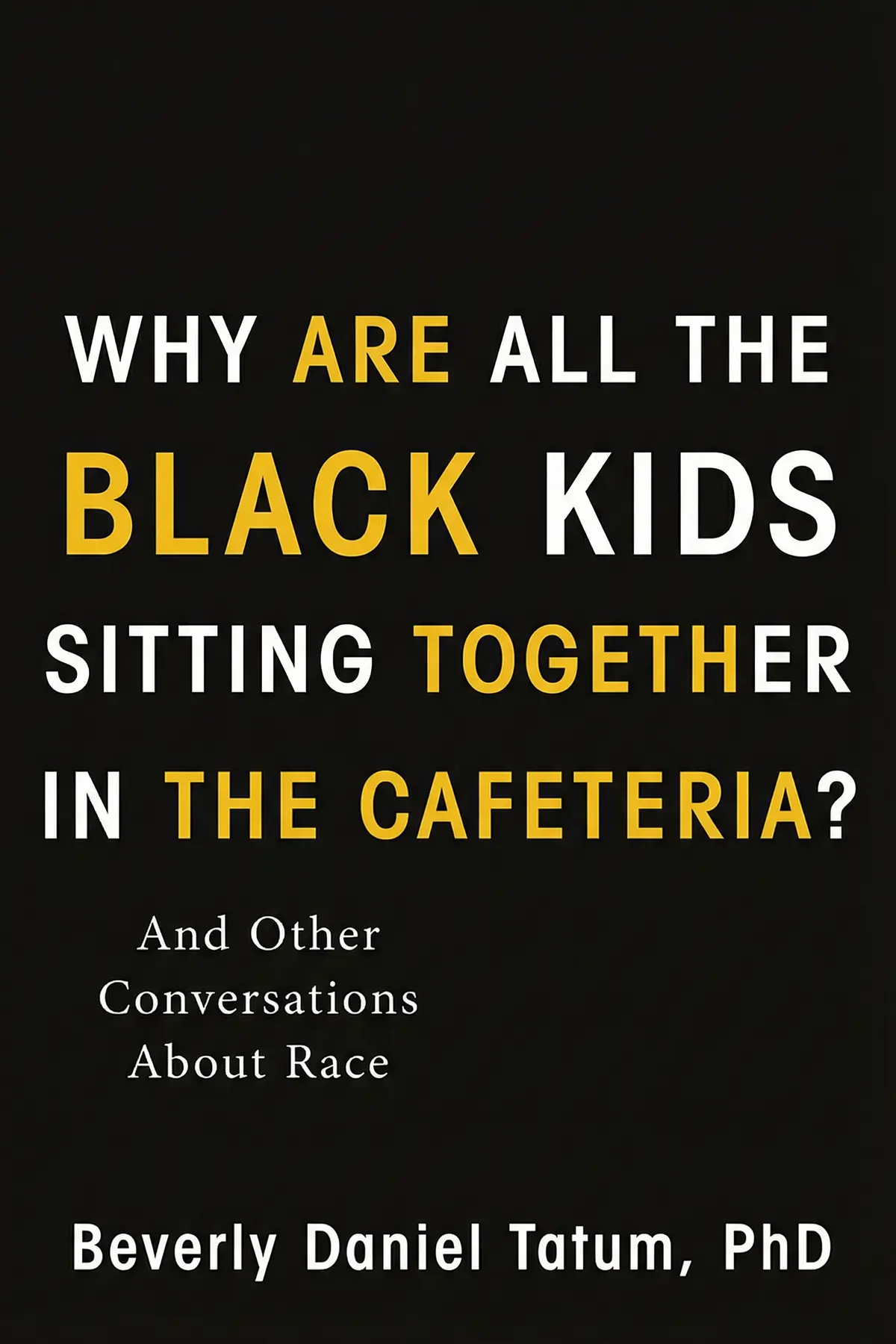
Table of Content
1. Introduction
59 sec
Talking about race makes many people freeze, and that silence lets old divisions carry on untouched. In her book on that cafeteria question, psychologist Beverly Daniel Tatum takes a familiar scene from racially mixed American high schools, students grouped by race at lunch, and treats it as a clue. Her answer to the title question is that the Black kids’ table makes sense: teenagers gather where others understand the racism they face.
From that scene Tatum builds a wider case. Racism persists, separation hides it from many white Americans, stereotypes fill the gap, and the way forward is identity work on every side plus the nerve to keep talking. Her argument offers a new reading of the lunchroom, ways to help a child grow up sure of who they are, and firm footing for staying in a hard conversation without going silent or defensive.
2. Spot the inequality many people never notice
1 min 47 sec
A college student once asked a teacher of race courses a question that left her baffled. The numbers on jobs, income and everyday treatment explain why that question still gets asked, and how much it misses.
3. See how living apart hides other people's problems
1 min 49 sec
Many assume school segregation ended with a famous court ruling in 1954. Figures from classrooms and a test of real estate agents tell a different story, and show what distance does to what people know about each other.
4. Catch the stereotypes you learned before age four
1 min 43 sec
Preschoolers who had never met a Native American drew one in seconds, and their pictures were almost identical. Where those images came from says a lot about the assumptions every adult carries without noticing.
5. See the cafeteria table as a healthy refuge
1 min 59 sec
A tall teenager, a new bike and a teacher’s remark about a school dance reveal what Black students live through, and why the lunch table so many adults worry about serves a real purpose.
6. Help Black children grow up sure of themselves
1 min 28 sec
Growing up as one of the few Black students at her school left the author isolated for years. A rag doll, a shelf of picture books and a gospel choir show what adults can do differently.
7. Learn to see whiteness as a racial identity
1 min 36 sec
Ask a room to describe its ethnic background and some people answer instantly while others stall. One workshop participant’s blurted reply exposes a common blind spot, and points to a way of correcting it.
8. Speak up about race even when fear says wait
1 min 43 sec
Silence about race often comes from fear: of losing friends, losing status or looking ignorant. Tatum names those fears plainly and offers a place to start, along with small actions anyone can take this week.
9. Conclusion
1 min 16 sec
The lunchroom scene that worries so many adults turns out to be a symptom and a shelter. It is a symptom of schools and neighborhoods that still keep groups apart, and a shelter where teenagers find people who believe them. In Tatum’s account, the real trouble lies in the distance around that table, in the cartoons that fill the distance with stereotypes, and in the silence that keeps it all unexamined.
Her remedy works in two directions. Black children need images, mentors and peers that let them define themselves before a hostile culture does it for them. White people need to see their own race clearly enough to notice what it gives them. Both have to keep talking when the talk gets uncomfortable.
A few habits follow from her argument. When someone describes a racist moment, believe them before defending anyone. When a group surprises you, ask where your expectation came from. And if you are white, Tatum’s idea of an ally is someone who stands in solidarity with people targeted by racism rather than rescuing them, which can start with challenging a racist joke.
A Black girl told a friend the truth about her teacher and was brushed off. Everything Tatum asks begins with refusing to be that friend.
About this book
What is this book about?
In racially mixed American high schools, students often sit with their own racial group at lunch and rarely talk across those lines. Many adults see this as a problem. Psychologist Beverly Daniel Tatum sees a sensible response to a society that still keeps people apart, and she uses the scene to open a wider discussion of race. Tatum shows how inequality persists in jobs, income, schools and housing, and why segregation leaves many white Americans unaware of it. She traces how children absorb stereotypes from cartoons before age four, how Black teenagers come to understand their racial identity in adolescence, and why they seek out peers who understand the racism they meet. Her examples range from her own son's encounter with a police officer to a teacher's careless remark about a school dance. The book then turns practical. It describes how parents and teachers can help Black children build a confident identity, why white people need to recognize whiteness as a racial identity, and how anyone can break the silence that keeps racism in place. Readers get a clear frame for everyday moments and small actions to take at home, at school and at work.
Book Information
Who it's for
Educators noticing racial clustering
Teachers and school leaders who notice students clustering by race and want to respond well.
Parents navigating race
Parents raising Black children in mostly white communities, or any parent building race-conscious habits at home.
Wanting confidence discussing race
Colleagues and managers who go quiet when race comes up and want to speak with more confidence.
About the Author
Beverly Daniel Tatum
Beverly Daniel Tatum is a psychologist, born in 1954 in Tallahassee, Florida, with a doctorate in clinical psychology from the University of Michigan. Her research covers race in education, how teenagers form a racial identity, and Black families and young people living in white neighborhoods. She taught Black Studies at UC Santa Barbara, chaired the psychology department at Mount Holyoke College and later served as president of Spelman College, a historically Black women's college in Atlanta. In 2014 she received the American Psychological Association's Award for Outstanding Lifetime Contribution to Psychology.
Ratings & Reviews
Ratings at a glance
What people think
Listeners view this work as essential material, especially for those in teaching or parenting roles, highlighting the extensive research and inclusion of modern studies. The text is engaging and stimulates deep thought, offering a detailed analysis of how racial identity forms. Listeners find it vital for fostering significant discussions regarding race and admire the compassionate tone throughout.
Top reviews
Kavya
As an educator, I found this book to be a transformative resource for understanding the social landscape of our schools. Tatum avoids the usual blame-game and instead provides a rigorous, psychological framework for why self-segregation occurs during adolescence. She uses the 'smog' metaphor to describe cultural racism, which is a brilliant way to explain how we all breathe in these prejudices without even realizing it. The research-backed sections on racial identity development helped me see my students in a completely different light. It isn't just about kids wanting to be separate; it’s about their need for a safe space to process their experiences in a world that often ignores their reality. Frankly, this should be required reading for every teacher entering a diverse classroom. It offers a path toward meaningful dialogue rather than just more silence.
Show moreRatthapong
Ever wonder why certain groups cluster together in public spaces? Beverly Daniel Tatum provides an incredibly articulate answer that goes far beyond surface-level observations. The way she breaks down the stages of identity—not just for Black children, but for Latinx, Native, and even White individuals—is masterfully done and deeply empathetic. I especially appreciated the sections on how to talk to children about race; it’s a guide for parents who want to raise socially conscious kids without instilling fear or resentment. The book is dense with academic insight yet remains remarkably accessible to the average reader. To be fair, some of the pop culture references feel a bit like artifacts of the late 90s, but the core psychological principles remain timeless. This isn't just a book about the cafeteria; it is a blueprint for understanding the systemic advantages that shape our entire society.
Show moreLek
This book should be mandatory for anyone who thinks we live in a 'post-racial' society. Tatum doesn't just point out problems; she provides a developmental roadmap that explains how children grow into their racial selves. I was particularly struck by her explanation of 'white identity development' and the stages of becoming an ally. It helped me realize that my own silence in the face of jokes or systemic issues was actually a form of participation in the 'smog' she describes. The writing is clear, patient, and surprisingly compassionate toward readers of all backgrounds. She isn't trying to make people feel guilty; she’s trying to make them responsible. The truth is, we can’t fix what we refuse to name, and Tatum gives us the vocabulary to finally start the conversation properly.
Show moreMai
The chapter on racial identity in the middle years changed my entire approach to parenting. As a mother, I wanted to believe that if I just didn't mention race, my children would grow up colorblind and happy. Tatum explains why that approach is actually a disservice to kids of color who are already noticing differences and feeling the sting of exclusion. She emphasizes that the 'Black table' in the cafeteria is often a place of psychological healing, not a site of hostility. The book is packed with references to studies and clinical observations that support her theories on affirmative action and institutional policies. It is a dense read, but the emotional payoff is worth it. I feel much better equipped now to support my son as he navigates a world that will inevitably try to define him before he can define himself.
Show moreFah
Beverly Daniel Tatum brings a much-needed psychological perspective to a topic that is usually dominated by shouting matches and political talking points. Her work on 'aversive racism' is particularly brilliant, highlighting how even people who believe they are egalitarian can still harbor unconscious biases that affect their behavior. Look, this isn't an easy read in terms of the mirror it holds up to the reader, but it is necessary. I found her breakdown of the 'Pre-encounter' and 'Encounter' stages of identity to be a perfect mirror for my own life experiences. The book provides a comprehensive breakdown of why we stay in our silos and, more importantly, how we can begin to step out of them. It is a well-researched, scholarly, and deeply human look at the American experience. A true masterpiece of social psychology.
Show moreLaddawan
Wow. I didn't expect a book about psychology to be such a page-turner. Tatum has a gift for taking the most uncomfortable topics and discussing them with such clarity and grace that you can't help but keep reading. The cafeteria metaphor is just the jumping-off point for a deep dive into the soul of America. I was moved by her stories of students who finally felt 'seen' after learning about their own identity development stages. It’s a call to action that doesn't feel like a lecture. Instead, it feels like an invitation to join a more honest society. If you care about education, justice, or just understanding your neighbors, you need this on your shelf. Simply essential.
Show moreWoramet
Finally got around to reading this classic, and I’m glad I did. Even though it was written decades ago, the core message about how identity forms in response to environmental messages is still incredibly relevant today. Tatum writes with a calm, clinical authority that makes complex psychological theories easy to grasp for someone without a degree in the field. I did find the chapter on 'Otherness' particularly enlightening, especially the breakdown of how subordinates must understand the dominant culture to survive while the dominant group can afford to remain ignorant. My only real gripe is that some of the examples regarding Hispanic and Asian-American experiences feel slightly dated given how much those demographics have shifted since the original publication. Still, the logic holds up. It's a thought-provoking read that challenged many of my own internal biases.
Show moreWitthaya
After hearing so much about this book in my sociology circles, I finally picked it up. It is a solid 101-level guide for white people who are just starting to realize that their experience isn't 'universal.' Tatum is a very patient teacher. She explains how the system benefits white people even when they aren't 'actively' being mean to anyone. I liked that she included sections on Native and Asian identity, though they felt a little shorter than the chapters on Black and White identities. The book is at its best when she is recounting her own experiences as a professor and mother. Those stories ground the heavy theory in real-world stakes. It’s a bit repetitive in the later chapters, but the overall message is powerful. It really makes you rethink every social interaction you've had in a professional or educational setting.
Show moreWissanu
Frankly, I have mixed feelings about this one. On one hand, the stages of adolescent development Tatum describes are very recognizable and help explain the social cliques you see in every high school across the country. On the other hand, I found the section on 'acting white' to be somewhat problematic. It felt like the author was suggesting that academic success or certain linguistic patterns are somehow inherently 'white,' which seems to reinforce the very stereotypes she claims to be fighting. While I appreciate the effort to bring statistics into the discussion, the book relies heavily on the 'system of advantage' definition which I personally find too narrow for a global context. It’s an interesting perspective, and certainly worth reading for the debate it sparks, but I wouldn't take everything in here as gospel. Some points felt more like personal ideology than clinical fact.
Show moreThongchai
Not what I expected at all. While the title suggests a sociological study of school dynamics, the content is largely an exercise in redefining words to fit a specific ideological agenda. Tatum’s insistence on defining racism solely as a 'system of advantage' effectively means she believes only white people can be racist, which is a logic I find deeply divisive and fundamentally flawed. The evidence provided is often anecdotal rather than empirical. For instance, her critique of The Lion King as a vehicle for racial bias because of character voice casting and the color of a lion’s mane felt like a massive reach. It’s hard to take the academic portions seriously when the author spends so much time hunting for microaggressions in children's cartoons. I was hoping for a bridge to help us understand each other better, but this book feels more like it’s building a wall.
Show moreQuestions about this book
What is the central message of Tatum's book on why Black kids sit together in the cafeteria?
Beverly Daniel Tatum argues that Black students grouping together at school is a sensible response to a society where racism persists and segregation hides it. Separated schools and neighborhoods leave many white Americans unaware of others’ experiences, and stereotypes from cartoons and news fill the gap. Her remedy is healthy racial identity for both Black and white people, plus open conversation and small, concrete actions against racism.
Why do Black students sit together in the cafeteria, according to Tatum?
Tatum says Black teenagers gather because their peers understand the racism they face, while white friends often do not. She tells of a Black girl whose teacher told her he knew her people loved to dance. When she shared her hurt, a white friend defended the teacher. At the Black table, she would have been understood rather than dismissed.
How can parents help a Black child build a positive racial identity?
Tatum recommends giving children good images of their own group early. She gave her one-year-old son a brown rag doll and read him books showing brown-skinned children. She also stresses peers and mentors: a teacher, Mrs. Campbell, brought a student named Terri into a gospel choir where she found supportive Black friends. Parents can arrange such social chances, even outside their own community.
How does Beverly Daniel Tatum suggest white people talk about racism?
Tatum urges white people to start conversations even when they feel risky, despite fears of ignorance or losing friends and status. Listeners should try to understand and support others’ experiences and let people of color express anger at the system without taking it personally. She also asks for action: challenging racial slurs and racist jokes, or encouraging an employer to hire more professionals of color.
Readers also enjoyed


Afropean: Notes From Black Europe
Johny Pitts


All About Love: New Visions
bell hooks


A Biography of Loneliness: The History of an Emotion
Fay Bound Alberti

A Force for Good: The Dalai Lama's Vision for Our World
Daniel Goleman


A Room of One’s Own
Virginia Woolf
AUDIO SUMMARY AVAILABLE
Listen to Why Are All the Black Kids Sitting Together in the Cafeteria? in 15 minutes
Get the key ideas from Why Are All the Black Kids Sitting Together in the Cafeteria? by Beverly Daniel Tatum, plus 5,000+ more nonfiction titles.
- 5,000+ titles
- Listen as much as you want
- 7-day free trial
- Cancel anytime









