


13 min 50 sec
Available in: English
 ไทย
EnglishไทยWhat Every BODY is Saying: An Ex-FBI Agent’s Guide to Speed-Reading People
By Joe Navarro
Shows how to read the body signals people send without knowing it, from feet that turn toward the door to pens that tremble, and how to judge them fairly against each person's normal behavior.
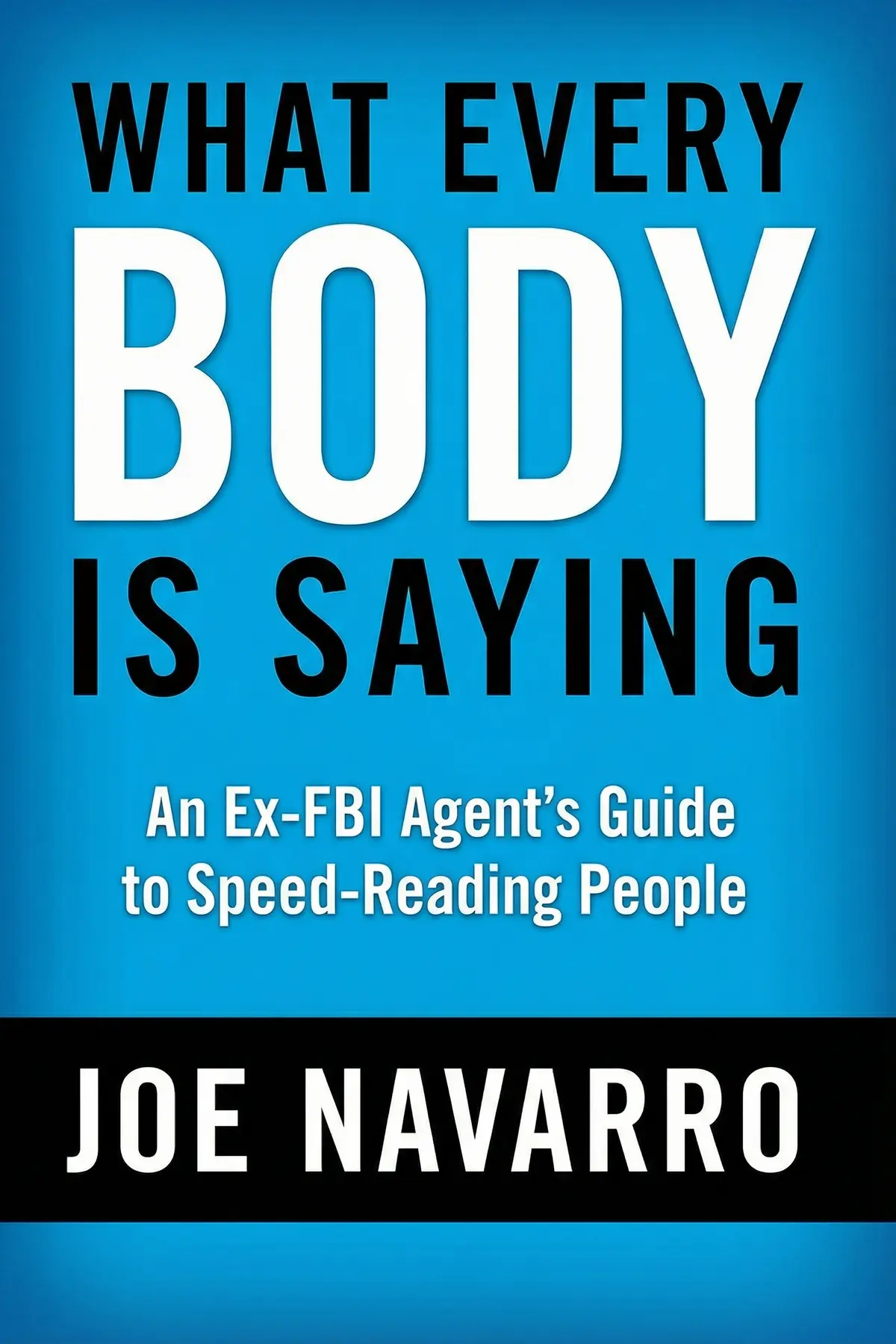
Table of Content
1. Introduction
1 min 00 sec
If you have ever left a meeting sure the other side agreed, then found out they meant no, you were listening to the wrong channel. In What Every BODY is Saying, former FBI special agent Joe Navarro argues that the body reports feelings more honestly than words do, and that the most truthful signals come from the feet and legs, not the face. He spent 25 years in counterintelligence and behavioral assessment, where reading people was part of the job.
His argument rests on one idea. An ancient part of the brain reacts to comfort and threat before we can think, and those reactions leak out through the body, so anyone who learns a person’s normal behavior can read what they truly feel. That reading is a learned skill, built through practice and discreet attention. What follows shows where to look first, which small gestures expose stress, and how to test a doubtful story without putting anyone on guard.
2. Hear what people tell you without words
1 min 39 sec
A schoolboy who spoke no English made friends anyway, and a suspect’s careful alibi fell apart without a single wrong word. Both stories point to a channel most of us ignore in every conversation.
3. Spot the escape instinct in a tense meeting
1 min 43 sec
Nobody runs out of a difficult negotiation, yet the urge to flee still shows up at the table. An old survival system explains why some reactions are almost impossible to fake.
4. Watch the feet before the face
1 min 42 sec
Most people trying to read someone look straight at their eyes and mouth. Navarro calls that the most common mistake, and points instead to the part of the body that evolved long before speech.
5. Read confidence in hands and thumbs
1 min 38 sec
A single finger can turn a casual remark into an accusation, and the position of a thumb can broadcast status across a room. The moment after a handshake may reveal even more.
6. Catch the small gestures people use to calm down
1 min 48 sec
A trembling pencil can mean excitement or fear, and on its own it proves nothing. What a person does in the seconds after a hard moment often says far more.
7. Know someone's normal before you judge them
1 min 34 sec
A distracted driver and a parent describing a sore throat to a doctor have the same problem. Both show why a list of gestures and their meanings will mislead you without one extra step.
8. Test a doubtful story without tipping your hand
1 min 37 sec
Suspicion is easy, and it is also the fastest way to ruin the evidence. Navarro explains what to look for in a questionable account, and why your own behavior can make an honest person look guilty.
9. Conclusion
1 min 09 sec
What Navarro offers, in the end, is a change of attention. Most of us listen to words and watch faces, the two channels people have learned to manage best. The honest brain speaks somewhere else: in feet that drift toward the exit, a pen that trembles and is then chewed, arms held tight across the chest, a hand that points left while the story turns right. None of these is a verdict on its own. Read against a person’s ordinary behavior, they tell you how comfortable that person really is.
The practice can start small. In your next meeting, look below the table before you look anyone in the eye, and notice who is turned toward you and who is turned away. Spend a few calm days learning how one colleague behaves when nothing is at stake, so that a change later actually means something. And when a story feels wrong, keep your own expression relaxed and your distance respectful, because the moment people feel judged, their bodies stop telling you anything you can trust.
The face shows what people want you to see. The feet show where they would rather be.
About this book
What is this book about?
People say yes when they mean no, claim calm when they feel cornered, and tell stories that are not quite true. Joe Navarro spent 25 years as an FBI special agent learning to see past the words. His argument is that the body keeps reporting the truth, because an old survival system in the brain reacts to comfort and threat faster than we can hide it. Navarro's angle is surprising. He tells readers to stop staring at faces, which we learn to control as children, and to watch the feet, legs and hands instead. He explains the freeze, flight and fight responses behind leaning away or turning sarcastic, the soothing gestures people make after a stressful moment, and what thumbs and handshakes reveal about confidence. Readers also get his method: build a picture of someone's normal behavior, take in the whole scene, observe without staring, check whether words and body agree, and avoid making people so uncomfortable that their signals become meaningless.
Book Information
Who it's for
Spotting a false yes
Managers, recruiters and salespeople who need to know when a yes is not really a yes.
Spotting stress quietly
Negotiators and investigators who want to spot stress and doubtful stories without putting people on guard.
Reading colleagues early
Shy or newly arrived professionals who want to read colleagues before they know them well.
About the Author
Joe Navarro
Joe Navarro was born in Cuba and moved to the United States as a child. He served 25 years as an FBI special agent, working in counterintelligence and behavioral assessment. He has written several books on nonverbal communication, including Dangerous Personalities and Louder Than Words, and What Every BODY is Saying has been translated into 29 languages. He lectures and consults for major corporations and is an adjunct professor at Saint Leo University.
Ratings & Reviews
Ratings at a glance
What people think
Listeners find this guide to body language to be an interesting and simple-to-grasp resource that provides reliable facts and useful advice. The straightforward and clear writing makes it an essential tool for decoding non-verbal cues. They enjoy applying the lessons to their daily routines, especially if they work closely with others, and one listener specifically mentions how the book helped them pay closer attention to their teenagers' body language.
Top reviews
Suwit
Ever wonder why someone's words say 'yes' while their body is screaming 'get me out of here'? This book is an absolute must-read for anyone who deals with people for a living. I started using these techniques with my teenagers, and it’s like I have a superpower now. I can tell when they are genuinely stressed versus just being grumpy based on their suprasternal notch touching. Navarro explains the science behind the limbic system in a way that’s easy to grasp without being condescending. Truthfully, I’ll never look at a person’s feet the same way again. The photos in the PDF were helpful to see the gestures in action. It’s practical, eye-opening, and deeply relevant to everyday life.
Show moreDuang
Wow, this is an incredible guide to human behavior that goes way beyond the usual 'cross your arms to look tough' advice. Joe Navarro breaks down how our biology dictates our movements, focusing heavily on the limbic system's role in our survival. I loved the anecdotes about his time in the field, even if some reviewers wanted more of them. It makes the academic parts feel much more real. I’ve started noticing 'nasal wing dilation' and leg-crossing barriers in my daily coffee shop people-watching. It’s like a muscle that grows stronger the more you use it. If you want to improve your communication skills or just understand your coworkers better, you need to pick this up.
Show moreKavya
Joe Navarro makes a compelling case for why the face is the biggest liar of all in our social interactions. We are taught from childhood to fake smiles, but our feet almost never lie. I found that concept fascinating! The book explains how 60-65% of our communication is non-verbal, and after reading this, I believe it. The writing is straightforward and accessible, avoiding overly dense medical jargon while still explaining the psychology. I particularly liked the part about the 'pugilistic position' and identifying potential threats. It’s not just for FBI agents; it’s for anyone who wants to navigate the world with more awareness. This is one of those rare books that actually changes how you see every person you meet.
Show moreSom
After hearing about this on a podcast, I decided to give it a go for my sales job. In professional settings, understanding non-verbal cues is half the battle. This book delivers a solid foundation. Navarro’s focus on the 'freeze, flight, or fight' response helps explain why people react defensively under pressure. It's not a 'hack' book—the author is very careful to say that there is no single gesture that proves someone is lying. I appreciate that honesty. My only gripe is that the middle sections drag a bit when he goes through every single arm movement. However, the insight that truthfulness decreases as you move from the feet to the head is worth the price alone. It’s a solid addition to my shelf.
Show moreSeksan
Picking this up was a game-changer for my social anxiety because it gave me a concrete map for what used to feel like guesswork. I always struggled to 'read the room,' but Navarro breaks it down into manageable parts. The chapter on 'comfort vs. discomfort' signs is especially useful. It turns out that neck touching or covering the 'neck dimple' is a huge tell for stress, and I’ve started catching myself doing it! The book can be a bit dry, and the author’s voice is very 'by the book,' which makes sense given his background. Still, the practical value is high. I feel much more confident in meetings now that I know what to look for. It’s not magic, but it’s the next best thing.
Show moreWacharapol
In my experience, most books on 'speed-reading' people are full of sensationalist fluff, but Navarro remains grounded and professional throughout. He avoids the trap of promising a perfect lie-detection system. Instead, he teaches you to look for clusters of behaviors and changes in a person’s baseline. This nuanced approach is much more realistic. I did find the sections on clothing a bit unnecessary, as it felt like he was stepping out of his area of expertise. Also, the audiobook narration was clear but a bit stiff. Despite those minor flaws, the core content regarding the 'limbic brain' and pacifying gestures is gold. It’s a great reference book to keep on hand and revisit whenever you feel like you’re missing something.
Show moreIff
The chapter on the 'limbic system' alone makes this worth the price of admission for any curious reader. I never realized how much of my body's reaction to stress was hardwired survival instinct. Navarro’s explanation of the 'freeze, flight, fight' response is clear and connects perfectly to why we do things like squint or shift our feet. While the book can be repetitive—he really hammers home the 'don't judge too quickly' point—the repetition actually helps the info stick. I’ve already noticed myself observing people more closely at the grocery store. It’s a bit dry at times, and some of the examples are a little basic, but the overall system he presents is extremely effective. A solid four-star read for sure.
Show moreSkylar
This book feels more like a college syllabus than a casual weekend read. Joe Navarro is clearly an expert, and his insights into non-verbal communication are undeniably accurate, but the prose is a bit dry for my taste. It lacks that narrative spark you might expect from an ex-FBI agent's memoir. Instead, you get a didactic breakdown of every body part from head to toe. It’s a fantastic reference tool if you want to understand the specifics of 'pacifying behaviors,' but don't expect a page-turner. I found myself reading it in small chunks because the repetition got a bit heavy. To be fair, though, the section on how the feet are the most honest part of the body was a total revelation. It changed how I sit in meetings.
Show moreLars
To be fair, the information provided here is indisputably correct, even if the delivery lacks a certain 'spark' or narrative drive. It reads very much like a textbook, which might put some people off if they were looking for a thriller-style FBI memoir. Navarro is a thoughtful teacher, but he is very didactic. He repeats his warnings about not jumping to conclusions so often that it becomes a bit boring after the first few chapters. I did appreciate the PDF illustrations, though some of the staged photos looked a bit dated. Is it helpful? Yes. Is it fun? Not really. If you're willing to slog through the repetition, you'll come out with a much better understanding of human nature.
Show moreYongyut
Frankly, I expected more 'FBI' and less 'common sense' from a guy with Navarro's background. I was hoping for thrilling case files, but instead, I got photos of the author acting out gestures that felt a bit cartoonish. Do we really need a picture to understand that finger-pointing is aggressive? It felt like 'Body Language for Dummies' at times. While the observations are on point, many of them are things most observant people already know intuitively. The writing is incredibly repetitive, and the author's advice on fashion felt totally out of place and unnecessary. If you have zero social awareness, this might be a five-star book for you. For me, it was a bit of a snoozefest that could have been half its length.
Show moreQuestions about this book
What is the main idea of What Every BODY is Saying?
Joe Navarro argues that the limbic brain, which he calls the honest brain, reacts to comfort and threat instantly and sends signals through the body before we can control them. Because people rarely notice these signals, they often reveal true feelings that words hide. With practice, anyone can learn to read them, especially the movements of the feet, legs and hands rather than the face.
Why does Joe Navarro say to watch the feet instead of the face?
Navarro explains that we learn to control our faces from childhood, for example when parents tell us not to pull a face at food we dislike, so expressions are easy to fake. The feet evolved to react instantly to danger long before language, and their movement stays involuntary. Feet turning away from you can mean a person wants to leave or feels unsure of themselves.
What are pacifying behaviors in body language?
Pacifying behaviors are actions people use to calm their bodies after stress, and Navarro notes they almost always appear right after the stressful moment. Examples from the book include chewing a pencil to stop a trembling hand and touching the face or neck after an uncomfortable question. Because everyone soothes themselves differently, they are easiest to spot once you know how a person normally behaves.
How can I use body language to tell if someone is lying?
Navarro suggests checking whether words and body agree, since truthful people gesture naturally as they speak. Watch the hands, legs and feet for unusual movement and notice longer pauses or slightly delayed movements while a story is being built. Compare everything to the person’s normal behavior, never show your suspicion, avoid making them uncomfortable, and be ready to change your view when the evidence does not fit.
Featured in
Readers also enjoyed

A Liberated Mind: How to Pivot Toward What Matters
Steven C. Hayes


Acting with Power: Why We Are More Powerful Than We Believe
Deborah Gruenfeld


Age of Propaganda: The Everyday Use and Abuse of Persuasion
Anthony Pratkanis




AUDIO SUMMARY AVAILABLE
Listen to What Every BODY is Saying in 15 minutes
Get the key ideas from What Every BODY is Saying by Joe Navarro, plus 5,000+ more nonfiction titles.
- 5,000+ titles
- Listen as much as you want
- 7-day free trial
- Cancel anytime









