
12 min 52 sec
Available in: English
Uncommon Sense Teaching: Practical Insights in Brain Science to Help Students Learn
Shows teachers and trainers how the brain's memory systems really work, and how retrieval practice, mixed and spaced practice, scaffolding and well-built online lessons turn material students only follow into knowledge they keep.
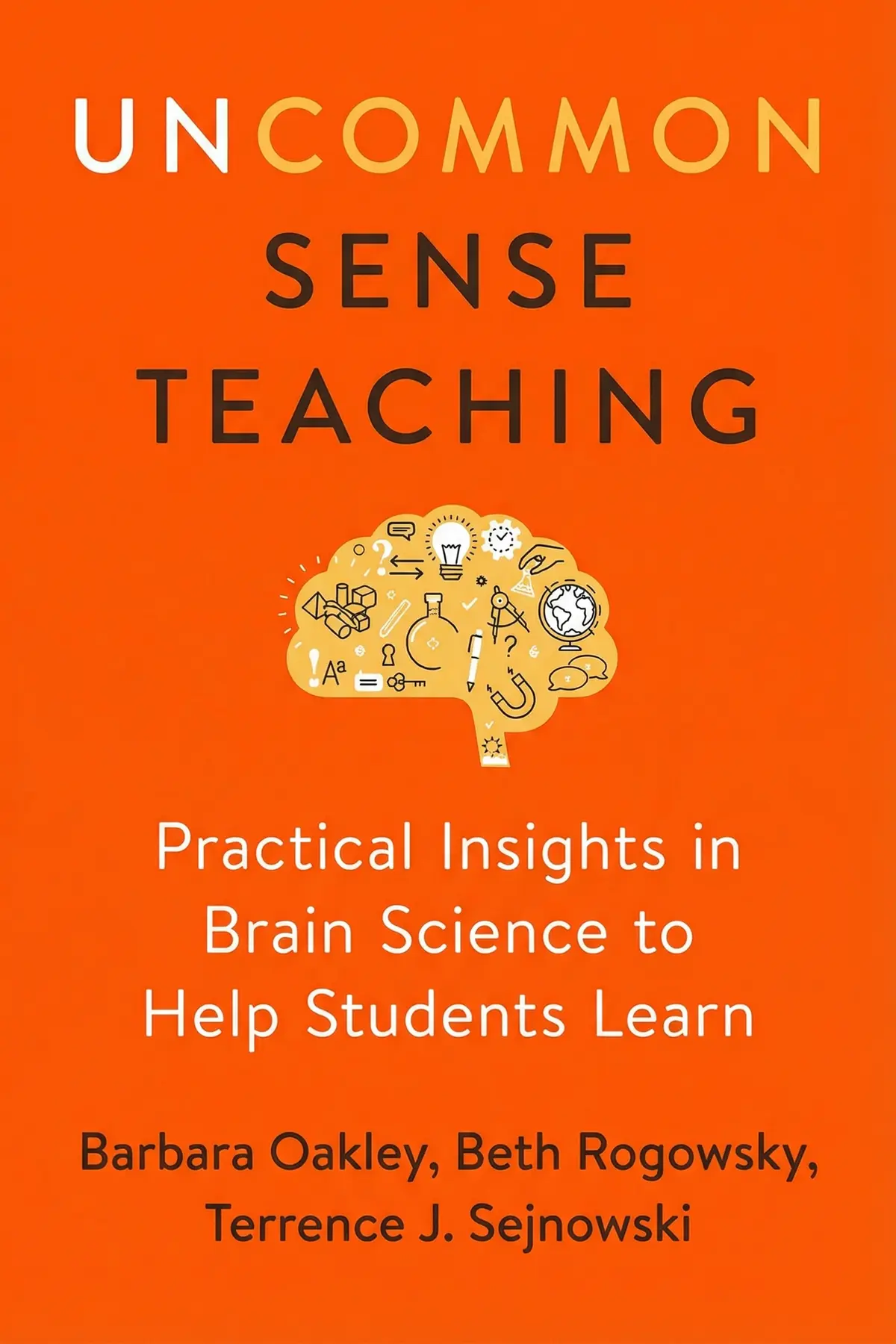
Table of Content
1. Introduction
1 min 00 sec
Most teachers have watched a class nod along to a lesson and then forget nearly all of it a week later. In Uncommon Sense Teaching, engineering professor Barbara Oakley, former middle school teacher Beth Rogowsky and neuroscientist Terrence J. Sejnowski trace that gap to one cause: the part of the brain that lets students follow a lesson is not the part that keeps it. Working memory can hold only about four pieces of information at once, and it tricks learners into believing they know what they have only held for a moment.
The authors argue that good teaching is built around that limit. It moves knowledge out of working memory and into long-term memory through recall, the right kind of practice, clear structure and a healthy amount of pressure, and the same rules hold on a video call. What follows is a set of moves for your next lesson, training session or study hour: ways to test, support, reward and pace learners that fit how brains actually store things.
2. Spot the trick your working memory plays
1 min 39 sec
A lesson can feel smooth and clear, with every student answering correctly, and still leave almost nothing behind. The reason sits in a part of the brain that is very good at making us feel we understand.
3. Teach facts and skills by different roads
1 min 44 sec
A historical date and a tennis serve enter the brain by separate routes, and each route has its own speed. Practicing a skill the way you memorize a fact can quietly slow everything down.
4. Make learners pull answers from their own heads
1 min 39 sec
Rereading notes and rewatching videos feel like hard work, yet they build surprisingly little. A two-minute habit at the end of a class does far more, provided the lesson also leaves room for something that looks like doing nothing.
5. Support slow and fast learners in one room
1 min 51 sec
Every group mixes quick learners with slower ones, and a lesson aimed at either group tends to lose the other. The fix the authors propose is less about pace than about what learners are asked to hold in their heads.
6. Routines and small surprises that keep students working
1 min 52 sec
Confusion about where to hand in homework costs more than time. So does a big assignment that nobody wants to start. The authors show how habits, rewards and the right kind of stress keep minds on the actual work.
7. Run an online class people actually stay in
1 min 56 sec
Without a physical room, attention slips away within minutes. The authors argue an online course can still match or beat in-person teaching, if the teacher makes a few specific choices about video, attention and structure.
8. Conclusion
1 min 11 sec
What the three authors offer is a change in where a teacher looks. A lesson’s success does not sit in how fluent the room felt at the bell. It sits in what students can still pull out of their heads days later, after the octopus has dropped its four balls. Every method in the book, from flashcards and think-pair-share to I do, we do, you do, a high-five nobody expected and a nine-minute video with a hook, is a way of getting knowledge past that small, convincing juggler and into memory that lasts.
The habits travel well, whether you teach children, onboard colleagues or study for yourself. Close sessions with a few minutes of recall instead of a review slide. Mix problem types and come back to them a week later. Give the slower learners in the room supports they can see, and keep the challenge in the range that stretches people without frightening them.
The authors’ own advice is short: work with how the brain learns, not against it. A room that nodded along tells you little. Clear recall a week later tells you nearly everything.
About this book
What is this book about?
Many lessons seem to go well and are then forgotten within days. Barbara Oakley, Beth Rogowsky and Terrence J. Sejnowski argue that this is not a failure of effort or talent. It is a mismatch between how lessons are taught and how the brain stores information. The authors bring together engineering, classroom teaching and neuroscience. They explain why working memory, which holds only about four items at once, fools learners into feeling they have mastered something, and how knowledge moves into long-term memory along two different pathways, one for facts and one for skills. From that model come the methods: retrieval practice, active learning with brain breaks, interleaving, spaced repetition, scaffolding for slower learners and direct instruction for hard material. The book also covers the conditions around learning: routines that free up attention, unexpected rewards, tactics against procrastination, the difference between harmful and helpful stress, and how to run online courses with short videos, a visible instructor and a clear structure. Teachers, trainers and anyone who studies get concrete moves they can try in their next session.
Book Information
Who it's for
Classroom teachers
Schoolteachers whose students follow lessons in class but forget them by the test.
Onboarding trainers and leads
Trainers and team leads who onboard people and want skills to stick.
E-learning teachers and students
Online instructors and students who want study and video habits that match how memory works.
About the Author
Barbara Oakley
Barbara Oakley teaches engineering at Oakland University and McMaster University and created some of the world's most popular online courses on learning, including Learning How To Learn with Terrence J. Sejnowski. Sejnowski holds the Francis Crick Chair at the Salk Institute, pioneered neural network learning algorithms and won the 2024 Brain Prize. Beth Rogowsky taught middle school English for 14 years, trained in neuroscience at Rutgers University and now teaches future teachers at Bloomsburg University of Pennsylvania.
The Deep Learning Revolution
Terrence J. Sejnowski
Ratings & Reviews
Ratings at a glance
What people think
Listeners find the book offers actionable instructional advice for any educational setting, paired with clear and straightforward explanations. They value its approachable style and describe it as a truly wonderful choice.
Top reviews
Malee
Picked this up because I’ve been a fan of Barbara Oakley’s work for years. While her previous books were great for students, this deep dive into the neuroscience of teaching is exactly what my lesson plans needed. The distinction between declarative and procedural learning systems really changed how I view my lectures. Truth is, I used to think students just weren't paying attention when they couldn't recall facts the next day. Now I realize I was overloading their working memory with too many "chunks" at once. Using her "Learn it, Link it" framework, I’ve started incorporating more retrieval practice and interleaving. My students are actually retaining the material now! To be fair, some of the classroom management tips feel a bit geared toward K-12, but the core science is universal. It’s a must-read for anyone who wants to move beyond "drill and kill" and actually help students build long-term schemas.
Show moreBo
Wow, this book actually made me rethink my entire approach to university lecturing. I’ve always relied on the "sage on the stage" model, but Oakley and her co-authors make a compelling case for active learning and direct instruction. The explanation of the "hippocampus as a library card catalog" is one of the best analogies I've ever read. It finally clicked for me why my students were struggling with complex problem-solving. They didn't have the "chunks" consolidated in their long-term memory yet! Personally, I loved the focus on spaced repetition and retrieval practice. It’s rare to find a book that is both intellectually stimulating and immediately actionable. I've already started restructuring my syllabus to include more "brainwriting" and small-group discussions. If you care about student outcomes, you need to read this. It’s easily one of the most useful professional development books I’ve ever picked up.
Show moreSara
Finally got around to reading this and I’m kicking myself for waiting so long! As a foreign language tutor, I’m always looking for ways to speed up the "link it" phase of learning. The breakdown of declarative versus procedural pathways gave me a whole new vocabulary for explaining the learning process to my students. I especially appreciated the tips on "interleaving" different topics to prevent the false sense of mastery that comes from "drill and kill" methods. The writing is incredibly clear and the authors clearly practice what they preach by using retrieval cues throughout the text. Gotta say, the section on online instruction was a lifesaver during my transition to remote tutoring sessions. It’s a comprehensive, research-backed guide that actually respects the teacher’s time. I'll be keeping this on my desk as a reference for a long time.
Show moreIce
This book should be required reading for every teacher preparation program in the country. We spend so much time talking about "curriculum" and so little time talking about how the human brain actually processes information. Oakley and her team bridge that gap beautifully. The "Learn it, Link it" framework is a stroke of genius because it’s so easy for busy teachers to remember in the heat of a lesson. I particularly enjoyed the sections on "procedural learning" and how it differs from conscious fact-recall. It’s helped me understand why some students struggle with "intuition" even when they know the rules. Not gonna lie, I was skeptical about the neuroscience bits, but they are explained with such clarity that I finally feel like I understand my own brain. It’s a masterpiece of practical pedagogy that focuses on what really matters: student mastery.
Show moreNina
Direct instruction often gets a bad rap in modern education circles, but this book restores its place as a vital tool in the teacher's arsenal. By balancing teacher-directed "learning" with student-led "linking," the authors provide a balanced roadmap for classroom success. The concept of "desirable difficulties" was a standout for me. It reminded me that making the mental effort to visualize or associate information forms much stronger neural links. I also appreciated the "brainwriting" tip to avoid the pitfalls of groupthink in small groups. Even though I’m not a K-12 teacher, I found myself taking pages of notes for my own self-study. The tone is encouraging and the science is solid without being dry. Frankly, it’s one of the few "how-to" books that actually lives up to its title. I’m definitely going to check out their other work now.
Show moreZoe
As someone who teaches art workshops rather than a traditional academic subject, I wasn't sure if this would apply to me. I was pleasantly surprised to find that the concepts of "procedural memory" are incredibly relevant to hands-on skills like painting or sculpting. The authors explain how the basal ganglia works in a way that isn't intimidating at all. I especially liked the section on "desirable difficulties" and how making things a bit harder can actually lead to better long-term mastery. My only real gripe is that the book leans heavily on American school testing culture, which feels a bit narrow. Still, the practical strategies for avoiding cognitive overload are gold. Frankly, I wish I’d known about the "brainwriting" technique years ago to stop groupthink during our critique sessions. It's a solid addition to any educator's shelf, even if you don't work in a standard classroom.
Show moreNaomi
Ever wonder why your students seem to "get it" during class but completely forget everything by the time the midterm rolls around? This book explains the biological "why" behind that frustration without getting bogged down in dense medical jargon. I found the discussion on "scaffolding" particularly enlightening for my high school science classes. By minimizing the gaps between current knowledge and the final goal, I'm losing fewer kids during the transition from lecture to lab. I did feel like the authors focused a bit too much on test-taking strategies though. Education should be about applying knowledge to novel situations, not just optimizing for assessments. That being said, the "learn it, link it" methodology is simple enough to implement immediately. It’s a practical guide that bridges the gap between lab research and the reality of a noisy classroom.
Show moreSumalee
After hearing Oakley's TED Talk, I had high expectations for this book, and for the most part, it delivered. The core idea that we can fool ourselves into thinking we know something just because it’s in our working memory is a total game-changer. I’ve started teaching my students about Hebbian learning so they understand why "just rereading the notes" doesn't work. To be fair, the book is a bit heavy on American educational jargon, which might be a hurdle for international readers. However, the strategies for managing cognitive load are universal. I’ve already seen a difference in how my students handle complex "chunks" of information. My only minor complaint is that I wish there was more on Bloom’s Taxonomy and higher-order thinking skills. Still, for understanding the mechanics of memory, this is top-tier.
Show morePing
The chapter on online instruction was what originally drew me to this book, but overall, it felt like a bit of a mixed bag. Look, if you’re a brand new teacher, the advice on formative assessment and scaffolding will be life-changing. But for those of us who have been in the trenches for a decade, a lot of this feels like "common sense" dressed up in neuroscience terminology. I appreciated the deep dive into Hebbian learning, but did we really need a summary of Harry Wong’s classroom management? It felt a bit repetitive at times. To be fair, the writing style is very accessible and the analogies are clever, which makes it an easy read. I just wanted more "uncommon" insights and fewer reminders of things I learned in my first year of professional development. It’s a good refresher, but seasoned educators might find themselves skimming the later sections.
Show moreNarumon
Not what I expected given the high praise I've seen on social media lately. While the neuroscience is interesting, the actual "teaching" advice felt incredibly basic and geared almost exclusively toward elementary school settings. I teach at a university level, and trying to use these simplified strategies feels patronizing to my students. The constant emphasis on standardized testing and US-centric school structures was another turn-off. Truth is, many of these "uncommon" strategies are just basic pedagogical concepts that have been renamed. Also, why recommend specific apps that will be outdated in six months? It makes the book feel less like a timeless guide and more like a trendy manual. If you’ve never read a book on teaching before, you might like it, but for anyone with a background in education, there isn't much new here.
Show moreQuestions about this book
What is the main idea of Uncommon Sense Teaching?
Oakley, Rogowsky and Sejnowski argue that teaching works best when it matches how the brain stores information. Working memory holds only about four items and makes learners feel they understand material they have only held briefly. Good teaching moves knowledge into long-term memory, through retrieval practice, active learning with brain breaks, interleaving, spaced repetition, scaffolding and direct instruction, both in person and online.
What is retrieval practice and how do I use it in class?
Retrieval practice means pulling information from your own mind instead of rereading or rewatching it. The authors suggest flashcards, jot recall, where students close their books and write down the key ideas they remember, and a whip around, where the teacher asks each student in turn for one point. A few minutes at the end of a lesson is enough to start.
What does I do, we do, you do mean?
It is the authors’ clearest example of direct instruction, which they consider necessary for hard material such as advanced math or layered literature. First the teacher demonstrates the task. Then the teacher guides the group through practice. Finally, students work on their own. Guidance shrinks as mastery grows, which makes it active and adaptive, unlike a long lecture.
How do the authors suggest teaching online?
They call instructor presence the most important factor. Use short videos of about three to twelve minutes, each with a strong opening hook and a brief wrap-up. Present complex content step by step with visual cues, avoid reading on-screen text aloud, add movement and a little humor, and support the course with an introductory screencast, upbeat emails, quizzes and discussion boards.
Who should read Uncommon Sense Teaching?
It is written for teachers, but it suits anyone who helps others learn, including corporate trainers, team leads onboarding new staff and online course creators. Students and lifelong learners can also apply its methods to their own study, especially retrieval practice, mixing problem types, spacing review over days and weeks, and the Pomodoro Technique against procrastination.
Readers also enjoyed

AUDIO SUMMARY AVAILABLE
Listen to Uncommon Sense Teaching in 15 minutes
Get the key ideas from Uncommon Sense Teaching by Barbara Oakley, plus 5,000+ more nonfiction titles.
- 5,000+ titles
- Listen as much as you want
- 7-day free trial
- Cancel anytime









