
12 min 59 sec
Available in: English
Design for How People Learn
A practical guide to designing workshops, courses and training that stick. It covers how to read your learners, get material into long-term memory, build active lessons and write tests that measure real learning.
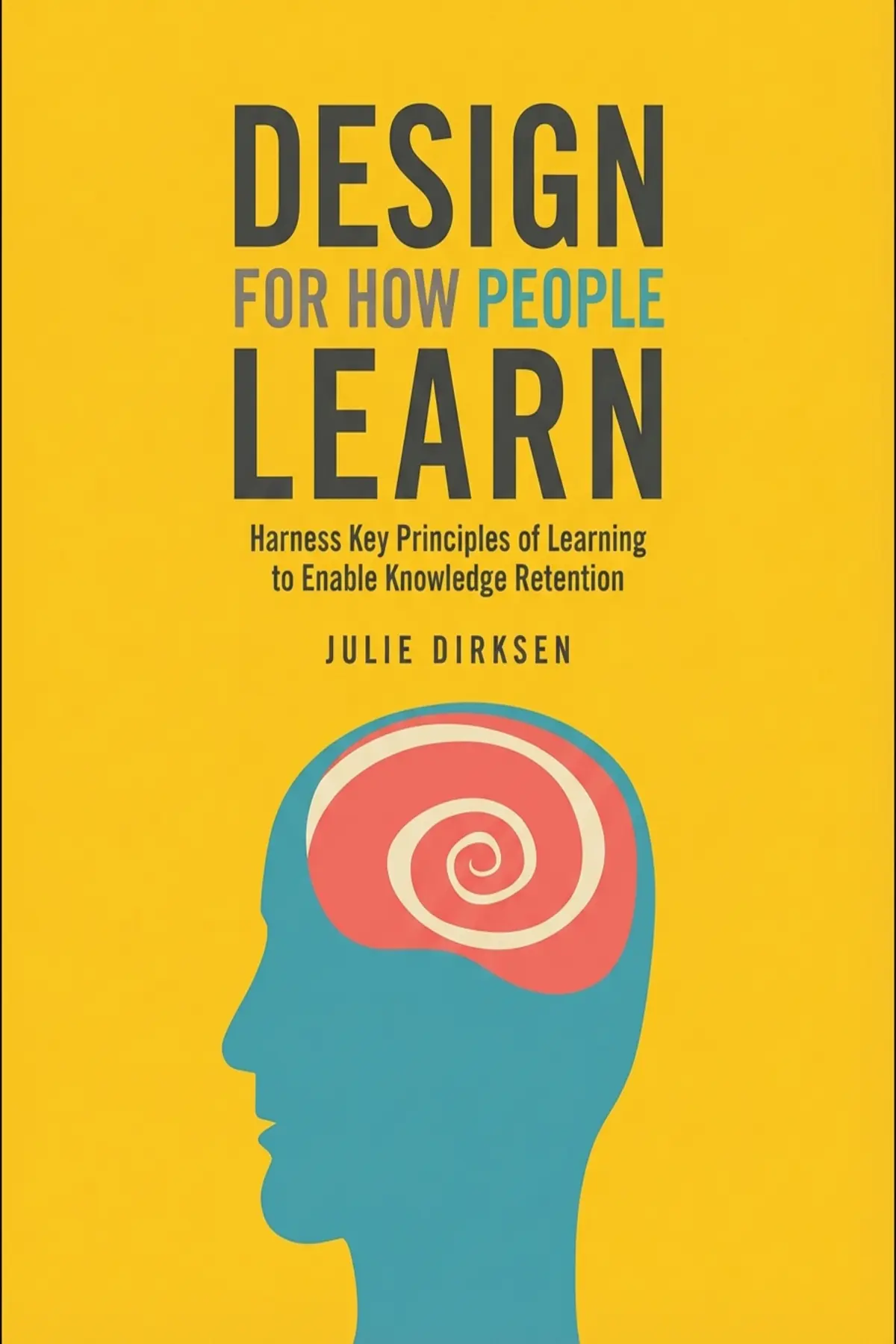
Table of Content
1. Introduction
1 min 04 sec
Most workplace training fails for a simple reason: it is built around what the expert knows, while learning happens inside the learner’s head. In Design for How People Learn, Julie Dirksen, an instructional designer who has built e-learning for Google, Microsoft and FedEx, shows how to design from the learner’s side instead. If you have been asked to run a workshop or teach a course, and you dread the glazed eyes and the phones under the table, her approach begins with one move: find out who your learners are before you teach them anything.
Dirksen’s throughline is that good teaching is a design problem. Lessons stick when they fit the learner’s starting point, the way memory filters information, and the place where the skill will finally be used. From there she builds a set of practical tools, from chunking and role-plays to habit triggers and tests that demand recall. By the end, you can plan a session people still remember a week later, and find out honestly whether it worked.
2. Start with what your learners already know
1 min 56 sec
A design lead walks into his workshop overprepared and full of enthusiasm, and the session still goes wrong before he says a word about fonts. The problem sits in the room, not in his slides.
3. Break lessons into chunks memory can hold
1 min 59 sec
You can probably answer three quiz questions about Nikola Tesla a minute after reading about him. A week later is another story, and a simple trick with a long number shows what makes the difference.
4. Teach skills where they will be used
1 min 54 sec
A receptionist who greets every client by name at his desk can walk past the same people in a restaurant. That everyday failure explains why so much classroom learning vanishes on the job.
5. Make learners do the hard work
1 min 46 sec
A lesson where the teacher simply explains each new concept can seem like enough. A psychologist’s research suggests the opposite, and a workshop on job interviews shows a better way to spend the same hour.
6. Let habits and surroundings carry the details
1 min 39 sec
Visitors can learn a city’s history without reading a page or opening a map. The trick behind that walk applies to any team buried under procedures it is expected to memorize.
7. Write the test before the course
1 min 39 sec
It can seem natural to write the exam last, once the teaching is done. Dirksen flips that order, and a single multiple-choice question shows how easily a test can reward guessing while measuring nothing you taught.
8. Conclusion
1 min 02 sec
Dirksen’s book turns teaching from a performance into a piece of design. Sven’s mistake was never a lack of knowledge. He designed for typography when he should have designed for Juanita and Liam, and the rest of the book follows from correcting that: material cut into pieces memory can hold, practiced in the setting where it will be used, hard enough to matter, supported by habits and by the environment, and checked with questions that make people recall.
If you have a session coming up, begin by writing the test. Then ask your learners what they already know, and whether the gap is skill, knowledge or both. Find one stretch of explaining and turn it into a task they have to do. And put one thing into the room, a sign or a reminder, so nobody has to memorize it.
Dirksen also tells teachers to stop worrying about shrinking attention spans. The average adult, she notes, can watch Netflix for hours at a time. When material is varied and absorbing, people stay with it. Attention is something a lesson earns.
About this book
What is this book about?
Sooner or later, most professionals are asked to teach something: a workshop for new hires, an onboarding session, a course in their own field. Most fall back on what they saw at school. The expert talks, the learners sit and listen, and a week later almost nothing remains. Julie Dirksen argues that the expert's knowledge was never the problem. The problem is that the lesson was designed around the topic and ignored the learner. Drawing on her years building e-learning for large companies, Dirksen treats teaching as a design problem. She shows how to tell a skills gap from a knowledge gap, and how to work with the filters of sensory, short-term and long-term memory. She explains why context and emotion decide what people can recall later, and why lessons should be active, interactive and hard in the right way. Readers get concrete tools they can use in their next session: chunking, role-plays, habit triggers, knowledge built into the environment, and assessments that test recall over recognition, written before the course begins.
Book Information
Who it's for
New to leading training
Managers and subject experts asked to run workshops, onboarding or internal training for the first time.
When e-learning gets forgotten
Learning and development staff and course designers whose e-learning modules get clicked through and forgotten.
Teachers and trainers
Teachers and trainers who want lessons and tests that measure real skill.
About the Author
Julie Dirksen
Julie Dirksen is a learning consultant and instructional designer who has built e-learning for large companies, among them Google, Microsoft and FedEx. She also speaks and teaches internationally, and The eLearning Guild has named her a Guild Master in recognition of her work in the field.
Ratings & Reviews
Ratings at a glance
What people think
Listeners find the writing clear and highly readable, providing valuable guidance on curriculum development and thorough explanations of various concepts. They enjoy the illustrations and find the content engaging, with one listener remarking that it makes the learning journey enjoyable. The text acts as a helpful refresher and is ideal for novices, while one listener emphasizes its usefulness for classroom teachers.
Top reviews
Rafael
The illustrations alone make this book worth the price of admission. Julie Dirksen manages to turn what could be a dry, academic subject into something that feels like an engaging conversation with a mentor. Her 'show-don't-tell' approach is incredibly effective, using visual metaphors to explain how our brains process information through sensory, short-term, and long-term memory. It’s a fast read—I finished it in a single weekend—but the concepts stick because the design of the book itself practices what it preaches. Frankly, it makes the entire educational design experience fun rather than a chore. Whether you are building a corporate workshop or just trying to explain a complex topic to a friend, this is the gold standard. It’s one of those rare 'books worth owning' because you’ll find yourself flipping back to the graphics every time you start a new project.
Show moreEllie
To be fair, most instructional design textbooks are about as exciting as watching paint dry, but Dirksen breaks that mold completely. This book is a masterclass in how to present complex information without relying on academic jargon. I especially loved the metaphor of the 'closet' for long-term memory—it’s such a simple way to think about how we need to shelve new information near existing knowledge to make it stick. The layout is beautiful and the pacing is perfect for a quick read that provides lasting value. I’ve already started using her tips for 'desirable difficulty' to make my training sessions more challenging but rewarding. It’s rare to find a book that is this practical and this enjoyable at the same time. If you design any kind of curriculum, you need this on your shelf.
Show moreJackson
As an elementary school teacher, I didn't think a book often cited in corporate training circles would apply to my classroom. I was wrong. The core principles Julie Dirksen outlines—like identifying triggers for habit formation and the importance of immediate feedback—are universal. I’ve started writing my assessments at the beginning of my lesson planning now, just like she suggests, and it has completely changed how I focus my teaching. The book is incredibly easy to read and the advice is tangible. I find myself constantly thinking about the 'elephant' and the 'rider' (her motivation metaphor) whenever a student seems disengaged. This isn't just for corporate IDs; it's for anyone who cares about making sure their message actually lands. It’s easily one of the most practical resources on learning design I have ever encountered.
Show moreLaor
Looking back at my previous lesson plans, I realize now how much I was cognitively overloading my students without even knowing it. This book is a wake-up call for anyone who teaches. Dirksen explains the filters of memory—sensory, short-term, and long-term—in a way that makes so much sense. She emphasizes that we can't just list information; we have to lead learners to discover it. The focus on interactivity and spaced recall is life-changing for anyone struggling with low engagement rates. Not gonna lie, I was skeptical of the 'fun' tone at first, but it actually helped the information sink in deeper. The book is well-organized, visually stimulating, and packed with 'real talk' from a seasoned pro. It’s the kind of book you don't just read once—you keep it on your desk to reference every single time you start a new project.
Show moreCarlos
Julie Dirksen writes with a level of clarity and humor that is rare in educational literature. I read the entire book in just a few sittings because it was genuinely enjoyable—not something I usually say about professional development texts. The advice on how to handle the 'expert/beginner' gap was particularly helpful for my current project. She suggests allowing experienced students to opt-out of basic sessions, which creates a much better sense of ownership for everyone involved. The focus on action-oriented design ensures that you aren't just creating 'shelfware' that no one ever uses. It’s phenomenal real talk from a professional who clearly knows the pitfalls of the industry. The book is a fast read but packed with solid design principles. If you want to move beyond just 'presenting' and actually start 'teaching,' this is the book you need to read.
Show moreTakeshi
I’ll admit that I picked this up thinking it was a guide for UI/UX or graphic design, but I was pleasantly surprised by what I actually found. Instead of layout tips, it’s a deep dive into instructional design and how to structure content so people actually retain it. The distinction between a knowledge gap and a skills gap was a massive 'aha' moment for me. Not every problem can be solved by throwing more information at a learner! Sometimes they just need better practice or a change in their environment. My only gripe is that some of the corporate-leaning examples felt a little repetitive by the end. Still, the advice is tangible and the intermittent humor kept me engaged through the more technical sections. It’s a solid resource for anyone who has to teach, even if you don't have 'educator' in your job title.
Show moreSophia
Finally got around to reading this staple of the ID world, and the distinction between a 'knowledge gap' and a 'skills gap' changed my entire approach to curriculum building. Most people think more content is the answer, but Dirksen proves that design is about so much more than just the information being delivered. I loved the section on creating environments that support the learner so they don't have to rely solely on memory. My only minor complaint is that the book feels a bit geared toward digital or slide-based learning, and I would have loved more examples of hands-on, physical training. However, the logic is sound and the writing style is refreshingly casual. It’s a fantastic reminder to always design with the learner’s struggle in mind. Definitely worth the read for any moderately experienced designer.
Show moreYindee
Personally, I found the chapter on habit formation to be the hidden gem of this entire volume. Most instructional design books focus strictly on the 'how-to' of a task, but Dirksen goes deeper into the 'why' and the motivation behind the learner's actions. The book is extremely accessible and avoids the dense, boring language found in most pedagogy texts. I will say that the breadth of topics means some areas feel a bit rushed, especially the section on assessment. I would have loved to see more varied examples of how to provide feedback in non-digital environments. Regardless, the checklists and summary points at the end of the chapters are gold for quick implementation. It’s a well-presented, tangible guide that respects the reader's time. This is a must-read for anyone pursuing a career in ID.
Show moreGai
Have you ever finished a book and felt like your brain was stuffed with too many ideas but no clear path forward? That was my experience here. While the information is undeniably great, it falls squarely into that '1,000 things to keep in mind' category. It’s broad and covers everything from habit formation to cognitive load, but I struggled to figure out exactly what I should do differently on Monday morning. To be fair, the writing is accessible and the tone is light, which I appreciated. However, as a seasoned professional, I was looking for a bit more focus on specific, actionable frameworks rather than a high-level overview of every possible learning variable. It’s a good introductory text for beginners, but it might feel a bit unfocused for those looking for a deep dive into specific instructional methodologies.
Show moreVipawan
While I appreciated the 'show-don't-tell' approach, this felt a little too light on the heavy-duty neuroscience for my taste. Don't get me wrong, the book is incredibly well-written and the graphics are charming, but I felt like it skimmed the surface of learning theory. If you are a total beginner, this is a five-star masterpiece. For someone with a background in education or psychology, it might feel like a refresher of things you already know, just presented in a prettier package. Look, it’s a great book for getting your feet wet in instructional design, but don't expect a dense academic treatise. I found myself wishing for more detailed citations or a deeper exploration of why certain methods work from a biological perspective. It’s a nice reference, but perhaps not the definitive guide for an expert.
Show moreQuestions about this book
What is the main idea of Design for How People Learn?
Julie Dirksen argues that teaching is a design problem centered on the learner. Knowing your topic is not enough: you need to know what learners already know, whether they lack skills or knowledge, and what motivates them. Lessons then have to pass through the filters of memory, fit the setting where the skill is used, and be checked with assessments that test recall.
What is chunking in Design for How People Learn?
Chunking means breaking material into smaller pieces so it can move from short-term into long-term memory. Dirksen shows it with a number: 100,783,305,222 is hard to repeat as one long figure but easy as four groups, 100, 783, 305 and 222. In a course, that means splitting processes into separate steps and long texts into clear sections.
Who should read Design for How People Learn?
It suits anyone who has to teach adults: managers leading workshops, experts running sessions in their field, learning and development teams, and designers of e-learning. Dirksen writes from her experience building training for large companies, and her examples range from typography workshops and telesales role-plays to programmers forming coding habits.
How do you write a good assessment according to Julie Dirksen?
Write the evaluation at the start of the course so you teach what you plan to test. Give informal, peer and self feedback throughout, and do not rely only on a final exam. Test recall over recognition: instead of a multiple-choice question with one obvious answer, ask learners to write down strategies themselves. Finish with a short anonymous survey so learners can tell you what worked.
How can I apply Design for How People Learn to my next workshop?
Ask participants what they already know before you begin, and let experienced people skip parts they have mastered. Turn explanations into tasks, such as asking a group to build a checklist from recorded examples. Use role-plays that match real pressure, attach new habits to existing triggers, and move details into signs, reminders or a manual.
Readers also enjoyed



AUDIO SUMMARY AVAILABLE
Listen to Design for How People Learn in 15 minutes
Get the key ideas from Design for How People Learn by Julie Dirksen, plus 5,000+ more nonfiction titles.
- 5,000+ titles
- Listen as much as you want
- 7-day free trial
- Cancel anytime









