

A Theory of Justice
John Rawls
 English
Shows how to train your thinking like a skill. Pin down the words you rely on, judge your own arguments as hard as you judge others', build fair-minded habits and spot the biases your group taught you.
59 sec
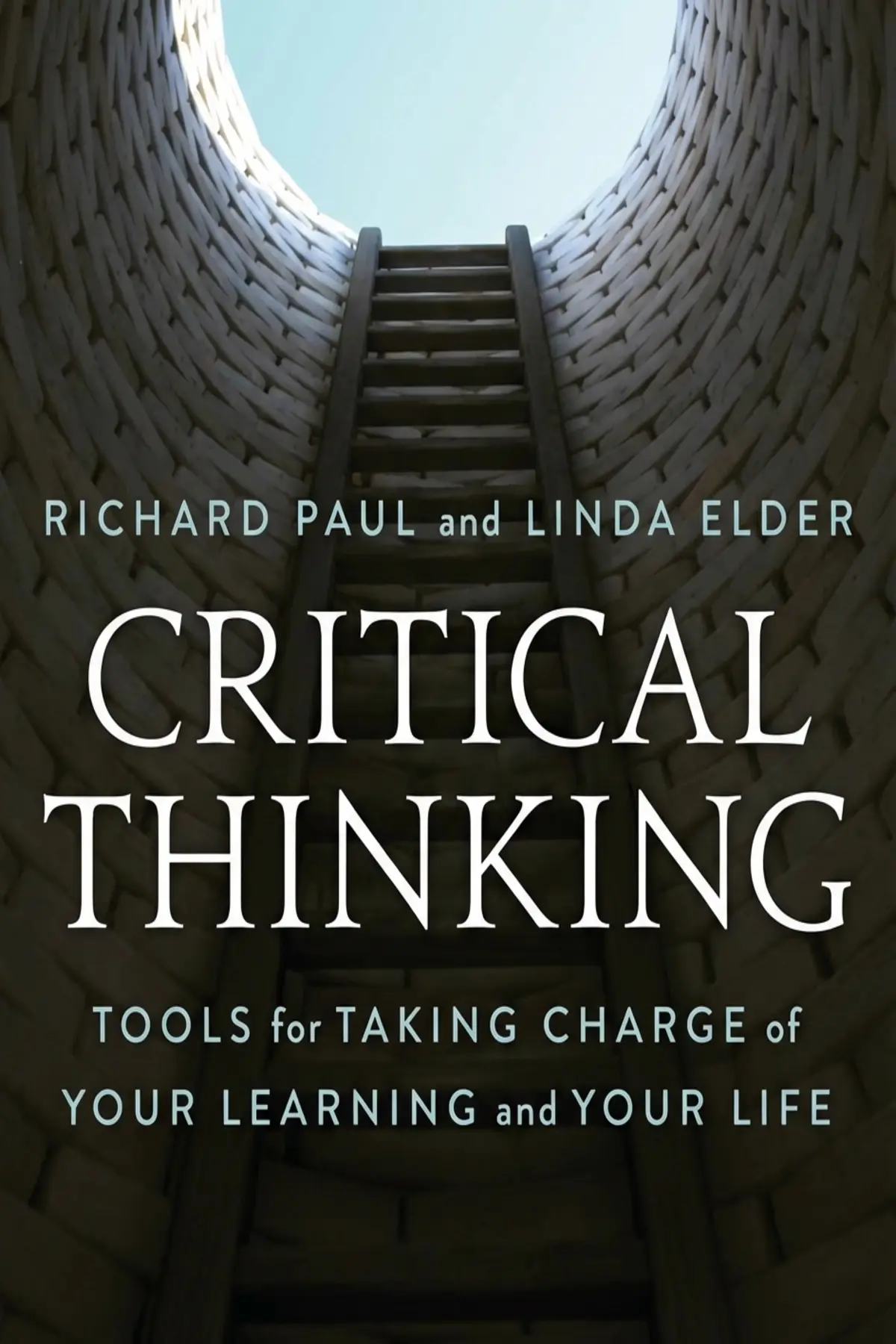
Most bad decisions don’t come from a lack of intelligence. They come from habits of thought we have never looked at. That is the starting point of Critical Thinking, by philosopher Richard Paul and educational psychologist Linda Elder. A tennis player can read a serve in an instant because of years of drills, and a clear thinker is trained in the same way.
Paul and Elder argue that good thinking is a skill built through deliberate practice. You examine the concepts you use. You hold yourself to the standards you apply to others. You grow the character traits that keep reasoning fair, and you step outside the views your own group handed you. Their claim is simple to state and hard to live by: you take charge of your mind only once you start watching it work.
What follows is a working kit: a test for vague words, a way to argue against yourself, a regular journal habit and a method for spotting biases that a whole culture shares.
1 min 46 sec
You can spot a broken sentence instantly, even when you can’t explain the rule it breaks. Yet the same mind lets confused ideas pass every day, and that blind spot may sit behind the choices you regret most.
1 min 45 sec
Some of the cleverest people in any meeting are also the worst at spotting their own errors. Paul and Elder explain how a real thinking skill can end up protecting your pride instead of finding the truth.
2 min 11 sec
Being smart and being fair are not the same thing, and only one of them protects you from your own blind spots. The authors name the habits of character that close the gap, and one may surprise you.
2 min 10 sec
Two people argue about politics. One wins on feeling, and the other actually reasons. The difference between them is not fixed, and the authors describe the steps that take anyone from the first kind to the second.
2 min 05 sec
The biases that shape you most are the ones that feel like plain common sense to everyone around you. Paul and Elder show how families, words and the news keep them invisible, and how to bring them into view.
1 min 18 sec
Go back to the tennis player at the baseline. The return looks effortless only because thousands of hours of practice went into it. Paul and Elder ask for the same kind of training for the mind. The reward is concrete: fewer decisions you regret, arguments that end in understanding, and a view of the world that is fair to people outside your own circle. The deeper point is that a mind nobody examines is run by someone else: by habit, by ego, or by the group you happened to be born into.
The practice can start small. Choose one standard, perhaps clarity, and hold every important email and meeting comment to it for a week. Start an intellectual journal, and write up the next exchange that leaves you rattled, including the assumption underneath your reaction. And when you feel certain that the other side simply cannot see the truth, take that certainty as a signal to examine your own group’s words and stories first.
None of this changes a person overnight. It moves you, one habit at a time, from the thinker who never checks to the one who does. The serve is coming either way. What changes is whether you have trained to read it.
Most people never check how they think. They trust their mental habits, notice other people's mistakes quickly, and miss the assumptions behind their own choices. Richard Paul and Linda Elder argue that clear thinking is a skill like tennis or music. It improves only with deliberate, regular practice. Their approach starts with the basics: knowing exactly what the concepts in your head mean, and holding your own reasoning to the standards you demand of everyone else. From there they describe the character behind fair thinking, seven intellectual virtues that run from humility and courage to empathy and autonomy. They also map the stages people move through, from unreflective thinkers who never question their beliefs to practicing thinkers who work on their reasoning every day. The book also turns outward. It shows how families, cultures, language and the media pass on group biases that feel like plain common sense. Readers get concrete practices, including a focus on one standard at a time, an intellectual journal and conceptual analysis of loaded words. Together they lead to fairer judgments and fewer regretted decisions.
Professionals who make decisions they later regret and want a method for checking their reasoning.
Students and lifelong learners who want thinking tools that work in any subject.
Team leads who want arguments at work to end in understanding instead of point-scoring.
Richard Paul earned a doctorate in philosophy and taught at Sonoma State University for almost thirty years. In 1980 he founded its Center for Critical Thinking, and in 1981 he convened the first global conference on the subject. He wrote more than 200 articles. Linda Elder is an educational psychologist who leads the Foundation for Critical Thinking. She has taught psychology and critical thinking at college level, has spoken to more than 20,000 educators and created a stage theory of critical thinking development.

Listeners find that this work provides enduring wisdom and actionable methods for enhancing reasoning and handling daily choices. They also value the way the material establishes a distinct structure for self-assessment and assists in spotting egocentric patterns. Although views differ regarding the heavy and occasionally high-flown writing style, listeners still consider the central principles about intellectual standards to be incredibly helpful. Furthermore, they highlight the benefit of keeping the book as a permanent guide, with one listener remarking that it needs to be "chewed and digested" at a slow pace to fully gain the strategic mindset it fosters.
The chapter on egocentric thinking was a total game-changer for my personal development. I never realized how much my own biases were clouding my everyday decision-making until I sat down with this text. It provides a very clear framework for self-critique that feels timeless, even if the writing gets a bit dry in the middle sections. You really have to treat this like a reference manual rather than a quick weekend read to get the full value. I found myself highlighting almost every other page because the standards of thought are so applicable to modern life. If you are willing to put in the work, the strategic thinking abilities you gain are well worth the effort.
Show moreAs someone who constantly struggles with letting emotions override logic, this book was exactly what I needed. It offers timeless insights into the human mind and provides a structured way to evaluate our own thought processes. I loved how it breaks down the parts of thinking into manageable pieces that can be applied to daily problems. It’s a bit of a difficult read because you have to take it real slow to appreciate the depth of the material. This isn't just a book you read once; it’s a tool for life-long self-improvement and ethical reasoning. Truly a must-read for anyone seeking a more disciplined mind.
Show moreIt is rare to find a book that offers such a comprehensive framework for redesigning your internal life. Paul and Elder have created a masterpiece that guides you through the messy process of understanding how you actually think. By highlighting the irrational tendencies we all share, they make it possible to take charge of our decisions in a way that feels empowering. I especially appreciated the focus on ethical reasoning and how it integrates with logical standards. This is a text that must be chewed slowly, allowing the concepts to sink in over time. It has fundamentally changed how I approach problems.
Show moreFinally got around to finishing this for my philosophy course and it was quite the journey. To be fair, some parts feel a bit pretentious and self-aggrandizing, which makes the initial chapters a bit of a slog to get through. However, once you move past the tone, the actual substance regarding logical structures is incredibly practical. It isn’t just academic theory; it’s about how to actually manage your irrational tendencies in real-world scenarios. I plan on keeping this on my shelf to revisit whenever I feel my logic is getting shadowed by pure emotion. It’s definitely a book that needs to be chewed and digested over several months.
Show morePick this up if you are tired of making impulsive decisions based on half-baked ideas or gut feelings. The authors provide exceptional techniques to help deal with egocentric tendencies that we all have but rarely acknowledge. I found the section on the standards of thought to be the most useful part of the entire text. My only real complaint is that the writing can feel a bit self-important at times, which might turn some people off. Still, the strategic thinking abilities it helps you develop are far more valuable than the price of the book. It’s a slow-burn experience that pays off if you stay patient.
Show moreLook, I’m not gonna lie, this book is heavy and requires a serious time commitment to finish. It’s one of those rare texts that stays with you long after you close the back cover because it touches on universal truths. I particularly liked the outline of the four levels of development and how they relate to becoming a more fair-minded thinker. It helps you identify those moments when your brain tries to take shortcuts or hide from the truth. While the prose is definitely academic and sometimes a bit dense, the practical techniques for improving logic are top-tier. It works best if you use it as a long-term reference.
Show moreFrankly, the prose in this book is quite a challenge, but the payoff is worth the struggle. It provides a level of depth regarding the parts of thinking that you just won't find in most pop-psychology books. I have been using it as a reference whenever I feel like my perspective is getting too narrow or biased. It’s not a perfect read—there is definitely a sense of self-aggrandizement in the writing style—but the logic is sound. If you can push through the dense academic language, you will find a wealth of practical advice for improving your intellect. Highly recommended for those who are serious about self-improvement.
Show moreWhile the concepts presented by Paul and Elder are undeniably spot on, the delivery often leaves much to be desired. The authors preach about fair-mindedness and avoiding bias, yet their own biases seem to flare up quite often in their examples. It is a dense read that feels over-stuffed at times, making it difficult to maintain focus for more than a few pages. I appreciate the focus on the four levels of development, but the prose is so thick it borders on being inaccessible for a casual reader. I’ll give it three stars because the core ideas are great, but the execution is frustratingly clunky.
Show moreEver wonder why it’s so hard to stay objective during a heated argument? This book tries to answer that by breaking down the mechanics of the human mind. The insights are definitely timeless, but I found the authors' style to be a bit too textbook-heavy for my personal taste. It often feels like it's going in circles, repeating the same points about egocentrism and standards without moving the needle forward. I do think the core message is important, especially the parts about self-critique and identifying bias. However, I wish it were written in a more conversational and less pretentious manner to reach a wider audience.
Show moreThis over-stuffed textbook is honestly one of the most frustrating things I have ever had to read for a class. I passed my final with flying colors, but I’m just relieved to be done with the pretentious tone that permeates every single chapter. The authors spend so much time talking about how great their system is that they forget to make it engaging for the student. Truth is, you could probably summarize the entire book into a twenty-page pamphlet and not lose any of the actual information. It feels like it was written to sound important rather than to actually teach students how to think clearly.
Show moreRichard Paul and Linda Elder argue that good thinking is a skill built through deliberate practice, much like tennis or music. That means examining the concepts you use and applying to your own ideas the standards you apply to others. It also means cultivating intellectual virtues such as humility and courage, and recognizing the egocentric and sociocentric biases that shape your views without your noticing.
Weak critical thinking uses real skill selectively, to defend existing beliefs or win arguments. People who think this way are good at finding flaws in other people’s reasoning and miss their own. Strong critical thinking adds ethics. You hold your own ideas to the same standards, seek out challenging views and treat every viewpoint fairly. The authors call this fair-mindedness and treat it as the moral foundation of the discipline.
The authors describe a progression. Unreflective thinkers accept their beliefs without question. Challenged thinkers become aware of flaws in their reasoning, often after a bad decision. Beginning thinkers start to recognize standards such as clarity, accuracy, relevance and completeness, but apply them unevenly. Practicing thinkers improve through regular, deliberate work, for example by examining one assumption each day.
Paul and Elder suggest focusing on one intellectual standard at a time, such as clarity, and asking whether you have expressed each idea as plainly as possible. They also recommend an intellectual journal, where you describe a difficult experience, note your emotions and analyze the assumptions behind your reaction. Rereading the entries over time shows patterns you can then work on.
Sociocentric thinking is egocentrism at the level of a group. Family, community and culture give us a shared worldview that feels obvious and right, so it is hard to see from the inside. Language and media can strengthen it, as when European colonizers called indigenous peoples savages to justify conquest. The authors recommend seeking opposing views, analyzing framing and examining how groups use words like freedom or justice.
John Rawls



William B. Irvine

Nigel Warburton
AUDIO SUMMARY AVAILABLE
Get the key ideas from Critical Thinking by Richard Paul, plus 5,000+ more nonfiction titles.









