
15 min 02 sec
Available in: English
Creative Schools: The Grassroots Revolution That's Transforming Education
Explains why schools designed for the industrial age bore and fail so many children. It also shows how teachers, principals, parents and policymakers can build personalized learning that develops curiosity, creativity and citizenship.
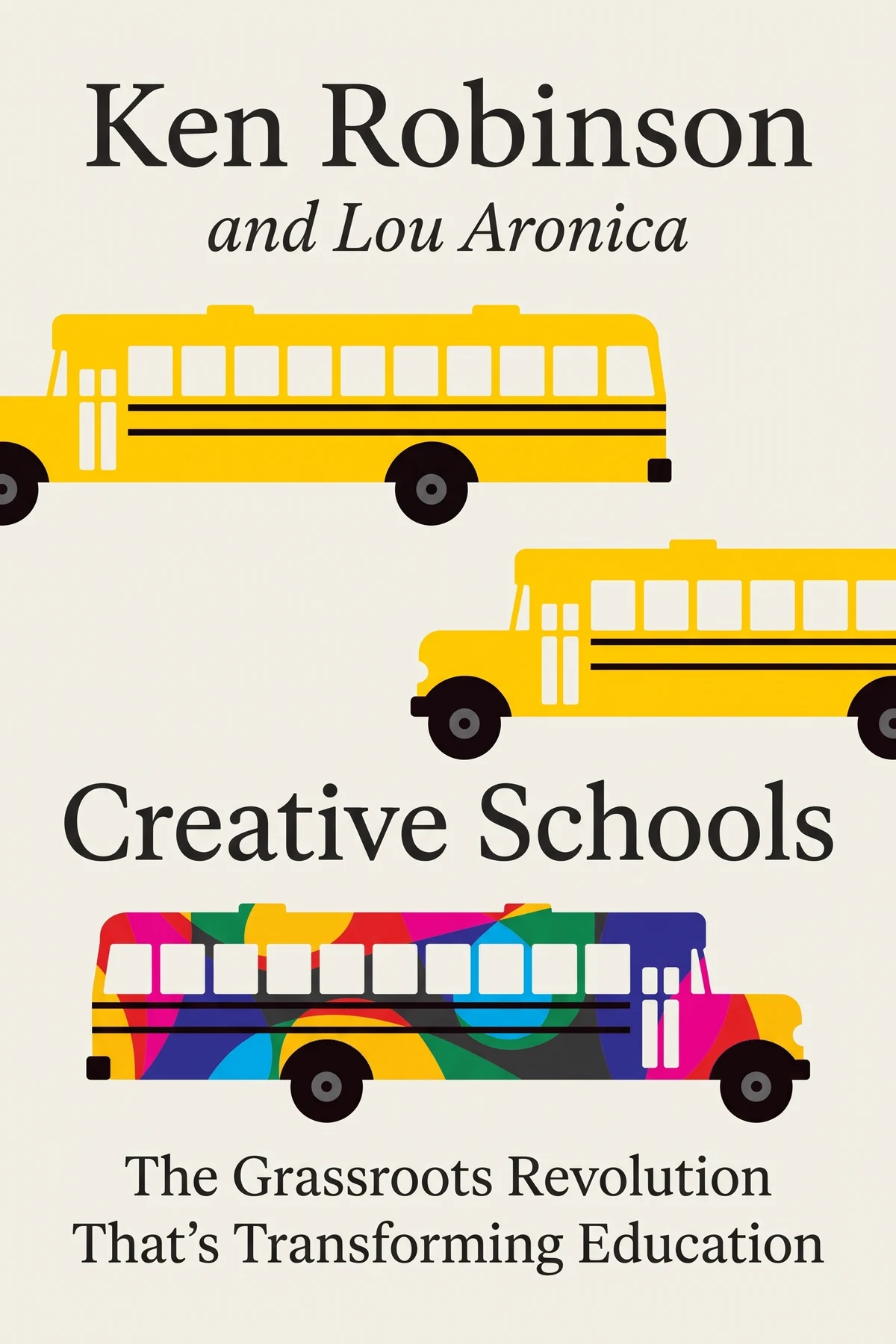
Table of Content
1. Introduction
1 min 11 sec
If you have watched a curious child turn into a bored student, Ken Robinson and Lou Aronica would say the design of school is mostly to blame. In Creative Schools, they trace that boredom to a system built during the Industrial Revolution to supply factories with obedient workers, a design that survives today as fixed standards and constant testing.
Their alternative is the creative school: no rigid timetables or endless assessment, learning shaped around how each pupil actually learns, and teachers, parents and the school itself learning too. The argument fits in one line. Children arrive as natural learners, and schools work when they stop processing them like products and start growing them like living things.
Along the way come a computer set into a wall in an Indian slum, a primary school run by its pupils as a small town, and eight skills worth teaching instead of an ever longer list of subjects. Anyone who teaches, raises or trains people will find methods to try straight away.
2. Spot the factory logic still built into school
1 min 53 sec
The way classrooms are organized, timed and tested was not designed with children in mind. Knowing who it was really designed for changes how you read every report card and exam result.
3. Teach each child in their own way
1 min 49 sec
Give the same new gadget to a few friends and each will tackle it differently. Schools behave as if that were not true, and the numbers on what young adults cannot do are startling.
4. Grow a school the way organic farmers grow food
1 min 59 sec
A factory pig farm and a modern school have more in common than anyone would like. A farming movement built on four simple principles suggests what a healthier school could look like.
5. Teach like a gardener who feeds curiosity
1 min 44 sec
Children who had never seen a computer or spoken English figured one out within hours, with no lesson at all. Their speed says a great deal about what teachers should and should not try to do.
6. Curiosity, creativity and criticism outlast any syllabus
1 min 43 sec
Nobody knows which school subjects will still matter when today’s pupils are grown. Robinson proposes teaching something sturdier, and the first three items on his list apply to adults just as much.
7. Five more Cs that build good citizens
1 min 53 sec
A child can ace every test and still be unable to speak up, work in a team or keep calm under pressure. Robinson names the skills that close that gap and the purposes they serve.
8. Anyone in a school community can drive change
1 min 40 sec
A headmaster turned his school into a town, and a struggling state asked parents what they wanted. Both stories show that reform does not have to wait for a perfect law or a new budget.
9. Conclusion
1 min 10 sec
Creative Schools comes down to a choice between two pictures. In one, learning is production, measured by output and tuned for efficiency. In the other, it is growth, with a child who already wants to learn and adults who arrange the conditions. Robinson’s examples, from the children at the wall computer to the young council members of Grangeton, show the second picture as the one that fits how people learn.
You do not need to run a school to act on it. Start from a person’s interest, the way baseball can lead a student into physics. Before you judge someone’s ability, ask whether the method suits them. And try the book’s most practical tip: let learners teach each other. Robinson observes that students often learn best from peers, because someone who mastered a skill recently still remembers which parts were hard. The next time something difficult needs explaining, at home or at work, give the job to the person who learned it last.
The factory was built to make identical things. Children were never going to be identical, and the schools that stop expecting them to be become places where everyone, teachers included, keeps learning.
About this book
What is this book about?
Young children are eager learners. A few years into school, many of them dread it. Ken Robinson and Lou Aronica argue that the problem lies in the design of mass education, which grew up to supply factories with compliant workers. Today it survives as the standards movement, with its fixed targets, frequent tests and fixed priority on STEM subjects. The authors offer another model, the creative school. They borrow four principles from organic farming: health, ecology, fairness and care. Teachers act as gardeners who give curiosity room to grow, and the long list of subjects gives way to eight core competencies, from curiosity and creativity to compassion and citizenship. Their examples include a computer set into a wall in an Indian slum, a Nottingham primary school run by its pupils as a town, and a statewide effort in South Carolina built on ideas from parents and teachers. Readers get a clear account of why standardized schooling disengages students, and practical ways to make learning more personal, whether they teach a class, lead a school, raise children or train adults at work.
Book Information
Who it's for
Teachers watching students disengage
Teachers who see bright students switch off under constant testing.
Wanting more personal schools
Principals, parents and policymakers looking for practical ways to make schools more personal.
Wanting curiosity over compliance
Managers and trainers who want adult learning to build curiosity and teamwork instead of compliance.
About the Author
Ken Robinson
Sir Ken Robinson (1950 to 2020) grew up in a working-class family in Liverpool. He advised governments and arts and education bodies, directed the Arts in Schools Project, and was Professor of Arts Education at the University of Warwick from 1989 to 2001. He was knighted in 2003 and became known worldwide for his TED talks on creativity. Lou Aronica is a publisher and author who held senior roles at Bantam and Avon Books. He co-wrote the bestseller The Element with Robinson.
Ratings & Reviews
Ratings at a glance

What people think
Listeners find the writing captivating and articulate, noting its depth of research and insight. They value its utility for teachers, pointing out the wealth of strategic examples and citations provided. The text champions the cultivation of creativity, which listeners view as essential, with one review highlighting its exceptional understanding of public schooling. Responses to the tempo are varied, as some listeners mention a lack of practical instructions for applying the suggested concepts.
Top reviews
Talia
Robinson really strikes a chord with his critique of the industrial education complex that treats children like widgets on an assembly line. His writing is incredibly engaging, blending a conversational tone with a sense of urgency that makes it hard to put down. I was particularly moved by how he redefines the curriculum not as a rigid checklist, but as the living expression of a school's culture. While some critics say he's light on the "how-to," I found the specific examples of innovative schools across the globe to be more than enough to spark my own ideas. This isn't just for administrators; it's a vital read for anyone who believes that curiosity and compassion should be at the heart of learning. It’s an optimistic antidote to the standardized testing obsession that has dominated our classrooms for far too long.
Show moreMint
Wow, what a refreshing perspective on the stale debates surrounding public school reform that usually focus only on test scores. This book is a passionate defense of the human spirit and an argument for why schools must evolve beyond the 19th-century factory model. Robinson argues that the goal of education is to create people who know what to do when they don’t know what to do, and that hit me hard. The examples he provides aren't just "fluff"; they are proof that alternative paths aren't just possible but are already thriving in pockets around the world. I finished this feeling energized and ready to advocate for my own children's right to a diverse and creative curriculum. It’s easily one of the most important books on social progress I’ve picked up in years.
Show moreLevi
After following Robinson’s work online for years, I was delighted to find that this book expands on his core message with a wealth of global references. He doesn't just complain about the status quo; he highlights educators who are actively pushing the envelope and reimagining what a classroom looks like. The comparison to other educational texts is striking because Robinson manages to stay optimistic without being naive about the challenges ahead. He correctly identifies that the curriculum should drive the schedule, not the other way around, which is a revolutionary concept in most districts. This book is a must-read for anyone involved in policy-making because it highlights the disconnect between what businesses say they want and what the system actually produces.
Show moreManee
Ever wonder why we still group kids by their "date of manufacture" instead of their interests or abilities? Robinson asks these tough questions with a sharp wit and a deep well of knowledge that makes Creative Schools an essential read for the modern age. He moves beyond the "standardization" trap to argue for a personalized approach that honors the unique talents of every child. The writing is punchy, the research is integrated smoothly, and the tone is one of hopeful determination rather than despair. It’s the kind of book that you’ll want to highlight and share with every parent in your neighborhood. We are living through a period of massive global change, and our schools need to start reflecting that reality if we want our kids to thrive.
Show moreGrace
Finally sat down with this one after hearing so much buzz in my faculty lounge, and I have to say it lived up to the hype regarding style. Robinson’s prose is fluid and remarkably accessible, making complex educational theories feel like common sense. The truth is, we have become so accustomed to batching students by age that we forget how arbitrary and counterproductive that practice can actually be. I loved the emphasis on personalized learning environments, though I do understand why some might find the lack of a "Step 1, Step 2" guide frustrating. To be fair, he’s trying to shift our entire philosophy rather than just provide a teaching manual. It’s a thought-provoking piece that forced me to reconsider my own pedagogy and how I foster creativity in my classroom.
Show moreElise
As a veteran teacher, I appreciate how Robinson dismantles the myth that a broad curriculum is a luxury we can no longer afford in a competitive economy. He makes a compelling case that innovation isn't just about technology; it's about fostering critical thinking and collaboration among students. The book is well-written and serves as a great bridge between abstract educational theory and the lived experiences of students who feel alienated by current norms. I did find the pacing a bit uneven in the middle sections where he lists off different school models, but the overarching message remains powerful. It’s a call to arms for educators to reclaim their profession from the bean-counters and refocus on the individual child. We need more voices like his in the conversation about where our schools go from here.
Show morePatchara
Look, this isn't a technical manual for school board members, and if you go in expecting that, you’ll likely walk away disappointed like some other reviewers. What this book actually offers is a profound shift in mindset that prioritizes the "curiosity" and "composure" of the student over standardized metrics. I found the historical context of how our schools became so rigid to be fascinating and deeply eye-opening. It provides a necessary vocabulary for parents and teachers who know something is wrong with the system but can't quite put their finger on the cause. While it's true that the book relies heavily on anecdotes, those stories serve to humanize a debate that is often far too clinical. It’s a highly readable and inspiring manifesto for change.
Show moreKrisada
The chapter discussing the Eight Core Competencies alone makes the entire purchase worthwhile for any parent or professional educator. Robinson breaks down essential skills like "Communication" and "Citizenship" in a way that feels actionable, even if the book doesn't provide a literal blueprint. I’ve been thinking a lot about his point that the basic prerequisite for effective education is cultivating a student’s enthusiasm for learning. Not gonna lie, some of the school examples felt a bit too "perfectly curated," but the underlying principles are sound and desperately needed. It's a balanced mix of research-backed insights and anecdotal evidence that makes for a very engaging read. I would have liked more focus on how to bridge the gap in low-income areas, but the overall vision is undeniably strong.
Show moreKob
The transition from watching his legendary TED talk to reading this full-length book left me feeling surprisingly conflicted about the final product. Robinson is an undisputed master of identifying the structural flaws in our current systems, and his "Eight Core Competencies" provide a fantastic framework for what a modern learner needs. However, the narrative often gets bogged down in rose-tinted anecdotes that feel more like success stories from a brochure than rigorous case studies. I kept waiting for a granular implementation plan or a deep dive into how to navigate restrictive state mandates, but those practicalities were largely missing. It’s a beautiful vision of what education could be, but it lacks the grit needed to help a teacher on the ground change their Monday morning routine.
Show moreAnna
Maybe my expectations were just too high after seeing how many people recommended this as a revolutionary text. Frankly, the book felt like a repetitive collection of abstract ideas that failed to address the harsh realities of underfunded urban schools. Robinson paints these glowing pictures of "creative schools" that seem to exist in a vacuum where budgets, parental pushback, and bureaucratic red tape simply vanish. Where are the stories of the failures or the schools that tried these methods and struggled to maintain them? It felt too much like a weekend movie script—impoverished kids, one charismatic leader, and suddenly everything is perfect. I agree that creativity is essential, but I needed more substance and less utopian dreaming to find this truly useful for my professional development.
Show moreQuestions about this book
What is the main idea of Creative Schools?
Ken Robinson and Lou Aronica argue that mass education was designed during the Industrial Revolution to produce factory workers, and that today’s standards movement keeps that factory logic alive through fixed targets and frequent tests. Since children are natural learners who learn in different ways, they propose creative schools: personalized, run on organic principles of health, ecology, fairness and care, and focused on eight core competencies.
What are the eight Cs in Creative Schools?
Robinson’s eight core competencies are curiosity, creativity, criticism, communication, collaboration, compassion, composure and citizenship. He argues schools should teach these instead of relying on an ever longer list of subjects, because no one knows which subjects will matter in the future, while these skills help people learn what they need and cope with changing social and economic conditions.
Why does Ken Robinson criticize standardized testing?
He argues that an education built almost entirely on drills and tests destroys creativity and leads students to disengage, and disengaged students learn poorly. He cites 2012 figures showing 17 percent of US high school graduates could not read or write fluently. Students with talents outside tested subjects, and children from poorer backgrounds, are especially likely to be failed by the system.
How can teachers apply Creative Schools in the classroom?
Robinson pictures the teacher as a gardener who creates conditions for growth. Connect lessons to students’ interests, as when baseball makes physics meaningful. Hold high expectations within warm relationships, vary methods to suit each learner, and build students’ confidence in facing uncertainty. He also suggests letting students teach each other, since peers who recently learned a skill remember what made it hard.
Who should read Creative Schools?
It suits teachers, principals, parents and education policymakers who feel the current system leaves many children bored or behind. It also speaks to anyone who designs learning for others, such as trainers and team leads, because its ideas about personalizing methods, building the eight competencies and asking the community for ideas apply well beyond the school building.
Readers also enjoyed

AUDIO SUMMARY AVAILABLE
Listen to Creative Schools in 15 minutes
Get the key ideas from Creative Schools by Ken Robinson, plus 5,000+ more nonfiction titles.
- 5,000+ titles
- Listen as much as you want
- 7-day free trial
- Cancel anytime









