
14 min 29 sec
Available in: English
Traffic: Why We Drive the Way We Do (and What It Says About Us)
Explains why calm people turn angry, overconfident and careless behind the wheel, and how understanding traffic's hidden dynamics helps you drive with less stress, fewer risks and clearer thinking about jams.
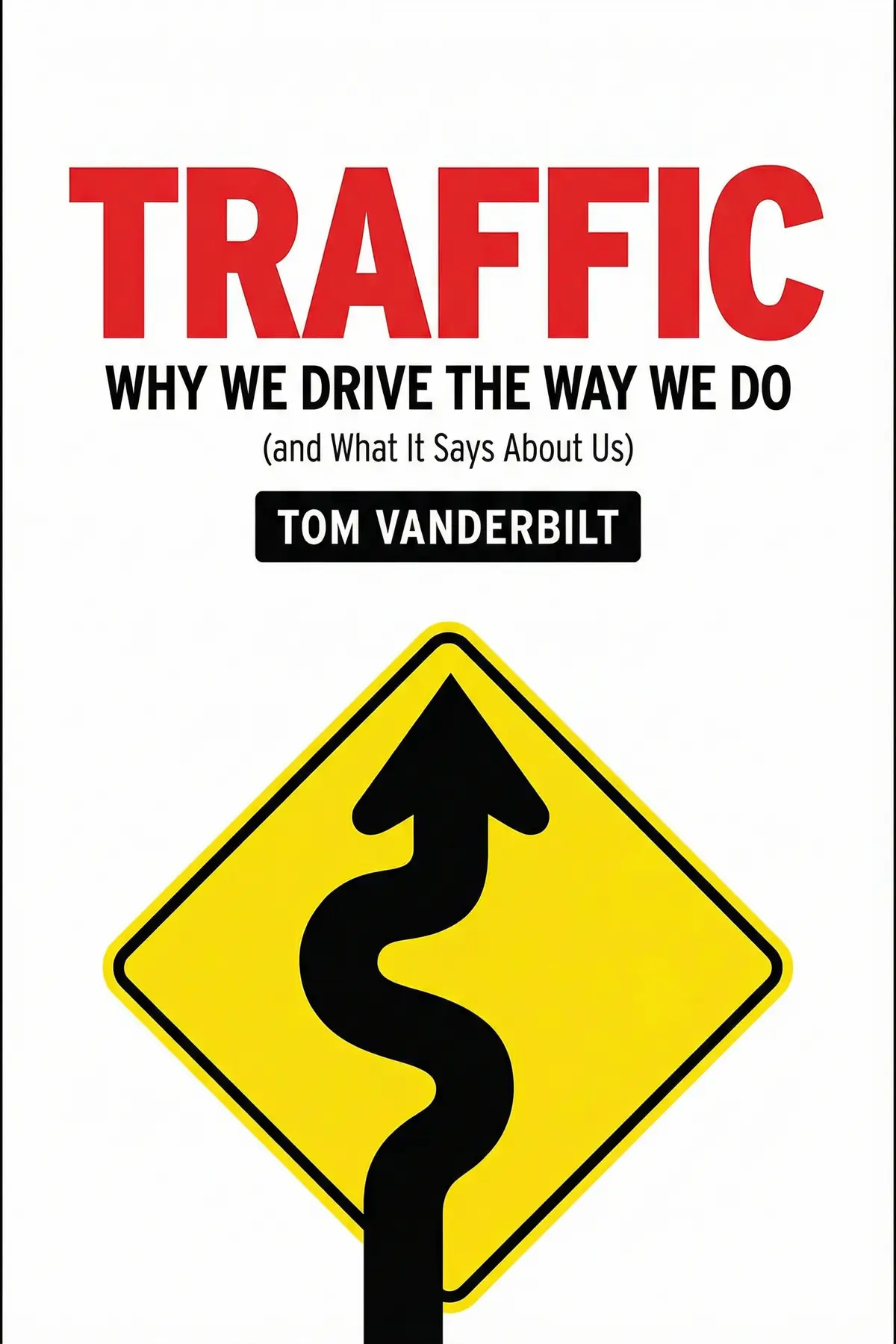
Table of Content
1. Introduction
1 min 06 sec
If traffic leaves you tense, rushed and certain that everyone else is the problem, Tom Vanderbilt’s Traffic offers a better explanation: the car itself changes how we think. Sealed inside a metal box, cut off from the usual ways people talk and correct each other, drivers misread time, their own skill and even danger. Vanderbilt, a journalist who has written for Wired and The New York Times Magazine, argues that this is why calm people turn furious at the wheel.
His case is also hopeful. Once you see the hidden dynamics of traffic, you can make wiser choices on the road and understand why it behaves as it does. Drivers who hopped between lanes on an 80-minute trip saved about four minutes. Sweden’s accidents fell in the year it switched sides of the road. Replacing two dozen intersections with roundabouts cut deaths by 90 percent.
Follow the argument and your next commute will feel less like a contest, with clear reasons to stay in your lane, keep your eyes up and slow down where the road feels easiest.
2. Stay calm when another driver cuts you off
2 min 04 sec
The gentlest colleague you know can turn into a horn-pounding stranger in a single second. Vanderbilt traces that sudden change to something the car takes away from us, and to something it quietly adds.
3. Stop weaving between lanes and arrive just as soon
2 min 04 sec
The lane beside you starts rolling while yours sits frozen, and the urge to switch feels overwhelming. One study timed what all that weaving actually buys, and the number is smaller than almost anyone expects.
4. Judge your own driving more honestly
2 min 04 sec
Millions of strangers trade online every day and are kept honest by feedback, yet drivers get no such feedback and are worse than they believe. The missing ingredient is simple, and almost no road on Earth supplies it.
5. Drive on autopilot without letting your eyes wander
1 min 58 sec
Arriving home with no memory of the drive is common, and the skill behind it is genuinely impressive. A year of in-car camera footage shows exactly when that same skill turns into a hazard.
6. Roads that feel risky can keep you safer
2 min 04 sec
A twisting mountain path or a smooth, well-signed highway: most people would pick the highway without a second thought. A national experiment in Sweden suggests that instinct may be exactly backward.
7. Learn how new roads fill up and what clears them
1 min 51 sec
A new lane opens on your commute and, within weeks, it is jammed like the rest. A strike at two California ports reveals the invisible crowd of drivers waiting to fill any space a road gives them.
8. Conclusion
1 min 18 sec
Vanderbilt’s portrait of the driver is unflattering but oddly reassuring. The anger, the lane hopping, the inflated confidence and the drifting attention are predictable responses to a strange situation: millions of people, each sealed in a box, unable to talk, rarely corrected and convinced the other lane is winning. The road brings out the irrational side of everyone. Knowing that is the first step to stepping outside it.
The book supports a few small changes. When someone cuts you off, remember that the insult landed on a box and its driver cannot hear you, and let it pass. Choose a lane and stay there, since constant switching bought four minutes on a drive of 80. Keep the phone out of reach, because a few seconds of distraction lie behind most crashes. And on the wide, easy road home, bring the alertness you would feel on a mountain path, or in Sweden in 1963.
None of this needs a better car or a new highway, which, as the California port strike showed, would only fill again. It needs a clearer view of traffic: a crowd of ordinary people, all a little worse at this than they believe, including you.
About this book
What is this book about?
Behind the wheel, mild people honk, shout and weave between lanes. They also feel sure they drive better than almost everyone else. Journalist Tom Vanderbilt sets out to explain why. His answer is that the car is a strange place for a human being. It seals us off from the ordinary ways we talk, apologize and learn from each other, and it distorts how we judge time, fairness and danger. Vanderbilt draws on studies and real-world cases to show how this plays out. Drivers who constantly switched lanes on an 80-minute trip arrived only four minutes sooner. Most crashes in a year-long camera study followed distractions of three seconds or less. Sweden's accidents dropped below average after the country switched sides of the road. When a 2002 port strike in California emptied a road of trucks, other cars quickly took their place. Readers get a clear picture of the forces behind everyday driving behavior. They also get practical reasons to stay in one lane, keep their attention on the road and treat easy, familiar roads with more care. Finally, the book explains why building new roads rarely ends congestion.
Book Information
Who it's for
Commuters arriving angry
Commuters who arrive at work already angry and want to understand where the anger comes from.
Drivers sure of themselves
Drivers who switch lanes, check phones or trust their skill more than the evidence supports.
Curious about endless congestion
Curious readers and city watchers asking why new roads never seem to end congestion.
About the Author
Tom Vanderbilt
Tom Vanderbilt, born in 1968, is a journalist, blogger and author who has written for Wired, The New York Times Magazine, Popular Science and The Financial Times. Traffic, published by Alfred A. Knopf in 2008, became a New York Times bestseller. His other books include Survival City, a travelogue through the secret Cold War history of America, and You May Also Like, a book about taste.
Ratings & Reviews
Ratings at a glance

What people think
Listeners find the book to be consistently engaging and skillfully written, offering solid information bolstered by enlightening research and footnotes. They value the way it applies psychological concepts to routine driving, helping them improve behind the wheel, while one listener points out how it clarifies the way human thoughts and emotions influence traffic patterns. Listeners feel the work is well worth the cost, with one review emphasizing its thorough analysis of the intricate nature of traffic.
Top reviews
Cholada
Tom Vanderbilt has managed to turn the mundane act of driving into a gripping psychological study. Before reading this, I viewed traffic as a purely mechanical problem, but now I see it as a complex language of human behavior. The way he explains our 'underdeveloped sense' of how to actually use our vehicles was a total wake-up call for me. I particularly loved the illuminating footnotes and the deep dive into why we get so visibly mad at an audience of no one. This isn't just a book about cars; it’s a book about how humans think and feel in high-stakes environments. It is a behemoth of information, but the way it applies psychology principles to everyday experiences is brilliant. I’ve already recommended it to three people in my office who complain about their commute.
Show moreHang
Wow, I will never look at a parking lot or a traffic sign the same way again. This book is a masterclass in making the invisible visible. Vanderbilt takes something we do every day without thinking—driving—and reveals the staggering complexity behind every decision we make. Not gonna lie, the section on how many decisions we make per minute was enough to scare me out of ever touching my phone in the car again. I appreciated the international scope, from New York to the Netherlands, showing how culture influences safety as much as engineering does. It’s a comprehensive examination that feels totally original. If you’re a nerd for 'why we do the things we do' books, this is a five-star classic that is absolutely worth the investment.
Show morePla
Truth is, we all think we’re above-average drivers, but Vanderbilt exposes the hilarious and dangerous illusions we live in every time we turn the key. I found the 'theatrical storytelling' aspect of road rage particularly relatable—I definitely play the 'wronged victim' more than I’d like to admit! The book is well-written and engaging throughout, provided you don't mind flipping to the back to check out the illuminating footnotes. It’s rare to find a book that combines anthropology, engineering, and psychology so seamlessly. It’s a timely study that explains how our emotions impact the flow of the world around us. Even though it was written in 2008, the core lessons about human nature and traffic still feel incredibly relevant today. A must-read for anyone who owns a license.
Show moreSaengdao
Ever wonder why you feel like an avenging hero during your morning commute? Tom Vanderbilt dives deep into the theater of the road, explaining how our cars become bubbles of moral drama. I was fascinated by the concept of 'traffic archaeology' and how ancient human instincts still dictate our behavior at four-way stops. The book is comprehensive and certainly well-researched, though I'll admit the sheer volume of data occasionally made my eyes go sideways. It's not a light, breezy read by any means. However, for anyone who wants to understand the psychology behind late merging or why building more roads just makes things worse, this is essential. It genuinely made me a more conscious driver, even if some of the statistics felt a bit dry toward the middle chapters. Definitely worth the price for the insight alone.
Show moreViroj
This is a massive tome that requires some serious stamina to finish, but the payoff is worth it. Vanderbilt leaves no stone unturned, exploring everything from the safety of compact cars to the evolutionary roots of the 'courtesy wave.' I found the chapter on roundabouts versus gridded cities especially enlightening, as it challenged my pre-existing views on urban planning. My only real gripe is that it reads almost like an academic journal at times, which might turn off readers looking for a casual weekend book. There are over a hundred pages of citations, which proves the research is top-notch but also makes the physical book quite heavy! Look, it’s a bit dense, but if you enjoy data-driven nonfiction that changes how you see the world, you should pick this up. It’s highly informative.
Show moreMonthon
After hearing about this book on a podcast, I picked it up hoping it would explain why my commute is so soul-crushing. It did that and a lot more. The truth is, most of us have a total lack of objectivity when it comes to our own driving skills. Vanderbilt uses physics and sociology to tear apart social myths, like the idea that small cars are always 'tin cans of death.' The writing style is engaging, though I agree with other reviewers that a summary page at the end of each chapter would have helped organize the massive amount of information. It’s a bit of a marathon read, but the sections on the fatal flaws of traffic engineering were eye-opening. It definitely changed the way I navigate lane drops on the highway.
Show moreHannah
The blurb for this book is a total bait-and-switch. I expected a lighthearted exploration of road rage and weird driving quirks, but what I got was an academic-style bombardment of statistics and government reports. To be fair, some of the content is genuinely interesting—like the stuff about how we 'construct moral dramas' in our heads—but the delivery is often flat. It feels like the author is trying too hard to be an expert on everything without having a background in actual data interpretation. The book is way too long for the points it's trying to make; as the saying goes, the covers are simply too far apart. It’s okay for a one-time read, but don’t expect to be entertained the whole way through.
Show moreNam
As someone who nerdishly enjoys urban planning, this was right up my alley—at first. I loved the technical details about traffic light timing and the psychology of the 'late merger' on the interstate. However, the author eventually gets bogged down in so many isolated studies that the main thread gets lost. One minute we're talking about cavemen and the next we're looking at New Zealand driving stats, and it doesn't always click together. Some of the conclusions, like the courtesy wave being an evolutionary carryover, felt a bit unconvincing and poorly supported. It's a good book to keep on your shelf for reference, but reading it cover-to-cover was a bit of a slog. It lacks a clear summary to help the information stick.
Show moreGame
I really wanted to like this book because I spend so much time behind the wheel, but it turned out to be an endless ramble. Vanderbilt is clearly a knowledgeable guy, but he desperately needed an editor to boil these facts down into a coherent summary. Instead of a narrative, you get a directionless stroll through random studies from New Zealand to New Jersey without any clear conclusion. Frankly, the author’s habit of telling me what I have or haven't experienced—like claiming I’ve surely encountered a traffic light stuck on red—was comically presumptuous. I’ve been driving for fifteen years across twelve states and that has never happened once. It felt like a New York worldview being forced onto everyone else. It’s basically an overstuffed magazine article that never quite reaches its destination.
Show moreJob
Frankly, I found this to be a disappointing, dry, and disengaging experience. The blurb makes it sound like a fun look at driving habits, but it’s actually just a list of research studies linked together by a very thin narrative. Vanderbilt smugly grabs any piece of data that fits his pre-existing narrative while ignoring anything that doesn't. If you’ve ever taken a class in research methods, the way he compares vastly different populations as if they are identical will drive you crazy. It lacks humor and fails to tie all the disparate facts together at a higher level, unlike the writing of someone like Stephen Jay Gould. I felt bombarded by stats that I won't remember in a week. I ended up getting off at the first exit and looking for something more rewarding to read.
Show moreQuestions about this book
What is the main idea of Traffic by Tom Vanderbilt?
Vanderbilt argues that traffic brings out our irrational side. Inside a car we cannot communicate normally, we get almost no feedback, and we misjudge time, our own skill and danger. That makes us angry, overconfident and sometimes reckless. Once we understand these hidden dynamics, he says, we can make wiser decisions behind the wheel and help make the roads better for everyone.
Does changing lanes in traffic get you there faster?
Barely. Vanderbilt cites a study of an 80-minute drive in which drivers who changed lanes constantly arrived only four minutes earlier than those who stayed in one lane. Switching feels effective because our sense of time in traffic is faulty: when we are stopped, the other lane always seems to move, and our own movement feels brief. Overall the lanes move at a similar pace.
Why do more roads lead to more traffic?
Vanderbilt points to latent demand. Many drivers avoid busy roads, using side streets, public transport or staying home. When a road gets clearer, they return and fill it. During a 2002 strike at two California ports, 9,000 trucks left the main port road, yet traffic fell by only 5,000 vehicles. He highlights congestion pricing, used in London and Stockholm, as one tested answer.
Why are roundabouts safer than intersections according to Traffic?
Roundabouts feel stressful, but their design forces drivers to slow down and removes the chance to run a red light, which is one of the riskiest things a driver can do. Vanderbilt cites research in which 24 intersections were replaced with roundabouts, and the result was a drop of nearly 40 percent in crashes, a 76 percent fall in injuries, and a 90 percent fall in deaths.
How can I apply the ideas in Traffic?
Let insults from other drivers pass, since they cannot hear you and the anger only escalates. Pick a lane and stay in it. Keep your phone out of reach, because a year-long camera study linked distractions of three seconds or less to 80 percent of crashes. And drive familiar, comfortable roads with the care you would bring to a dangerous mountain path.
Readers also enjoyed


Acting with Power: Why We Are More Powerful Than We Believe
Deborah Gruenfeld


Age of Propaganda: The Everyday Use and Abuse of Persuasion
Anthony Pratkanis




59 Seconds: Change Your Life in Under a Minute
Richard Wiseman


AUDIO SUMMARY AVAILABLE
Listen to Traffic in 15 minutes
Get the key ideas from Traffic by Tom Vanderbilt, plus 5,000+ more nonfiction titles.
- 5,000+ titles
- Listen as much as you want
- 7-day free trial
- Cancel anytime









