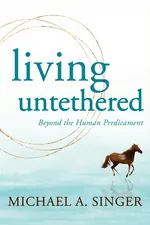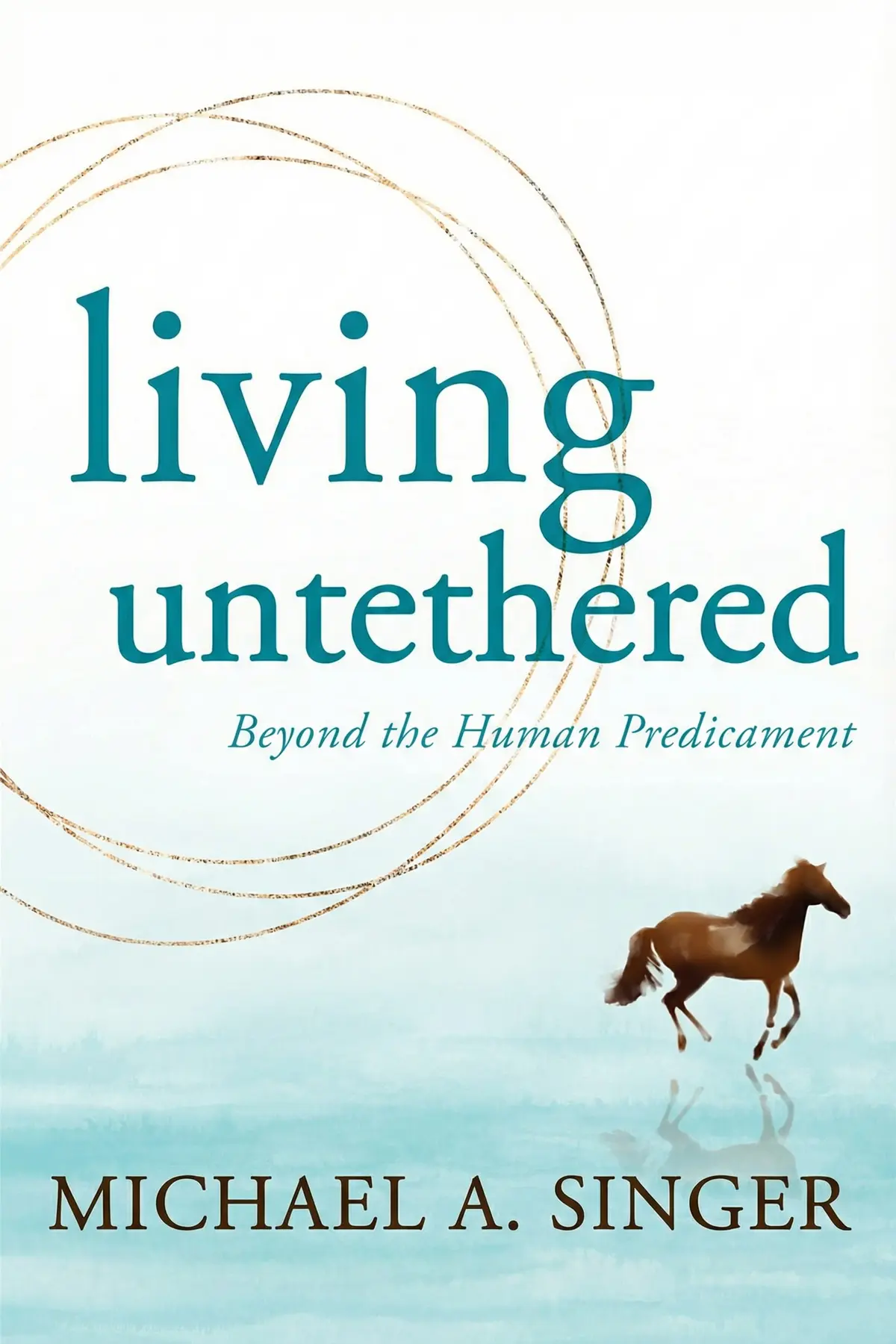
Living Untethered: Beyond the Human Predicament
Michael A. Singer
 English
 ไทย
Shows how to stop being ruled by your own thoughts by treating them as passing events, letting feelings move through you, and using fear, death and balance as guides to a calmer, clearer life.
1 min 00 sec
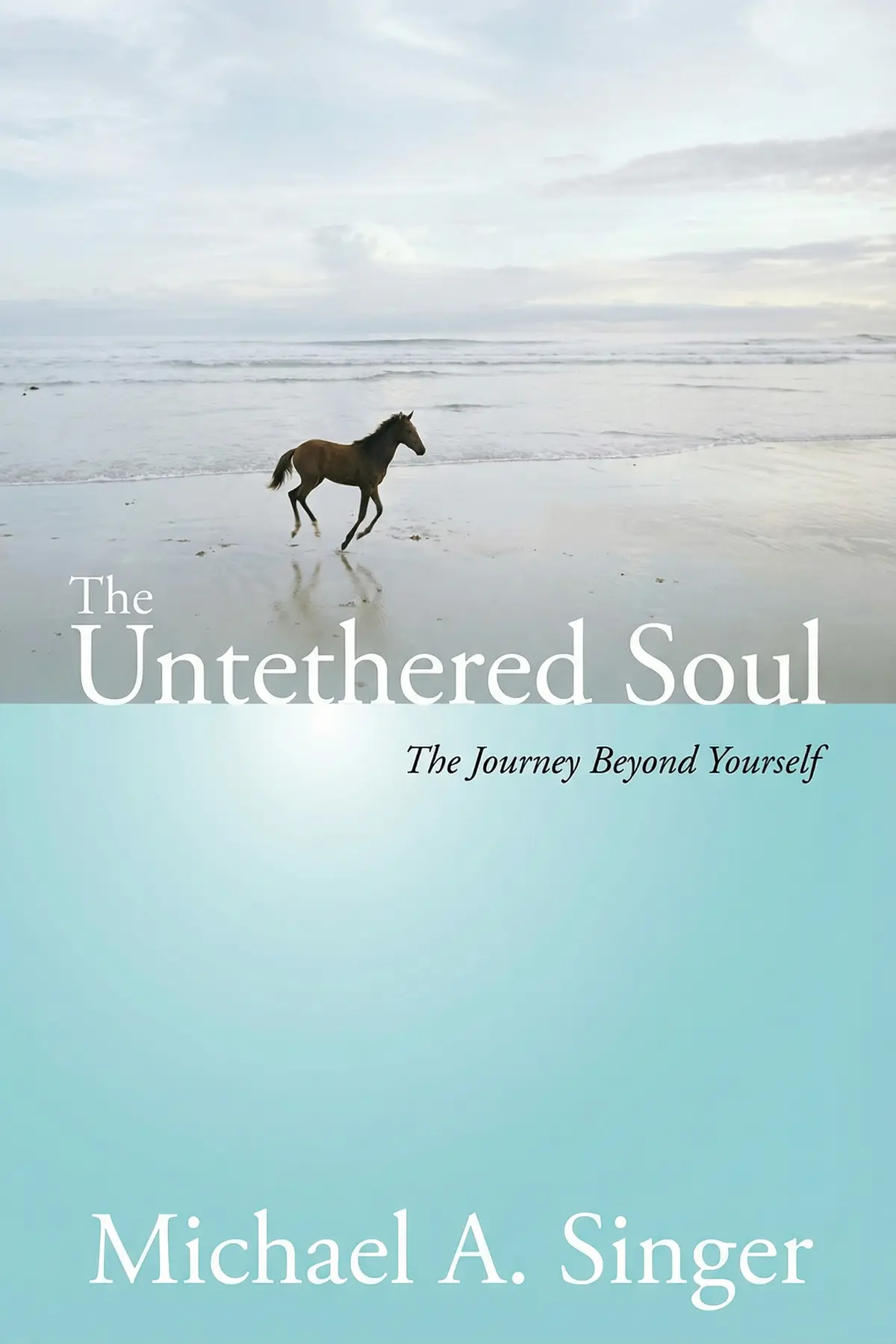
If your own thoughts keep pulling you into jealousy, worry or gloom, Michael A. Singer offers a way to stop being dragged along. In The Untethered Soul, Singer, who founded a yoga and meditation center in 1975, argues that you are not the voice talking in your head. You are the one who hears it.
That small change in where you stand alters how much power any thought holds over you. His teaching comes down to one practice: notice your thoughts and feelings, let them move through instead of gripping them, and the energy they were trapping returns to you.
From there he takes on the walls we build around our self-image, the inner energy that gets stuck, fear, the clarifying effect of thinking about death, and the balanced path described in the Tao Te Ching. The aim is practical. The next time a thought hooks you, you will know what to look at and what to release.
1 min 37 sec
There is a running commentary in your head that almost never pauses. Singer argues that we often get lost in our thoughts and forget whose voice that is, mistaking what it says for who we are.
1 min 37 sec
Visitors at a zoo often pity the animals behind the bars. Singer suggests the visitors are confined too, by walls they put up themselves and defend every day without noticing.
1 min 41 sec
A single phone call can lift someone out of days of lying in bed. Singer uses that moment to show where our energy really comes from, and the everyday habit that keeps it locked away.
1 min 38 sec
There are two ways to live with a splinter in your finger, and most people pick the wrong one with their fears. Singer explains why our minds make this choice so tempting.
1 min 40 sec
A husband watching his wife laugh with another man at a party feels his evening turn sour. Singer offers him an unlikely way out, one that comes from thinking about the end of everything.
1 min 44 sec
One partner wants every waking minute together; another vanishes for months. Both relationships share the same fate, and Singer finds in a profound spiritual teaching a rule that applies far beyond love.
1 min 02 sec
Singer’s teaching keeps returning to one move, made in different places. A jealous image on a drive, a fear you have arranged your days around, a self-image you defend, a goal pushed to an extreme: each is something you are holding, and each loosens once you remember that you are the one aware of it. Being untethered, in his sense, means thoughts still arrive but no longer get to steer.
He does not ask anyone to silence hard emotions. Jealousy and fear are to be acknowledged honestly, then allowed to go their own way. In practice that can be as small as hearing the inner voice and naming what it is doing, or catching the moment your mind seizes one image and starts replaying it. It can mean pulling out one fear instead of building your life around it, and doing this week what you would do if a week were all you had.
The voice in your head will keep talking. You do not have to keep believing that it is you.
Most people know the feeling of being trapped by their own minds: a jealous image that replays all day, a worry that colors every decision, a habit of seeing themselves as simply anxious or sad. The mind that drives creativity can also drag us down, and few of us understand how it works. Michael A. Singer argues that the way out begins with one distinction. You are not the voice chattering in your head. You are the awareness that hears it. From there he shows how clinging to thoughts blocks an inner energy that Chinese medicine calls chi and yoga calls shakti, how fear can be removed like a splinter instead of being built around, and how the mental walls we put up to defend our self-image become a cage. He also turns to two older sources of wisdom. Reflecting on death, as yogis and saints have done, sorts what matters from what does not. The Tao Te Ching's middle path between extremes keeps relationships and goals alive. Readers come away with a simple practice: notice, acknowledge and let go.
People who get stuck replaying jealous, anxious or gloomy thoughts and want a way to step back from them.
Professionals and students feeling drained who are curious about meditation and ideas of inner energy.
Anyone whose fears or extreme habits keep shaping their relationships and goals.
Michael A. Singer, born in 1947, studied economics at the University of Florida and completed a master's degree in 1971. During his doctoral studies he went through a deep inner awakening and withdrew into seclusion to practice yoga and meditation. In 1975 he founded Temple of the Universe, a yoga and meditation center open to people of any faith. He also co-founded the medical software company Medical Manager in 1981, and three of his books have been New York Times bestsellers.
Michael A. Singer
Michael A. Singer

Listeners find this work highly accessible and clear, offering actionable tips that strike a profound chord with them. They further characterize it as a transformative resource packed with insights for reaching a state of joy and internal tranquility. The prose is also highly praised, with one listener mentioning that the author uses a very conversational tone.
Picked this up during a particularly chaotic month and it really shifted my perspective on mental chatter. Michael Singer describes our internal dialogue as an 'inner roommate' who is often irrational and overbearing, which is a hilarious but deeply profound way to look at anxiety. The truth is, I never realized how much energy I wasted trying to argue with my own thoughts instead of just observing them. To be fair, the writing style is very conversational and accessible, making complex spiritual concepts feel like a chat over coffee. This guide is life-changing because it doesn't just theorize; it offers a way to achieve genuine inner peace by stepping back into the seat of the observer. I found the sections on 'letting go' to be the most practical advice I’ve received in years. It’s a gem that I plan on gifting to my siblings this Christmas.
Show moreWow, this book is essentially a much-needed manual for the human mind that I wish I had discovered a decade ago. It’s written in such an easy-to-understand way that even the most abstract ideas about energy and consciousness feel grounded. Personally, the concept of the 'seat of the self' changed how I react to traffic and difficult emails almost instantly. You start to realize that you are not your thoughts; you are the one hearing them, which is a massive distinction. The book acts as a life-changing guide that helps you find happiness by simply stopping the internal struggle against reality. Not gonna lie, some of the more 'new age' descriptions of energy flow felt a bit fluffy, but the psychological benefits are undeniable. It’s a profound piece of work that manages to be both spiritual and incredibly practical for modern life.
Show moreFinally got around to reading this and I'm genuinely surprised by how much it stuck with me after the final page. It’s a much shorter and more accessible version of the ideas you might find in Eckhart Tolle’s writing, but without the dense prose. Singer walks you through the process of witnessing your 'inner roommate' with a level of clarity that is rare in the spiritual genre. I found the chapters on the 'infinite energy' and the 'heart' to be particularly moving, even if they require a bit of an open mind. This book truly helps you peel off the layers of the 'bullshit-self' onion to find something more stable underneath. I’ve started practicing the 'letting go' technique during my morning commute, and the results have been nothing short of transformational. It’s rare to find a book that feels like both a warm hug and a wake-up call.
Show moreThis book acts as a gentle nudge to stop taking your own thoughts so seriously and start living in the moment. Singer’s conversational style is a breath of fresh air compared to the stuffy, academic tone of most philosophy books. I particularly loved the way he explains how we trap ourselves in rigid perceptions of how the world 'should' be, rather than accepting how it is. By realizing that my thoughts are just a parade of projections, I’ve found a level of inner peace I didn't think was possible. The advice is practical and resonates deeply because it addresses the universal human experience of being bullied by one's own mind. It’s a life-changing guide that I've already recommended to several friends who struggle with overthinking. If you want to achieve happiness without a bunch of complicated rituals, this is the book for you.
Show moreSinger manages to distill profound ancient wisdom into something you can actually use while sitting in traffic or dealing with a difficult boss. The book is transformational because it gives you a different set of eyes through which to view your internal world and your external reactions. I've read a lot of self-help, but nothing has made the concept of 'the observer' as crystal clear as this. Truth is, we spend most of our lives being jerked around by emotional knee-jerk responses, and this guide shows you how to cut the strings. The writing is incredibly well-received for a reason—it’s simple, direct, and doesn't waste time on fluff. Since finishing it, I’ve felt a significant shift in my ability to stay centered during stressful moments. This is a gem of a book that truly delivers on its promise of helping you find your true self.
Show moreEver wonder why that nagging voice in your head never seems to take a day off? This book tackles that question head-on by teaching you how to differentiate between your true self and the constant stream of consciousness that dictates your mood. Look, I found the early chapters about the 'observer' absolutely brilliant and they gave me immediate tools to handle stress at work. However, the book does get a bit repetitive toward the middle as if Singer is trying to hammer the same point home through different metaphors. In my experience, it’s a bit like a list of high-quality ingredients with no specific recipe, leaving you to figure out the actual 'how-to' of meditation on your own. Despite the lack of a structured practice guide, the core message resonated deeply. It’s a solid 4-star read that I would recommend to anyone feeling trapped by their own mind.
Show moreAfter hearing so many recommendations from friends, I finally dove into Singer’s work to see if it lived up to the hype. The book does an excellent job of synthesizing themes from Buddhism, Taoism, and even some Christian mysticism into a cohesive whole. To be fair, it felt like nails on a chalkboard whenever random Bible verses were dropped in, but the underlying logic was strong enough to keep me engaged. Singer’s conversational tone makes the heavy lifting of spiritual growth feel manageable and even lighthearted at times. My only real gripe is that the book tends to gloss over the 'how'—it tells you to stay open, but doesn't give you a meditative roadmap to get there. Still, the insights into how we build mental fortresses to protect our fragile egos were worth the price of admission. It’s a very useful tool for anyone seeking a more peaceful spirit.
Show moreAs someone who was raised in a secular home and is naturally suspicious of organized religion, I found this book surprisingly grounded and logical. Singer manages to bridge the gap between ancient wisdom and modern psychology without getting bogged down in dogma. Personally, the 'inner roommate' concept was the breakthrough I needed to understand my own anxiety from a distance. The book is easy to understand and the conversational tone makes it feel like you’re learning from a wise mentor rather than a distant scholar. My only criticism is that it gets a bit repetitive in the final third, and some of the 'just let go' advice feels a bit like 'just be happy.' That being said, the core message is incredibly powerful and offers a path to freedom that feels achievable with practice. It’s a great synthesis of spiritual truths.
Show moreThe first few chapters were genuinely insightful, but the rest of the book felt like a redundant lecture that could have been a long essay. I totally buy into the idea of being a neutral observer of my thoughts, yet the author’s suggestion that we should live like 'the world's best amoeba' didn't sit right. He suggests floating through life without desires or goals, which seems to strip away what makes us human and driven. To be fair, the writing is clear, and the 'inner roommate' metaphor is a brilliant hook that almost everyone can relate to. However, the lack of evidence or concrete strategies for people dealing with real-world trauma felt like a major oversight. It’s a decent introduction to mindfulness, but it lacks the depth of more traditional texts like those by Lao Tzu. It’s fine for a quick read, but I likely won't revisit it.
Show moreWhile I appreciate the attempt at simplifying complex spiritual concepts, this book fell flat for me because of its many contradictions. Frankly, I am quite suspicious of any author who claims it is possible—or even desirable—to live a life completely free of all worries and suffering. We need the contrast of the dark to appreciate the light, but Singer seems to view any negative emotion as a failure of consciousness. The structure felt disorganized, like a long-winded lecture that just repeats 'just open up' or 'let go' without acknowledging the immense difficulty of those actions. One minute he says the divine is non-judgmental, and the next he implies that you’re blocking your own light by having natural human reactions. Truth is, I found the tone a bit dismissive of the human experience. I stayed tethered to the ground on this one and couldn't wait to finish.
Show moreMichael A. Singer argues that you are not your thoughts but the awareness that notices them. He separates the self, which is pure consciousness, from the personal self, the image built from your recurring thoughts and feelings. When you stop clinging to thoughts and let them pass, he says, your inner energy flows freely and negative emotions such as jealousy and fear lose their grip on who you are.
The self, in Singer’s account, is pure awareness that flows freely and simply notices. The personal self is how you see yourself, shaped by the patterns of your thoughts. Someone who often feels sad may decide they are a sad person, and someone who is often envious may call themselves jealous. Singer’s point is that these feelings are things you observe, and they do not define the real you.
Singer compares fear to a splinter in your finger. You can rearrange every movement so nothing touches it, or you can pull it out. Most people do the first with fear, bottling it up and avoiding anything that triggers it. He recommends the second: recognize fear as a separate object and let it go. The aim is not to eliminate fear but to notice it without letting it take over your life.
Start by listening to your inner voice and naming what it is doing, without silencing it. When an image keeps replaying, such as seeing an ex with someone new, let it pass instead of holding on. Imagine you have one week to live and ask why you are not already doing what you would do then. And look for the middle path between extremes in your goals and relationships.
Singer draws on the Tao Te Ching’s teaching that a way, the Tao, runs between extremes. He shows it with relationships: clinging to a partner every minute and disappearing for months both tend to end the relationship. He also uses it to explain failed New Year’s resolutions and argues that wandering off the balanced path wastes energy, while keeping to it makes life simpler and clearer.


Daniel Goleman

Marianne Williamson

Deepak Chopra

Alcoholics Anonymous World Services

Eckhart Tolle


Pico Iyer
AUDIO SUMMARY AVAILABLE
Get the key ideas from The Untethered Soul by Michael A. Singer, plus 5,000+ more nonfiction titles.