
11 min 56 sec
Available in: English
The Productivity Project: Accomplishing More by Managing Your Time, Attention, and Energy
By Chris Bailey
Shows how to get the work that matters done without longer days. You manage your time, attention and energy together, starting from a clear purpose and using small tools like three daily goals and a brain dump.
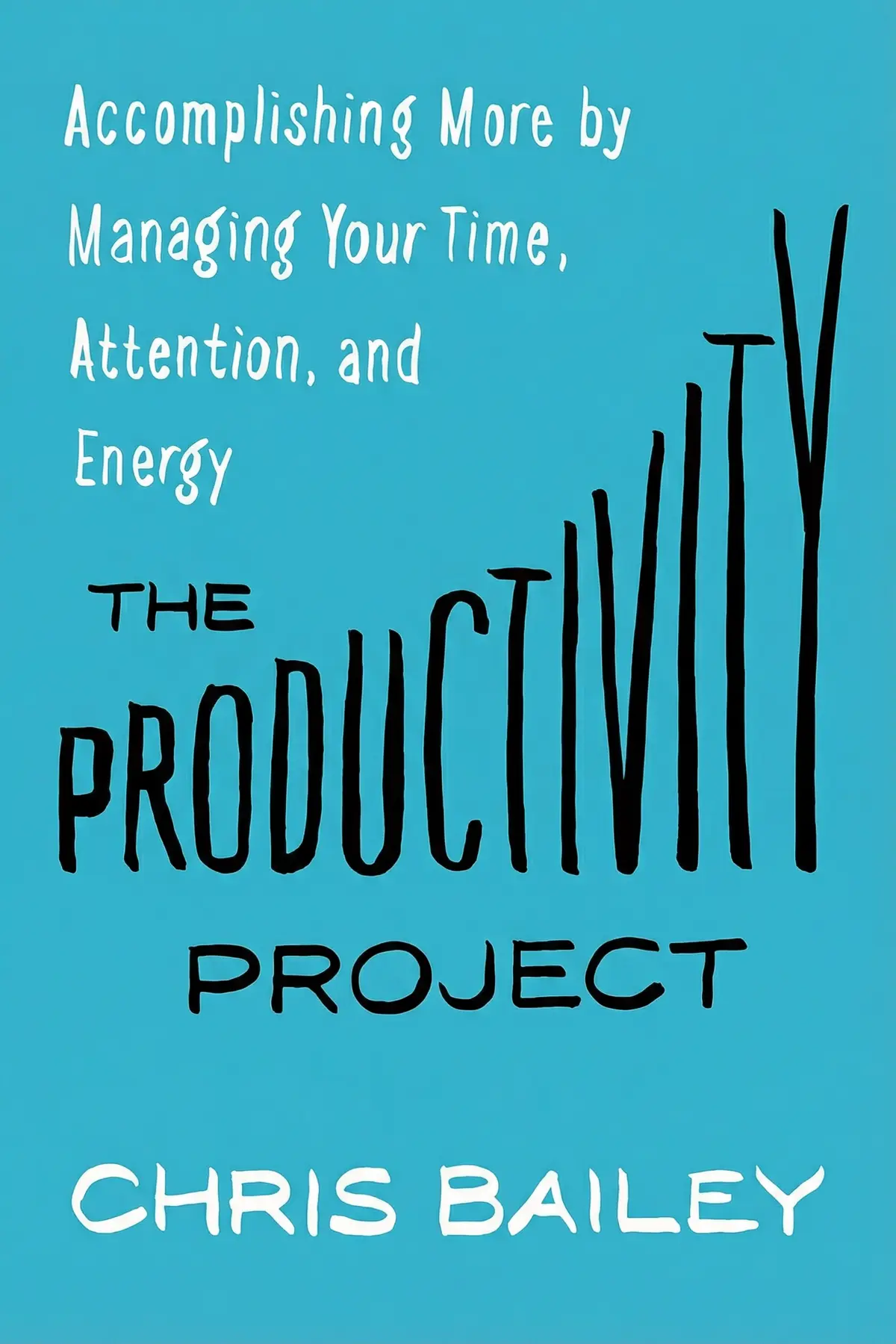
Table of Content
1. Introduction
1 min 01 sec
If your days fill up with activity while the important work keeps slipping to tomorrow, more hours are probably not the fix. In The Productivity Project, Canadian writer Chris Bailey reports on a year he spent testing productivity techniques on himself. One of his clearest findings is that his output barely changed whether he worked 20 hours a week or 90. Productivity, Bailey argues, means getting the important things done, and that depends on managing three resources together: your time, your attention and your energy.
Everything that follows comes back to that idea. Bailey starts with purpose, because a routine built for the wrong reason eventually collapses. Then he offers small tools you can test: three goals a day, a makeover for dreaded tasks, a cap on the working week and a habit of emptying your head onto paper. Each one is simple enough to try tomorrow morning. Together they show how to spend a limited number of hours on what you actually care about.
2. Find the pace between the trader and the monk
1 min 37 sec
One worker moves so fast he forgets why he works. Another reflects so deeply he barely finishes anything. Bailey places real productivity somewhere between them, and finding that spot takes more than a good schedule.
3. Know what your extra hours are for
1 min 30 sec
Bailey woke at 5:30 every morning for months, fit in the gym, reading and planning, and looked like a model of discipline. Then he noticed something about the routine that made all of it feel pointless.
4. Plan each day around three wins
1 min 38 sec
Most mornings begin with a clear plan that falls apart by the first email. A Microsoft executive’s simple rule keeps the plan intact, as long as you check one thing before you commit to it.
5. Give the task you dread a makeover
1 min 43 sec
A quarter of workers in one survey lost two hours or more a day to putting things off. A psychologist’s list of six traits explains why some jobs get delayed, and suggests a way to change them.
6. Cap your workweek between 35 and 40 hours
1 min 46 sec
Bailey tried weeks as short as 20 hours and as long as 90 to see which length gave him the best results. What he actually measured, and what a Stanford study found, should worry anyone who measures dedication in late nights.
7. Free your mind by writing everything down
1 min 30 sec
Walk into a supermarket without a list and your memory goes blank among the shelves. Bailey argues the same thing happens at work every day, and that the fix takes a few minutes and a pen.
8. Conclusion
1 min 11 sec
What Bailey learned from a year of testing on himself is that productivity is mostly about subtraction. The 5:30 alarm, the 90-hour week and the head full of unwritten lists all looked like effort, and none of them added much. What worked was choosing. That meant knowing why he wanted more done, picking a few goals, cutting the hours that only looked busy and clearing away whatever ate his attention.
That is why the monk and the trader make such a useful pair. Each manages one resource well and runs short of another. The productive person sits between them, calm enough to see what matters and driven enough to finish it.
The book supports a small start. Answer the two-extra-hours question tonight, so you know what your effort is meant to buy. Tomorrow morning, before opening email, empty your head onto a page and circle the three things that would make the day count, checked against your calendar. Silence your phone while you work on them. If one of the three is something you keep avoiding, take it to a cafe and promise yourself a reward for finishing.
More hours were never the answer. Better-chosen ones are.
About this book
What is this book about?
Many capable people end their days busy and tired, with the important work still waiting. Chris Bailey spent a year testing productivity techniques on himself to find out what actually helps. His conclusion is that productivity is not about doing more. It means getting the important things done, and that depends on three resources managed together: time, attention and energy. Bailey begins with purpose, because a routine built to impress others will not last. From there he offers a handful of simple, testable tools. He borrows the Rule of 3 from Microsoft executive J.D. Meier, uses psychologist Timothy Pychyl's six traits of tasks people put off, and reports on his own experiment with workweeks from 20 to 90 hours. He also explains why writing everything down frees the mind for real thinking. Readers get a short, practical system. It covers finding out what their extra time is for and choosing three goals a day. It shows how to make dreaded jobs bearable, keep the workweek near 40 hours and stop alerts from breaking their focus.
Book Information
Who it's for
Office workers staying late
Office workers who stay late every night yet feel the important work never moves.
Students and new professionals
Students and early-career professionals building their first routines and tempted to copy someone else's.
Wanting simple weekly planning
Freelancers and founders who postpone dull tasks and want simple tools for planning a week.
About the Author
Chris Bailey
Chris Bailey is a Canadian writer and productivity consultant whose articles have appeared in the New York Times, the National Post and Harvard Business Review. He has written four books, Intentional, Hyperfocus, The Productivity Project and How to Calm Your Mind, published together in more than 40 languages. He shares his ideas on his website, A Life of Productivity, and speaks to organizations around the world about becoming more productive while still enjoying the work.
Ratings & Reviews
Ratings at a glance

What people think
Listeners find this productivity guide to be a top-tier, accessible manual that offers actionable techniques for boosting output in creative fields. The content features valuable insights and tools, with one listener highlighting the integration of scientific studies, and listeners characterize the material as direct and fun. Feedback on the prose is varied: some listeners appreciate how well it is written, whereas others feel the book could be more succinct.
Top reviews
Supatra
Finally finished this massive dive into productivity, and I have to say the 'Rule of 3' is a total game-changer for my daily workflow. Chris Bailey spent a year as a human guinea pig, and while some experiments seem wild, the core lessons about energy management are spot on. I used to think productivity was just about grinding more hours, but his research into Biological Prime Time helped me realize I was wasting my best brainpower on emails. The writing is conversational and light, making it feel less like a dry textbook and more like a chat with a very intense friend. Not every tip will work for a parent or someone in a rigid 9-to-5, but the overall framework is incredibly flexible. I really appreciated how he cites actual scientific studies to back up his claims instead of just relying on 'vibes.' It’s a refreshing take on a genre that often feels stale and repetitive.
Show moreAim
Picked this up on a whim during a period of massive burnout, and it genuinely helped me reshape how I view my workday. The experiment comparing a 90-hour week to a 20-hour week was eye-opening and confirmed my suspicion that more time doesn't equal more results. Bailey’s tone is humble and honest, especially when he talks about the experiments that failed or made him feel miserable. I’ve started implementing the 'Maintenance Day' for all my boring errands, and it has freed up so much mental energy during the actual week. It’s rare to find a productivity book that actually encourages you to watch more movies or take more naps as a way to fuel your work. This is an excellent resource for anyone who feels like they are constantly running on a treadmill and getting nowhere. I would highly recommend it to anyone who does creative or knowledge work.
Show moreNan
This book actually surprised me with how much scientific data was woven into the narrative without making it feel like a chore to read. I loved the section on how caffeine affects our focus and why drinking water first thing in the morning can actually jumpstart your brain. Chris Bailey has a way of making complex cognitive concepts feel easy to understand and, more importantly, easy to apply to your own life. Some might find his personality a bit much, but I found his honesty about his own procrastination and struggles to be very relatable. The '20-second rule' for distractions has already helped me stop checking my phone every five minutes while I’m trying to write. It’s an entertaining and straightforward guide that actually delivers on its promise to help you accomplish more.
Show morePor
Why do we keep treating our time like it’s an infinite resource when our energy is clearly the thing that runs out first? This is the central question of Bailey’s project, and his answers are both practical and backed by interesting research. I’ve read a lot of self-help, but this is the first book that actually made me feel okay about taking a break to let my mind wander. The 'Rule of 3' is such a simple concept, yet it has completely transformed how I plan my weeks and lowered my daily anxiety levels significantly. I love how he breaks down the triggers of procrastination, making it easier to identify why I’m avoiding a specific project. It’s an easy, engaging read that offers a lot of value for anyone willing to actually do the exercises included in the text.
Show morePensri
Ever wonder what happens when someone treats their life like a laboratory for an entire year? Bailey’s approach to testing focus and energy is fascinating, even if the book feels a little bit longer than it probably needed to be. I particularly enjoyed the section on 'attentional space' and how our brains need room to wander to actually be creative. It’s a practical guide that moves beyond simple time management into the much more important realm of managing your attention. While I agree with other reviewers that some suggestions are a bit 'out there,' the underlying science is sound and well-explained. The chapters are broken down into manageable chunks with estimated reading times, which is a meta-touch that I actually found quite helpful. It’s not a perfect manifesto, but it’s a solid resource for anyone looking to optimize their output without burning out.
Show moreKofi
After hearing so much hype about this title, I was prepared to be disappointed, but the focus on 'intention' really resonated with me. The book asks you to define why you want to be productive in the first place, which is a step most other guides completely skip over. I’ve been using the 'Rule of 3' for two weeks now, and it’s surprisingly effective at cutting through the noise of a long to-do list. The author’s writing is very accessible, though I do think he overuses certain metaphors and could have been a bit more concise. I appreciated the specific tips on how to handle 'aversive' tasks—you know, the ones that are boring or unstructured. It isn't a revolutionary text, but it’s a very practical toolkit that focuses on energy rather than just grinding out minutes. A solid four stars for the actionable advice.
Show moreChatri
Not gonna lie, the idea of a guy spending a year just 'being productive' sounded a bit pretentious at first. However, once I got past the premise, I found the 'Biological Prime Time' tracking to be one of the most useful exercises I’ve ever done for my career. It turns out I was doing my hardest tasks when my energy was at its lowest, which explained why I was always so stressed. The book is well-written and moves at a fast pace, though some of the advice definitely assumes you have a high level of control over your environment. I wish there was a bit more focus on how to apply these techniques in a high-pressure corporate setting where you can't just ignore emails. Still, the core message about working smarter instead of longer is a lesson that everyone needs to hear at least once.
Show moreEvelyn
As a creative professional, I was hoping for more revolutionary insights, but what I got was mostly a well-organized collection of existing productivity tropes. To be fair, having all these techniques in one place is useful, and the author’s enthusiasm is definitely infectious throughout the chapters. I struggled with some of the more extreme suggestions, like checking email only three times a day, which would get me fired in about forty-eight hours. However, the concept of the 'Biological Prime Time' gave me a new vocabulary for something I had felt but never acted on. The writing style is a bit wordy, and you could probably get the same value from a long-form article, but the challenges at the end of each section are a nice touch. It’s a decent entry-level book for someone new to the self-help world, but veterans won’t find much new material here.
Show moreOwen
Look, most of this book could have been a series of tweets or a very short PDF instead of a full-length hardcover. While the author seems like a nice enough guy, his 'experiments' often feel like a young man playing at life rather than dealing with actual adult problems. I found the redundancy to be a major hurdle; he repeats the same three or four core ideas in every single chapter with slightly different wording. The advice to 'just say no' to meetings is laughable for anyone who isn't the CEO or a freelance blogger with no clients. It’s frustrating because there are a few decent nuggets of wisdom buried under mountains of fluff and unnecessary anecdotes about his year-long project. If you’ve read any other productivity book in the last decade, you can safely skip this one and not miss anything important.
Show morePakinee
The truth is, I found this book incredibly difficult to stomach because of the author’s obvious lack of real-world experience. It is easy to be 'productive' when you have zero responsibilities, no kids, and a massive safety net to support a year of meditation and blogging. He suggests things like ignoring your boss or hiring an assistant for $30 an hour as if that’s a viable option for the average person. Most of the 'insights' are just recycled common sense that you could find in a five-minute Google search or a better book like Getting Things Done. Frankly, the tone feels condescending and totally disconnected from the reality of modern office culture where you can't just turn your phone off for a week. I felt like I was being lectured by a privileged kid who has never had a 'real' job with consequences. Save your money and your time—ironically, this book is a total productivity killer.
Show moreQuestions about this book
What is the main idea of The Productivity Project?
Chris Bailey argues that productivity is not about doing more. It means getting the important things done. To do that you manage three resources together: time, attention and energy. He starts with purpose, asking what you would do with two extra hours a day. He then offers simple tools such as setting three goals a day, making dreaded tasks more pleasant, keeping the workweek near 40 hours and writing everything down.
What is the Rule of 3 in The Productivity Project?
Bailey borrows the Rule of 3 from Microsoft executive J.D. Meier, who wrote Getting Results the Agile Way. At the start of each week you choose three things to finish by its end. At the start of each day you choose three things to complete before bed. Bailey adds one check: look at your calendar first, so a booked presentation or meeting does not make your goals unrealistic.
How many hours a week does Chris Bailey recommend working?
About 35 to 40. Bailey tested workweeks from 20 to 90 hours and got roughly the same amount done, because his energy and attention stretched or shrank to fit the time. He also cites journalist Sara Robinson’s review of 150 years of research, which found tasks take twice as long past 60 hours, and a Stanford study showing productivity falls sharply after 55 hours.
How does The Productivity Project suggest beating procrastination?
Bailey uses psychologist Timothy Pychyl’s six traits of tasks people delay: boring, frustrating, difficult, unstructured, without personal meaning and without a built-in reward. The more traits a task has, the more you postpone it. His fix is a makeover. You could do your taxes in a favorite cafe with a drink you enjoy, or pay yourself an hourly wage for the task and spend it on a treat.
Readers also enjoyed



AUDIO SUMMARY AVAILABLE
Listen to The Productivity Project in 15 minutes
Get the key ideas from The Productivity Project by Chris Bailey, plus 5,000+ more nonfiction titles.
- 5,000+ titles
- Listen as much as you want
- 7-day free trial
- Cancel anytime









