
12 min 34 sec
Available in: English
The Practice of Not Thinking
A Japanese monk's guide to calming an overactive mind. Name the habits that drive overthinking, then turn your attention to sound, sight and touch through small exercises that fit into an ordinary workday.
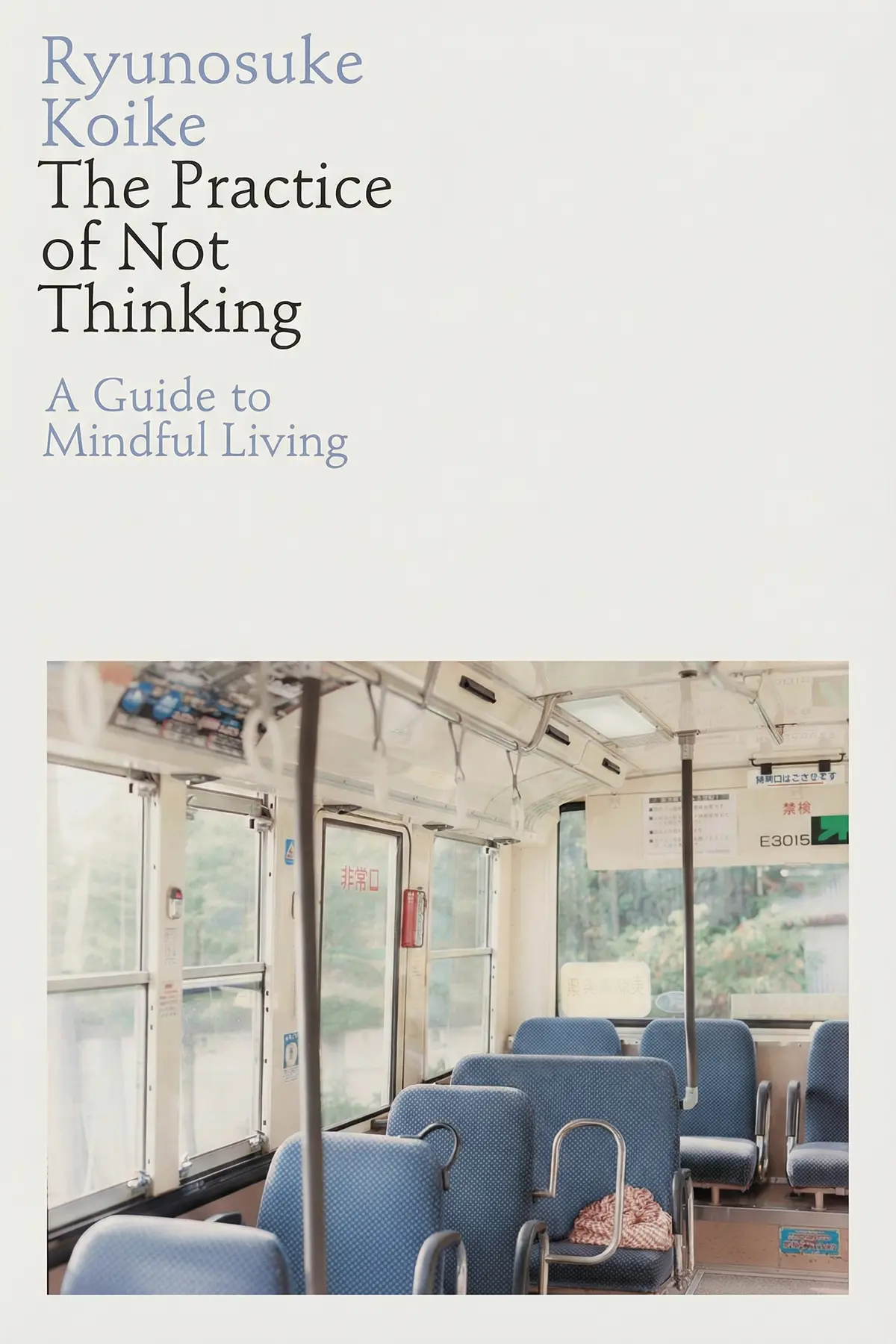
Table of Content
1. Introduction
1 min 08 sec
If your mind keeps undoing your own plans, replaying a small mistake from yesterday or doubting a task before you begin it, you may be thinking too much, not too little. In The Practice of Not Thinking, the Japanese monk Ryunosuke Koike argues that the brain is built to hunt for stimulation, and that negative thoughts capture it far more strongly than calm ones. His remedy is a form of mindfulness built on the senses, which means paying deliberate attention to sights, sounds, textures, flavors and scents.
Koike studied philosophy at the University of Tokyo and teaches Zazen meditation. In this book he joins old Buddhist teaching to scenes from modern working life. The whole argument rests on one claim. Overthinking runs on habits of craving, resisting and not noticing, and returning to the senses interrupts those habits right where they start.
Along the way you get a short phrase that takes the heat out of irritation, a brief listening exercise to try before meetings and a simple way to restore focus through your hands and feet.
2. See the three habits that feed your overthinking
2 min 10 sec
A shallow compliment, a sharp remark and a conversation you only half heard all seem harmless. Buddhist teaching says each one starts a different kind of mental noise, and together they keep the chatter going.
3. Defuse irritation by calling it a thought
2 min 07 sec
Venting feels good and holding it in feels mature, yet Koike argues that both make anger worse over time. A third response exists, and it fits into a sentence short enough to say under your breath.
4. Listen better at work by noticing ordinary sounds
1 min 59 sec
Your favorite song before a meeting may be the reason you cannot follow a colleague who then starts talking about a project. Koike offers a simple warm-up for the ears, built on an old Buddhist idea about how everything connects.
5. Guard your eyes against images that agitate
2 min 02 sec
Someone from two centuries ago would be stunned by what passes in front of your eyes in a single day. Koike argues that the habit costs more than time: it blunts your ability to see.
6. Reset a scattered mind through your hands and feet
1 min 52 sec
Hours at a desk leave you restless, and the usual escape only scatters you further. Koike points to touch as one of the best ways to regain clarity, and to an unlikely training ground: the vacuum cleaner.
7. Conclusion
1 min 16 sec
Koike’s book reverses a common instinct. When the mind is loud, most of us try to think our way out, analyzing the worry or arguing with it. He points the other way, toward the plain evidence of the senses. Desire, anger and ignorance keep the chatter running because they pull attention away from what is actually happening. Hearing the air conditioning, watching a street sign grow and pass, feeling the keys under your fingers: each of these brings it back.
The approach is usable because it is small. Nothing here requires a retreat or an hour of sitting. The practices fit into the gaps of an ordinary workday. When irritation rises, tag it with the words I’m irritated, I think, and let it pass before you answer. Before a meeting that matters, spend a few moments on the background sounds so your ears are ready for a colleague’s voice. When focus breaks down, give up one more scroll through distressing headlines and feel your feet on the floor.
Each practice trains attention, and trained attention carries over from home to work and from one moment to the next. The world you kept thinking about was there all along, waiting to be noticed.
About this book
What is this book about?
You can start the day with energy and watch it fade as the hours pass. They overthink simple tasks, doubt themselves and replay small mistakes. Ryunosuke Koike, a Japanese monk who teaches Zazen meditation, argues that this happens because the brain looks for stimulation, and negative thoughts hold its attention more strongly than calm ones. Koike draws on Buddhist teaching to explain the pattern. He describes three poisons, desire, anger and ignorance, that keep the mind's chatter running and pull us away from the present. His answer is not to think harder. He calls it sense-oriented mindfulness: steady attention to what you hear, see, touch, taste and smell. The book turns that idea into small, specific practices. A short phrase takes the heat out of irritation before you snap. A few moments of listening to background sounds help you focus in meetings. Cutting back on agitating images keeps your sight sharp, and paying attention to your chair, your keyboard and your feet brings a scattered mind back to the task. Readers get a clear account of why their minds run away from them and a set of practices they can try that same day.
Book Information
Who it's for
Interrupted desk workers
Office workers whose focus breaks apart under constant meetings, messages and interruptions.
Overthinkers
People who replay small mistakes and sharp remarks long after the moment has passed.
New meditators
Beginners to meditation who want short practices built on sound, sight and touch.
About the Author
Ryunosuke Koike
Ryunosuke Koike is a Japanese monk who joins traditional Buddhist wisdom with contemporary ideas. He graduated from the University of Tokyo, where he specialized in philosophy. Koike leads courses in Zazen meditation, and his work centers on mindfulness and mental clarity. He has written several bestselling books in Japan.
Ratings & Reviews
Ratings at a glance

What people think
Listeners view this title as a functional gateway to Zen Buddhism, and while perspectives on the author’s sometimes direct tone vary, many find value in the uncomplicated methods for attaining a tranquil mind. Furthermore, they respect the priority given to using mindfulness in daily life, with one listener remarking that the tips for decluttering physical objects helped them manage the anxiety of letting go. They also point to the featured conversation with a neuroscientist as a fascinating addition that delves into the intersection of meditative techniques and brain science.
Top reviews
Chiw
This book is a refreshing departure from the usual fluff you find in the self-help section of most bookstores. Ryunosuke Koike doesn't offer 'positive thinking' or affirmations; instead, he shows you how to stop the cycle of useless thoughts entirely. I found his description of 'thought disease' to be a perfect metaphor for the way my anxiety functions. The strategies for controlling the senses—like how to view 'neutral' objects to calm the mind—are brilliant in their simplicity. Even the dialogue with the neuroscientist was enlightening, as it explored the intersection of meditative states and brain waves without making overblown claims. It’s a short volume, but it’s packed with insights that I keep coming back to whenever I feel overwhelmed. This is the pure stuff, straight from a former monk who knows exactly how the mind tries to trick us into suffering.
Show moreJom
Wow, I didn't expect a short volume like this to have such a profound impact on my daily anxiety levels. The trick, according to Koike, is not to try to defeat your negative thoughts but to see them as the wisps they actually are. I’ve started using his technique for 'noticing' my senses when I’m eating, and it has completely changed my relationship with food. I’m much more present and far less stressed. The author’s pragmatic approach makes mindfulness feel like a skill you can actually master with practice. Truth is, I even appreciated the blunt sections because they forced me to examine my own ego and why I get offended so easily. If you are serious about a mindful living practice, I thoroughly recommend this authentic source. It’s a clear and straightforward marvel of a book that stays with you long after you finish it.
Show moreBank
Look, there are some undeniable gems hidden in these pages, and for me, they were absolutely life-changing. I especially loved the section on journaling and planning, which is something many mindfulness books tend to overlook. Koike shows how to organize your life without becoming attached to the outcomes, which is a difficult balance to strike. The emphasis on 'not thinking' isn't about becoming a zombie; it's about being so present in your actions that there's no room for the useless chatter of the ego. I found the advice on how to handle silence particularly moving. It’s not just about the absence of noise, but about how you relate to the world around you. While his tone is occasionally sharp, I think that’s necessary to wake the reader up from their habitual patterns. This is easily one of the most practical Zen books I’ve ever owned.
Show moreRosa
Finally got around to reading this, and I was surprised by how much the practical strategies resonated with my daily routine. The author argues that our brains are constantly overstimulated by internal noise, and he provides a step-by-step guide to quieting that chatter. I’ve started practicing the 'mindful listening' technique he describes, where you focus purely on the vibration of sounds rather than labeling them. It really helps when I'm feeling stressed at work or in a crowded area. Look, the guy is definitely blunt, and he doesn't sugarcoat his views on things like greed or laziness. Some people might find him rude, but I found the directness refreshing compared to the usual vague 'just breathe' advice. The chapters are short enough to read one per morning as a meditation. It’s a solid 4-star guide for anyone who actually wants to change their habits rather than just read about philosophy.
Show morePaisley
The chapter on discarding physical items was exactly what I needed to hear to finally clear out some clutter in my apartment. Koike explains that we often hold onto things out of a fear of the future, and that this 'stuff' eventually weighs down our minds. I finally let go of a bulky cabinet I hadn't used in years because I realized I was only keeping it 'just in case' my life changed. In my experience, the book works best when you treat it as a series of experiments rather than a rigid set of rules. The advice on breathing and walking with awareness is classic Zen but presented in a very modern, jargon-free way. Not gonna lie, some of the relationship advice is questionable, but the core message of decluttering your mind is powerful. It’s a pragmatic entry point into Buddhism that focuses heavily on action.
Show moreTong
After hearing a lot about this Japanese bestseller, I decided to give it a shot as a newcomer to Zen concepts. The book is divided into short, digestible sections that focus on the five senses, which makes the practice feel accessible. I appreciated the emphasis on doing one thing at a time, like fully noticing the act of swallowing your water or feeling the weight of your feet on the ground. However, some of the specific advice is incredibly blunt and might rub people the wrong way. For instance, the section on how to talk to a partner about their weight felt extremely harsh and socially awkward. Personally, I found the interview with the neuroscientist at the end to be the most compelling part of the book. It provided some much-needed scientific grounding for the monk’s more abstract claims. It’s a bit of a mixed bag, but worth a skim for the basic exercises.
Show moreSatit
Ever wonder how to actually apply Zen to your morning commute or your cluttered desk? This book attempts to bridge that gap with very specific, albeit sometimes strange, instructions for daily life. I liked the focus on 'sensory' living over 'thought' living, which did help me catch myself when I was spiraling into useless worries about the future. On the downside, the author's disdain for things like comedy and common social interactions felt a bit extreme and unnecessary for a layperson. Gotta say, the translation is smooth and the book is physically small enough to carry around, which is a plus. It’s not a life-changing masterpiece, but it serves as a decent reminder to slow down. Just be prepared to take some of his more eccentric opinions with a massive grain of salt. It’s a 3-star read that offers some utility if you can ignore the occasional judgmental remark.
Show morePlernpiriya
While the cover is beautiful and the title is very catchy, the actual content falls flat under any kind of scrutiny. Koike makes some truly wild claims, such as the idea that senility in old age is simply caused by 'noise' from past thoughts blocking new realities. That kind of victim-blaming for serious medical conditions is dangerous and highly irresponsible. To be fair, he does offer some basic tips on being present while eating or drinking, but these are buried under pseudoscience about how dull knives destroy the nutrients in vegetables. Truth is, most of this felt like a guide to overthinking rather than the opposite. The author seems to jump to massive conclusions based on very flimsy, anecdotal evidence that rarely applies to a modern, western context. If you are looking for a grounded introduction to Zen, I would suggest looking elsewhere and skipping this particular volume.
Show moreKanchana
To be fair, Koike provides a decent introduction to basic mindfulness, but his conclusions are often far too simplistic for complex modern lives. I found the writing style repetitive and the tone a bit too 'holier-than-thou' for my liking. It feels like the author is trying to create a 'thought disease' out of every normal human emotion. I was particularly put off by the dietary advice, specifically the claim that a vegetarian diet makes your stools smell less pungent as if that’s a primary reason to change your lifestyle. There are so many better reasons for plant-based living, like animal welfare or sustainability. The book tries to be a practical manual for everything from sleeping to talking, but it ends up feeling like a list of chores. It lacks the warmth and depth I’ve found in works by Thich Nhat Hanh. It’s a very quick read, but not necessarily a nourishing one.
Show moreSam
I really wanted to like this, but the author’s tone felt incredibly judgmental and borderline mean-spirited in several chapters. By the time I reached the part where Koike suggests telling an overweight partner that their body size causes you social embarrassment just to motivate them, I was ready to throw the book across the room. Frankly, this doesn’t feel like compassionate Zen Buddhism; it feels like a collection of personal biases disguised as ancient wisdom. He even attacks the concept of laughter, claiming it stems from a sense of superiority or ignorance, which is a bizarrely narrow view of human connection. The advice on parenting also felt completely detached from the reality of raising actual children. While the core idea of reducing mental noise is valuable, the delivery is so hectoring and blunt that it’s hard to extract anything positive. I've read much better books on mindfulness that don't make you feel like a failure for enjoying a joke or having a snack.
Show moreQuestions about this book
What is the main idea of The Practice of Not Thinking?
Ryunosuke Koike argues that overthinking comes from three habits Buddhist teaching calls poisons: desire, anger and ignorance. The brain seeks stimulation and finds negative thoughts more gripping than calm ones, so the chatter grows. His remedy is sense-oriented mindfulness, which means paying steady attention to what you hear, see and touch. Doing this interrupts the mental noise and brings you back to the present.
How does Koike suggest handling anger and irritation?
He rejects both venting and suppressing. Venting feels rewarding and makes a quick temper more likely, while suppressing adds frustration at being frustrated. Instead, watch the emotion as it arises and say to yourself, I’m irritated, I think. The phrase turns the feeling into a passing thought, which creates a gap before you react, for example before snapping at your partner.
How can mindful listening improve focus at work?
Koike suggests spending a few moments before a meeting listening to ordinary background sounds, such as the hum of the air conditioning, footsteps or rustling papers. This prepares the mind to accept everyday input, so a colleague’s voice no longer feels dull after your favorite music. He links it to the Buddhist idea of dependent arising: attention in one moment improves attention in the next.
What practical exercises does The Practice of Not Thinking offer?
The exercises are short. Tag irritation as a thought. Listen to background sounds before conversations. Limit violent or sensational images and watch the small details on a walk. When stress builds at your desk, feel where your body meets the chair or notice the keys under your fingertips. If focus fails, step away and pay attention to the physical feel of tidying, cooking or vacuuming.
Who should read The Practice of Not Thinking?
It suits people whose busy minds work against them: professionals distracted by constant interruptions, people who replay slights and mistakes, and anyone who loses hours to scrolling distressing news. It also fits beginners to mindfulness who want practices tied to everyday moments, such as meetings, walks and desk work, instead of long meditation sessions.
Readers also enjoyed

A New Earth: Awakening to Your Life’s Purpose
Eckhart Tolle


Aflame: Learning from Silence
Pico Iyer
Be Here Now
Ram Dass

Aware: The Science and Practice of Presence
Daniel Siegel
AUDIO SUMMARY AVAILABLE
Listen to The Practice of Not Thinking in 15 minutes
Get the key ideas from The Practice of Not Thinking by Ryunosuke Koike, plus 5,000+ more nonfiction titles.
- 5,000+ titles
- Listen as much as you want
- 7-day free trial
- Cancel anytime









