

13 min 51 sec
Available in: English
The Model Thinker: What You Need to Know to Make Data Work for You
Shows how simple models such as bell curves, power laws, straight lines and curves turn raw data into explanations, designs and forecasts, and why combining several models beats trusting any single one.
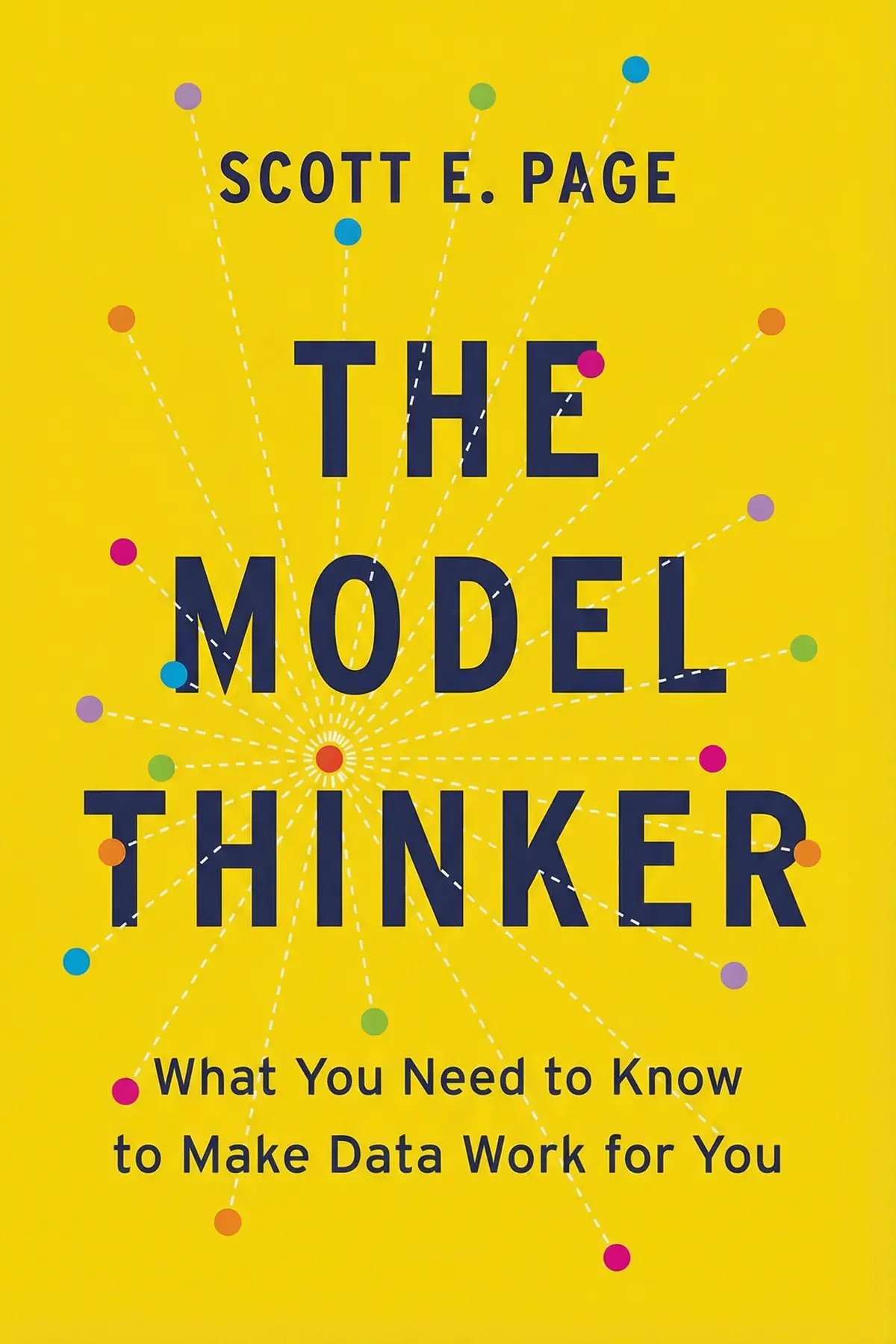
Table of Content
1. Introduction
1 min 01 sec
Most of us sit on more numbers than we can use. What we buy, eat, stream and even whom we date is recorded somewhere, yet raw data explains nothing by itself. In The Model Thinker, Michigan professor Scott E. Page argues that a model is what turns data into understanding: a deliberate simplification that strips away noise and keeps the few factors that actually drive an outcome. With models we can explain what puzzles us, design what does not yet exist and predict what comes next.
Page’s larger claim is that no single model is ever enough. Each one fits some systems and not others, and each is built by people who make mistakes. The skill is to recognize the shape a problem has and then check your answer from several angles. A lost airliner, a bell curve of school grades, a college club that keeps growing and a pizza that loses its charm slice by slice each give you a tool for your next decision.
2. Turn scattered data into answers you can act on
1 min 36 sec
Searchers spent weeks, then a second attempt a year later, hunting for a lost airliner in the Atlantic and found nothing. What finally led them to the wreck within days had nothing to do with more ships.
3. Know when the average tells the whole story
1 min 36 sec
Teachers see far more C students than A plus students, and nobody finds that strange. The pattern behind it runs through height, aircraft design and much more, but it fails badly for one thing people care about a lot.
4. See how growth makes more growth easier
1 min 40 sec
Ten students arrive on a new campus and form three clubs of very different sizes. The odds of where the eleventh student goes reveal the hidden rule behind fortunes, best sellers and viral videos.
5. Test a hunch with a straight line
1 min 35 sec
You suspect that tea drinkers are less often depressed, and a graph seems to agree. One simple technique can tell you whether the link is real, and one warning tells you what it can never prove.
6. Stop assuming this year's growth repeats next year
1 min 46 sec
The first slice of pizza after a long hike tastes wonderful, and the last barely registers. That same bend in the curve explains why fast-growing economies slow down and why forecasts so often overshoot.
7. Choose the right picture of how people decide
1 min 46 sec
Bowling balls never change their minds, which makes them easy to model. People feel pressure, make mistakes and sometimes learn. Page offers a way to decide which version of a person you are actually dealing with.
8. Consult many models, the way you consult friends
1 min 38 sec
Polls have called states by a landslide that the candidate then lost. A theorem about juries explains how to make your forecasts less prone to that kind of miss, and where that protection quietly breaks down.
9. Conclusion
1 min 13 sec
What Page offers is a different way to face a pile of numbers. The searchers over the Atlantic had the whole ocean in front of them, but the wreck stayed hidden until a model told them where to look. Each tool in the book is a shape the world can take. Height crowds around an average. Club membership and fortunes feed on themselves. Some quantities move in step, some bend as they grow, and human choices depend on what kind of decider is choosing. Seeing the shape correctly is half the work.
The other half is humility. Every model is made by someone who can be wrong, which is why Page keeps returning to the jury: several reasonable views, combined, beat any single one.
The habits follow naturally. Before trusting an average, check whether a few extremes dominate it. Before extending a trend, ask whether it is starting to bend. When two numbers rise and fall together, look for another explanation before you assume one causes the other. And before a big call, test it against models that start from genuinely different places. The plane was found in a week, once someone picked the right model and searched where it pointed.
About this book
What is this book about?
Numbers about what we buy, eat, stream and even whom we date are collected all the time, yet raw data explains nothing on its own. Scott E. Page, a professor at the University of Michigan who studies complex systems, argues that what turns data into understanding is a model: a deliberate simplification that keeps the few factors that decide an outcome and drops the noise. Page shows how models help us explain puzzling events, design products and policies before committing to them, and predict what comes next. He walks through the basic shapes the world can take: the bell curve behind school grades and height, the power law behind wealth and viral videos, the straight line of linear regression, and the bending curves of enjoyment and economic growth. He also explains why people are so hard to model, and how to choose between rule-following and rational pictures of human choice. The book's larger lesson is humility. Every model is made by people who can be wrong, so Page urges readers to consult many diverse models, much as a jury of mostly right members reaches better verdicts than any one juror.
Book Information
Who it's for
Everyday data users
Analysts, managers and students who handle data every day but are unsure which tool fits which question.
Growth forecasters
Founders and planners who forecast growth and want to stop extending straight lines.
Curious statistics learners
Curious readers who want plain explanations of bell curves, power laws and regression.
About the Author
Scott E. Page
Scott E. Page has taught at the University of Michigan since 2000, where he holds a distinguished university professorship named for John Seely Brown. He directed Michigan's Center for the Study of Complex Systems from 2009 to 2014 and is external faculty at the Santa Fe Institute. His research covers collective wisdom, path dependence and computer models of social life. A Guggenheim Fellow and member of the American Academy of Arts and Sciences, he also wrote The Difference and The Diversity Bonus and teaches the online Model Thinking course on Coursera.
Ratings & Reviews
Ratings at a glance
What people think
Listeners consider the work highly educational and skillfully authored, aiding their ability to express intricate concepts while offering an overview of essential modeling techniques. Furthermore, they value the content and find it engaging, with one listener characterizing it as a weighty subject handled with systematic clarity. The opening section also earns praise, as one listener points out it serves as a superb guide to modeling both social and natural occurrences. On the other hand, the prose style draws varied opinions, including one listener who finds the mathematical formulas somewhat daunting.
Top reviews
Nan
Working as a data scientist, I often find myself searching for a comprehensive reference that bridges the gap between raw data and actionable wisdom. Scott Page delivers a masterclass in how to look at the world through diverse lenses rather than relying on a single, flawed perspective. The 'Many Model' approach is revolutionary because it forces you to acknowledge that no single framework can capture the complexity of human behavior or natural systems. I particularly appreciated the sections on signaling and spatial models; they offered immediate utility for my current projects. While the math can feel dense for a casual reader, the real-world examples in every chapter keep the concepts grounded. Frankly, this isn't a book you read once and put away. It’s a desk reference that I’ll be returning to whenever I feel stuck in a linear thinking rut. Truly an essential guide for anyone working in analytics or strategy.
Show moreDream
Wow, this is easily one of the most organized and informative overviews of systems thinking I've ever encountered. Page manages to survey an incredible amount of ground, from game theory to random walks, without it feeling like a disjointed mess. Every chapter follows a logical structure: definition, math, and application. This consistency makes it an excellent reference book for when you're trying to frame a difficult problem. The introduction alone is worth the price of admission for its explanation of why 'many-model' thinking is superior to expertise in a single niche. Personally, I found the examples regarding social inequality and population growth to be particularly enlightening. It’s a dense read, but the value you get out of it is immense. If you’re a geek for graphs and logical frameworks, you need this on your shelf.
Show moreAroon
Directly stating my opinion: this is one of the most important books on thinking I’ve read in the last decade. It treats a serious topic with the organization and gravity it deserves without becoming totally inaccessible. Page’s 'Many-Model' approach has completely changed how I consume news and analyze business trends. Instead of looking for a single cause, I now look for the interaction of different systems. The book is dense, yes, but it’s dense with actual substance, not fluff. Not gonna lie, I had to read several chapters twice to really 'get' the mathematical nuances, but the effort was rewarded. It’s a survey of human ingenuity in understanding the world. Whether you're a programmer, a manager, or just a curious person, this book offers a set of mental tools that are worth their weight in gold. A must-read for the modern age.
Show morePisit
The chapter on the Global Financial Crisis was what finally made all these abstract concepts click for me. Scott Page has a unique talent for taking high-level modeling techniques and applying them to messy, real-world events. I loved how the book moves from simple distributions to complex adaptive systems without losing the narrative thread. It’s a serious treatment of a complex topic, yet it remains accessible if you’re willing to put in the mental work. My only gripe is the Kindle formatting, which makes some of the diagrams nearly impossible to read. To be fair, that’s a technical issue rather than a content one, but it did impact my enjoyment. It provides a fantastic survey of important methods that most people never encounter in school. If you want to articulate complex ideas more clearly, this is a great starting point for your library.
Show morePrae
After hearing about Page's work in a management seminar, I decided to dive in and see if it could help my strategic planning. The book is essentially an encyclopedia of intellectual tools. In an era of big data, simply having information isn't enough; you need the right framework to interpret it. Page’s argument for leveraging multiple perspectives to solve 'wicked' problems is spot on. I’ve already started using some of the signaling models to rethink our marketing approach. My one caution is that you shouldn't try to read this cover to cover in a weekend. It took me nearly two months to digest because the content is so concentrated. Some sections on the mathematical breakdowns are a bit dense, but you can skim those if you're more interested in the conceptual application. It’s a solid 4-star resource for any professional analyst.
Show morePop
Ever wonder why some problems seem impossible to solve until you look at them from a completely different angle? Page explores that exact phenomenon by providing a massive toolkit of models. I was pleasantly surprised by the emphasis on creativity; it's not often you see a math-heavy book acknowledge the artistic side of data analysis. By teaching us how to switch between different frameworks, the author helps us see patterns we would otherwise miss. To be honest, I do wish there were more illustrations and diagrams to break up the text. Some of the more complex concepts, like the spatial models, would have been much easier to grasp with better visual aids. That said, the introduction is superb and the overall quality of the writing is high. It’s a great pick for anyone who wants to sharpen their logical reasoning.
Show moreOrawan
Picked this up as a supplement to my graduate stats course and it has been a lifesaver. While it doesn't have the deep-dive math of a specialized textbook, it provides the connective tissue that many academic courses lack. It explains the 'why' behind the models, which is something many professors gloss over in favor of pure calculation. The writing is clear and the chapters are short enough to be digestible in small bursts. I particularly liked the discussion on how to avoid the 'law of the instrument' by having a broad variety of tools at your disposal. Some of the formulas are a bit intimidating at first glance, but the real-life scenarios usually clarify things quickly. It’s a very practical guide for anyone who needs to make sense of natural and social phenomena. Definitely a worthwhile investment for students or researchers.
Show moreDaranee
Finally got around to this after seeing it recommended on Coursera, but I have mixed feelings. The core premise—that we need multiple models to understand the world—is incredibly powerful and well-argued. However, the execution feels like a dry encyclopedia that’s more concerned with breadth than depth. Truth is, the first hundred pages were a slog of definitions that I’d already encountered elsewhere. I found myself nodding off during the more repetitive sections on basic statistics. Some of the formulas are just dropped there without enough context for those who aren't already math-inclined. It’s caught in a weird middle ground where it’s too heavy for a pop-science book but not rigorous enough for a proper textbook. If you're a beginner, it's overwhelming; if you're an expert, it's review. Still, it’s a decent reference to keep on the shelf for when you need a quick refresh on a specific model.
Show moreAnucha
This book is like a five-course meal where every dish is just a different kind of potato. It’s good, solid, and nutritious, but eventually, you just want something else to happen. The content is undoubtedly important, but the delivery is so incredibly dry that it’s hard to stay engaged for more than a chapter at a time. I found the first half quite tedious because it covers a lot of ground that anyone with a basic social science degree already knows. However, the later sections on complex systems and hedonic models provide some interesting nuggets that I hadn't seen before. I think it works best as a reference book rather than a narrative. It’s not enjoyable to read, but it’s definitely useful to have. I’ll keep it nearby for work, but I won’t be reading it again for fun.
Show moreJai
Not what I expected at all given the catchy title and the hype surrounding the author's lectures. I found the writing style to be incredibly dry, almost like reading a technical manual for a piece of software I don’t own. The book seems to struggle with its identity, landing somewhere between a narrative and a textbook without succeeding at either. I was hoping for more practical guidance on how to actually apply these models to my daily life. Instead, I got a lot of intimidating formulas and very little 'so what?' factor. Look, I appreciate the intelligence behind it, but the lack of illustrations makes the numerical reasoning feel like a chore. It’s probably a great companion for a structured course, but as a standalone read, it’s a bit of a bore. I wouldn't recommend it unless you're already deeply invested in the subject matter.
Show moreQuestions about this book
What is the main idea of The Model Thinker by Scott E. Page?
Page argues that raw data becomes useful only when we run it through models, simplifications that keep the factors that matter and drop the noise. Models help us explain events, design products and policies, and predict outcomes. Because each model fits only some systems and is made by fallible people, he urges readers to combine many diverse models rather than trust any one.
What is the difference between a normal distribution and a power law?
A normal distribution, or bell curve, clusters values around a central mean, with equal deviations on both sides equally likely and extremes rare, as with height or school grades. A power law describes systems that amplify themselves, such as wealth, book sales or viral videos, where a few cases become huge. Page explains the second with preferential attachment, where bigger things attract growth in proportion to their size.
Does linear regression prove that one thing causes another?
No. Page stresses that when a straight line fits plotted values, it shows only that two variables are associated. His example is tea drinking and depression: tea drinkers might simply happen to be less depressed. Proving cause requires a proper experiment. Regression is still useful because it points to which questions deserve that more careful testing.
Why does Page recommend using many models?
He draws on Condorcet’s jury theorem: if each juror is right more often than wrong, the majority is more likely to be right than any individual, and adding jurors improves the odds. The same holds for models. The catch is that the models must truly differ; sorting voters by income and by education, for example, gives overlapping views that add less variety than they seem to.
How can I apply The Model Thinker at work?
Start by naming the few variables that drive a result. Check whether your data clusters around an average or is dominated by a few extremes. Treat any chart where two numbers move together as a lead, not proof. Be wary of extending growth in a straight line, since many trends bend. And test important decisions against several models built from different starting points.
Readers also enjoyed

Adults in The Room: My Battle With Europe’s Deep Establishment
Yanis Varoufakis

1929: Inside the Greatest Crash in Wall Street History--and How It
Andrew Ross Sorkin

23 Things They Don’t Tell You About Capitalism
Ha-Joon Chang
A Little History of Economics
Niall Kishtainy


A Splendid Exchange: How Trade Shaped the World
William J. Bernstein

AUDIO SUMMARY AVAILABLE
Listen to The Model Thinker in 15 minutes
Get the key ideas from The Model Thinker by Scott E. Page, plus 5,000+ more nonfiction titles.
- 5,000+ titles
- Listen as much as you want
- 7-day free trial
- Cancel anytime









