
13 min 38 sec
Available in: English
The Messy Middle: Finding Your Way Through the Hardest and Most Crucial Part of Any Bold Venture
By Scott Belsky
Shows how to survive the long, volatile stretch between launching a venture and finishing it, using self-made milestones, honest self-awareness, patient long-term bets and steady testing of what already works.
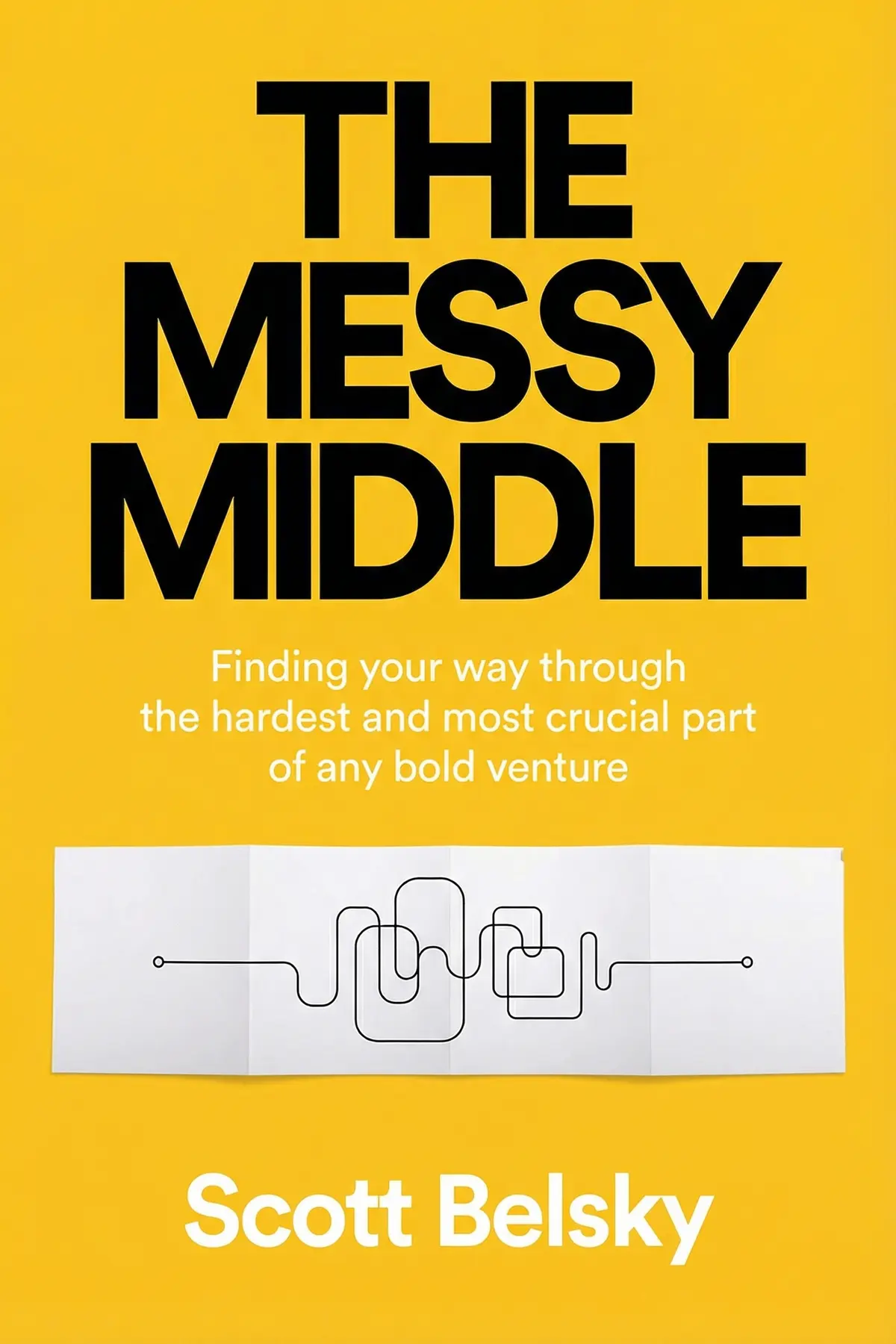
Table of Content
1. Introduction
1 min 01 sec
If you have started something bold, like a company, a book or a new team, you know the thrill of the launch and you dream about the finish. In The Messy Middle, Scott Belsky argues that neither one decides the outcome. What decides it is the long, unstable stretch in between, where your enthusiasm and the project itself swell and shrink without warning.
Ninety percent of start-ups fail before they make any mark on their market. Belsky, who built the creative platform Behance through years of doubt, treats that middle as the real test. His case is that you get through it by managing yourself as carefully as the venture: inventing rewards, guarding your judgment, betting on the long term and improving what already works.
The ideas ahead give you a calmer way to read your own lows, a method for keeping a team motivated before any money arrives, and a habit of testing small changes until your progress starts to slope upward.
2. Expect the middle to be the hardest stretch
1 min 52 sec
The usual story of success runs from idea to hard work to a steady climb. Belsky lived through years that looked nothing like that, and his account changes how a bad month should be read.
3. Make your own rewards before the market does
1 min 55 sec
Long creative work pays almost nothing for years, and people are trained from childhood to need regular payoffs. One odd problem with a search engine gave Belsky’s team a way to feel like winners anyway.
4. Guard your judgment at every peak and valley
1 min 53 sec
A great quarter and a terrible one can damage a founder’s thinking in opposite ways. Belsky has watched which founders get through both, and their shared habit is uncomfortable for most of us.
5. Invest in patient bets that pay off later
2 min 05 sec
In 2000, one company had the chance to buy a promising but unproven venture for a bargain sum and said no. The decision shows what happens when a busy schedule leaves no room for the long view.
6. Improve what already works with small tests
1 min 52 sec
Most teams pour their energy into fixing what is broken. Internet companies built a habit around a different question, and it applies just as well to meetings, routines and the tools on your desk.
7. Keep your early boldness long after success
1 min 49 sec
Reaching the finish line has a hidden cost that most founders never see coming. One company that has stayed good at resisting it uses a slogan on posters and laptop stickers around its headquarters.
8. Conclusion
1 min 11 sec
The Messy Middle reframes what being in trouble feels like. The swings, the silence from the outside world and the doubt that keeps you awake all feel like signs of failure. Belsky treats them as the normal weather of the stretch that decides everything, and his own years of anti-nausea pills at Behance show how rough that weather can get, even for a project that later succeeded.
What the book offers is a way to steer through it. Invent the milestones the market will not give you yet, and celebrate them, even with cheap champagne. Watch for the arrogance that comes with good weeks and the blame that comes with bad ones, and ask for criticism before it is forced on you. Keep running small tests on what already works.
And if a venture does not end the way you hoped, Belsky’s advice is to finish with grace. Resist the urge to shut it down fast and disappear. Face your investors and other stakeholders, own the outcome and explain it, because your reputation is what you carry into the next attempt.
Every bold project ends somewhere. How you leave it is the one part fully in your hands.
About this book
What is this book about?
Launches and exits get the headlines, yet 90 percent of start-ups fail before they make any real impact. Scott Belsky, who helped create the creative platform Behance, argues that what separates the survivors happens in between. This is the long, unpredictable middle, when enthusiasm and progress rise and fall without warning and nobody outside the team is cheering. Belsky draws on his own years of doubt at Behance and on examples from Bill Gurley, Netflix and Blockbuster, Google and Facebook. He treats the middle as something to manage, not just endure. He shows how to manufacture short-term rewards when the market offers none, why both success and stress distort a founder's judgment, why the long game often feels unproductive, and how small tests can improve parts of a venture that already work. Readers get an honest picture of what building something bold feels like, along with practical habits for keeping a team motivated, staying open to criticism and holding on to early boldness after success arrives. The book also covers the case nobody plans for: how to end a disappointing project with grace.
Book Information
Who it's for
Funded founders awaiting customers
Founders in the years after launch, when funding is in but customers and recognition are not.
Creators on long projects
Writers, designers and other creators deep in a long project with no outside rewards yet.
Managers keeping teams motivated
Team leads who need to keep people motivated and open to criticism through good and bad stretches.
About the Author
Scott Belsky
Scott Belsky helped create Behance, an online platform where creative professionals show and discover work, and led it as CEO until Adobe acquired it in 2012. He founded 99U, a publication and annual conference on productivity in creative work, and invested early in companies including Uber and Pinterest. His books Making Ideas Happen and The Messy Middle were both bestsellers, and Fast Company named him one of its 100 Most Creative People in Business in 2010.
Ratings & Reviews
Ratings at a glance
What people think
Listeners find this book an excellent resource for those navigating an entrepreneurial journey, highlighting its high-quality prose and refreshing transparency. Additionally, the content is packed with valuable guidance, with one listener mentioning it offers practical tips that can be used immediately. Listeners also value the deep storytelling, while one review notes its effective balance of empathy and candor. Furthermore, they appreciate the dense concentration of high-value insights and its authentic depiction of the middle stages of a business venture.
Top reviews
Praepimon
Scott Belsky hits the nail on the head regarding the volatility of scaling a business. Most books obsess over the initial "aha!" moment or the massive exit, but this focuses on the grueling years of endurance required to keep a team together. I loved the emphasis on hiring and onboarding carefully; it’s advice we hear often, but Belsky contextualizes it through his own Behance journey in a way that feels incredibly fresh. The writing is polished, yet it retains a certain level of vulnerability that most business books lack. Personally, I found the sections on maintaining team morale through non-financial rewards during the "down" periods to be the most valuable. It’s a complete psychological checklist for anyone currently in the trenches of a long-term project.
Show moreNoo
Finally, a book that acknowledges that the path to success is rarely a straight line. I was deeply moved by the author’s story of looking back at old team screenshots of bugs and customer complaints just to find a sense of progress. It highlights the importance of empathy before passion in leadership. The way Belsky balances contrarian perspectives—like when to make small bets versus when to take a giant leap—is masterful. There is a lot of philosophical thought involved, which some might find boring, but I found it profound and necessary for long-term survival. It’s easily one of the best books on project management I’ve read in recent years because it treats the reader like a human.
Show moreSamira
The chapter on subtraction alone is worth five stars. Belsky explains how simplicity drives users to a product, using Behance's own history of removing features to prove his point. It's a bold stance in an industry that usually rewards "more, more, more." I loved the balanced approach between empathy for the founder and the cold candor required to kill a failing project. The book is packed with these little gems that challenge the status quo of modern entrepreneurship. If you are struggling with "ego analytics" or vanity metrics, this book will set you straight. It’s honest, well-written, and provides a much-needed reality check for anyone stuck in the middle of a difficult project.
Show moreMarasri
Why don't we talk more about the parts of a project that aren't glamorous? Belsky dives into the "middle" with a level of candor that is quite refreshing for a Chief Product Officer. He argues that for every feature we add, we should probably be looking for something to subtract. This "Ockham's razor" approach to product development really resonated with me, especially the case study about HBO Go’s engagement drivers. The book is a bit long, and it gets slightly philosophical toward the end, but the core insights are top-tier. Frankly, the discussion on building a narrative before the product is fully polished is worth the price of admission alone. It’s a realistic portrayal of the grit required to survive.
Show moreAmelia
Picked this up during a particularly rough patch in my latest venture and it was exactly what I needed. Belsky doesn't sugarcoat the reality that startups are basically just a series of positive and negative bumps. His distinction between "engagement drivers" and "interest drivers" changed how I look at our product roadmap entirely. We were focusing way too much on the flashy stuff that gets downloads but doesn't actually keep people around. The book provides immediate, practical tips that you can implement on a daily basis to help manage organizational debt. It’s not just theory; it’s an authentic look at the middle years that most people choose to forget once they have finally made it.
Show moreSuphan
As a startup founder, I've seen many books try to capture the "hustle," but few capture the psychological toll. This book is a mix of 'Rework' and 'Principles,' offering a wide-ranging checklist of emotional and tactical hurdles. The concepts of "boulders and pebbles" in decision making were particularly helpful for my current team structure. Some of the ideas do mirror other books like 'How to Build a Billion Dollar App,' yet Belsky’s take on "non-scalable art" as a differentiator is unique. It’s a long read, and you might want to skip the more navel-gazing sections, but the insights per page remain quite high. Definitely an important read for product managers navigating their own messy stages of growth.
Show moreSau
Look, the truth is that most business books are just filler around one good idea, but this feels different. Belsky manages to pack in a ton of high-value insights about the "middle years" that others usually skip over. I particularly appreciated the advice on "internal marketing" and keeping a team motivated when the finish line isn't even in sight yet. He talks about how excellence in one area often comes at the expense of another, which is a hard pill to swallow but necessary for focus. My only minor quibble is that the writing can be a bit dense at times. Still, the practical tips on delegation and DRIs (Directly Responsible Individuals) are absolute gold.
Show morePenelope
Ever wonder what happens after the initial excitement of a launch fades? This book is the answer. Belsky describes the middle as a volatile, mysterious space that nobody talks about because it's just a series of endless bumps. I found his focus on "analog muscle memory" and cognitive friction to be incredibly insightful for anyone building digital products today. The storytelling is profound, drawing from his sixth year at Behance to show how to handle organizational debt. While it gets a bit philosophical toward the end when discussing life and time, the overall experience is highly rewarding. It’s a refreshing departure from the usual, overly-simplified startup narratives we see on social media.
Show moreLillian
To be fair, a lot of what is presented here feels like a restatement of common leadership tropes you'd find in any MBA syllabus. Endure the hard times, hire diverse teams, focus on your best idea—it's all been said before. However, the author’s perspective as the founder of Behance adds a layer of credibility that makes the advice easier to swallow. I did find the middle of the book itself to be a bit of a slog, which is ironic given the title. It scratches many surfaces without diving deep into specific "how-to" metrics for every scenario. It’s a good emotional support tool for founders, but don’t expect a revolutionary new framework that changes the industry.
Show moreNatnicha
Not what I expected given the hype surrounding Belsky’s career at Adobe. While the beginning and end of the book offer some decent storytelling regarding his exit, the bulk of the content felt like a series of disjointed opinions. He makes a point about calculated risks, but then immediately claims you just have to "leap" without providing any concrete examples or data to back it up. I was looking for a more nuanced breakdown of his methods, but instead, it felt like he was just scratching the surface of too many topics. It’s a bit too "teachy" for my taste and lacks the gritty, detailed stories I wanted. I found the "middle" of the book quite poor.
Show moreQuestions about this book
What is the main idea of The Messy Middle by Scott Belsky?
Belsky argues that the success of a bold venture is decided less by its start or its end than by the long, volatile stretch in between. In that middle, enthusiasm and progress rise and fall without warning. The task is to make each low shallower and each high higher, by managing your own motivation and judgment as carefully as the project itself.
How do you stay motivated when a start-up has no customers or profits yet?
Belsky recommends manufacturing short-term milestones and celebrating them. At Behance, which earned no profits or recognition for years, he set the team the goal of getting Google to stop correcting behance to enhance. When it happened, they celebrated with cheap champagne. Small, visible markers replace the regular rewards that school grades and salaries used to provide.
Why does Belsky say success can hurt a founder's judgment?
At a peak, ego takes over and founders start believing only their opinion matters, so they ignore good advice and early warning signs. In a valley, stress pushes them to blame others instead. Belsky has found that the founders with the most potential are the least defensive about hard truths, and the best ones actively seek criticism.
What does The Messy Middle say about A/B testing?
Belsky presents A/B testing, which Google and other internet companies pioneered, as a mindset of improving what already works. An online shop might try a new button color on some visitors and keep it only if more of them buy. He suggests applying the same approach to meeting formats, meeting days or new tools, keeping each change only when it helps.
What should you do if your venture fails?
Belsky’s advice is to end with grace. Instead of shutting things down quickly and moving on, stay through the final phase. Own the outcome, explain it to investors and other stakeholders, and have the difficult conversations. That protects your reputation, which is what you take into your next venture.
Readers also enjoyed



7 Powers: The Foundations of Business Strategy
Hamilton Helmer



Alibaba: The House That Jack Ma Built
Duncan Clark

Bad Blood: Secrets and Lies in a Silicon Valley Startup
John Carreyrou
AUDIO SUMMARY AVAILABLE
Listen to The Messy Middle in 15 minutes
Get the key ideas from The Messy Middle by Scott Belsky, plus 5,000+ more nonfiction titles.
- 5,000+ titles
- Listen as much as you want
- 7-day free trial
- Cancel anytime









