Strangers in Their Own Land: Anger and Mourning on the American Right
Arlie Russell Hochschild
 English
Shows that keeping a pleasant face for customers, bosses and family is real work, traded like money, and explains why people with less power, especially women, end up doing most of it.
57 sec
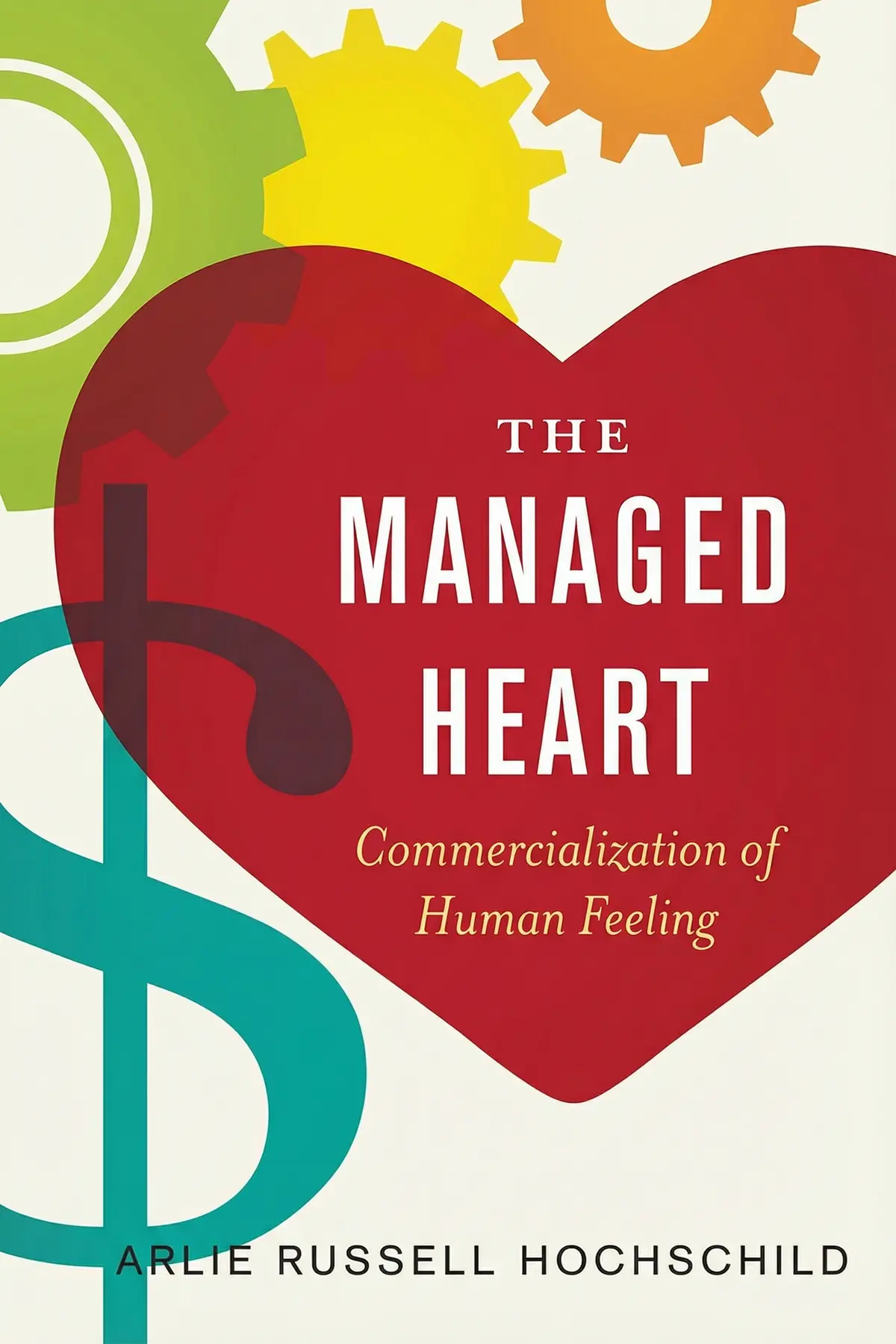
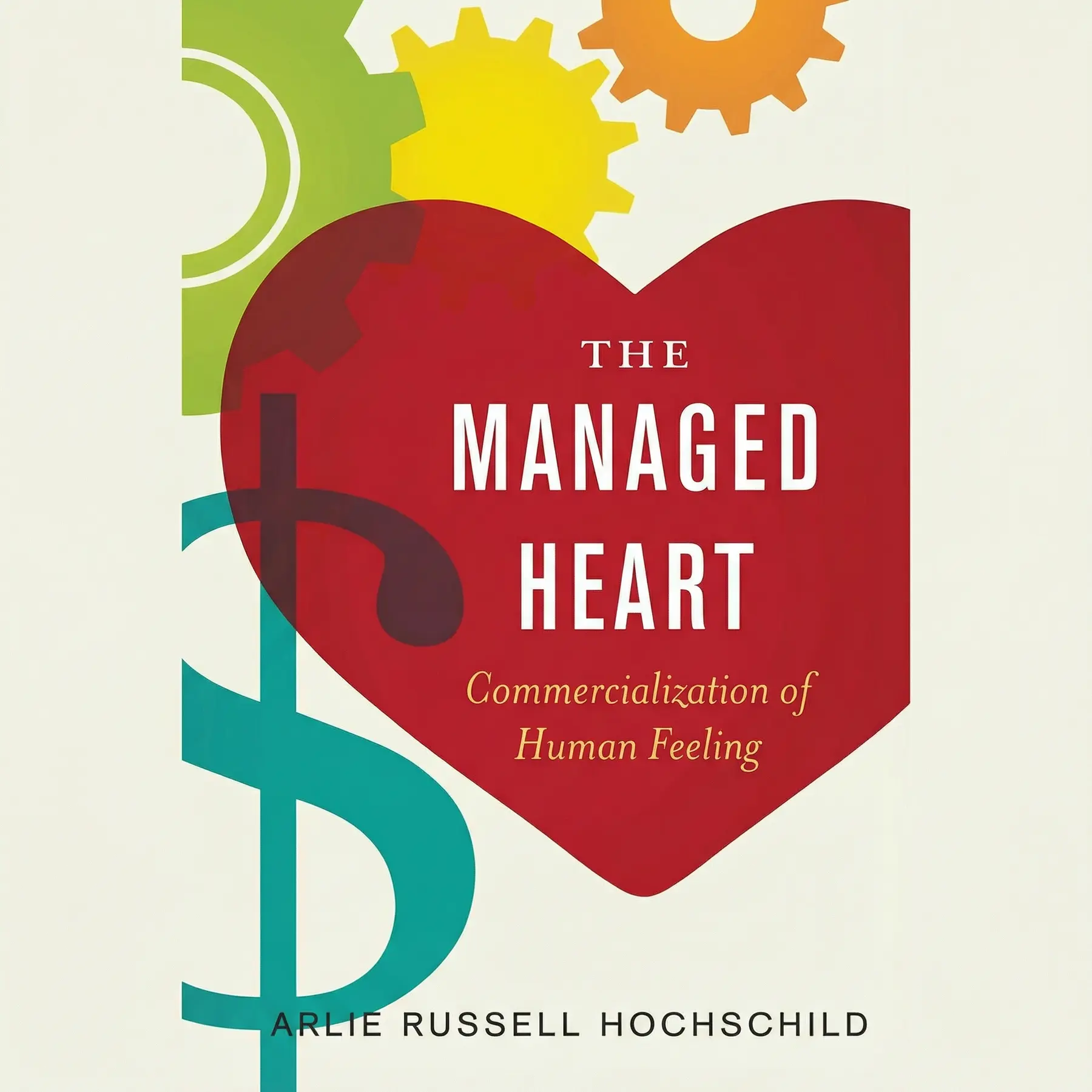
If your job means keeping customers, clients or colleagues happy, you already do a kind of work that almost never appears in a job description. In The Managed Heart, Arlie Russell Hochschild gives it a name: emotional labor, the deliberate shaping of your own feelings so they fit what a job or a social moment demands. To her it is a skill and an effort, not a personality trait, and it can be bought, sold and traded.
Her argument has four steps. Managing feelings is real work. It follows rules most of us never notice. It moves like money, from people with less power to people with more. And women end up carrying far more of it than men. Once you follow that thread, a cheerful flight attendant, a grateful intern and a mother who remembers every birthday all look different. So do your own moods, your workplace and the people who quietly absorb your complaints.
1 min 54 sec
Passengers barely register a flight attendant’s warmth, yet they notice the moment it disappears. Hochschild asks what that smile really costs, and who decided it should be part of the job.
1 min 45 sec
A student cancels a party at the last minute and feels almost no guilt. That missing guilt says more about her friendship than any conversation could, and it exposes rules we follow without knowing it.
1 min 44 sec
An intern thanks a busy colleague warmly, and both seem to win. Then the favors keep coming, the price keeps rising, and the intern finds himself paying in ways no one would call fair.
1 min 52 sec
Most people know which parent remembered the birthdays and bought the presents. Hochschild argues the reason has less to do with nature than with money, and a survey of manipulation tactics shows the strain.
1 min 46 sec
A woman who loses her temper is called irrational, while a man doing the same sounds convinced. The bias reaches doctors’ offices and airplane aisles, and it grows out of the very skill women are asked to perform.
1 min 05 sec
The Managed Heart asks you to see a whole economy that never appears on a balance sheet. Every smile at a check-in desk, every thank-you that pays off a favor and every remembered birthday is effort. Rules about feeling shape it, and power sets its price. Hochschild’s case is that this labor matters most where it is least visible, and that it falls hardest on women, who are then trusted less for doing it well.
Seeing it changes small things. Hochschild’s own advice starts with complaints. The next time a late bus or a broken product leaves you fuming, pause and notice who is hearing it. Often it is a woman, at home or behind a counter, already absorbing more of other people’s moods than the men around her. You can also listen to your own feelings before you correct them, since relief or dread may be telling you what someone really means to you. And when thanks start to feel like a payment, ask what the exchange is costing the person who pays.
A pleasant face is work. Once you can see the work, you can stop taking it for free.
Customer service is often treated as unskilled work, yet anyone who has smiled through a long shift knows it takes real effort. Arlie Russell Hochschild calls that effort emotional labor: deliberately shaping your feelings to fit what a job or a social moment requires. Employers require it in many jobs, yet they rarely even think to name it. Hochschild follows emotional labor from airplane cabins to university friendships and office favors. She shows how feelings act as signals of what people really mean to us, how unwritten rules decide which emotions are acceptable, and how thanks and flattery work as a kind of currency whose value rises and falls with power. From there she explains why women, with less access to money and status, end up doing far more of this work, and why doing it well can make others take them less seriously. Readers get a clear vocabulary for an effort they already make every day, plus practical ways to notice who carries the emotional load at work and at home.
Service workers, nurses and flight crew who want words for the effort behind their daily smile.
Managers who want to see who carries the emotional load on their team.
Anyone curious why women so often end up doing the remembering, soothing and listening.
Arlie Russell Hochschild, born in 1940, has written ten books about how people manage their emotions in family life, at work and in politics. Her book Strangers in Their Own Land, based on five years of research among Tea Party supporters, became a New York Times bestseller and a National Book Award finalist. Stolen Pride looks at life in a struggling Appalachian town, and her other titles include The Second Shift and The Time Bind.
Arlie Russell Hochschild
Listeners find this essential book to be a profoundly perceptive look at "emotional labor" and the ways human sentiments are commodified. Listeners value the detailed study of how service-oriented roles require the management of emotions, with one listener highlighting the intriguing parallel drawn between professional behavior and method acting. Although perspectives differ regarding the complex, scholarly prose, many believe the book's investigation into alienation and burnout is still incredibly pertinent. Furthermore, they point to the gripping examples of bill collectors and flight attendants as powerful demonstrations of the ways "feeling rules" are applied within the workplace.
Hochschild’s comparison between service work and method acting is absolutely mind-blowing. She explores how workers are trained to perform 'deep acting,' where they don't just fake a smile but actually try to force themselves to feel the emotions the company demands. This isn't just about being polite; it's about a fundamental alienation from one's own internal state. As a retail worker, I felt seen. The way she describes the burnout that comes from this 'emotive dissonance' is chillingly accurate to the modern economy. While the book focuses heavily on 'stewardesses' of the 80s, the theory applies perfectly to the influencer and gig economy of today. Essential reading for anyone interested in labor rights.
Show moreAs someone who worked in retail for a decade, this book felt like a personal attack in the best way possible. Wow. Hochschild perfectly captures that specific type of exhaustion that comes from being 'on' all day. She describes how the commercialization of human feeling leads to a loss of the signal function of our emotions. We stop knowing what we actually feel because we’ve sold our reactions to an employer. The concept of 'guilt as a promissory note' really hit home for me. It is a dense academic text, but the payoff is worth the effort. It completely changed the way I view my interactions with service workers and my own professional persona.
Show moreGotta say, it is chilling how a book written in 1983 still perfectly diagnoses the modern service economy. We live in a world where 'authenticity' is a product, and Hochschild saw it coming decades ago. Her analysis of how we manage our hearts for a paycheck is both heartbreaking and enlightening. The way she breaks down the 'feeling rules' of different social classes is masterclass sociology. It’s not an easy, breezy read, but it’s an essential one if you want to understand the psychological cost of capitalism. The distinction between private emotion work and commercial emotional labor is a tool I’ll use for the rest of my life.
Show moreFinally got around to reading the source material for 'emotional labor' after hearing the term misused online for years. Hochschild’s 1983 study of Delta flight attendants remains a fascinating deep dive into how companies don’t just buy our time, but our very smiles. The concept of 'feeling rules' is incredibly helpful for understanding why customer service is so draining. I found the academic tone a bit dry in the middle sections, but the insights into the 'managed heart' are undeniable. It’s a foundational text that explains why we feel so alienated when our private emotions are commodified for a paycheck. Definitely a must-read for sociology nerds, even if some of the airline history feels a bit dated.
Show moreThe chapter on bill collectors was a total revelation for me. Most people associate emotional labor with smiling, but Hochschild shows the dark side: how workers are forced to manufacture anger and suspicion to perform their jobs. It’s a brilliant look at how corporations institutionalize human feeling across the spectrum. I loved the references to Erving Goffman; the balance between psychology and sociology is handled with great care. My only minor gripe is that it leans so heavily on the airline industry. I would have loved more diverse case studies from other sectors. Still, it’s a brilliant, thoughtful analysis of how capitalism creeps into our inner lives.
Show moreEver wonder why you're so exhausted after a 'simple' day of customer service? This book provides the answer through the lens of gender and class. Hochschild demonstrates how women are often tasked with more emotional management than men, both at home and in the office. The research is incredibly thorough, though the 1980s context means some of the specific examples feel like a time capsule. I particularly liked the discussion on 'surface acting' versus 'deep acting.' It made me realize how often I’ve been guilty of the latter just to survive a shift. It’s a bit dry, but the theoretical framework is still the gold standard for understanding workplace psychology.
Show moreLook, if you're a social worker or a psych major, you absolutely need this on your shelf. Hochschild’s definition of emotional labor as requiring one to induce or suppress feeling is a vital concept for understanding professional burnout. I found her exploration of how status affects emotional expectations to be particularly stinging. When you have lower status, you’re expected to contribute more emotional rewards to those above you. It’s a heavy read, and the sentence structure can be a bit 'obtuse' as other reviewers have noted, but the intellectual value is immense. It’s a sobering look at how the 'managed heart' eventually leads to a fractured sense of self.
Show moreThe truth is, while the concept is revolutionary, the prose itself is a bit of a slog. Hochschild is clearly a brilliant researcher, but her writing style can be obtuse and repetitive at times. I felt like I was reading a very long history of Delta Airlines employee training manuals rather than a cohesive social theory. I appreciate her inventing the term 'emotional labor,' but I found myself skimming the dense sections on methodology. To be fair, her analysis of how we manage feelings in private life versus the workplace is insightful. However, unless you have a specific academic interest in the development of sociology, you might find a more recent summary of these ideas more engaging.
Show moreI'll be honest: I picked this up thinking it was about household chores, but it's strictly a sociological study of the workplace. The term 'emotional labor' has been co-opted by social media to mean 'doing the dishes,' but that's not what Hochschild is talking about here. She's focused on the alienation of the self in the service economy. While the theory is strong, the book is very dated. I found the endless details about 1980s airline culture to be more than I ever needed to know. It’s a foundational text, sure, but it feels like it could have been half the length and still made the same point.
Show moreNot what I expected given how much this book is cited in feminist circles. Frankly, the work felt incredibly limited by its era and demographic focus. Hochschild almost entirely overlooks the experiences of Black and racialized communities, whose emotional labor is often tied to survival rather than just 'service.' She focuses so much on middle-class flight attendants that she misses the nuances of domestic workers, caregivers, or sex workers. The writing is also quite dense and academic, making it a difficult read for a casual audience. I appreciate the core idea, but the execution feels like a product of its time that hasn't aged particularly well in terms of intersectionality.
Show moreEmotional labor is the conscious management of your own feelings so they suit a particular commercial or social setting. Hochschild’s main example is flight attendants, who are trained to smile in a way that looks genuine and to stay warm and chatty with passengers. Employers rely on this effort in many jobs, from cashiers to baristas, but rarely name it as part of the work.
Hochschild argues that managing feelings is real work that is often overlooked. Feelings follow unwritten rules about what we should feel and when, and they are exchanged like money, so people with less power end up paying more in flattery and patience. Women, with less access to money and status, perform far more of this labor than men and are then taken less seriously.
She links it to unequal power. In 1980 in the United States, about half of men earned over $15,000 a year against 6 percent of women. With less independent money, managing feelings becomes an asset. A UCLA study found 45 percent of women used emotion deliberately to get what they wanted, versus 20 percent of men, and emotionally demanding jobs make up half of women’s jobs but a quarter of men’s.
Start with Hochschild’s advice about complaints: when a delay or a bad product frustrates you, notice who is absorbing your rant, since it is often a woman. Treat surprising feelings like relief or dread as signals about what people mean to you. At work, notice when gratitude has turned into a payment, and count the emotional work your colleagues do when you assess their contribution.


Virginia Woolf

Tracy Rosenthal

Jessica Valenti


Johny Pitts


bell hooks

Margaret Heffernan
AUDIO SUMMARY AVAILABLE
Get the key ideas from The Managed Heart by Arlie Russell Hochschild, plus 5,000+ more nonfiction titles.