

14 min 24 sec
Available in: English
 ไทย
EnglishไทยThe Inevitable: Understanding the 12 Technological Forces That Will Shape Our Future
By Kevin Kelly
Kevin Kelly maps twelve technology forces, from artificial intelligence to sharing and tracking, that are already reshaping work, buying and knowledge, and shows why staying a lifelong beginner is the smartest way to adapt.
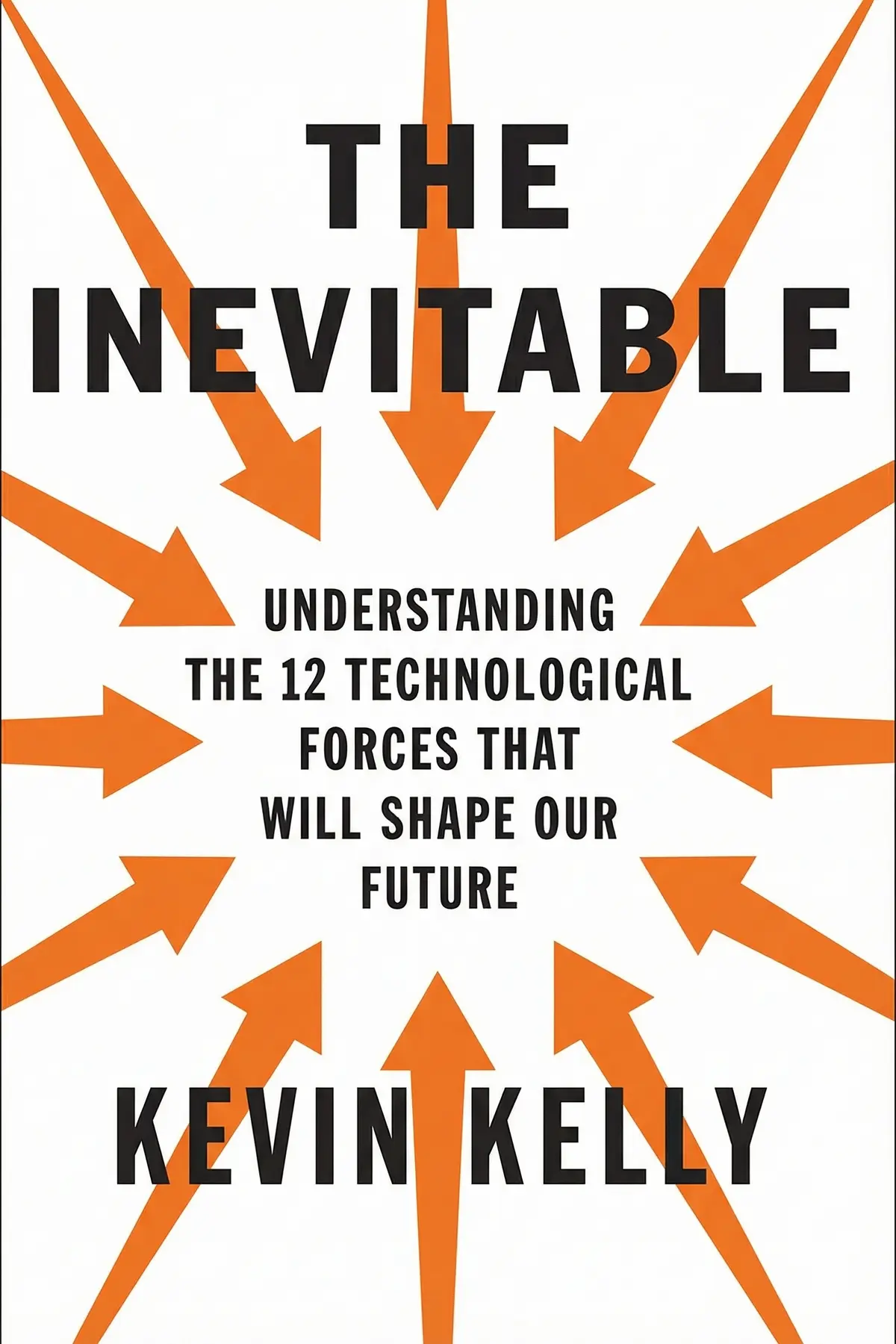
Table of Content
1. Introduction
1 min 02 sec
If new technology often leaves you feeling one step behind, Kevin Kelly has a reassuring answer: that feeling is permanent, and it is normal. In The Inevitable, the founding executive editor of Wired argues that the future can be read through twelve forces already visible today, with names like cognifying, sharing, tracking and remixing. Kelly does not try to forecast particular gadgets such as flying cars or android spouses.
He maps the broad directions technology keeps pushing, because general trends are the best predictions he thinks we can make. His case is that these forces will grow stronger, so the useful question is how to work with them. Grouped here into six clusters, they explain why Uber can reach you faster than a taxi firm, why doctors will work beside software, and why a printed photo may one day look broken. Each cluster ends with a habit you can start using now, while the forces are still young.
2. Stay a permanent beginner and stop fighting it
1 min 53 sec
Most people assume that with enough effort they will finally catch up with technology. Kelly argues the opposite is true for everyone, and that accepting it changes how you should spend your learning time.
3. Hand machines the tasks they do better
2 min 09 sec
Artificial intelligence is spreading into objects, science and medicine, and many workers fear for their place. Kelly sees a different outcome, but it depends on a skill most people have never practiced deliberately.
4. Understand products that flow like streams, not objects
1 min 55 sec
The things people pay for are slipping out of boxes and off shelves. Kelly explains what replaces them, and why every listener who shares a song is already part of a new kind of economy.
5. Rent and remix instead of owning and starting over
2 min 10 sec
The world’s biggest provider of places to stay owns none of them, and a taxi app outpaces taxi companies. Kelly traces both to one shift, and shows how it also changes what counts as creating something new.
6. Read every screen as an open conversation
1 min 56 sec
Virtual worlds may soon make an ordinary printed photo feel faulty, and screens are spreading to every surface. Kelly argues this changes how people relate to facts, and what a careful reader should do about it.
7. Learn to live well with less privacy and certainty
2 min 02 sec
Personal data can tailor medicine to your body or be turned against you, and every new fact seems to arrive with its rival. Kelly takes a surprising position on both, and it is not the fearful one.
8. Conclusion
1 min 17 sec
The twelfth force gives the whole book its scale. The internet already connects some 15 billion devices, which in Kelly’s picture work like one enormous circuit that gains new links every second. Within a few hundred years, he expects machine intelligence to merge with human minds into a kind of super intelligence. He calls this the force of beginning, and he insists the new era has already started.
That is why the permanent newbie is not a sad figure in his account. If the whole system is only starting, everyone is early. Kelly admits the problems, from lost privacy to endless doubt, yet he concludes that the future is mostly one of opportunity, and that these forces will touch every part of life.
What follows for daily life is modest and concrete. Keep a regular slot for learning tools you have not mastered. Give machines the memorizing and sorting, and keep the caring and intuition for yourself. Choose access over ownership where it saves money and effort. And when a screen tells you something with confidence, treat it as the opening line of a discussion. The forces are inevitable, in Kelly’s view. How early you start moving with them is up to you.
About this book
What is this book about?
New apps, devices and business models arrive so fast that most people feel permanently behind. Kevin Kelly argues that this feeling is a sign of the times. Instead of predicting particular gadgets, he identifies twelve broad forces that are already underway and will only grow stronger: becoming first, then cognifying and flowing, followed by screening and accessing, then sharing, filtering and remixing, and after those interacting and tracking, then questioning, with beginning closing out the list. Kelly, the founding executive editor of Wired, shows each force through concrete cases. Uber reaches riders faster than central taxi firms. Airbnb rents out homes it does not own. People share 1.8 billion photos a day, and the average app keeps a user for only about 30 days. He also weighs the costs, from lost privacy to a flood of contradictory facts. Readers get a practical map of where technology is heading and how to position themselves: what to hand over to machines, when to choose access over ownership, how to read screens critically and why being a newbie forever is an advantage. Kelly's overall verdict is hopeful: despite the problems, the future he describes is mostly full of opportunity.
Book Information
Who it's for
Professionals feeling left behind
Professionals who feel they can never catch up with new tools and want a map of where technology is heading.
Rethinking products around access
Founders and managers rethinking products around access, streaming and sharing.
Changing careers amid automation
Career switchers deciding which skills machines will take over and which will stay human.
About the Author
Kevin Kelly
Kevin Kelly, born in 1952, is a writer, photographer and conservationist. He was the founding executive editor of Wired and, before that, published and edited the Whole Earth Review from 1984 to 1990. He co-founded the Hackers' Conference and helped launch the WELL, an online service that started in 1985. He is a founding editor of the Cool Tools website, which has reviewed tools daily since 2003. His other books include Out of Control, on decentralized emergent systems, What Technology Wants and the graphic novel The Silver Cord.
Ratings & Reviews
Ratings at a glance
What people think
Listeners find this work to be a thought-provoking and necessary read for smart audiences, offering thorough perspectives on upcoming shifts in technology. Furthermore, the prose is cleverly written, and listeners value the content provided. However, the tempo draws varied feedback, with some considering the material captivating while others find it tedious.
Top reviews
Dream
This book is essentially a blueprint for the next thirty years of human development. Kelly’s central thesis—that we are moving from products to services—felt incredibly prescient given the rise of the subscription economy we see today. I found the concept of 'cognifying' particularly brilliant because it simplifies the complex AI revolution into a manageable framework: take X and add intelligence. While some might find his boundless optimism a bit naive, it serves as a necessary counter-balance to the typical dystopian narratives we get in sci-fi. His prose is sharp and clearly the work of a seasoned thinker who has spent decades at the center of the digital world. It’s a deep dive that requires focus, but the payoff is a clearer lens through which to view our rapidly shifting reality. If you want to understand why your world looks the way it does, start here.
Show moreOtt
As someone who struggles to keep up with the latest gadgets, I found Kelly's focus on 'verbs' rather than 'nouns' to be incredibly helpful. Instead of talking about iPhones or specific software, he looks at the underlying forces like 'Screening' and 'Interacting.' This approach ensures the book doesn't feel dated the moment a new model comes out. The writing is sophisticated yet accessible, making it a perfect pick for a book club of intelligent readers. I loved the section on how we are all 'newbies' now because technology evolves faster than we can master it. It’s an empowering thought! My only real gripe is that he glosses over the power imbalance between individuals and the corporations doing the 'tracking.' Still, the optimism is infectious and it’s a refreshing change from the usual doom-and-gloom. This is a big-picture book that actually lives up to the hype.
Show moreAurora
To be fair, I was skeptical of the title at first. 'Inevitable' sounds so deterministic, doesn't it? But Kelly makes a compelling case that while specific products aren't inevitable, the general form absolutely is. This distinction is the key to the whole book. His writing is incredibly intelligent and serves as a great deep-dive for anyone who wants to look past the headlines. I particularly enjoyed the sections on 'Remixing' and how digital bits allow for endless mutation of culture. It's a very optimistic work, which I found refreshing, though it does occasionally ignore the social reforms needed to handle these massive shifts. The pacing was brisk for me, though I can see how some might find the heavy detail a bit much. Overall, it’s a brilliant summary of where we are and where we are going. A true must-read for the digital age.
Show moreSatit
Picked this up after seeing it on several 'must-read' lists for entrepreneurs. Kelly has this amazing ability to take massive, abstract concepts like 'Remixing' or 'Filtering' and turn them into actionable insights. The idea that the next 10,000 startups will just be 'Take X and add AI' is a sentiment that has stuck with me. Some critics argue he ignores the darker side of automation—like what happens to the millions of truck drivers replaced by robots—and that’s a valid point. He definitely leans into a 'protopian' view where things get slightly better every day. Personally, I found the chapter on the universal library and the future of networked books to be the most fascinating part of the entire work. It’s an intelligently written guide that challenges you to stop reacting to technology and start anticipating it. Even with the occasional dry patch, the value here is undeniable.
Show moreSupachai
The chapter on 'Screening' alone is worth the price of admission. Kelly envisions a world where every surface is a display, changing how we consume information and interact with our environment. It’s a fascinating, if slightly claustrophobic, vision. I found his writing style to be very engaging, though he does have a habit of using five sentences where one would do. Not gonna lie, the book is a bit of a marathon. He covers so much ground—from blockchain to the 'quantified self'—that it can feel overwhelming at times. However, the way he connects these dots into a singular narrative about the 'global matrix' is impressive. It’s definitely a must-read for anyone interested in the intersection of society and tech. Even if you disagree with his sunny outlook on privacy, he's asking the right questions. It's a detailed roadmap that made me look at my smartphone differently.
Show moreThitiwan
Frankly, this is one of the most thought-provoking books I’ve picked up in years. Kelly isn't just predicting gadgets; he's describing a fundamental shift in how human civilization functions. The concept of 'Flowing'—the idea that we are moving away from fixed products toward real-time, unstoppable streams of data—is already coming true. I particularly liked the discussion on how AI will become a cheap utility, much like electricity. To be fair, some of the 'day-in-the-life' scenarios he writes felt a bit like bad science fiction, and his dismissal of the 'filter bubble' problem was a little too hand-wavy for my taste. But the core arguments are incredibly solid and backed by years of observation. It’s an intelligent, value-packed read that doesn't talk down to the audience. Whether you’re a techie or a total novice, there’s something here that will make you think.
Show moreAkosua
After hearing Kevin Kelly on a podcast, I had high hopes for this book. It mostly delivered! The way he describes the 'Beginning'—this moment in history where we are starting to build a planetary-scale computer—is genuinely mind-blowing. It makes you realize how early we actually are in the digital revolution. I loved the intelligent, almost philosophical tone of the writing. He doesn't just say 'things will change'; he explains the 'why' behind the shift. I do think he is a bit too casual about the loss of privacy, viewing it as a voluntary trade-off for better services. Many people, including myself, might find that trade-off a bit more coercive than he suggests. However, the sheer scope of the book is impressive. It’s a detailed, insightful look at the forces shaping our future. Definitely worth a read if you want to understand the 'Inevitability' of the title.
Show moreRiley
Ever wonder why every single device you own is suddenly trying to talk to you? Kelly explains this through his twelve 'inevitable' forces, though I’ll admit the middle sections on 'Flowing' and 'Sharing' felt a bit repetitive. To be fair, if you’re already working in tech, much of this will feel like a recap of the last decade rather than a shocking revelation. The pacing is a bit uneven, and I found myself skimming some of the more flowery descriptions of our future. However, for a general reader, this provides a fantastic vocabulary for discussing how AI and tracking are reshaping our social contracts. It’s a thought-provoking read even if it occasionally feels like a series of long-form magazine articles stitched together. I appreciated the insight into how 'accessing' is replacing 'owning,' even if the loss of privacy makes me nervous.
Show moreSophia
Finally got around to reading this, and I have mixed feelings. On one hand, Kelly is a visionary, and his breakdown of the twelve trends is masterfully done. On the other hand, the book feels bloated. There’s a lot of repetition, and I think the whole thing could have been a 50-page manifesto rather than a 300-page tome. In my experience, tech books often suffer from this 'magazine-article-turned-book' syndrome. That said, the insights into 'Accessing' vs. 'Owning' are spot on. I find myself using Spotify and Uber more than I ever thought I would, exactly as he predicted. He captures the 'twitchy' nature of our modern lives perfectly. It’s a must-read for the big ideas, even if the execution is a bit of a slog in the middle. Just be prepared for some very dense passages that require a second read to fully grasp.
Show moreKomsan
Not what I expected, and frankly, a bit disappointing. While Kelly is clearly a brilliant guy, his 'mindless optimism' feels almost irresponsible when he discusses the future of labor. He glibly suggests that as robots take our jobs, we will simply dream up more interesting work. However, he fails to explain how a 50-year-old truck driver is supposed to transition into a VR experience designer. The book reads like a manifesto for Silicon Valley elites who assume everything will naturally work out for the best. Truth is, the 'inevitability' he preaches feels more like a surrender to corporate interests than a technological certainty. I found the pacing to be quite sluggish in the chapters about social media and sharing, which felt like things we've been discussing since 2010. If you want a one-sided look at the future, this is for you.
Show moreQuestions about this book
What is the main idea of The Inevitable by Kevin Kelly?
Kelly says the years ahead will be shaped by twelve technological forces already visible today, starting with becoming and moving on to cognifying, then flowing and screening, next accessing and sharing, then filtering and remixing, after that interacting and tracking, and ending with questioning and beginning. These trends will keep growing stronger and will touch every part of life, not only our devices. Instead of predicting specific gadgets, Kelly maps these general directions and concludes that, despite real problems, the future holds mostly opportunity.
Will artificial intelligence replace human workers according to Kevin Kelly?
No. Kelly says AI will redefine human intelligence but not make people superfluous. The best results, he argues, come from humans and machines working together, such as physicians who combine intuition with modern diagnostic software. People will need to keep handing machines the tasks they do better, like memorization, while focusing on distinctly human work such as caring for others and intuitive thinking.
Why does Kelly say we will all be permanent newbies?
Because technology never stops improving, every invention leads to another, and devices and software have shorter and shorter lives. The average smartphone app keeps a user for only about 30 days. That leaves little time to master any tool, so everyone keeps relearning. Kelly treats this beginner status as normal, which suggests building regular learning time into your routine instead of hoping to finish learning.
What does Kelly mean by access replacing ownership?
Kelly sees possession becoming less important than access. Airbnb supplies more places to stay than any other company on earth, yet it owns none of the homes it lists. Renting rather than selling lets a business earn more from the same object, and not owning it removes maintenance costs. Uber’s self-employed drivers, each with a car, let it reach riders faster than central taxi firms.
How can I apply the ideas in The Inevitable?
The book supports a few habits. Set aside time to learn new tools, since you will always be a beginner. Delegate tasks machines handle better and develop the human ones. Consider renting instead of buying things you rarely use. Read screens critically, treating online claims as open to discussion. And decide consciously which parts of your life you are willing to have tracked.
Readers also enjoyed










AUDIO SUMMARY AVAILABLE
Listen to The Inevitable in 15 minutes
Get the key ideas from The Inevitable by Kevin Kelly, plus 5,000+ more nonfiction titles.
- 5,000+ titles
- Listen as much as you want
- 7-day free trial
- Cancel anytime









