

14 min 53 sec
Available in: English
The Haves and the Have-Nots: A Brief and Idiosyncratic History of Global Inequality
Milanović explains how inequality is measured, when it helps or harms a society, and why the country you are born in now shapes your income more than your class or your effort.
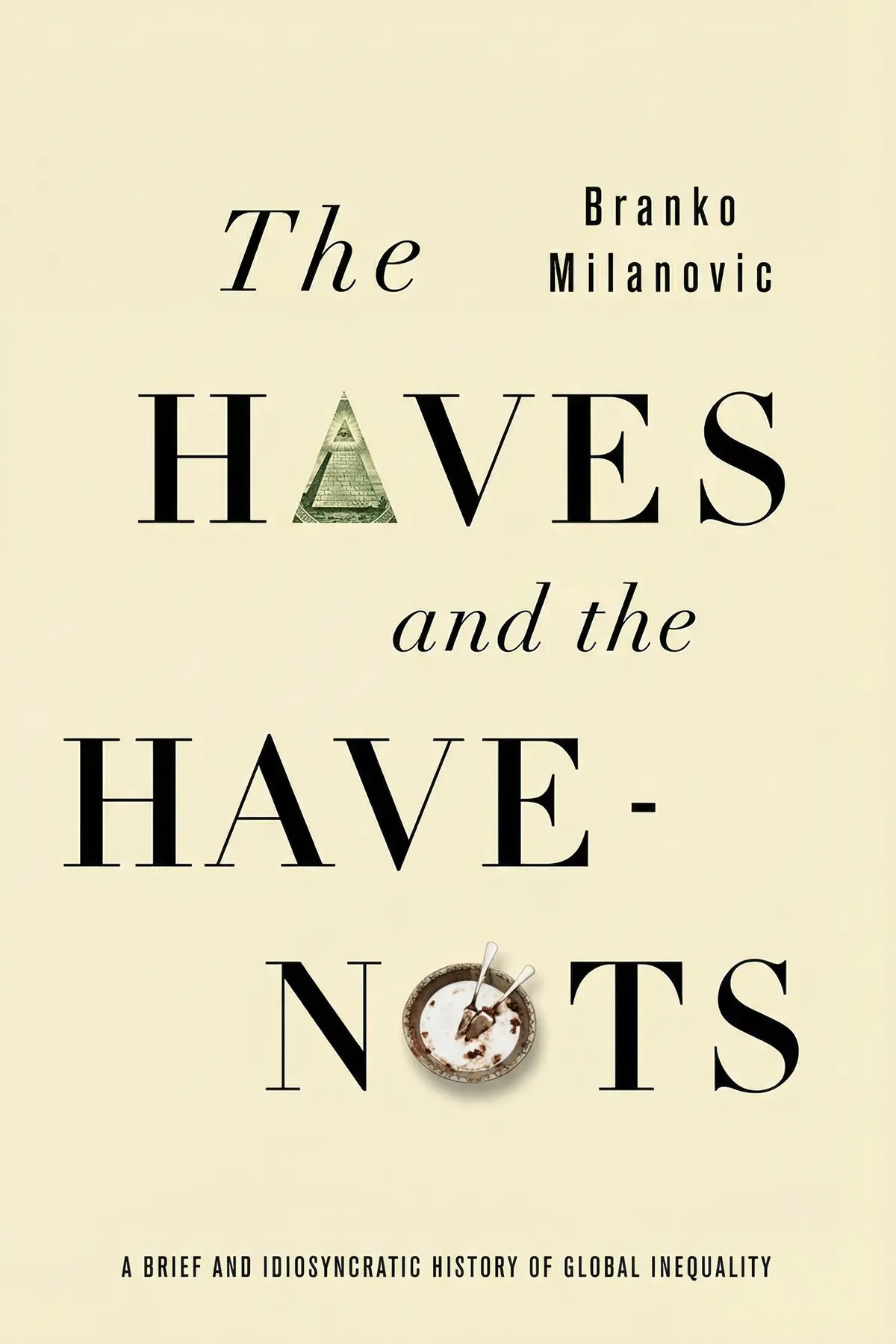
Table of Content
1. Introduction
57 sec
Most people explain wealth by effort, talent and a bit of luck within their own society. In The Haves and the Have-Nots, economist Branko Milanović points to a far bigger factor: the nation of your birth explains over 60 percent of why incomes differ across the globe. Add your parents’ income class and the two together explain over 80 percent.
That finding caps a wider argument about what inequality is and how it moves. Milanović shows that the gap between rich and poor shifts as societies change, that it can feed growth or choke it, and that it can be measured and compared across centuries and borders. Follow the measurements far enough and one conclusion stands out: today the gaps between countries outweigh the gaps inside them. By the end you will be able to read a Gini score, explain why investment avoids poor countries and place your own paycheck on a global map.
2. See why the rich-poor gap is never fixed
1 min 39 sec
One of the founders of inequality research believed no political system could ever change how income is shared. Decades later, in 1955, another economist looked at the evidence and reached a very different verdict.
3. Tell helpful inequality from the harmful kind
1 min 37 sec
Some differences in reward make people work harder and build new things. Others make a whole society stall. Milanović borrows an image from medicine to tell them apart, and adds a second test that growth cannot answer.
4. Read any country's inequality in one number
1 min 51 sec
Adding up a nation’s income is easy. Capturing how that income is spread across millions of people is not, and reliable data barely exists for much of history. An Italian economist found a workable answer.
5. Compare fortunes across centuries and borders
1 min 53 sec
Bill Gates’ fortune looks far larger than John D. Rockefeller’s. Measured a different way, the ranking flips. The same method also reveals who really makes up the world’s richest one percent, and some famous groups are missing.
6. The hidden cost of making everyone equal
1 min 44 sec
After World War II, socialist economies really were more equal than their capitalist neighbors. Milanović looks at what they produced, and at who was quietly taking more, to ask whether that equality was worth its price.
7. Learn how capital keeps flowing to rich countries
1 min 51 sec
Low wages and high returns should pull investment toward poorer nations, and globalization should speed that up. The numbers say otherwise. One year of investment figures for China, France and the United States shows the puzzle clearly.
8. Your birthplace sets most of your income
2 min 04 sec
Karl Marx saw class as the great divider of incomes. Milanović finds a different line now matters more, and it changes how much effort can move you up the world’s ranking. Even the global middle class lives somewhere unexpected.
9. Conclusion
1 min 17 sec
The Haves and the Have-Nots changes what the word luck means. Pareto saw inequality as a fixed law; Milanović shows it bending with industry, schooling, taxes and political systems. Some of it rewards effort and drives growth, and some protects insiders or rests on race, gender and inheritance. Measured carefully, across currencies and centuries, the widest gap of all turns out to be the border between countries.
That reframes ordinary facts. A salary is partly a reward for work and partly the return on where you were born. When a report quotes a Gini score, place it between the Nordic 0.25 and Brazil’s 0.6. When a debate turns on inequality, ask whether the gap motivates people or shields them, and whether it rests on something nobody chose. And when headlines celebrate globalization, remember that capital still prefers rich, safe economies, which keeps the distance between nations wide.
Hard work still counts. It simply operates inside lines drawn long before any of us arrived.
About this book
What is this book about?
Most debates about inequality focus on the gap between rich and poor inside one country. Branko Milanović widens the frame. He asks what inequality is, how economists measure it, when it helps a society and when it harms it, and why the gap between nations has grown so large. He traces the field from Vilfredo Pareto, who thought inequality barely changed whatever the system, to Simon Kuznets, who showed it rising and then falling as economies industrialize. He explains the Gini coefficient, compares Rockefeller's fortune with Bill Gates', weighs socialism's equality against its lack of innovation, and follows capital as it keeps moving toward rich countries. The result is a short, clear map of who has what in the world, and a striking conclusion: the country of your birth explains more of your income than your class or your hard work. Readers get the tools to read inequality figures in the news with confidence.
Book Information
Who it's for
Professionals tracking economic news
Professionals who follow economic news and want to understand Gini scores and inequality figures.
Social science students
Students of economics, politics or development looking for a short, clear map of global inequality.
Thinking of working abroad
People weighing work abroad who want to see how much birthplace shapes earnings.
About the Author
Branko Milanović
Branko Milanović is an economist born in Belgrade in 1953. His 1987 PhD from the University of Belgrade examined economic inequality in Yugoslavia. He was a lead research economist at the World Bank, held visiting professorships at the University of Maryland and Johns Hopkins University, and was a senior associate at the Carnegie Endowment for International Peace from 2003 to 2005. Since 2014 he has been affiliated with the Graduate Center of the City University of New York and the Luxembourg Income Study, and he teaches at the London School of Economics. In 2019 he was named to the honorary Maddison Chair at the University of Groningen.
Ratings & Reviews
Ratings at a glance
What people think
Listeners describe the work as insightful and compelling, featuring clear writing that makes the material simple to digest. They value the comprehensive analysis of worldwide disparity and its evidence-based method, with one listener highlighting the blend of historical and financial viewpoints. Listeners prize how approachable the text is; one listener points out that it avoids overly dense jargon, making it a great fit for those who aren't economists.
Top reviews
Cameron
Milanović manages to turn what could have been a mind-numbing pile of data into a truly delightful exploration of human history and economics. The book is cleverly structured into three main essays that distinguish between national, international, and truly global inequality. His inclusion of literary and historical anecdotes—like comparing the wealth of Roman billionaires to modern tycoons—adds a layer of color that most economics books lack. It’s fascinating to see how citizenship has replaced class as the primary driver of income in the modern world. If you want to understand why the world looks the way it does today, this is a perfect starting point. The insights here are essential for anyone interested in global development.
Show morePaiboon
Ever wonder why your passport matters more for your bank account than your actual hard work or your college degree? This book provides a rigorous, factual answer to that question by looking at the citizenship premium that many of us take for granted. Milanović is a master at explaining how the gap between nations has grown so massive that the poorest person in a rich country is often still wealthier than the richest person in a poor one. The data on the top 10 percent receiving over half of global income is presented without hyperbole, making the reality even more shocking. It’s a brilliant, idiosyncratic history that feels more relevant now than when it was first published.
Show moreGift
The sheer scale of global disparity is laid bare in this book, and the numbers are honestly quite terrifying when you see them all lined up. Seeing that the top five percent of the world’s population controls nearly half of the total income really puts our current political climate into perspective. Milanović doesn't just give you the how of these numbers; he helps you understand the what by simplifying the ways we compare different currencies and economies. It's a factual, eye-opening journey that feels like a masterclass in global sociology as much as it does in economics. I walked away with a much deeper understanding of why migration is such a powerful force in the 21st century.
Show moreNina
Picked this up because I wanted a grounded look at how the world’s wealth is actually split, and Milanović delivers a surprisingly readable guide. Instead of just dry graphs, he uses these creative vignettes involving characters like Elizabeth Bennett from Pride and Prejudice to illustrate economic concepts. It makes the distinction between inequality within a country and inequality between nations feel much more tangible for a layperson. While some sections get a bit technical, the narrative drive usually carries you through the denser data points. I appreciated how he breaks down the global distribution without making it feel like a lecture. It’s an eye-opening look at how your birthplace might be the biggest predictor of your success.
Show moreAmelia
The chapter on the global financial crisis was worth the price of admission alone because it offers a perspective I hadn't encountered in other mainstream media. Milanović argues that massive inequality created a surplus of investable funds that couldn't find profitable homes, leading to the credit explosion that eventually collapsed. It’s a sobering look at how political stability in a democracy is threatened when the middle class is left behind by an unequal model of development. The book does an excellent job of bridging the gap between historical data and the current political rage we see in the West today. It’s slightly uneven in parts, but the core arguments are incredibly strong.
Show moreMingkwan
Before inequality became a trendy topic in the wake of Piketty’s massive tome, Milanović was already doing the heavy lifting in this concise and thoughtful volume. He breaks down the complex layers of how we measure wealth across borders, making it clear that globalization is not a simple win-lose scenario for everyone. I particularly enjoyed the way he explains how inequality within a country like the US compares to the disparities found across the entire European Union. The writing is clear, the tone is professional yet accessible, and the historical context provided for each vignette is genuinely fascinating. It’s a great piece of popular economics that doesn't sacrifice intellectual rigor for the sake of being easy.
Show moreGioia
Look, if you’re looking for a step-by-step policy guide on how to redistribute wealth, you are probably going to be disappointed by this particular book. However, if you want to understand the underlying mechanics of why some people are born into wealth while others face impossible odds, this is excellent. The vignettes are a clever way to break up the data, though I’ll admit some of the Mark Twain paraphrasing felt a bit unnecessary and forced. It’s a short read that packs in a lot of information about the three different ways we can perceive and measure inequality. It serves as a great introduction for non-specialists who want to understand the actual facts behind the headlines.
Show moreWyatt
As someone who usually feels a bit overwhelmed the moment a statistic appears on the page, I found this surprisingly engaging despite my natural aversion to numbers. Milanović has a gift for translating wonkish concepts into stories that actually resonate with the real world and current events. He shows that your citizenship and your parents’ income determine eighty percent of your life’s path, which is a pretty devastating realization to swallow. While I sometimes got lost in the more technical comparisons of purchasing power, the short chapters kept me moving forward. It’s not exactly light reading, but it’s definitely accessible if you’re willing to put in a little bit of mental effort.
Show moreThanit
To be fair, I learned a decent amount about the Gini coefficient and historical income gaps, but the book often felt like a series of ramblings without a clear destination. Two hundred pages later, the main takeaway seems to be that global inequality is complicated and there are no easy answers, which feels like a bit of a letdown. He spends a lot of time detailing the what of income distribution but almost no time on the significance of these findings. I found the lack of analysis regarding the quality of life or the actual lived experience of the middle class frustrating. It is statistically heavy but lacks the prescriptive punch I was hoping for when I started the first chapter.
Show moreBo
Not what I expected at all, and frankly, I found the idiosyncratic style to be more of a distraction than an asset to the serious reader. The author jumps between serious economic analysis and weirdly placed jokes or literary references that do not always land for me. While some people might find the anecdotes about soccer or Jane Austen charming, I felt they diluted the actual research and data. There’s a lot of talk about income distributions, but very little attention paid to the actual cost of living or rising luxury standards. It felt less like a cohesive book and more like a collection of blog posts that were stitched together without a final edit.
Show moreQuestions about this book
What is the main idea of The Haves and the Have-Nots?
Branko Milanović describes three kinds of inequality: within a nation, between nations, and across all the world’s people. Because incomes now differ more between countries than inside them, the country you are born in has the biggest effect on what you earn, explaining more than 60 percent of global income variation. Along the way he shows how inequality shifts as societies change and how economists measure it.
What is the Gini coefficient?
It is the measure of inequality devised by the Italian economist Corrado Gini and still the preferred one. It compares each person’s income with everyone else’s and scales the result by population and average income. Zero means everyone earns the same; one means one person takes all the income. The Nordic countries score between 0.25 and 0.3, while Brazil and South Africa score around 0.6.
Does Milanović think inequality is always bad?
No. He likens it to cholesterol, which may help or harm depending on how much there is and what it does. Inequality that motivates people to work hard or start new businesses helps growth. Inequality that shields a small elite in protected positions holds growth back. Gaps based on race, gender or inheritance are unjust even when growth does not suffer.
Why does investment not flow to poor countries?
Milanović points to the Lucas Paradox: capital tends to circulate among rich countries and even flows from poor to rich, because investors want to limit risk. Foreign direct investment into China in 2007 came to $138 billion, close to the Netherlands and below France or Britain, while the United States took in $240 billion. For China’s population, that amount is small.
Who should read The Haves and the Have-Nots?
It suits readers who want a compact grounding in global inequality: students of economics and politics, professionals who meet inequality statistics in their work or the news, and anyone curious why some countries stay rich. It covers ideas from Pareto, Kuznets and Gini, the record of socialism, investment flows and the surprising makeup of the global middle class.
Readers also enjoyed

All About Love: New Visions
bell hooks


Adults in The Room: My Battle With Europe’s Deep Establishment
Yanis Varoufakis



A Biography of Loneliness: The History of an Emotion
Fay Bound Alberti

A Force for Good: The Dalai Lama's Vision for Our World
Daniel Goleman

1929: Inside the Greatest Crash in Wall Street History--and How It
Andrew Ross Sorkin

AUDIO SUMMARY AVAILABLE
Listen to The Haves and the Have-Nots in 15 minutes
Get the key ideas from The Haves and the Have-Nots by Branko Milanović, plus 5,000+ more nonfiction titles.
- 5,000+ titles
- Listen as much as you want
- 7-day free trial
- Cancel anytime









