

13 min 16 sec
Available in: English
The Great Mental Models, Volume 4: Economics and Art
Shows how core ideas from economics and art, from scarcity and trade-offs to framing, plot and setting, work as practical lenses for weighing everyday choices and shaping how your messages are received.
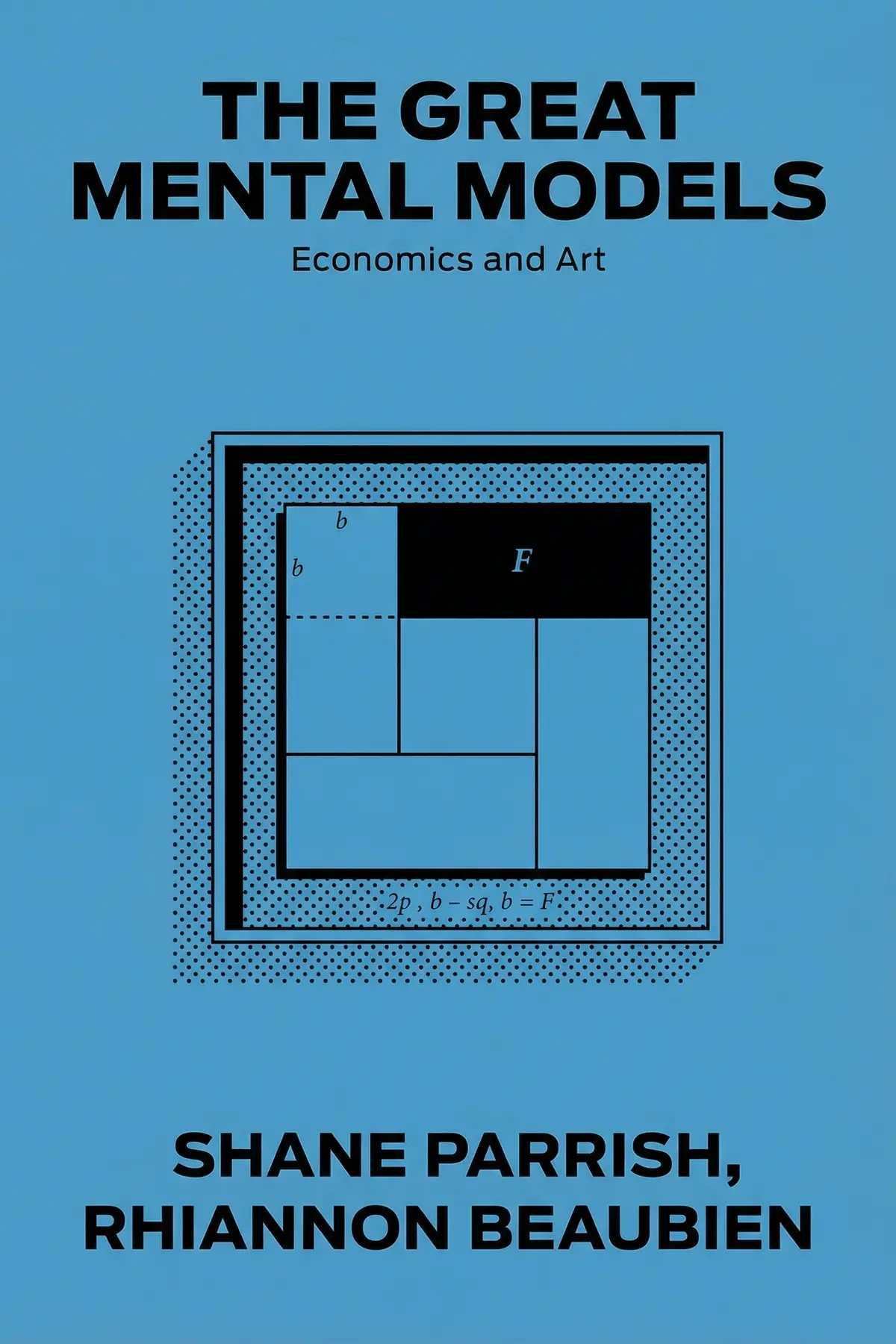
Table of Content
1. Introduction
1 min 00 sec
Most people make dozens of choices a day about time, money and how to say something, with no clear way to judge any of them. In The Great Mental Models, Volume 4, Shane Parrish and Rhiannon Beaubien offer a way: borrow the central ideas of economics and art and use them as lenses on ordinary life. Their first point is that none of these ideas is good or bad in itself. Scarcity, efficiency or a strong story can help or harm, depending on who uses it and how.
The book splits almost evenly between the two fields, and together they make one case. Economics shows that every choice spends something limited and sends ripples through a web of other people. Art shows that every message arrives framed, shaped for an audience and placed in a setting. Hold both and you can see what a decision really costs, why a story persuades you, and how to use the same tools in your own work.
2. Spend what is scarce on what matters most
1 min 46 sec
One pizza at a crowded party contains most of what economists worry about. It explains why empty shelves refill themselves and why even cheap furniture carries a price you never see on the tag.
3. Go deep in your skills, but keep a reserve
1 min 30 sec
Focusing on what you do best raises output, and trimming every spare minute looks like smart management. Both habits carry a hidden risk that only shows up on the day conditions suddenly change.
4. Let old methods fall to make room
1 min 46 sec
Competition sounds like the obvious hero and monopoly the obvious villain. The authors complicate that picture, then turn to an economist who believed progress requires something most people would rather avoid.
5. Shape your message for the people receiving it
1 min 39 sec
Artists have always known that the people watching help make the work. That insight, plus the unwritten promises behind every genre, changes how you might plan your next report, pitch or talk.
6. Ask what every frame leaves out
1 min 29 sec
News, history and even a friendly chat reach you through a lens you rarely notice. A chess piece that changed its power over the centuries shows how much those choices reveal about the people who make them.
7. Spot the false connections a tidy story hides
1 min 41 sec
Stories give events a beginning, a middle and a satisfying end. That same appeal can lead careful people to see causes where none exist, and a famous toy doll shows how deep our attachment runs.
8. Change the room to change the result
1 min 22 sec
A story set in the wrong decade loses whole options before the first page. The same hidden limits shape your own routines, and live theater offers a model for handling what no plan can predict.
9. Conclusion
1 min 03 sec
The two halves of this book look unrelated at first, and then they meet. Economics asks what a choice costs and who else it touches. Art asks how a message is shaped and how it lands. Most real decisions involve both: a manager who decides where a budget goes still has to explain that decision to a team, in a frame, with a story, in a particular room. The warning the authors give at the start still holds. None of these tools is good or bad until someone picks it up.
The most practical habits are small. Before a commitment, name what it will push aside, and leave a little slack wherever every margin has been cut. When a story convinces you fast, ask what sits outside the frame and which of its causes are only assumed. And when a behavior refuses to change, change the setting it happens in.
The chess queen gained her power because the world around the board changed. Your choices and your messages work the same way, so learn to read the board.
About this book
What is this book about?
Most of us make constant decisions about time, money and how to say things, with no clear way to judge them. Shane Parrish and Rhiannon Beaubien suggest borrowing tools from two fields that rarely share a shelf: economics and art. They stress at the outset that none of these tools is good or bad on its own. What matters is how they are used. The economics half covers scarcity, supply and demand, trade-offs, specialization, interdependence, efficiency, monopoly and Joseph Schumpeter's idea of creative destruction. Each one helps explain what a choice really costs and how it ripples out to others. The art half turns to audience, genre, contrast, framing, representation, plot, character, setting and performance, the forces that decide how a message is shaped and how it lands. Readers get a set of lenses they can carry into a budget meeting, a pitch or a personal habit: name what a choice pushes aside, keep some slack in a lean plan, ask what a frame leaves out, distrust a story that is too tidy, and change the setting when behavior will not change.
Book Information
Who it's for
Professionals making daily tradeoffs
Professionals who make daily calls about time, budgets and priorities and want clearer ways to weigh them.
Needing messages that land
Managers, founders and presenters who need their messages to land with a specific audience.
Continuing the series
Curious readers of the earlier Great Mental Models volumes who want lenses from economics and art.
About the Author
Shane Parrish
Shane Parrish founded Farnam Street, which began as a personal blog on how to make decisions, live with purpose and understand the world, and now runs workshops, a podcast and the Brain Food newsletter. He hosts The Knowledge Project podcast and wrote Clear Thinking. The Financial Times, the Wall Street Journal and the New York Times have all carried his work. Rhiannon Beaubien researches and writes for Farnam Street, drawing on a background in science and philosophy, and co-authors The Great Mental Models series with Parrish.
The Great Mental Models: General Thinking Concepts
Shane Parrish

The Great Mental Models Volume 3: Systems and Mathematics
Rhiannon Beaubien
Ratings & Reviews
Ratings at a glance
What people think
Listeners find the book’s wealth of information beneficial, and one listener highlights how it builds an amazing foundation for understanding the world. Nevertheless, reactions to the series remain mixed among listeners.
Top reviews
Jib
This book acts as a remarkable capstone for anyone looking to build a multidisciplinary knowledge base. I found the section on economics particularly enlightening because it goes beyond just numbers to explain the psychology of scarcity and optimization. Parrish uses the 'I, Pencil' example to perfectly illustrate how interdependent we all are in a globalized world. While the art section felt a little more abstract, the concepts of contrast and framing still provided a useful lens for looking at daily communication. Frankly, having these models at your disposal feels like having a secret map to human behavior. It is a solid foundation for understanding the world better and making smarter decisions.
Show moreCha
After hearing Parrish discuss these concepts on his podcast for years, I finally got around to finishing the fourth volume. It offers an amazing foundation for understanding the hidden forces that drive our decisions every day. I was fascinated by the section on creative destruction and how letting go of outdated systems is necessary for growth. The authors have a unique way of taking complex economic theories and turning them into practical tools for life. Even the art section, which I thought would be less relevant, changed how I view storytelling and characters in my professional interactions. This series is a must-read for anyone serious about clear thinking.
Show moreRose
Wow, the way Parrish explores 'I, Pencil' to explain interdependence really hit home for me. It’s a powerful reminder that none of us are truly self-sufficient, and acknowledging that can lead to better collaboration and support systems. I love how the book emphasizes that models like 'plot' and 'character' aren't just for writers—they are frameworks for understanding our own lives. Truth is, I feel much more equipped to handle uncertainty after reading about creative destruction and the necessity of change. This volume ties the series together nicely and provides a diverse set of tools for anyone wanting to get closer to reality.
Show moreFelix
Ever wonder why you make certain trade-offs without even thinking about them? Volume 4 breaks down supply, demand, and specialization in a way that makes you realize how often we over-optimize our lives at the expense of flexibility. The authors do a great job of bridging the gap between cold economic principles and the creative nuance of art. I especially enjoyed the discussion on how 'setting' dictates our behavior, much like a stage influences an actor. To be fair, some of the examples from niche books felt a bit like the author was showing off his library. However, the core message about building resilience through diverse mental frameworks is incredibly valuable.
Show moreChamlong
The chapter on scarcity and optimization provides an incredible foundation for anyone trying to navigate the complexities of modern life. It forces you to look at every decision through the lens of trade-offs, which is something we often ignore in our 'always-on' culture. I found the inclusion of 'genre' and 'audience' as mental models to be a brilliant touch that I hadn't considered before. Not gonna lie, I think the economics section is much stronger and more practical than the art portion. Still, the overall series is one of the best investments I’ve made in my personal development library. Parrish and Beaubien have created something truly special here.
Show moreGrace
In my experience, the art models like contrast and plot were much more insightful than the basic economic laws mentioned in the first half. While supply and demand are fundamental, the way the authors apply artistic principles to communication and persuasion was a breath of fresh air. It makes you realize that we are constantly performing for an audience, whether we realize it or not. My only real gripe is that some of the chapters felt a bit short and could have used more robust real-world applications. Regardless, it’s a high-quality read that encourages you to think more critically about the world around you.
Show moreBoss
To be fair, the shift from economics to art in the second half felt a bit jarring and less cohesive than previous volumes. While the early chapters on scarcity and competitive advantage were quite sharp, the art section seemed rather rudimentary by comparison. Parrish continues with a very specific, cookie-cutter chapter format that can feel repetitive if you read the book in one sitting. I appreciate the effort to make these concepts accessible to beginners, but as a fan of the series, I was hoping for more advanced applications. It’s a decent refresher on some important concepts, but it definitely feels like the weakest entry in the set.
Show moreOrm
Looking back at the whole series, this feels like the most beginner-friendly entry yet, which is both a blessing and a curse. While it’s great for someone who has never studied economics, I found the explanations of scarcity and monopolies to be quite basic. The authors tend to use a very structured format that introduces a model and then gives two specific examples. This works for clarity, but it lacks the deep, nuanced exploration found in Volume 1. I also wasn't a fan of the physical book design this time around. It's a useful book for a quick refresher, but don't expect it to blow your mind if you're already well-read.
Show moreSukit
Not what I expected given the depth of the earlier volumes on physics and chemistry. This volume feels a bit like a collection of blog posts rather than a deep dive into the 'great' models of the world. The chapter on art and representation was interesting, but it didn't feel as 'hard-hitting' as the models from the earlier books. I also noticed the authors' tendency to flaunt their reading lists through unconvincing examples that didn't always stick the landing. It’s still a good book with a positive knowledge base, but it’s definitely the point where the series starts to lose its steam. Good for a one-time read.
Show moreEleanor
Picked this up after following the series for years, but I found the design and layout of Volume 4 to be a massive letdown compared to the others. The book had some good examples in bits and pieces, but it lacks the punchy, revelatory nature of the physics volume. Many of the economic principles like supply and demand are things you likely already know if you've spent any time in the business world. The writing style feels a bit dry here, and the 'niche' references often distracted from the main point. If you are brand new to mental models, this might be okay, but for advanced thinkers, it’s a bit of a bore.
Show moreQuestions about this book
What is The Great Mental Models, Volume 4 about?
Shane Parrish and Rhiannon Beaubien take central ideas from economics and art and apply them to everyday life. The economics half covers scarcity, supply and demand, trade-offs, specialization, efficiency, monopoly and creative destruction. The art half covers audience, genre, contrast, framing, representation, plot, character, setting and performance. The authors stress that none of these ideas is good or bad in itself; what matters is how people use them.
How can economics help with personal decisions?
The authors argue that economics is really about trade-offs in everything, including how you spend time and rank goals. Since resources are limited, saying yes to one thing always means saying no to another, for instance giving up a party so you can study, or choosing less expensive furniture that you have to put together yourself. Naming the opportunity cost before committing, and keeping some slack instead of chasing maximum efficiency, helps your choices match your priorities.
What does art teach about communication?
Art shows that messages are shaped for an audience and received through a frame. The authors describe genre as a contract that sets expectations, contrast as the tool that grabs attention, and framing as a lens that decides what is shown and hidden. Planning who you are speaking to, what they expect and what your frame leaves out makes communication more deliberate.
Why do the authors warn about stories and plot?
Plot orders events into cause and effect, which helps people find meaning. The authors warn that our hunger for that order can make us link events that were actually random. Since life rarely follows a neat sequence, they suggest treating plot as a lens: use stories for direction, but test which causal links in your own explanations you can really prove.
Readers also enjoyed


59 Seconds: Change Your Life in Under a Minute
Richard Wiseman

A Splendid Exchange: How Trade Shaped the World
William J. Bernstein







AUDIO SUMMARY AVAILABLE
Listen to The Great Mental Models, Volume 4 in 15 minutes
Get the key ideas from The Great Mental Models, Volume 4 by Shane Parrish, plus 5,000+ more nonfiction titles.
- 5,000+ titles
- Listen as much as you want
- 7-day free trial
- Cancel anytime









