The Great Mental Models: General Thinking Concepts
Shane Parrish
 English
Shows how to catch the four mental defaults that hijack everyday judgment, emotion, ego, social pressure and habit, and how a deliberate pause, firmer character and clear purpose lead to better decisions.

55 sec
Most bad decisions are not made in big meetings. They slip through in ordinary moments, when a feeling, a bruised ego, a crowd or plain habit chooses for you before you notice.
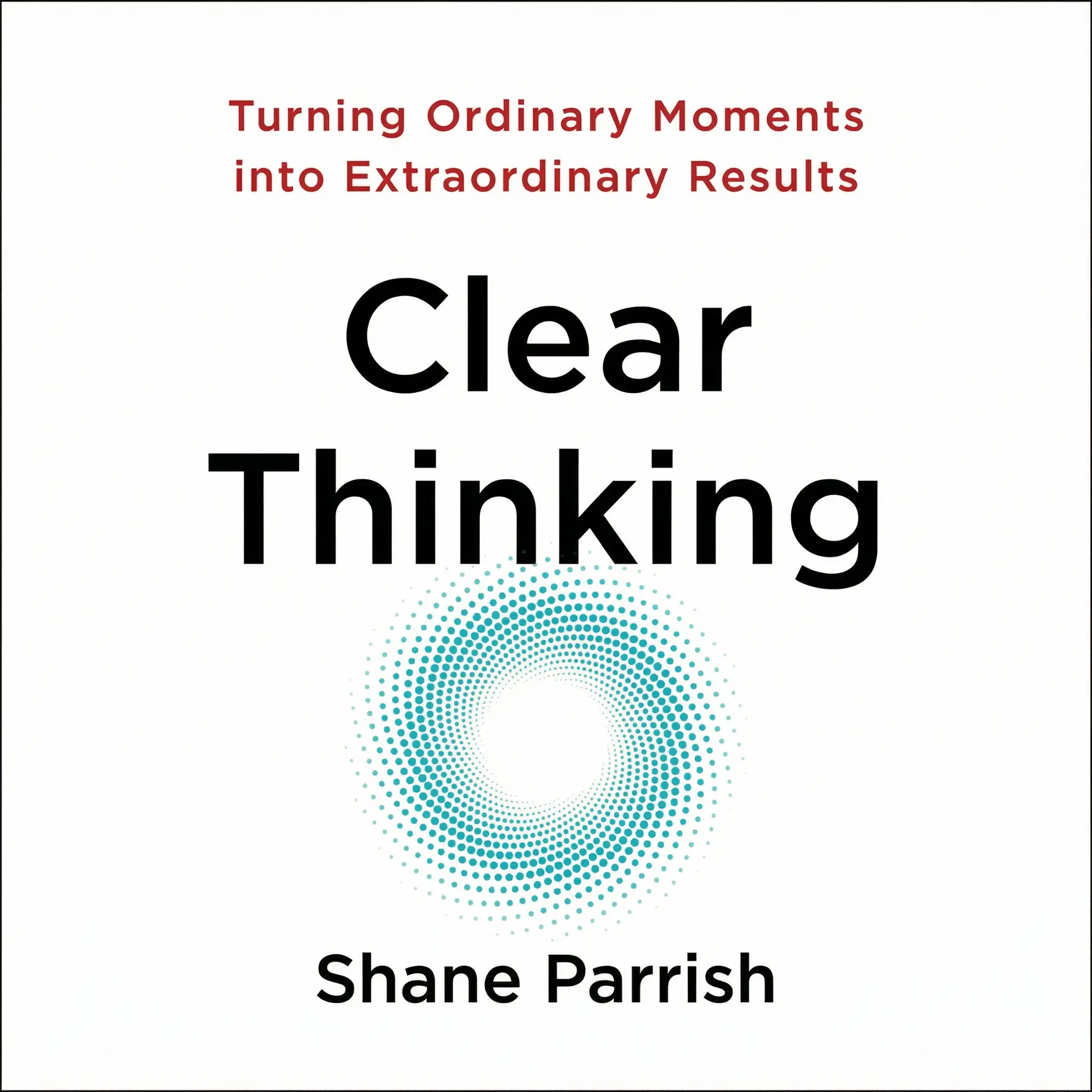
In Clear Thinking, Shane Parrish, founder of the Farnam Street blog, names those four forces and offers one simple counter: a deliberate pause between the moment and your response. His argument is that clear thinking is a skill built through practice, much like strengthening a muscle. You catch the defaults early, build the inner strengths that resist them, guard the weaknesses that remain, and point every choice at a purpose you have chosen yourself.
Along the way you get a name for each trap, a Navy commander who changed his ship by standing in a meal line, a step-by-step way to make hard decisions with a team, and a question about the end of your life that can sort your priorities this week.
1 min 48 sec
You have probably cheered for a show you privately found dull. That small moment reveals a family of instincts that make important choices on your behalf, and one short habit that gives the decision back to you.
1 min 43 sec
Knowing about thinking traps does surprisingly little to stop a tired or proud mind from walking into them. Parrish treats the fix as a kind of gym, and one of its four exercises matters more than the rest.
1 min 42 sec
A struggling Navy ship became one of the best in the fleet, and an early turning point happened in the line for lunch. Sometimes the answer to a stubborn weakness is not willpower but a clever arrangement around it.
1 min 45 sec
Teams can end up solving the wrong problem when the first or loudest framing wins loose agreement and the group rushes ahead to solutions. Parrish describes how it slips in and the simple process that keeps it out.
1 min 42 sec
Sharp reasoning can carry you efficiently toward a life you never really wanted. One uncomfortable thought experiment, set at the very end of your life, shows where the gap lies and what deserves your effort now.
1 min 09 sec
Clear Thinking makes a modest-sounding claim with large consequences. A life is shaped in ordinary moments, where a default either takes over or gets caught, at least as much as in rare dramatic decisions. A clap you did not mean, a purchase you could not afford, a meeting that rushed past the real problem: each is small, and Parrish argues they add up.
The counter is never heroic. It is a pause, plus the habits that keep the pause open: honest knowledge of your weak spots, a rule or a bit of friction where willpower fails, and the discipline to name the problem before anyone solves it.
Start where the stakes are next highest for you. Before your next reply that feels urgent, name which of the four forces is pushing. Write down one gap between the life you are living and the one you would want to look back on, and let that gap judge your next choice.
Abrashoff began reshaping a ship’s culture with small gestures, such as standing in the meal line with his crew. Clear thinking usually starts with a step that small.
Most poor decisions are not made in a crisis. They happen in ordinary moments, when a feeling, a bruised ego, the pull of a group or plain habit chooses for us before we notice. Shane Parrish, founder of the Farnam Street blog, argues that these four defaults are the main enemies of clear reasoning, and that the first defense is a deliberate pause before reacting. From there he builds a practical system. Readers learn to strengthen four qualities, accountability, self-knowledge, self-control and confidence, and to manage the flaws training cannot fix with rules, friction and a change of perspective, as one Navy commander did by joining his crew in the meal line. Parrish also lays out a decision process that starts with naming the real problem and ends with reviewing how the choice was made. The book closes on direction: an end-of-life thought experiment that shows what actually matters, so that clearer thinking serves a life you have defined for yourself.
Professionals who make fast calls under pressure and later regret letting pride or the room decide.
Team leads whose meetings jump to solutions before anyone agrees on the problem.
Anyone stuck in habits or priorities they drifted into rather than chose.
Shane Parrish started Farnam Street as a personal blog exploring decision-making, purposeful living and how the world works. It grew into a large site offering workshops, a podcast and the Brain Food newsletter. He hosts The Knowledge Project podcast, and his work has appeared in the New York Times, the Wall Street Journal and the Financial Times.
Listeners find the work intellectually stimulating, and one listener mentions it is full of practical wisdom for making decisions. Furthermore, the book is very accessible and functions as a vital manual, with one listener characterizing it as a must-read for managers. They also value the hands-on content and narrative style, with one listener emphasizing the persuasive business examples. The work receives praise for its tempo and utility; one listener observes that it transforms their perspective on work and life, while another remarks that it remains consistently engrossing.
This book is a masterclass in behavioral architecture that feels like a necessary upgrade for your brain's operating system. Parrish takes the complex web of decision-making literature and synthesizes it into something remarkably actionable for the average professional. While some critics argue it’s just a distillation of his blog, I find the structured narrative provides a clarity that a newsletter simply cannot achieve. To be fair, the section on 'defaults' is worth the price of admission alone because it highlights how often we run on autopilot. It is an indispensable guide for anyone tired of getting in their own way during high-stakes moments. The pacing is snappy and kept me engaged from the first chapter to the last.
Show moreWow, I wasn't expecting this to hit as hard as it did. Clear Thinking isn't just about logic; it’s about the emotional management required to actually use that logic in the real world. Parrish has a gift for taking high-level abstractions and turning them into practical tools for life and work. I binged the whole thing in two sittings because the storytelling was so compelling. Not gonna lie, I was a bit skeptical of the title at first, but the depth of the insights won me over. It reshapes how you view every interaction, from choosing your dinner to navigating a corporate merger. This is easily one of my favorite reads of the year.
Show moreShane Parrish has outdone himself with this one, creating what I consider a must-read for any modern manager. In my experience, most leadership books are fluff, but this is dense with actual mechanisms you can enforce to ensure better outcomes. The focus on 'thought governance' provides a level of control that most people don't even realize they're missing in their daily lives. It’s not just about thinking; it’s about creating the environment where clear thinking becomes the path of least resistance. I found myself highlighting almost every other page because the insights were so sharp. It’s a gold mine for anyone with high intellectual self-awareness.
Show moreAs someone who manages a team of twenty, this is gold for improving our collective output. The book provides a shared language for discussing errors in judgment, which is incredibly valuable in a high-pressure environment. Truth is, we often know what we should do, but our inertia or social influences prevent us from actually doing it. Parrish gives you the tools to bridge that gap between knowing and acting. The writing is crisp and clear—just like the title suggests—and it doesn't waste the reader's time with unnecessary filler. It’s a rare self-help book that actually feels like it was written for adults with real responsibilities.
Show moreFinally got around to reading Shane's latest, and it’s a solid addition to the shelf even if it retreads some familiar ground. The truth is, if you’ve spent years lurking on Farnam Street, you will recognize the core philosophy immediately. However, the way he frames the 'pause' between stimulus and response is genuinely helpful for managing daily frustrations. I appreciated the business-centric examples; they make the abstract concepts feel much more grounded and less like a philosophy lecture. My only gripe is that a few chapters felt a bit like common sense dressed up in fancy terminology. Still, it’s a very readable manual for anyone looking to sharpen their judgment.
Show moreEver wonder why smart people make such catastrophically dumb decisions when they're under pressure? Parrish explores this by breaking down our biological defaults—like the social or ego defaults—that cloud our vision when we need it most. Frankly, the writing style is very accessible, which is a relief compared to some of the denser academic texts on cognitive biases. It’s packed with actionable wisdom that I’ve already started applying to my morning workflow. It might not be a revolutionary breakthrough for those well-versed in Stoicism, but the taxonomy he creates is very useful. It’s the kind of book you keep on your desk to flip through before a big meeting.
Show moreThe chapter on biological defaults really opened my eyes to how my own ego was sabotaging my career progress. I've read plenty of self-help, but this feels different because it focuses on the mechanics of thought rather than just vague motivation. Look, the ideas aren't necessarily brand new—you’ll see shades of Atomic Habits and various Stoic thinkers throughout—but the structure is excellent. It’s a very easy read that manages to be thought-provoking without being overly wordy or academic. I did find the 'finance bro' vibe a bit strong in certain sections, but the practical value outweighs the stylistic choices. It’s a great gift for an indecisive friend.
Show morePicked this up because I wanted to improve my decision-making at work, and it definitely delivered on that front. The author's focus on 'positioning' yourself so that luck has less of an impact on your success is a game-changer. Gotta say, the way he explains how sub-optimal choices compound over time was a bit of a wake-up call for my daily habits. It’s not a perfect book; some of the personal anecdotes felt a little forced and lacked the punch of the business examples. However, the overall framework for avoiding 'default' behaviors is something I’ll be revisiting frequently. It’s well-structured and moves at a brisk pace that keeps you interested.
Show moreLook, if you're a long-time Farnam Street follower, you know the drill: mental models, avoiding stupidity, and long-term thinking. This book is essentially that philosophy 'enspined' into a single volume, which makes it a great entry point for newcomers. Personally, I enjoyed the distillation of these complex ideas into a readable format, even if I’d seen some of the stories before on the blog. It’s a highly effective guide for navigating life’s complexities without falling into the usual traps of emotion and ego. While it may not be the most 'original' book in the genre, its effectiveness lies in its simplicity and clarity. Definitely worth a read for the practical tips on pausing before you react.
Show moreAfter hearing so much hype on the podcast, I'm frankly disappointed by how derivative the content feels. Much of the book reads like a greatest hits compilation of better works by Kahneman or Munger without adding a truly unique perspective. Parrish quotes Montaigne to justify the lack of original thought, but the 'thread' he uses to bind these ideas together feels incredibly thin and repetitive. If you’ve read his 'Great Mental Models' series or followed the blog for a while, you will find very little here that justifies a new purchase. It’s not a 'bad' book per se, but it lacks the depth and novelty I expected. It feels like a distillation of highlights rather than a coherent new theory.
Show moreParrish argues that good judgment is lost in ordinary moments, when one of four defaults takes over: emotion, ego, social pressure or inertia. The key habit is a deliberate pause before reacting. He then shows how to strengthen accountability, self-knowledge, self-control and confidence, manage stubborn flaws, decide through a careful process, and aim choices at a purpose you have defined.
The emotional default lets feelings outrank facts, like an impulse purchase you cannot afford. The ego default protects your status over finding the best answer. The social default makes you follow the group or authority while privately disagreeing, like applauding a poor performance. The inertia default keeps things the same out of habit, like holding on to a broken workflow.
Parrish says many teams go wrong by accepting the first or loudest framing of a problem and rushing to solutions. He recommends confirming the problem and its root cause first, sometimes in a separate meeting, then generating at least three options, combining ideas, judging them against clear criteria, allowing a safety margin, and reviewing the process afterward.
He suggests workarounds. Take another person’s perspective, as commander Mike Abrashoff did by joining his crew in the meal line. Set firm rules, such as drinking only on Saturdays. Add friction, like clearing junk food from the cupboards. And when a flaw causes harm, take responsibility and rebuild trust through consistent action over time.



Steven C. Hayes



Deborah Gruenfeld




Anthony Pratkanis
AUDIO SUMMARY AVAILABLE
Get the key ideas from Clear Thinking by Shane Parrish, plus 5,000+ more nonfiction titles.