
15 min 03 sec
Available in: English
 ไทย
EnglishไทยThe Four Tendencies: The Indispensable Personality Profiles That Reveal How to Make Your Life Better (and Other People’s Lives Better, Too)
Shows how your response to expectations, the ones others set and the ones you set yourself, sorts you into one of four types, and how to use that to keep goals and work with people better.
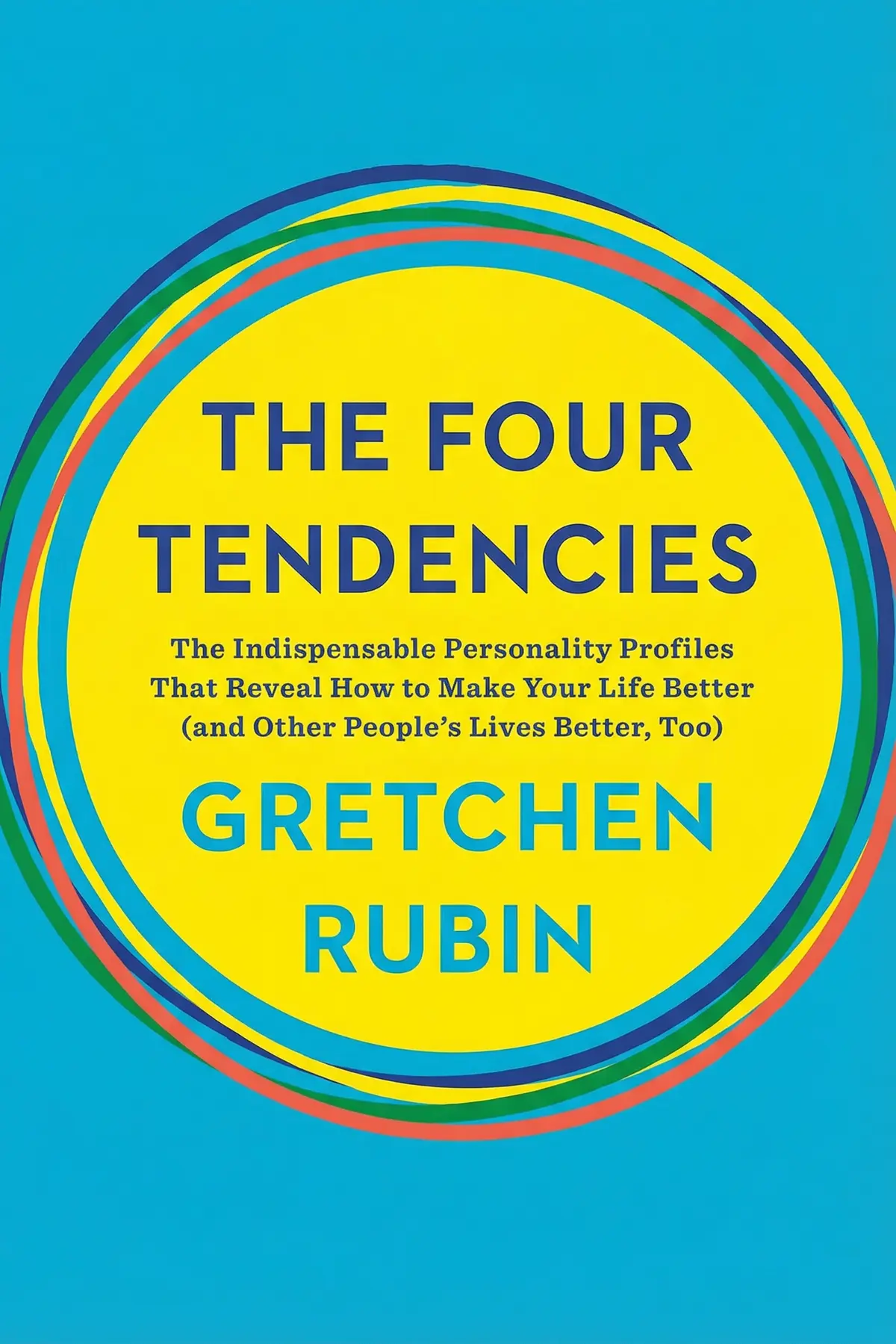
Table of Content
1. Introduction
56 sec
A goal you set for yourself can keep slipping while every deadline at work gets met, and the cause may have little to do with discipline. In The Four Tendencies, writer Gretchen Rubin argues that people fall into four types according to how they respond to expectations: the outer ones others place on them and the inner ones they set for themselves. Some meet both, some meet only their own, some meet only other people’s, and some resist all of them.
Her claim is that knowing your tendency, and the tendencies of the people around you, lets you stop treating a pattern as a personal failing and start arranging things so that you and they follow through. Each type gets its portrait below, along with the setups and phrasings that make it act: a more useful text about bread, a gym bag handed to a friend, a bet that helps a Rebel quit smoking.
2. Sort anyone by how they meet two expectations
1 min 56 sec
A woman who ran every day on her school team now cannot find a single free hour to run. Her excuse sounds reasonable, and Rubin thinks it hides the real cause.
3. Give Upholders clear rules and watch for rigidity
2 min 09 sec
The most reliable person in the office looks like the easiest to manage. Yet the same trait that makes them dependable can lead them to follow a bad instruction all the way to the end.
4. Give a Questioner reasons and get cooperation
2 min 08 sec
The colleague who challenges every policy can be exhausting, and some managers mistake them for a troublemaker. Handled well, they are the person most likely to find a better way of working.
5. Build outside accountability for goals you keep dropping
2 min 19 sec
The largest group of people readily meet what others expect of them yet struggle with what they expect of themselves, and many are simply told to grow up and hold themselves accountable. Rubin argues that advice misreads them, and offers a fix that works.
6. Offer Rebels information, consequences and a choice
2 min 10 sec
An email marked urgent can be deleted unread, and a direct order can backfire completely. With some people, the harder you push, the less happens, yet the same people will work hard on their own terms.
7. Lead a mixed team without ranking the types
2 min 04 sec
At one dinner, a group of Upholders agreed their type made the best business leaders, though Questioners would probably claim the same about CEOs. Rubin’s takeaway, and her advice on writing a sign for a whole office, follow from that.
8. Conclusion
1 min 21 sec
The Four Tendencies turns a familiar complaint, that someone lacks willpower or just won’t listen, into a design problem. Most failures to follow through, in Rubin’s account, are mismatches: an Obliger left alone with a private goal, a Questioner given an order without a reason, a Rebel stared at until they comply. Change the setup and the same person acts.
That makes the framework useful in two directions. Start with yourself. Pick the goal you keep abandoning and ask what your tendency needs: a clear schedule if you are an Upholder, a solid reason if you are a Questioner, someone waiting on you if you are an Obliger, a challenge or an identity if you are a Rebel. Then look outward. The next time a colleague, child or partner fails to do what you asked, notice which kind of expectation they keep and rewrite the request to match, before deciding they are lazy or difficult.
Rubin’s point about happiness follows from this. No type wins, and none is happier by nature. What raises happiness is knowing yourself well enough to stop working against your own pattern.
Her friend never lost the ability to run. She lost the teammates who were waiting for her at the track.
About this book
What is this book about?
Some people meet every deadline at work and still cannot keep a promise to themselves. Others question every instruction, or refuse to be told anything at all. Gretchen Rubin argues that these patterns are not flaws of character. They follow from how each of us responds to two kinds of expectations: the outer ones that come from work and other people, and the inner ones we set for ourselves. Crossing the two gives four types. Upholders meet both. Questioners meet only expectations that make sense to them. Obligers meet other people's but struggle with their own. Rebels resist both. Rubin describes the strengths and pitfalls of each, and the specific setups and phrasings that help each type act, from outside accountability for Obligers to information and free choice for Rebels. Readers learn to identify their own tendency, stop blaming themselves for the wrong reasons, and write requests that work for partners, children, colleagues and mixed teams.
Book Information
Who it's for
Professionals dropping personal goals
Professionals who meet every work deadline but keep dropping the goals they set for themselves.
Managers and team leads
Managers and team leads puzzled by a report who questions everything or ignores instructions.
Tired of unheard requests
Parents and partners tired of requests that go unheard at home.
About the Author
Gretchen Rubin
Gretchen Rubin began her career in law and decided to become a writer while clerking for Supreme Court Justice Sandra Day O'Connor. Several of her books, including The Happiness Project, Better Than Before and The Four Tendencies, have been New York Times bestsellers, and The Happiness Project reached number one. Her books have sold millions of copies in more than thirty languages. She hosts the podcast Happier with Gretchen Rubin with her sister, Elizabeth Craft, and founded The Happiness Project.

Ratings & Reviews
Ratings at a glance
What people think
Listeners find this work highly practical and insightful, delivering useful lessons that apply to everyday social interactions. Additionally, it receives praise for its smooth pacing and enjoyable content, with listeners mentioning that it is a quick, fun read to talk about with friends. Listeners also appreciate the way the book explores personality traits, providing clear definitions for each tendency and explaining how to effectively motivate different individuals. Finally, they value the guidance on communicating and working with people of every category, calling the experience a life-changing read.
Top reviews
Big
After decades of feeling like I was 'too much' for people, this book gave me the peace of mind I didn't know I needed. Identifying as an Upholder made so much sense of my rigid adherence to schedules and my frustration when others don't follow through. Rubin’s insights into how these tendencies interact are brilliant. I finally understand why my husband needs me to ask him to do things specifically rather than just expecting him to see what needs to be done. The prose is clear and the tone is encouraging without being overly sugary. It’s a practical guide to human behavior that feels very accessible. I’ve recommended it to everyone in my circle. It’s rare to find a book that offers such immediate, actionable value for your personal relationships. Truly life-changing!
Show moreSuthinee
Wow, this was a total lightbulb moment for me. I’ve spent years feeling guilty because I couldn't stick to habits that seemed easy for everyone else. Reading the chapter on 'Rebels' was like looking in a mirror; I finally understand that I’m not lazy, I just resist internal and external expectations! Gretchen Rubin has a gift for making complex behavioral patterns feel simple and manageable. The book is well-structured and moves at a great pace, never getting bogged down in too much jargon. I’ve already started using her tips for 'harnessing' my tendency rather than fighting it, and it’s been incredible. If you’ve ever felt like a failure because traditional productivity advice doesn’t work for you, you need to read this book immediately. It is a game-changer for self-acceptance.
Show moreSarawut
Not gonna lie, I was skeptical about another personality framework, but this one actually stuck. Unlike other systems which can feel a bit abstract, the Four Tendencies is focused entirely on action. How do you respond to expectations? That’s it. That one question reveals so much about how we function daily. I found the advice for 'Questioners' to be particularly helpful for my own work habits. I no longer feel bad about needing to do hours of research before making a decision! Rubin’s voice is friendly and relatable throughout. She doesn't pretend to be a clinical psychologist; she’s just a keen observer of human nature. This book provided the 'aha' moments I was looking for to finally get my habits in order. Highly recommend for any self-help junkie.
Show moreChatri
Finally got around to listening to the audiobook version, which Gretchen Rubin narrates herself, and I loved it. Her passion for the subject really comes through in her voice. The framework is simple enough to remember but deep enough to be useful in almost any situation. I’m an Obliger married to a Rebel, and let me tell you, this book saved our marriage from a lot of unnecessary arguments. Knowing that his resistance isn't a personal attack on me, but just his natural tendency, changed everything. The book is practical, insightful, and surprisingly fun to get through. It’s a quick listen that leaves you with tools you can use five minutes after finishing. I can see why people call her one of the most influential writers on human nature.
Show moreFatima
My manager recommended this book to help our team communicate better, and I have to say, it’s actually quite useful in a professional setting. Understanding that some coworkers need a 'why' before they start a task while others just need a clear deadline has saved us a lot of friction. Rubin’s writing is punchy and she keeps the momentum going, which I appreciate. Look, it’s not a medical textbook, but it offers a practical framework for navigating daily interactions. Some of the strategies for dealing with 'Rebels' were particularly eye-opening for me. It’s a fast read and provides immediate takeaways that you can apply at the office or at home. It’s definitely improved the way I approach my delegating and my own task management. It is a solid tool for anyone in a leadership position.
Show moreDivya
Picked this up for book club and we had a blast trying to type each other! It’s such a fun, social book because it gives you a new vocabulary to describe people’s quirks. I’m definitely a Questioner, which explains why I spent half the book looking for her sources, haha! Even though the evidence is mostly anecdotal, the observations feel incredibly spot-on in practice. The truth is, it doesn't matter if it's 'scientific' if the advice actually helps you get things done and understand your friends. I appreciated the specific suggestions for how to communicate with people of each tendency. It’s a quick, engaging read that avoids the dry, preachy tone of many self-help books. Definitely worth the time if you're interested in personal growth or just want to understand your family better.
Show moreGai
Gretchen Rubin has a very specific way of looking at the world that is both incredibly organized and deeply personal. This book takes one small concept from her previous work and expands it into a comprehensive system. While I can see how some might find it a bit 'neat and tidy' for something as messy as human personality, I found the clarity refreshing. It’s not trying to be a deep dive into the psyche; it’s a tool for habit formation. Personally, I think the real strength lies in the sections on how to effectively motivate others. Whether you’re a parent, a teacher, or a boss, there’s something here for you. The pacing is excellent and the chapters are bite-sized, making it easy to jump around. It’s a smart, observant piece of writing.
Show morePim
Ever wonder why you can keep a promise to your boss but can’t seem to stick to a gym routine you set for yourself? That’s the core question here, and Rubin provides some interesting answers. I found myself relating to parts of the 'Obliger' descriptions, which helped me realize why I need external accountability to get things done. However, I’m not sure I buy into the idea that every person on earth fits perfectly into one of these four categories. It’s a bit reductive. The book is fun to discuss with friends, and the anecdotes are relatable, but don’t expect deep psychological insights. It’s a light, breezy read that works better as a conversation starter than a life manual. I liked the practical tips for communicating with different types, but I’m still a bit skeptical of the theory's validity.
Show moreRohan
I really wanted to like this because I enjoyed her previous work on habits, but this felt like a massive stretch. The entire book is based on a short quiz about how people respond to expectations, and frankly, it doesn’t justify a full-length publication. It felt like reading the same chapter four times with minor variations. To be fair, her writing style is conversational and easy to digest, but the content is incredibly repetitive and self-congratulatory. She seems to hold her own tendency—the Upholder—as the gold standard while describing Obligers in a way that feels almost condescending and trapped. I found the labels more limiting than liberating. Instead of helping me grow, it felt like she was just trying to shove me into a tidy little box that ignores individual nuance. It’s a quick read, but ultimately, it lacks the substance I was hoping for.
Show moreNatchaya
As someone who appreciates psychological depth, I found this incredibly frustrating. Rubin presents her 'Four Tendencies' as if they are established scientific facts, but there is absolutely no peer-reviewed research or empirical data to back them up. It’s essentially one person’s observation of her social circle and blog commenters masquerading as a breakthrough in human nature. If you question her logic, she simply labels you a 'Questioner' to dismiss your critique entirely. It feels like a neat little trick to avoid real accountability for a theory built on shaky ground. The framework is far too rigid for the complex nature of human personality. While her writing is accessible and the pacing is fine, I can’t get past the lack of academic rigor. It’s pop-psychology at its most anecdotal and shallow. I expected more than just a rehashing of ideas she already introduced in her previous books.
Show moreQuestions about this book
What is the main idea of The Four Tendencies?
Gretchen Rubin argues that people respond to two kinds of expectations, outer ones from work and others and inner ones they set for themselves, in four predictable ways. Upholders meet both, Questioners meet only what makes sense to them, Obligers meet others’ but not their own, and Rebels resist both. Knowing your tendency explains why some goals slip and shows how to set things up so you follow through.
How do you know which of the four tendencies you are?
Ask how you treat outer and inner expectations. If you keep both easily and love schedules, you are likely an Upholder. If you follow rules only once you see the reason, you are a Questioner. If you never let others down but abandon private goals like exercise, you are probably an Obliger. If being told what to do, even by yourself, makes you resist, you are a Rebel.
How can an Obliger stick to their own goals?
Rubin’s answer is to turn an inner expectation into an outer one. Invite guests over so the apartment gets cleaned, or join a gym that charges for missed sessions. Since money is not always enough, the strongest tool is the risk of letting a real person down, such as swapping workout gear with a friend so that skipping a session stops the friend from training too.
How do you get a Rebel to do something?
Avoid direct orders. Rubin suggests giving a Rebel the information, explaining the consequences of each option and leaving the decision to them, then walking away so they do not feel watched. For their own goals, Rebels do best when a goal becomes part of their identity, or when someone bets they cannot do it, since they enjoy proving people wrong.
Is one tendency better than the others?
No. Rubin argues that every type has strengths and weaknesses, any of them can produce a great leader, and none is happier by nature. Upholders are reliable but can follow bad rules, Questioners improve processes but can freeze over decisions, Obligers carry others but neglect themselves, and Rebels work hard when free to choose. Happiness comes from understanding your own tendency.
Featured in

Readers also enjoyed

Acting with Power: Why We Are More Powerful Than We Believe
Deborah Gruenfeld




Age of Propaganda: The Everyday Use and Abuse of Persuasion
Anthony Pratkanis



A Guide to the Good Life: The Ancient Art of Stoic Joy
William B. Irvine


AUDIO SUMMARY AVAILABLE
Listen to The Four Tendencies in 15 minutes
Get the key ideas from The Four Tendencies by Gretchen Rubin, plus 5,000+ more nonfiction titles.
- 5,000+ titles
- Listen as much as you want
- 7-day free trial
- Cancel anytime









