

A Room of One’s Own
Virginia Woolf
 English
Germaine Greer's 1970 classic argues that women are trained to be docile, sexless and dependent. It shows how refusing that training in sex, education, the body and marriage opens a freer definition of womanhood.
1 min 13 sec
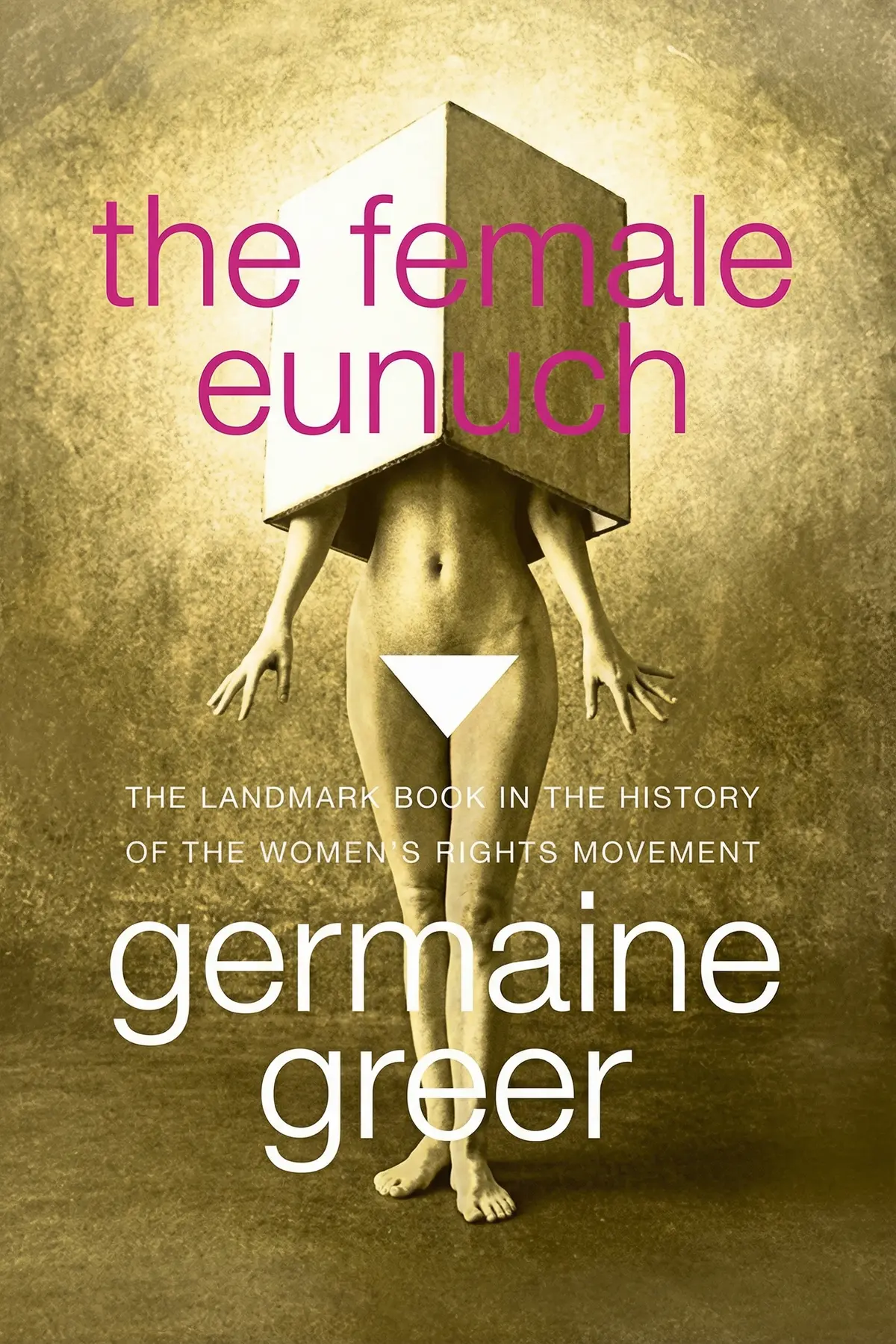
Many women do everything asked of them, staying pleasant, patient and agreeable, and still feel smaller than the people around them. In The Female Eunuch, Germaine Greer offers a blunt explanation: the qualities society praises in women are exactly those of a eunuch, obedience and the absence of desire. Greer published the book in 1970, and many of its ideas still feel relevant today. Women had by then won the vote and property rights almost everywhere, yet the fight over their bodies and choices was far from settled, and Greer argued that this ideal is not nature but training.
That training arrives through films and comics, through the stories told about sex, through classrooms and through marriage. Her throughline is simple to state. Women were shaped to look harmless, feel ashamed and depend on others, and they become free only by refusing that shape and defining womanhood themselves. Follow her argument and you will be able to name the pressures you were raised with, see why admiring poems are not really flattery, and decide which of her demands still fit your own life.
1 min 52 sec
The compliments women hear most often sound kind enough. Greer reads them as a job description for someone whose power has been removed, and she finds the same message in every comic book ending.
1 min 51 sec
Romance novels make their heroines wait, and readers cheer the strategy. Greer points to what that story leaves out entirely, and argues the omission shapes how women experience their own bodies.
1 min 56 sec
Girls often start school ahead of boys, then lose the lead just as learning gets more interesting. Greer traces the reversal back to the playground and forward to the lecture hall.
1 min 50 sec
Centuries of paintings and poems have celebrated female beauty, and Greer finds the tribute anything but flattering. She also asks why the most powerful things a woman’s body does are treated as something to hide.
1 min 47 sec
The attraction to a man in uniform seems harmless, and so does the dream of a husband to rely on. Greer argues both keep women in a role that costs everyone, men included.
1 min 16 sec
The Female Eunuch is an argument about where obedience comes from. Greer traces it through a chain that begins with dolls and sitting still and runs through romance plots and comic-book endings. It carries on through classrooms that reward caution and ends in a marriage that leaves a woman unable to support herself. Each link teaches the same lesson: be pleasant, be safe, want nothing. Her claim is that none of this is natural, which means it can be refused.
For Greer, refusing is also a way of building. Women are not only to reject the eunuch ideal but to create and model a new idea of womanhood. That idea makes room for ambition, desire, a body known without shame and an income of one’s own.
You can begin on a small scale. Notice when a compliment rewards silence or compliance. Learn how your own body works, without embarrassment. Before a decision about a job or a relationship, check whether it leaves you more dependent or less.
Some of her prescriptions still divide readers. Her central question has lasted far better: whose idea of a woman are you living out?
Women have won the vote and the right to own property almost everywhere. Yet many still feel boxed in by expectations they never chose. In The Female Eunuch, first published in 1970, Germaine Greer names the problem with a deliberately shocking image. She argues that the qualities society praises in women, such as patience, agreeableness and a lack of open desire, are the qualities of a castrated person. Greer follows that ideal through every stage of a woman's life. She looks at the strong heroines that films and comic books always defeat, and at romance plots that turn sex into a trade for commitment. She examines girls who are taught caution while boys are taught daring, the shame attached to menstruation, and marriages that leave women financially dependent. The book does more than diagnose. Greer calls on women to take ownership of their bodies, to treat pleasure as their own, to admire courage of the mind over displays of force, and to test what they really want from work and love. Readers get a sharp framework for spotting inherited scripts and a provocative case for writing new ones.
Women who feel praised for being agreeable and want to understand where that pressure comes from.
Parents, teachers and managers who shape how girls and young women learn to take risks.
Readers curious about a founding text of modern feminism and the debates it still sparks.
Germaine Greer, born in Melbourne, Australia, in 1939, is a writer, journalist and scholar of early modern English literature. She has held academic posts at the University of Warwick, Newnham College in Cambridge and the University of Tulsa, and has lived in the UK since 1964. The Female Eunuch, her first book, became an international bestseller and made her a household name. She has since written more than 20 books, including Sex and Destiny, The Change and The Whole Woman, and has written columns for The Guardian and The Spectator.
Listeners find this book to be a significant read for women, valuing its eye-opening perspective. Additionally, the pacing earns positive remarks, with one listener describing the work as groundbreaking in its time. However, several listeners consider the text dated, and some feel the writing is full of hate and anger. Furthermore, reactions to the writing quality are varied.
Wow, I finally finished this behemoth and I’m genuinely surprised by how much of Greer's wit still resonates after fifty years. To be fair, there are sections that feel like relics of a bygone era, but her central thesis on the 'castrated' woman is still remarkably sharp. She cuts through the absurd fantasies of romantic love that we are still fed today. The way she dismantles the suffocating nature of the nuclear family feels as groundbreaking now as it must have been in 1970. It’s an electric, feisty, and uncompromising read. Even when I disagreed with her, I couldn't stop turning the pages. This is essential reading for anyone who wants to understand the roots of the movement.
Show moreThis book is a total firecracker that absolutely refuses to apologize for its own existence or its confrontational nature. I love how Greer just shoots off her mouth without a filter; it forces you to actually think about your own biases. To be fair, she is often hilariously wrong or remarkably condescending, but the energy of the prose is infectious. This isn't just a dry academic study. It is a stirring call for a complete rethink of how we live our lives. Despite the dated parts, her central diagnosis of the 'female eunuch' remains an enlightening, essential concept for anyone interested in gender dynamics. Truly a powerful piece of writing.
Show moreThe chapter on the psychological construction of the female stereotype blew my mind and changed how I view my own social conditioning. This is a powerful book. At times it is almost too powerful. Greer doesn't just want equality within the existing system; she wants a complete reshaping of society for the benefit of everyone. I think people who label this as 'man-hating' haven't actually read it properly. It's an indictment of the roles we are all forced to play. Even the parts that are hilariously wrong provide a fascinating look at the evolution of feminist thought. It is an enlightening experience that I think every woman should have at least once. Simply groundbreaking.
Show morePicked this up during a spring cleaning session and ended up devouring it in two sittings because the prose is just that electric. It’s a classic rant. Greer’s argument about the 'castrated' nature of womanhood is still cuttingly relevant, even if her stance on menstruation and hygiene feels like a weird, hippie relic. I laughed out loud at her biting humor and her refusal to hem and haw around difficult subjects. Not gonna lie, some of the specific examples are very dated now. However, the core message about escaping patriarchal templates for achievement is incredibly powerful. She really demands that you ask yourself what you are going to do about your own freedom.
Show moreAfter hearing about this book for decades, I expected a dry academic tome, but instead I found a feisty, blunt assault on patriarchy. This 'softly spoken Australian'—as she was once ironically called—is actually anything but delicate in these pages. She attacks every assumption we have about marriage, work, and sex with a straight-talking wit that is refreshing to find in older literature. Some bits regarding the history of women in work are genuinely great. While I didn't agree with every conclusion, especially the more inflammatory comments on gender, I think the book is an indictment of society that still carries a lot of weight. It asks the hard questions that many people are still afraid to answer today.
Show moreNot what I expected at all, especially given how controversial Greer remains in modern social media circles. Look, the book is certainly problematic in several ways, particularly regarding its patchy views on homosexuality and trans identity. But if you can look past those serious flaws, the analysis of how women are socialized to be passive receptacles for male sexuality is brilliant. The pacing is excellent for a non-fiction text. I found it to be a very readable and funny exploration of why women feel so much anxiety in their domestic lives. It’s a bit of a mixed bag, but the high points are high enough to justify the read.
Show moreAs someone who came to this text late in life, I found myself oscillating between profound agreement and deep frustration. In my experience, the writing quality is quite mixed; Greer is capable of spooky perceptiveness one moment and then descends into dry, academic boredom the next. The chapter on body image was enlightening, yet the pseudo-scientific claims about biology felt like straight-up nonsense. It is definitely a product of its time. You can feel the anger bubbling under the surface, which is sometimes empowering and sometimes just exhausting. It’s an important historical document, but I wouldn't call it a definitive guide for modern life. Take the good bits and leave the rest behind.
Show moreEver wonder what second-wave feminism felt like in its rawest, most unpolished form? This book provides that window, though it isn't always a comfortable view. Greer is witty and perceptive, but she’s also a bit of an attention-seeking troll at times. I found the sections on capitalism's role in shaping the female stereotype to be the most compelling parts of the entire work. On the other hand, the blatant lack of intersectionality makes it feel very much like a middle-class white woman's grievance list. It’s interesting to see how feminism has changed since then. She’s definitely someone I’d invite to a dinner party just for the drama, but I’m not sure I’d follow her advice blindly.
Show moreThe truth is, while Greer is obviously intelligent, her writing is so suffused with a particular brand of vitriol that it becomes hard to digest. I expected a manifesto for liberation but found something that frequently felt elitist and, frankly, quite misogynistic in its dismissal of 'normal' women. The blatant transphobia is impossible to overlook and colors much of the text's second half. While it was likely groundbreaking in 1970, reading it now feels like listening to an angry relative who refuses to update their worldview. There are better feminist books that don’t rely on such exclusionary rhetoric. It’s just too full of hate for me to find it genuinely empowering.
Show moreWhatever historical value people claim this book has is completely eclipsed by how repugnant the author’s worldview feels today. I picked this up hoping for a foundational text but instead found something that is dated, elitist, and shockingly homophobic. Greer’s prose is incredibly condescending, frequently veering into pseudo-scientific nonsense and weirdly aggressive 'hippie' rhetoric that just doesn't hold up. Frankly, it feels like she takes pleasure in being inflammatory rather than actually helping women. The transphobia alone is enough to make me regret buying it. I would recommend skipping this trash and reading literally any other modern feminist author. Germaine Greer is a figure better left in the past.
Show moreGermaine Greer argues that society values in women the qualities of a eunuch: obedience and the absence of desire. Through popular culture, the stories told about sex, schooling, shame about the body and financial dependence in marriage, women are trained to look harmless and wait for approval. Greer’s answer is for women to reject that dependence and create a new, self-defined idea of womanhood.
Greer uses the eunuch, a castrated man, as an image for how women are expected to behave. In her view, the traits society rewards in women, such as patience, agreeableness, passivity and a passionless kind of devotion, amount to having power and desire removed. By demanding that women act this way, she argues, society signals that they cannot be true equals in public or private life.
Greer argues that girls are taught caution from childhood while boys are allowed to run wild. Girls often start school ahead of boys, but fall behind as learning comes to depend on independent thought, because they have been taught to avoid risk. At university, she claimed, many focused on winning professors’ approval instead of challenging ideas, repeating the obedience expected of them later in marriage.
The book supports a few habits. Notice when strong women in films or comics are defeated by the end, and when compliments reward compliance. Learn about your own body without shame, which Greer sees as the first step toward a new femininity. Before major choices about work or relationships, ask whether they increase your independence, and treat what you want as something to discover through trial and error.
Published in 1970, it made Greer a household name, and her ideas have stirred controversy ever since. Many of her themes still hold up: pressure on girls to be careful, shame around menstruation, women leaving work after having children, and pop culture that tames its strong heroines. Readers may reject some of her prescriptions while finding her diagnosis of inherited roles useful.
Virginia Woolf

Tracy Rosenthal

Jessica Valenti



Johny Pitts


bell hooks


Fay Bound Alberti
AUDIO SUMMARY AVAILABLE
Get the key ideas from The Female Eunuch by Germaine Greer, plus 5,000+ more nonfiction titles.









