
14 min 48 sec
Available in: English
The Confidence Game: Why We Fall For It . . . Every Time
Shows how con artists find and use the normal instincts everyone has, such as trust, pride, optimism and fear of embarrassment, and how knowing your own triggers makes you much harder to fool.
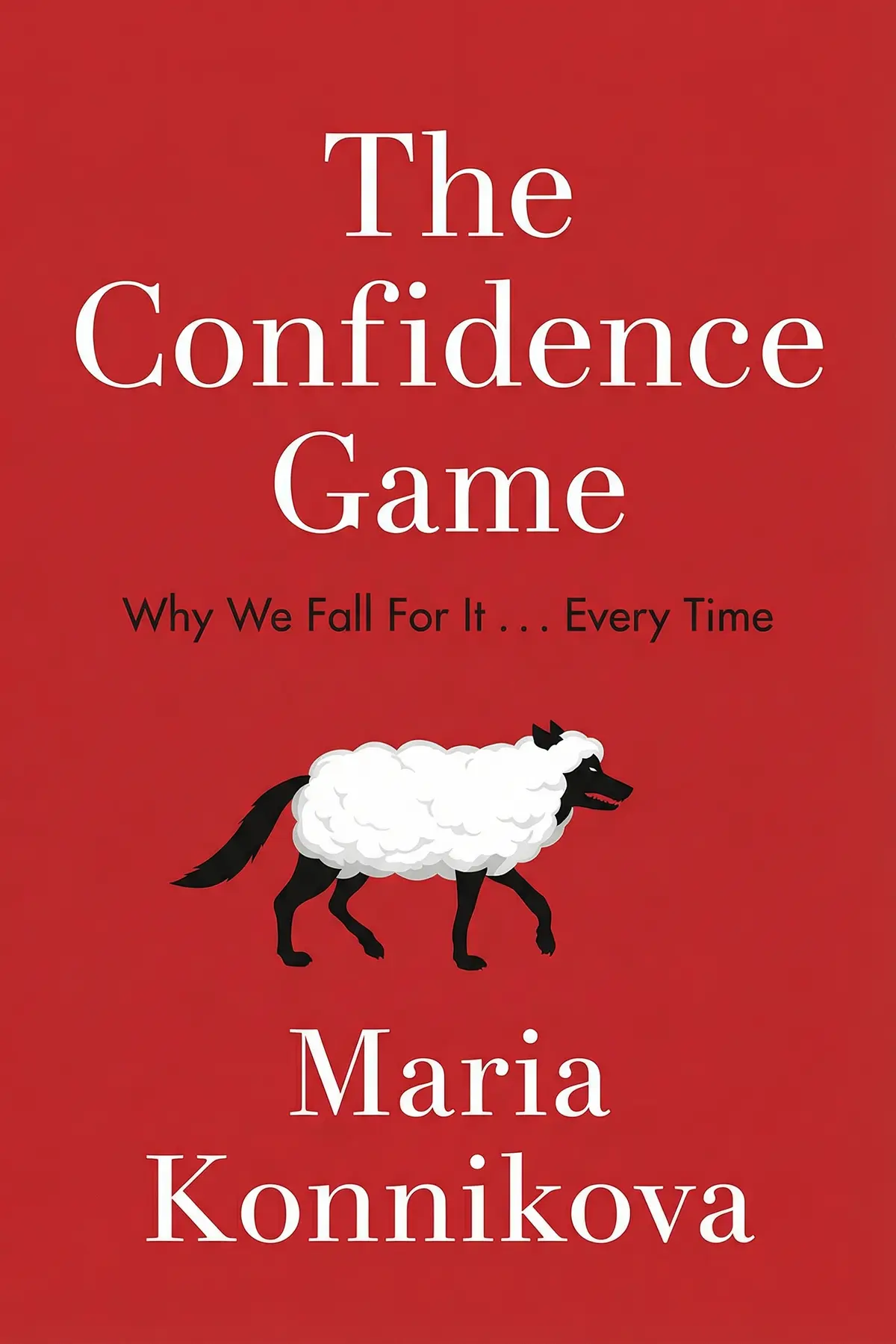
Table of Content
1. Introduction
1 min 02 sec
Most people who hear about a big fraud assume they would have seen through it, and that confidence is exactly what con artists count on. In The Confidence Game, psychologist and writer Maria Konnikova argues that fraudsters do not hunt for fools. They hunt for ordinary human needs: to trust people like us, to feel special, to expect good things, to stay consistent and to protect our good name.
Every one of us carries those needs, so every one of us has a weak point that a skilled con artist could find in minutes. Konnikova follows the con from first glance to final cover-up, with cases that range from a fake Nigerian prince who turned out to be a 14-year-old American boy to a professor arrested with cocaine in a stranger’s bag. Each step shows a normal instinct being turned against its owner. Learn those steps and you can recognize the moment someone starts pressing your particular buttons, and step back before the check is written.
2. Spot the stranger who reads you too closely
1 min 43 sec
Married couples who misread each other’s feelings turned out to be happier than the accurate ones. Con artists live by the opposite rule, and one clairvoyant needed only a few minutes to prove why.
3. Check the story of anyone who seems perfect
1 min 42 sec
He built her a kitchen and cared for her sick grandmother, and for two years nothing gave him away. Then a single phone call did. The trust he used rests on a reflex almost nobody notices.
4. Small yeses that lead to big losses
1 min 49 sec
A four-dollar request from a fake prince and a bronze pig at a charity auction show how fraudsters use our politeness. The trap works whether you said yes first or no first.
5. Flattery of your self-image is the real hook
1 min 50 sec
A respected professor flew to Bolivia to meet a model he had never spoken to, and a noble French family handed over everything it owned. Both were caught by the same flattering picture of themselves.
6. Optimism makes a fake success look real
1 min 51 sec
Investors queued to hand money to a man promising 10 percent a week, and a gallery owner bought masterpieces with no history. Hope for a good future made both ignore what should have stopped them.
7. Once you trust, warning signs get explained away
1 min 49 sec
A cult explained away an end of the world that never came, and a rancher kept believing in his promised profits as the story grew ever less likely. The same mental trick protected both beliefs, and it works on you too.
8. Spot how fear of looking foolish shields fraudsters
1 min 38 sec
Seventy thousand people paid into a tale about lost royal treasure, and not one of them called the police afterward. Their silence reveals how much we will give up to protect our good name.
9. Conclusion
1 min 24 sec
The Confidence Game turns the comfortable story about fraud inside out. Victims are seldom stupid; they are people whose good qualities were used against them. Trusting someone who seems like us, finding it hard to refuse twice, taking pride in who we are, hoping for a better future, staying loyal to what we already believe and caring about our good name all help us live alongside other people. In a skilled con artist’s hands, each one becomes a handle. Konnikova believes many people have been fooled at some point, likely more than once, without ever finding out.
Her advice is to study yourself and learn which weak points and emotional triggers make you act on impulse. Watch yourself for the moments that make you feel rushed, flattered or hopeful enough to skip a check, and notice when one person keeps returning to exactly those moments. Notice what makes you act on impulse, and if someone looks too good to be true, it does no harm to check his story. That way, when someone keeps pressing those buttons, you can recognize what is happening and avoid being drawn in.
The clairvoyant who took $27,000 from Debra Saalfield spotted her vulnerability from her body language, before Saalfield had described her problems. Turned on yourself, that same attention is the best protection you have.
About this book
What is this book about?
Almost everyone who reads about a famous fraud feels sure they would have seen through it. Maria Konnikova argues that this certainty is part of the problem. Con artists are not searching for fools. They are searching for the ordinary needs we all share, and they can find a person's weak point remarkably fast. Drawing on psychology research and real cases, Konnikova follows a con from the first close reading of a target to the cover-up afterward. A clairvoyant sizes up a vulnerable client, a charming partner invents two years of a life, a fake Nigerian prince turns out to be an American teenager, and an aristocratic French family signs away everything it owns. Along the way she explains the foot-in-the-door technique, our built-in optimism, cognitive dissonance and the fear of looking foolish. Readers learn why intelligent, careful people get taken in, which instincts a fraudster pulls on at each stage, and how to recognize the moment their own buttons are being pressed. The book's closing advice is simple: study your own triggers, because that is exactly what a con artist will do.
Book Information
Who it's for
Sure they're scam-proof
People who are sure they would never fall for a scam and want to test that belief.
Deciding whom to trust
Investors, buyers and managers who make trust decisions about strangers, deals and offers.
Fooled once before
Anyone who has been fooled once and wants to understand which of their instincts was used.
About the Author
Maria Konnikova
Maria Konnikova is an American writer, born in 1984, who studied at Harvard University and earned a PhD in psychology from Columbia University. She writes regularly for The New Yorker and hosts The Grift, a podcast about con artists and the damage they cause. The Confidence Game won the 2016 Robert P. Balles Prize in Critical Thinking. For a later book, The Biggest Bluff, she learned poker well enough to win more than $300,000 in tournaments.
Ratings & Reviews
Ratings at a glance

What people think
Listeners find the book consistently engaging and value its deep dive into intricate psychological concepts. The caliber of the writing is also praised, particularly by one listener who noted the author's ability to use common, everyday language. Conversely, reactions to the exposition are varied, as several listeners felt the examples became repetitive. Some listeners also found the clarity of the prose to be inconsistent, describing certain sections as wordy.
Top reviews
Narong
The psychology behind the 'put-up' and the 'rope' is absolutely fascinating to deconstruct! Maria Konnikova has a masterful way of blending true crime storytelling with academic research. I was particularly struck by the observation that education and money don't actually protect you from being taken. In fact, our inherent need to trust others is what makes society function, yet it’s the exact thing a con artist exploits. The book is entertaining from start to finish and the writing quality is top-notch. I loved how she broke down the steps of a con, from the initial empathy building to the 'blow-off' at the end. It makes you realize that most of us are just an 'asshair' away from being a mark ourselves if the circumstances are right. Truly a great window into the weird ways our minds make us idiots.
Show moreBae
Wow, this book really shifted my perspective on why 'smart' people end up losing everything to a con artist. We often look down on victims as being greedy or dumb, but Konnikova proves that's rarely the case. We are simply social animals built for rapport and empathy. The author’s writing style is incredibly accessible and she has a knack for picking the perfect stories to illustrate her points. I found the 'convincer' stage of the game particularly interesting—it's wild how we will ignore red flags just to keep the story we’ve told ourselves alive. It is a wealth of complex knowledge delivered in a way that feels like a conversation. Even though it's a bit wordy in the middle, I found it impossible to put down. Highly recommended for anyone who thinks they're too smart to be scammed!
Show moreJoshua
Picked this up because I loved The Biggest Bluff and wanted more of Konnikova’s insight into the human mind. This isn't quite as tight as her poker book, but it’s still a fascinating look at the 'soft skills' of manipulation. The truth is, we are all vulnerable because we want to believe we are special. I particularly enjoyed the stories about the old-school Ponzi schemes where victims defended the scammer even after the fraud was exposed. It really highlights how we become complicit in our own undoing. My only gripe is that the middle sections get a bit wordy and the examples start to feel a little samey after a while. Still, the author uses everyday language to explain complex ideas, making it very digestible for a casual reader. It's a solid 4-star read for anyone interested in social engineering.
Show moreElise
Frankly, it’s a bit terrifying to realize how hard-wired we are for belief over skepticism. Konnikova points out that religious people or those who are naturally optimistic are often the easiest targets. This isn't because they are stupid, but because they are primed to believe in things they haven't earned. I loved the anecdote about the Nigerian prince scam and how it's actually designed to fail for most people so the scammer only deals with the most gullible. That kind of insight made the book worth it for me. The prose is clear and she avoids overly technical jargon, which I appreciated. Some sections did feel a bit long-winded, and I wish there were more footnotes to back up the bolder claims. Overall, it's a very engaging look at the dark side of human nature and persuasion.
Show morePim
As someone who grew up hearing 'there's no such thing as a free lunch,' I still found plenty of surprises here. The book dives deep into the 'hot hand fallacy' and other cognitive biases that leave us wide open for a con. I liked how it wasn't just about the money, but about the emotional investment we make. The way con artists play on our vanity and our desire to be part of something special is explained so well. While some of the examples are repetitive, the overall narrative is strong. Konnikova’s background in psychology really shines through without making the book feel like a dry textbook. It’s a bit of a breezy read, perfect for a weekend. Just be prepared to realize that you've probably been scammed at least once in your life, even if it was just for twenty bucks.
Show moreSarawut
Finally got around to reading this, and it’s a solid deep dive into the 'soft skills' of manipulation. The central premise—that we believe because we want to, not because we're forced—is a powerful one. I found the breakdown of the different phases of a con to be very helpful for understanding human interaction in general. It’s not just about criminals; it’s about how we all persuade and are persuaded every day. The book is well-written, though it occasionally meanders into stories that feel like filler. Truth is, it could have used a tighter edit to keep the momentum going. However, the insights into why we stay quiet after being fleeced were eye-opening. We are indeed the best deceivers of our own minds. Definitely worth a look if you enjoy true crime with a scientific twist.
Show moreSuda
Ever wonder why people fall for the most obvious scams on the planet? Konnikova explores the mechanics of the 'put-up' and the 'rope' with some really interesting psychological depth. I found the section on why scammers use bad grammar in emails to weed out anyone with a brain absolutely brilliant. However, the book as a whole is oddly organized and circles back on itself way too often. It’s an easy, breezy read in terms of language, but it definitely could have been shorter by at least a third without losing any impact. There are no footnotes or a formal bibliography, which makes some of the 'science' feel a bit like pseudo-science at times. It’s good for a plane ride, but don't expect it to change your life or offer a foolproof shield against every con artist out there.
Show moreRungrat
To be fair, I expected a bit more practical advice on how to protect myself from modern fraudsters. Instead, this felt more like a historical survey of famous cons mixed with some general psychological principles. The stories are well-told, but many of them were already familiar to me from other books or documentaries. The author keeps emphasizing that we should 'trust but verify,' which feels like a bit of a letdown after so much buildup. I also found the structure a bit repetitive, as she keeps coming back to the same points about vanity and our desire for easy money. It’s a decent read if you like pop psychology, but it lacks the 'wow' factor I was hoping for. The science is interesting enough, but much of it feels like stuff you'd see on a typical detective show.
Show moreGoy
I’ve been a fan of Konnikova’s journalism for a while, but this one felt a little bloated. There’s a lot of interesting research here, but it’s stretched thin over too many pages. I found myself skimming through the parts that felt like a repeat of stuff I’d already heard on podcasts. The conclusion—that we have to trust each other to have a society—is a bit of a 'duh' moment. It’s good to see the science behind it, I guess, but it doesn't offer much in the way of utility. If you can’t avoid being a social animal, then you can’t avoid being a potential mark. The yarns were okay, but they didn't get me the way her poker stories did. It’s an okay book, but I wouldn't call it essential reading unless you are totally new to the subject of social psychology.
Show moreBo
After about fifty pages, I just couldn't force myself to keep going. I really enjoyed her poker book, but this one felt like a massive step backward. Part of the problem is that the research feels recycled, covering things like the hot hand fallacy and basic probability that I’ve already read elsewhere. To be fair, the writing style is accessible enough, but the actual content felt like common sense dressed up as deep psychology. I’ve already watched the Netflix documentaries on some of these cases, like Glafira Rosales, so the 'yarns' didn't really hook me. It’s repetitive and, frankly, a bit boring because it never quite delivers on the promise of showing us how to actually avoid these scams. It basically just tells you that humans are social animals who trust each other. I already knew that, and I didn't need 300 pages to confirm it.
Show moreQuestions about this book
What is the main idea of The Confidence Game by Maria Konnikova?
Konnikova argues that anyone can be conned, because con artists exploit ordinary human traits rather than stupidity. They read people closely, build trust by faking similarity, draw victims in with small requests, flatter their self-image, feed their optimism, and rely on cognitive dissonance and the fear of looking foolish. Since everyone has these weak points, she believes many people have been fooled without ever realizing it.
What is the foot-in-the-door technique in The Confidence Game?
It is the tendency to agree to a larger request after agreeing to a small one. Konnikova cites a 1966 Stanford study in which mothers who first answered a few phone questions were 30 percent more likely to accept a two-hour home interview. A con artist around 1900 used the same step: a fake Nigerian prince seeking pen pals later asked respondents for $4.00 in exchange for gems that never arrived.
Why do smart people fall for con artists?
According to Konnikova, intelligence offers little protection because cons target needs, not knowledge. A 68-year-old professor was arrested with cocaine after trusting an online model he had never spoken to, because he was confident in his own appeal. An experienced gallery owner bought forged paintings because she hoped for a great discovery. Optimism, pride and trust affect clever people as much as anyone else.
How can I protect myself from con artists according to Maria Konnikova?
Her main advice is to know yourself: notice which things stir your emotions and push you to act on impulse, so you can tell when someone keeps pressing those buttons. The cases in the book also suggest checking one verifiable fact about anyone who seems too good to be true, judging each new request on its own, and reporting a fraud instead of hiding it out of embarrassment.
Why don't victims of fraud report it?
Konnikova points to the value we place on reputation. Dunbar’s research found that 65 percent of conversation is gossip, showing how much we care about how we are seen. In 1915, seventy thousand people paid into a false story about Sir Francis Drake’s lost treasure, and when it was exposed none of them went to the police, because they feared looking foolish.
Readers also enjoyed

A Liberated Mind: How to Pivot Toward What Matters
Steven C. Hayes


Acting with Power: Why We Are More Powerful Than We Believe
Deborah Gruenfeld


Age of Propaganda: The Everyday Use and Abuse of Persuasion
Anthony Pratkanis




59 Seconds: Change Your Life in Under a Minute
Richard Wiseman

AUDIO SUMMARY AVAILABLE
Listen to The Confidence Game in 15 minutes
Get the key ideas from The Confidence Game by Maria Konnikova, plus 5,000+ more nonfiction titles.
- 5,000+ titles
- Listen as much as you want
- 7-day free trial
- Cancel anytime









