

15 min 08 sec
Available in: English
Talk: The Science of Conversation
Shows how everyday conversation follows predictable patterns, and how reading pauses, filler words and turn-taking, and changing a single word in a question, can help you predict reactions, avoid friction and get more yes answers.
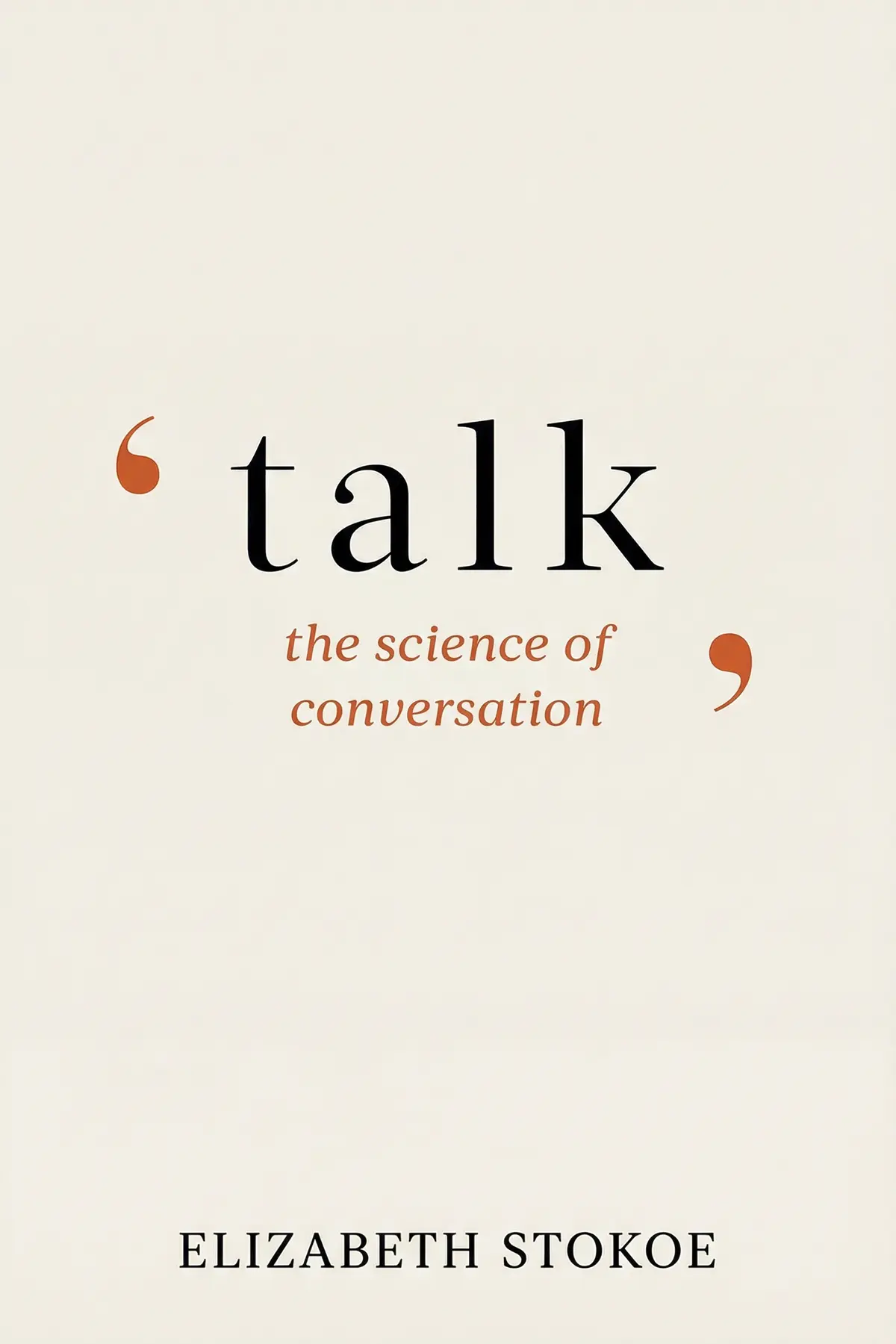
Table of Content
1. Introduction
57 sec
If your requests keep meeting refusals and your small talk feels flat, the fix may be one word long. In one study, doctors who swapped any for some when asking patients about other concerns saw the share who spoke up rise from half to nine in ten. In Talk, Elizabeth Stokoe, a professor of psychological and behavioral science at the London School of Economics, shows where findings like that come from.
Conversation feels improvised, she argues, yet most of it runs on structures that repeat. Once you can see them, you can predict how people will react and change the outcome by adjusting a word or the order of a turn. Here you will learn to hear the refusal hiding in a pause, word a request so it gets granted, return an unwanted burden politely, and see why rehearsed role-play teaches the wrong lessons.
2. Take turns so people feel heard
1 min 34 sec
Most interruptions are accidents, and they still make you look like you stopped listening. A neighbor’s reply to a cheerful good morning shows how one skipped step in the rhythm of talk can turn a fair point into rudeness.
3. Make small talk build rapport
1 min 27 sec
Nobody wants an honest answer to how are you, yet ignoring the question costs you. A hotel receptionist shows how the same few words can sound like a script or like real interest, depending on one thing.
4. Hear a no before it arrives
1 min 35 sec
Most people think a pause before an answer means the other person is choosing words. Conversation analysts disagree, and what they found makes a tiny silence, and a few filler words, far more revealing than they sound.
5. Read gestures alongside the words
1 min 47 sec
One famous statistic claims your body does most of your talking. Its origin is a surprisingly small experiment, and a hand resting on someone’s arm shows why gestures are harder to read than the experts promise.
6. Turn a no into a yes with one word
1 min 41 sec
Doctors asked patients a simple closing question and only half took the opening. A second version, almost identical, changed the picture completely, and the reason applies to every meeting that ends in awkward silence.
7. Ask plainly to get better service
1 min 30 sec
Most of us hint rather than ask, and the way we finally phrase a request tells the listener something about us. A question about Wi-Fi in a hotel bar shows what good service hears that bad service misses.
8. Accept offers gracefully and dodge forced ones
1 min 32 sec
A half-meant offer gets accepted, or a friendly colleague somehow leaves you organizing their meeting. Small moves in timing and phrasing protect both sides, and one reply hands the work back without any friction.
9. Real recordings beat role-play for better workplace talk
1 min 54 sec
Acting out an angry customer in front of your manager feels like training. Analysts who compared rehearsals with real police interviews and hospital talks found the rehearsals pointing people toward the wrong words.
10. Conclusion
1 min 11 sec
Talk shows that the most ordinary thing people do all day follows rules nobody taught them. A beat of silence, a casual so, the choice between any and some, a greeting answered or skipped: each belongs to a structure that turns up everywhere from a doctor’s office to a hotel bar. Spontaneous talk is still patterned talk, and a pattern you can see is one you can work with.
The practice starts small. Before your next meeting ends, ask whether people have some questions and see who speaks. When a quick yes turns into a pause, take it as an early answer and adjust. Strip the apologies from your requests and ask plainly. And if you train people to talk with customers or patients, stop staging scenes and start listening, with permission, to the conversations that already happen.
The doctors in that 2007 study changed only the wording of their question. When they swapped “any” for “some”, the share of patients responding positively rose from 50 percent to 90 percent.
About this book
What is this book about?
Conversation feels spontaneous, so most of us assume it cannot be studied or improved. Elizabeth Stokoe, a researcher who works from recordings of real talk, argues the opposite. Using conversation analysis, she shows that interactions are built from repeating building blocks: turns that come in matched pairs, ritual openings, telling pauses and small words such as so, um and oh. Seeing those blocks changes what you can do. A pause before a reply often signals a refusal. Ignoring a casual how are you can damage rapport. In one 2007 study, swapping any for some in a question raised the share of patients who mentioned another health concern from 50 to 90 percent. Plain requests are more likely to be granted than apologetic ones, and a well-chosen reply can hand back a burden someone tried to place on you. Stokoe also takes on two popular beliefs: that body language makes up 93 percent of communication, and that role-play is a good way to train staff. Readers get a clear picture of how talk works and practical changes they can try in the next meeting, sales call or difficult conversation.
Book Information
Who it's for
Leaders met with silence
Managers and team leads who end meetings by asking for any questions and hear only silence.
Customer-facing staff
Salespeople, receptionists and service staff who want customers to feel genuinely helped.
HR and training teams
Trainers and HR teams who rely on role-play and want a more accurate way to improve how staff talk.
About the Author
Elizabeth Stokoe
Elizabeth Stokoe has been a professor of psychological and behavioral science at the London School of Economics since January 2023. From 2002 to 2022 she was Professor of Social Interaction at Loughborough University, where she is still an Honorary Professor, and the University of South-Eastern Norway has given her a Professor II post since 2016. She developed the Conversational Analytic Role-Play Method, or CARM, which uses recordings of real conversations to identify common problems and patterns, and she has advised on talk in settings from hostage negotiation to speed dating.
Ratings & Reviews
Ratings at a glance

What people think
Listeners note that although views differ on whether the insights are revolutionary or merely intuitive, the work provides a compelling and distinct look at the structures of casual, day-to-day conversation. Audiences value the extensive reliance on actual data and qualitative research, with one listener highlighting the benefit of studying talk within "natural situations" instead of lab-based experiments. Furthermore, they find the analysis of conversational "building blocks" useful for recognizing habits and reducing conflict during routine exchanges. Many also comment that the approachable style and organized format turn intricate linguistic ideas into something very reachable and captivating.
Top reviews
Hassan
Wow, I will never listen to a simple phone call the same way again. Elizabeth Stokoe has a way of making you realize that every 'um,' 'ah,' and slight hesitation is doing heavy lifting in our social lives. This book encapsulates the wonders of language and psychological insight perfectly. It is packed with take-home points and models that I know I’ll be going back to for years. I loved the heavy use of real-world data—it feels so much more authentic than those sterile laboratory studies you usually see in psychology. The writing is personable and engrossing, making it an easy read despite the depth of the research. It truly did change the way I think about talk. It's a must-read for any logophile out there!
Show moreAmy
After taking a criminology module with Liz at Loughborough University back in 2017, I became obsessed with how language works. This book is the reason I ended up pursuing an MSc in Psychology. It’s absolutely fascinating stuff! Stokoe manages to take the complex structure of discourse—things like overlapping talk and those tiny intakes of breath—and explain why they matter for human connection. The layout is great and the tone is so personable that you feel like you're having a conversation with the author herself. It's totally different from other books on communication because it focuses on the spontaneous stuff, not just formal meetings. I recommend a copy to all my friends who are interested in what makes humans tick. It’s brilliant.
Show moreLucas
The chapter on conversational 'building blocks' is worth the price of the book alone. Honestly, I didn't expect to be so captivated by a book about such a mundane topic, but the way Stokoe analyzes the 'predictable patterns' of talk is masterly. It teaches you the best method for identifying conversational pitfalls before they even happen. Most communication books are about persuasion or negotiation, but this guides you through the techniques of daily life. The qualitative analyses are deep and provide a perspective that is missing from most linguistic texts. If you want to understand the art of conversation as it actually happens in the real world, this is the book. It’s a five-star guide for anyone looking to reduce friction in their daily interactions.
Show moreChatchai
Finally got around to reading 'Talk' and it’s surprisingly practical despite the academic roots. Most books on the art of communication focus on formal settings like boardrooms or negotiations, but Stokoe looks at the messy, spontaneous talk we use every day. Look, understanding that our conversations follow predictable patterns is a game-changer for avoiding friction. The way she breaks down conversational building blocks helps you spot where a simple chat might be going off the rails. I found the layout clear and the tone very accessible, which is rare for this kind of subject matter. It’s not just theory; it’s about identifying those pitfalls that cause misunderstandings in real life. Definitely recommended for anyone who wants to analyze their own verbal habits.
Show moreDimitri
The way Elizabeth Stokoe breaks down the mechanics of human interaction is genuinely eye-opening. I’ve read a lot of self-help books on 'how to talk to anyone,' but this is different because it’s based on actual data rather than just anecdotes. Gotta say, the CARM (Conversational Analytic Role-Play) method is a fascinating way to look at how we fit together the elements of a sentence. The book is full of qualitative analyses and real-world examples that make the concepts stick. While some parts feel slightly repetitive, the personable tone kept me engrossed for the most part. It’s a solid 4 stars for providing a unique lens on the 'spontaneous' talk we usually take for granted. It really highlights how much structure exists in our supposedly random interactions.
Show moreNook
After hearing a brief summary of the CARM method, I had to dive into the full book. In my experience, most people think conversation is just random, but Stokoe proves it’s anything but. By analyzing the predictable patterns in how we respond to each other, we can actually improve how we navigate difficult interactions. The personable tone and clear layout made complex linguistic concepts feel very approachable. My only minor complaint is that the book leans very heavily on qualitative examples. I would have appreciated a bit more statistical depth to round out the conclusions. Regardless, it’s a fascinating look at the 'art' of everyday talk that is far more rigorous than your average communication guide. It changed how I listen to people.
Show moreAubrey
Picked this up because I’ve always been curious about how we interact, and it was... okay. Truth is, the book has the odd interesting take, especially regarding how we manage pauses and overlaps in conversation. However, it’s mostly common sense and becomes very repetitive by the halfway mark. I liked the concept of looking at 'natural' speech instead of laboratory experiments, but I wish there was more quantitative analysis to back up the qualitative observations. It’s a 3-star read because while the insight into conversational 'building blocks' is solid, the delivery is a bit dry. It takes a while to get through, and I’m not sure I learned enough to justify the time spent. It’s decent if you’re a linguistics nerd, but maybe too granular for everyone else.
Show moreNing
As someone coming from a background in philosophy of language, I found the Harvey Sacks-style approach here quite refreshing. Elizabeth Stokoe makes a compelling case for the value of looking at natural, non-experimental speech. We often ignore the 'liminal signs' like intakes of breath or those tiny, meaningful pauses, but this book puts them front and center. Personally, I think there is a lot for philosophers to chew on here, even if it isn't framed within a traditional theory of communication. My main gripe is that it feels a bit light on the data side; I would have loved to see these qualitative findings extended to a fuller corpus with some quantitative rigour. It’s a good introduction to the field, though it lacks the 'final conclusion' feel I was hoping for.
Show moreNaomi
Ever wonder if you can spend hours reading about things you already do instinctively every single day? Not gonna lie, this didn't really hold my attention for long. While it’s nice to get a slightly different perspective on communication, most of the 'findings' here felt like pure common sense wrapped in fancy terminology. The book is incredibly redundant, repeating the same points about predictable patterns until you just want to skip to the end. I appreciate the focus on real data, but it’s hard to stay engaged when the pace is this slow. It feels more like a textbook for a very specific class than a book for a general audience interested in self-improvement. It has its moments, but they are few and far between.
Show moreTern
This book was a massive disappointment, bordering on useless. To be fair, I expected a deep dive into the mechanics of human connection, but what I got was a postmodernist lecture that felt obsessed with shallow taxonomy rather than actual substance. It’s essentially a 300-page admonishment for people who already find speech interesting. I found myself mostly bored, occasionally stumbling upon insights that I probably could have derived from my own thoughts without the academic fluff. The author spends so much time categorizing words that the actual art of 'talk' gets lost in the weeds. If you're looking for depth, look elsewhere. Frankly, it felt like being told 'words are important' over and over again without any real 'how-to' or meaningful theory. It’s a tedious read for anyone not already steeped in this specific academic niche.
Show moreQuestions about this book
What is the main idea of Talk by Elizabeth Stokoe?
Stokoe argues that conversation, though it feels spontaneous, follows predictable patterns that conversation analysis can reveal. Talk is built from turns that come in matched pairs, ritual openings, pauses and small words such as so, um and oh. Once you recognize these patterns, you can anticipate how people will respond, avoid needless friction and change outcomes by adjusting a word or the order of what you say.
Why does asking for some questions work better than any questions?
In a 2007 study in the United States, only half of patients raised another concern when doctors asked if there was anything else they could help with. When doctors asked about some other issue instead, 90 percent said yes. The word any usually appears in negative sentences, so questions built on it make no the easy answer. Some keeps the exchange open.
Does Talk say body language is most of communication?
No. Stokoe takes apart the popular claim that 93 percent of communication is body language. It comes from a narrow 1971 study by Albert Mehrabian, in which listeners judged mood from one spoken word, and Mehrabian has said it is misapplied. Gestures do communicate, but they are often ambiguous, so the book treats them as one part of a conversation, read together with the words.
How can I apply Talk at work?
Several changes come straight from the book. Ask meetings and clients whether they have some questions. Treat a pause after a request as a likely no. Make requests plainly instead of wrapping them in apologies, and when a colleague hands you the work of organizing something, agree and ask them to propose times. If you train staff, record real calls and meetings, with permission, instead of relying on role-play.
Who should read Talk?
It suits anyone whose work depends on conversations: managers running meetings, salespeople and service staff, doctors, and trainers who design communication programs. Its examples range from doctors’ offices and hotel receptionists to police interrogations and neonatal care, and its advice is small enough to try in your next conversation, from rephrasing one question to noticing what a sudden pause is telling you.
Readers also enjoyed

Acting with Power: Why We Are More Powerful Than We Believe
Deborah Gruenfeld


Age of Propaganda: The Everyday Use and Abuse of Persuasion
Anthony Pratkanis






59 Seconds: Change Your Life in Under a Minute
Richard Wiseman
AUDIO SUMMARY AVAILABLE
Listen to Talk in 15 minutes
Get the key ideas from Talk by Elizabeth Stokoe, plus 5,000+ more nonfiction titles.
- 5,000+ titles
- Listen as much as you want
- 7-day free trial
- Cancel anytime









