Abundance: The Inner Path to Wealth
Deepak Chopra
 English
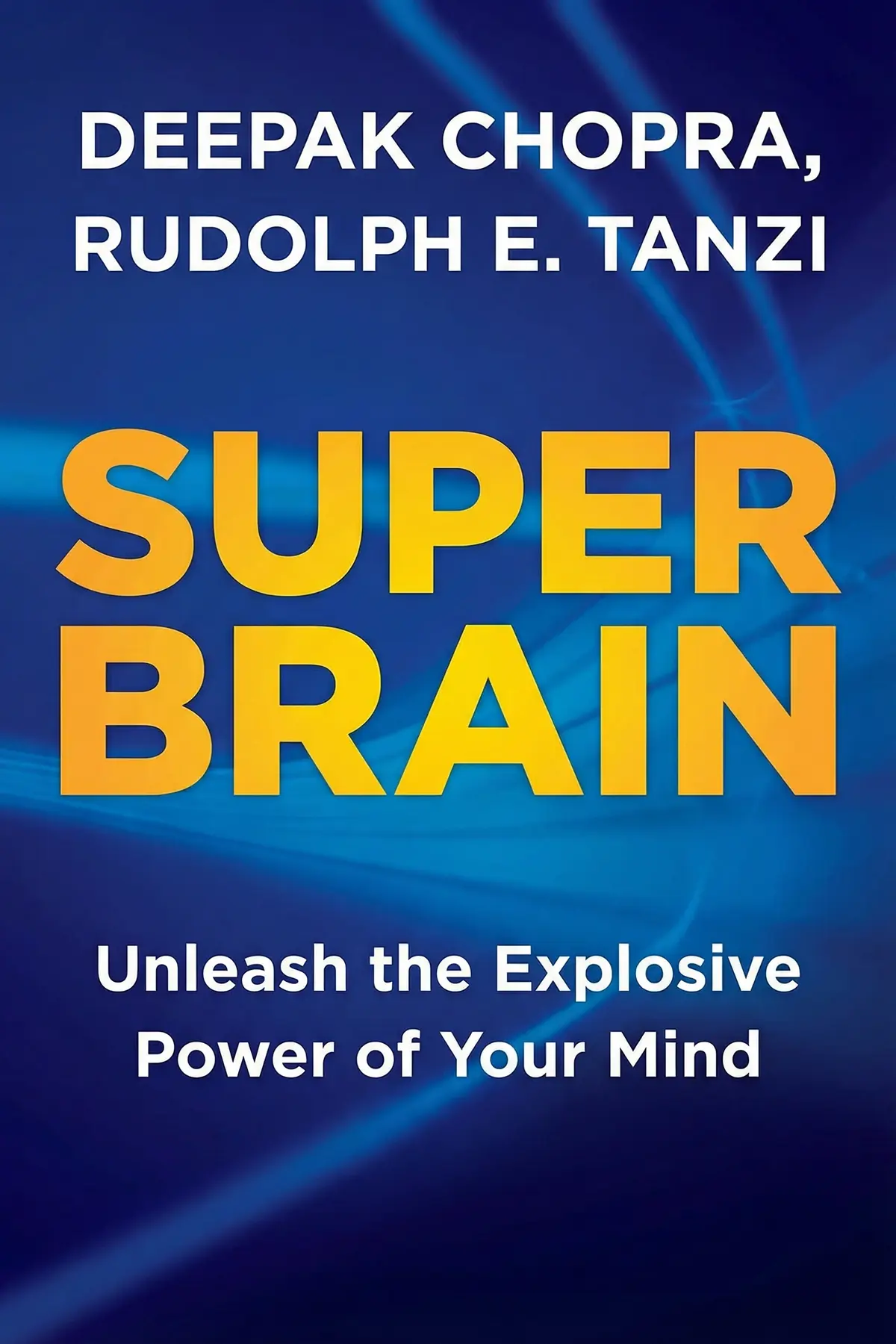
Chopra and Tanzi argue that the brain keeps growing at any age and responds to focused attention. They show how to use that to heal, curb emotional eating, trust intuition and pursue lasting happiness.
58 sec
If you treat your brain as a machine that slowly wears out, Deepak Chopra and Rudolph E. Tanzi want to change your mind. In Super Brain, the physician and wellness author and the Harvard neurologist report that a 70-year-old brain holds about as many neurons as a 20-year-old one, because the brain keeps making new cells.
Their case is that the brain is a living organ in constant conversation with every cell in the body. Steer that conversation with focused awareness, they argue, and you can heal, grow, eat more wisely and live longer and happier. The evidence runs from Tibetan monks warming themselves in freezing air to singing finches and a 50-year follow-up of volunteers.
What you take from it is a handful of habits: feeding your brain new challenges, noticing why you reach for food, choosing goals that pay off over a lifetime, and checking in with your own feelings during the day.
1 min 45 sec
A startled walker, a meditating monk and a stroke patient lifting a cup all reveal the same hidden system. Once you see how it works, the line between mind and body starts to look far thinner.
1 min 39 sec
Every day your brain stops using tens of thousands of neurons, which sounds like a slow countdown. A neurologist who compared young and old brains found something that should change how you think about aging.
1 min 48 sec
The best role model for a stronger brain is not a famous investor or tech founder. It is someone who cannot yet walk or talk, and who does one thing most adults stopped doing long ago.
1 min 39 sec
Diets often fail at the very moment they start working, and a hormone is partly to blame. The authors’ answer does not involve stronger willpower. It starts with one honest question before you eat.
1 min 42 sec
People in one study recognized faces better when they had less time to look. Another experiment went much further, and suggested that the body may react to some events before they even happen.
2 min 01 sec
Money, fame and even family often fail to deliver the happiness people expect from them. A former journalist on a tropical island and a 50-year study of graduates point toward goals that keep giving.
1 min 47 sec
Most people meditate to feel calmer, but one study suggests the practice reaches all the way into the ends of your DNA. The authors pair it with a simple habit, then question what reality is.
1 min 04 sec
What Chopra and Tanzi finally offer is a different picture of the organ behind your eyes. It is no calculator running down its battery. It is a living organ that grows when challenged, answers to the attention you give it and passes its messages to every cell in the body. The monk warming himself in freezing air and the stroke patient lifting a cup for the hundredth time are doing the same thing: sending the brain focused, repeated signals and letting it respond.
That picture turns into habits small enough to begin today. Before you eat outside mealtimes, name the feeling behind the urge and look for the person who can help with it. Give your brain something new each week, a dish, a conversation with someone who disagrees, a problem you cannot yet solve, and keep your body moving. Hold your goals up against your values and against whether they serve anyone else, the way Grimshaw’s mahogany trees did.
And through the day, keep asking the question the authors return to: how do I feel? A brain asked that honestly has every reason to keep growing.
Many people quietly assume their brain is a machine that wears down with age, losing cells it can never replace. Deepak Chopra and Rudolph E. Tanzi argue the opposite. In their account, the brain keeps producing new neurons, grows when it is challenged and stays in constant contact with every cell in the body through feedback loops that we can learn to influence. They build the case with examples ranging from Tibetan monks who raise their own body temperature to stroke patients relearning movement, zebra finches whose brains grow as they learn songs and mice protected by exercise. They then apply the same idea to everyday problems: diets undone by a hunger hormone, snap judgments that beat careful thought, and goals like money and fame that fail to deliver happiness. Readers get practical habits drawn from that picture of the brain: staying open to new experiences the way babies do, telling emotional eating apart from real hunger, choosing goals that fit their values, and using meditation, altruism and mindfulness as daily care for body and mind.
Professionals who fear their memory and focus are fading with age and want habits that keep the brain growing.
Chronic dieters who keep regaining weight and suspect stress or loneliness is behind it.
Readers drawn to meditation and mind-body health who want the authors' case in one sitting.
Deepak Chopra was born in New Delhi in 1946, trained in internal medicine and endocrinology, and co-founded the Chopra Center for Wellbeing; his books appear in more than forty-three languages, though some of his health ideas have been criticized by medical and scientific professionals. Rudolph E. Tanzi is a Harvard professor of neurology who leads the Genetics and Aging Research Unit at Massachusetts General Hospital. He co-discovered all three genes linked to familial early-onset Alzheimer's disease and has published over 800 research papers.

Listeners find this work spectacular and accessible, highlighting its straightforward scientific data and useful exercises. Furthermore, it offers a transformative method for maximizing cognitive potential by illustrating how consciousness manages neurological inputs and can be coached for improved performance. Listeners also value the encouraging material, noting that a positive mindset will change your life, and they admire the polished prose.
This book is a fascinating deep dive into the concept that our brains aren't fixed entities but evolving processes we can actually direct. I was particularly gripped by the distinction between the mind and the brain, which helps clarify how we can consciously rewire our daily habits. Chopra’s spiritual insights pair surprisingly well with Tanzi’s heavy-hitting neuroscience, making the idea of a 'super brain' feel achievable rather than just a sci-fi dream. While some might find the spiritual sections a bit airy, the overall message about neuroplasticity is incredibly empowering. It truly makes you rethink your daily mental ruts and encourages a more proactive stance toward aging. Not gonna lie, I started looking at my common 'senior moments' differently after finishing this.
Show moreAs someone who has followed Chopra’s work for years, I found this to be one of his most grounded and practical releases to date. The partnership with Dr. Tanzi brings a level of scientific rigor that balances out the more philosophical elements beautifully. They make a strong case for why we are not our brains, but rather the users of our brains, which is a powerful shift in perspective. The writing style is clear and accessible, avoiding the overly dense jargon that usually kills my interest in science books. By setting higher expectations for our mental health, they show us how to move past 'average' functioning. This is exactly the kind of inspirational content that can spark a real transformation.
Show moreWow. This book completely changed the way I view my mental habits and the aging process in general. The authors explain that the brain is a process, not a thing, which means we have way more control over our cognitive health than we’re led to believe. I found the sections on 'super-memory' and math prodigies particularly enlightening, as they challenge our standard norms for what the human mind can achieve. Instead of accepting decline, we are encouraged to treat the brain like a muscle that needs consistent challenge and novelty. The scientific explanations are spectacular and well-integrated into the broader narrative about mind-body wellness. If you’re looking for a way to maximize your intellectual potential, this is the manual you’ve been waiting for.
Show moreEver wonder why you feel stuck in the same old patterns of thinking despite your best efforts to change? This collaboration provides a compelling answer by explaining how the mind can train the brain to function at a much higher level. I appreciated the emphasis on the brain as a muscle that requires constant exercise and healthy maintenance to stay sharp as we age. The stories about recovery from brain injuries were particularly inspiring and served as proof that we shouldn't underestimate our biological potential. Truth is, some of the numbered lists felt a bit forced for the sake of the 'self-help' format. Still, the core lessons about awareness and intention are genuinely life-changing if you actually apply them.
Show moreThe chapter on the triune brain was a total eye-opener for me and helped me understand why my 'reptilian' reactions sometimes override my logic. I loved the idea that we can guide our own evolution through desire and intention, essentially using the brain as a tool for personal growth. The authors provide very clear scientific information without making the reader feel like they're sitting through a boring university lecture. My only gripe is that the layout uses these catchy lists that don't always feel like they fit the complexity of the topic. In my experience, human psychology is rarely as neat as a five-step bulleted list. Regardless, the practical lessons on mindfulness and stress reduction are top-notch and very easy to implement.
Show moreAfter hearing so much about this book on various health podcasts, I finally took the plunge and I'm glad I did. It’s a well-written guide that bridges the gap between ancient wisdom and cutting-edge neuroscience in a way that feels very modern. I particularly enjoyed the sections that debunked long-held myths about the brain's inability to heal itself or adapt after a certain age. Some of the analogies are a bit glittery and strange, but the core message about taking small steps to improve your mental state is solid. Personally, I found the practical tips on diet and exercise just as valuable as the meditative practices mentioned. It’s a great resource for anyone wanting to take their brain health seriously.
Show moreLook, I’m usually skeptical of 'miracle' self-help claims, but this book manages to stay grounded thanks to the scientific expertise of Rudolph Tanzi. The main takeaway for me was that our brains are constantly eavesdropping on our thoughts, so a positive mindset actually changes the physical structure of our heads. It’s an empowering thought that we can move from being passive observers to active directors of our own neural pathways. While the audio version made it a bit tough to keep track of the frequent lists, the narrator’s voice was engaging and kept me hooked. There are a few sections that get a little too 'quantum' for my taste, but the overarching advice is practical and inspiring. Definitely a worthwhile read.
Show moreFinally got around to reading this one, but I have to say I walked away feeling a bit conflicted. On one hand, the scientific breakdowns of neurons and synapses are brilliant and easy to digest for a layperson. However, the book struggles with its identity, often veering away from hard science into territory that feels more like a sermon. The chapters on anxiety and depression offered some good perspective, but the advice occasionally felt a bit repetitive or overly simplified for complex clinical issues. It’s a decent read if you enjoy a mix of self-help and biology, but if you want pure neuroscience, you might find the metaphysical pivots a bit distracting.
Show moreI picked this up because I was fascinated by the idea of regenerating brain cells and debunking the old 'you're born with all you'll ever have' myth. The first third of the book is stellar, focusing on the amazing capacity for neuroplasticity and the way our thoughts create new neural growth. But then it starts to meander through metaphysics and arguments against atheism that felt completely unrelated to the super brain concept. To be fair, Chopra writes with a lovely, poetic style, but the logic gaps in the later chapters were hard to ignore. It felt like they were trying to cram an entire spiritual worldview into a book about biology. It’s an okay read, but I’d recommend stopping once you get past the physical science.
Show moreNot what I expected at all, and frankly, I’m quite disappointed given the hype surrounding these two famous authors. While the initial talk about neuroplasticity was promising, the book quickly devolved into abstract concepts that felt disconnected from reality. I was specifically looking for help with chronic worry, but the suggestions offered in the anxiety chapter were basically just 'stop thinking about it.' That kind of advice is frustratingly unhelpful for anyone actually struggling with those mental loops. Then there’s the whole section on making God real, which felt totally out of place in a book supposedly grounded in brain science. It’s a jumbled mess of ideas that tries to do too much and ends up failing to deliver.
Show moreThe authors argue that the brain is a living organ, not a machine that wears out. It keeps producing neurons, grows when challenged and stays in constant contact with every cell in the body through feedback loops. By giving it focused awareness, they say, people can help the body heal, curb emotional eating, make better snap judgments and live longer, happier lives.
The book says yes. It cites University of Rochester neurologist Paul Coleman, who found that 20-year-olds and 70-year-olds have roughly the same number of neurons. Mental challenges such as learning a language drive growth, zebra finches grow their brains while learning mating songs, and Sam Sisodia at the University of Chicago found that exercise-made neurons helped protect mice from Alzheimer’s.
The authors explain that the hormone ghrelin surges after weight loss, which makes people very hungry and helps the weight return. Their answer is awareness: learn to tell emotional eating from real hunger. When you admit a craving is about stress, loneliness or tiredness, they argue, the brain eventually stops sending you to food and pushes you to seek out a friend or counselor instead.
Seek out new experiences, people, foods and news, the way babies take in the world. Keep your body moving. Before eating, ask whether you are hungry or emotional. Choose goals that fit your values and help others, since the authors cite evidence that sincere volunteers live longer. Practice meditation and mindfulness, checking in with yourself regularly by asking how you feel.
It suits people worried about mental decline, those whose diets keep failing for emotional reasons, and readers interested in meditation, altruism and the mind-body connection. It pairs a Harvard neurologist’s view of brain growth with Chopra’s focus on wellbeing, and moves from brain biology to bigger questions about happiness, intuition and the nature of reality.


Richard Wiseman





William B. Irvine


Andrew D. Thompson

AUDIO SUMMARY AVAILABLE
Get the key ideas from Super Brain by Deepak Chopra, plus 5,000+ more nonfiction titles.