



14 min 53 sec
Available in: English
Social Chemistry: Decoding the Patterns of Human Connection
By Marissa King
Shows how your natural networking style (convenor, broker or expansionist) shapes your mix of close and loose ties. It also shows how to borrow from the other styles and make each new conversation count.
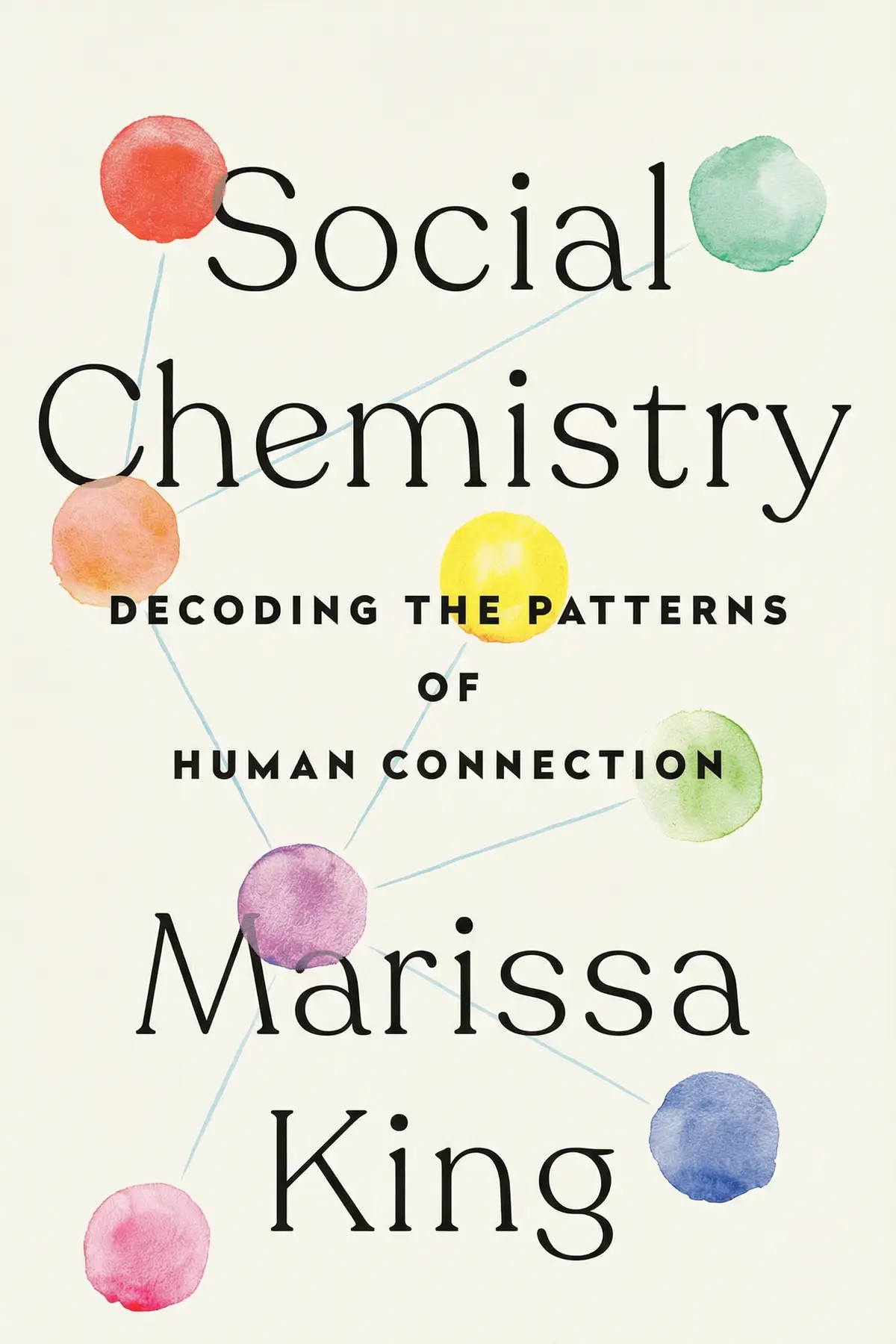
Table of Content
1. Introduction
1 min 02 sec
If networking means business cards from people who kept looking over your shoulder, Marissa King offers a better picture: most of us already network in one of three natural styles, and each one shapes what our relationships can do. In Social Chemistry, King, who teaches strategic networks at the Yale School of Management, opens with Vernon Jordan. In 1960s Georgia, Jordan lost an internship offer once his employers learned he was Black, so he took a job driving for Robert Maddox, a former Atlanta mayor. That link led to others. Jordan became an executive and civil rights leader who sits on nine boards, once described as the quickest route between any two Fortune 500 companies.
King’s argument is that networking stops feeling like a chore once you know your own style, see the trade between close and loose ties that comes with it, and borrow from the other styles when you need to. Expect a way to read your own contact list, advice matched to your career stage and three habits that make a first meeting count.
2. Balance a few close friends with many loose ties
1 min 48 sec
One kind of relationship pays off reliably but always sends a bill. The other costs almost nothing and might change your life, or might never pay off at all. Most people never notice how they split their time between them.
3. Build a tight circle where trust runs deep
1 min 47 sec
Researchers compared the networks of A-list film stars with those of lesser-known actors and found a clear pattern. The same structure gives its members rare advantages, and it carries a risk most close-knit groups never see.
4. Bridge separate worlds without sounding fake
1 min 52 sec
One of the world’s most celebrated chefs is often pictured as a solitary genius, and he says the picture is wrong. His real method depends on a social talent that can win trust or wreck it.
5. Weigh what a huge contact list costs you
1 min 57 sec
One American president kept tens of thousands of names in his address book, decades before social media. Huge networks bring higher pay and better perks, yet the people who hold them report a surprising gap.
6. Borrow the other styles as your career moves
1 min 46 sec
Your natural way of connecting feels fixed, but King argues it should change with your age and position. She also makes the case for contacting the people you feel most awkward about calling again.
7. Make a stranger feel heard in one conversation
1 min 42 sec
In one experiment, three out of four people missed something absurd happening right in front of them. The reason explains why so many first meetings go flat, and what to do differently at the next one.
8. Reach almost anyone through a few friends
1 min 51 sec
In 1967, packets passed only between people on first-name terms reached a Boston stockbroker through surprisingly few hands. The structure that made it possible is already in your own network, if you know where to look.
9. Conclusion
1 min 08 sec
Social Chemistry turns networking from a performance into a question of shape. What counts is how your ties are arranged: a close circle that trusts itself, bridges between groups that never meet, or a wide field of loose contacts. Each shape gives something and costs something, and the best networkers, like Vernon Jordan, keep turning one connection into the next.
That makes the work smaller and kinder than the cocktail-party version. Know which style comes naturally, then borrow on purpose: widen your reach early in a career, build bridges in the middle, and reopen a dormant tie at any stage. In your next real conversation, leave the phone in your pocket, hold eye contact for a few seconds and ask the follow-up question.
Then stop replaying the meeting on the way home. King points to a Yale study in which people judged how much a stranger had enjoyed meeting them, and they badly underestimated it. The other person probably liked you more than you think. That doubt is the one part of networking you can safely leave behind.
About this book
What is this book about?
Most people dislike networking. They picture crowded events, forced small talk and a pile of business cards from people they can't remember. Marissa King, who studies social networks at the Yale School of Management, argues that this picture misses what networks really are and what they can do for us. Her angle is structure. Everyone splits their limited time between a few strong ties and many weak ones, and most people do it in one of three ways. Convenors build tight, trusting circles. Brokers link groups that would otherwise never meet. Expansionists collect huge numbers of loose contacts. Each style brings real advantages and real costs, which King illustrates with A-list film stars, the chef Ferran Adrià, Franklin Delano Roosevelt's address book and Stanley Milgram's famous small world experiment. Readers learn to recognize their own style and to borrow from the others at the right career stage. They learn why dormant ties are worth reviving and how a few simple habits (eye contact, a phone left in the pocket and good follow-up questions) turn a stranger into a real connection.
Book Information
Who it's for
Reluctant networkers
Professionals who dread networking events and want a way of connecting that fits who they are.
Early and mid-career workers
Recent graduates and mid-career employees deciding where to put their limited social time.
Friends who drifted apart
People who have lost touch with old friends and want to rebuild ties without awkwardness.
About the Author
Marissa King
Marissa King teaches at the Yale School of Management, where she created a popular course on managing strategic networks. For about fifteen years she has studied how people's social networks develop, the shapes they take and why those shapes matter. Her recent research looks at the individual and group behaviors that large-scale organizational change depends on, and she has used wearable sensors alongside traditional social science data. Her work on networks has been applied to the opioid crisis and the loneliness epidemic.
Ratings & Reviews
Ratings at a glance
What people think
Listeners describe this work as highly insightful, with one noting that it helped them analyze their own networking style. Additionally, the book earns praise for its readability and thorough research, as one listener called it the best book on networks they've ever read. They also appreciate the concentration on social chemistry, with one review explaining how it can fundamentally change one's perspective on social interactions.
Top reviews
Charles
Social Chemistry is easily the most comprehensive look at human connection I have encountered in years. It successfully shifts the perspective on social interactions from "using people" to understanding the architecture of our communities. I loved the extensive research content, particularly the bits about how our brains process touch and diversity. It isn't just a business book; it’s a manual for understanding why we gravitate toward certain groups and how those structures influence our success. If you are looking to reflect on your networking style and its global impact, this is the best book on the market.
Show moreBee
This book completely flipped the script for me on how I approach my professional circles. King’s categorization of "Conveners" versus "Expansionists" helped me realize why I always feel burnt out after large industry events. I’m definitely more of a Broker, and seeing the value in that—despite how others might perceive it—was incredibly validating. The writing is engaging and moves quickly, though I wish there was more "how-to" advice for actually changing one's style. Overall, the research content is top-notch and provides a fascinating look at the chemistry behind our social bonds.
Show moreTariq
Finally got around to reading this after seeing it recommended next to Adam Grant, and the depth of sociological detail here is unparalleled. King manages to make networking feel less like a "necessary evil" and more like an exciting puzzle to be solved. Identifying as a Convener has helped me lean into my strengths of building high-trust, cohesive groups while being mindful of the risks of groupthink. The endnotes are exceptionally well-written and serve as a great guide for anyone who wants to dive deeper into the science. This is truly the best book on networks I’ve read in a very long time.
Show morePhichai
After hearing so much buzz about Marissa King’s research, I finally dove into Social Chemistry. The breakdown of networking styles into Expansionists, Brokers, and Conveners gave me a much-needed vocabulary for my own social habits. To be fair, some of the sections on organizational psychology felt a bit dense, but the anecdotes about Reid Hoffman and LinkedIn added a nice practical touch. I especially appreciated the focus on 'dormant' connections, which encouraged me to reach out to old colleagues I hadn't spoken to in years. It’s a very readable guide for anyone who feels like networking is a chore.
Show moreNoah
The chapter on 'Brokers' was a total lightbulb moment for me because I finally understood why some colleagues seem so efficient yet so distant. Marissa King does a fantastic job of synthesizing complex organizational psychology into something that feels relevant to everyday life. While the book is research-heavy, the tone remains conversational enough that it doesn't feel like reading a textbook. I was particularly interested in the discussion about whether men and women can be just friends, which added a layer of social chemistry I didn't expect. It’s an insightful read that definitely rewards a careful, slow approach to its many layers.
Show moreIsabelle
Picked this up because I wanted to understand the 'why' behind social dynamics, and King certainly delivers on the research front. There’s a lot of information packed into these pages, covering everything from the Kevin Bacon game to the importance of physical proximity at work. At times, the sheer volume of studies felt a bit overwhelming and I felt the book lacked a cohesive through-line. I still think it's a valuable resource for anyone who hasn't spent much time thinking about their social network structure. It’s a good starting point, even if it doesn't quite reach the heights of other sociology classics.
Show moreNadia
Not what I expected, but in a good way, as the focus on physical proximity and even the speed of touch was fascinating. I’ve read a lot about networking, but I’ve never seen a book connect it so directly to neuroscience and biology. The distinction between those who separate work and life and those who integrate them was especially helpful for my own self-reflection. King’s writing is simple and easy to follow, making complex topics like "the strength of weak ties" accessible to a general audience. This book is a must-read for anyone who wants to improve their social impact without feeling like a user.
Show moreScarlett
As someone who has always felt a bit slimy about networking, I appreciated how this book reframes those connections as a matter of science rather than manipulation. The author provides a great primer on neuroscience, discussing everything from the strength of weak ties to how open-plan offices actually affect our productivity. I did feel that the book was a bit of a smorgasbord of studies, which sometimes made it lose focus on the core three types. However, the online assessment tool mentioned in the text provided some very helpful personal insights. It's a solid read for those new to the genre of sociology.
Show moreValentina
Look, the three types of networkers—Expansionists, Brokers, and Conveners—is a solid framework for a long-form article, but it felt stretched thin as a full-length book. I found myself skimming through the endless citations and academic studies that seemed specifically chosen just to prop up the central thesis. While the writing is clear and accessible, the content didn’t feel entirely original if you’ve already read authors like Malcolm Gladwell or Adam Grant. Truth is, I could have gathered most of these insights from a summary or a well-written blog post. It's not a bad read, but it lacks the punch I was hoping for.
Show moreNiphon
Frankly, I found the writing style a bit too clinical and the data points felt like they were cherry-picked to fit a specific narrative. I was expecting more of a social psychology deep-dive, but it often read like a dry business manual aimed at middle managers. Even the more "fun" references, like the Biggie Smalls quote, couldn't save the middle chapters from feeling like a slog. Life is short, and I’d honestly recommend sticking to David Epstein or something with a bit more narrative flair. It's a shame because the core concept of the three networking archetypes is actually quite useful.
Show moreQuestions about this book
What is the main idea of Social Chemistry by Marissa King?
King argues that networking only feels like a chore when it is done badly. Everyone divides limited time between a few strong ties and many weak ones, and most people do it in one of three styles: convenor, broker or expansionist. Each style has real advantages and costs. The best approach is to know your natural style and borrow tactics from the other two when your situation calls for it.
What are the three networking styles in Social Chemistry?
Convenors build tight circles of strong ties whose members know and trust each other, as many A-list film stars do. Brokers link diverse groups that would otherwise never meet, like the chef Ferran Adrià drawing on friends in physics and architecture. Expansionists collect very large networks of loose contacts. King says no style is better than another, but each shapes what your relationships can give you.
What is the difference between strong and weak ties?
Strong ties are the roughly 150 stable, friendly relationships that research by anthropologist Robin Dunbar suggests we can keep, with only two to five truly intimate. They deliver reliable help but also create obligations. Weak ties are everyone beyond that circle, such as old classmates or former colleagues. Their benefits are unpredictable, yet they are more likely to produce chance opportunities like a job offer.
How can I make better connections when meeting someone new?
King suggests three habits. Put your phone away, since phones cause inattentional blindness: in one study only 25 percent of people looking at their phones noticed a clown on a unicycle. Hold eye contact for about three seconds at a time. And ask follow-up questions, such as what someone enjoys most about their job, which a Harvard speed-dating study linked to stronger connections.
Is it worth reconnecting with old friends I lost touch with?
Yes, according to King. Many people feel embarrassed about contacting dormant ties, but these relationships keep some of their earlier trust even after years apart. If your lives have gone in different directions, the old friend is also likely to offer fresh perspectives. She presents reviving dormant ties as one of several effective ways to build on your natural networking tendencies, whatever your style.
Readers also enjoyed

Acting with Power: Why We Are More Powerful Than We Believe
Deborah Gruenfeld


Age of Propaganda: The Everyday Use and Abuse of Persuasion
Anthony Pratkanis






59 Seconds: Change Your Life in Under a Minute
Richard Wiseman
AUDIO SUMMARY AVAILABLE
Listen to Social Chemistry in 15 minutes
Get the key ideas from Social Chemistry by Marissa King, plus 5,000+ more nonfiction titles.
- 5,000+ titles
- Listen as much as you want
- 7-day free trial
- Cancel anytime









