Energy: A Beginner's Guide
Vaclav Smil
 English
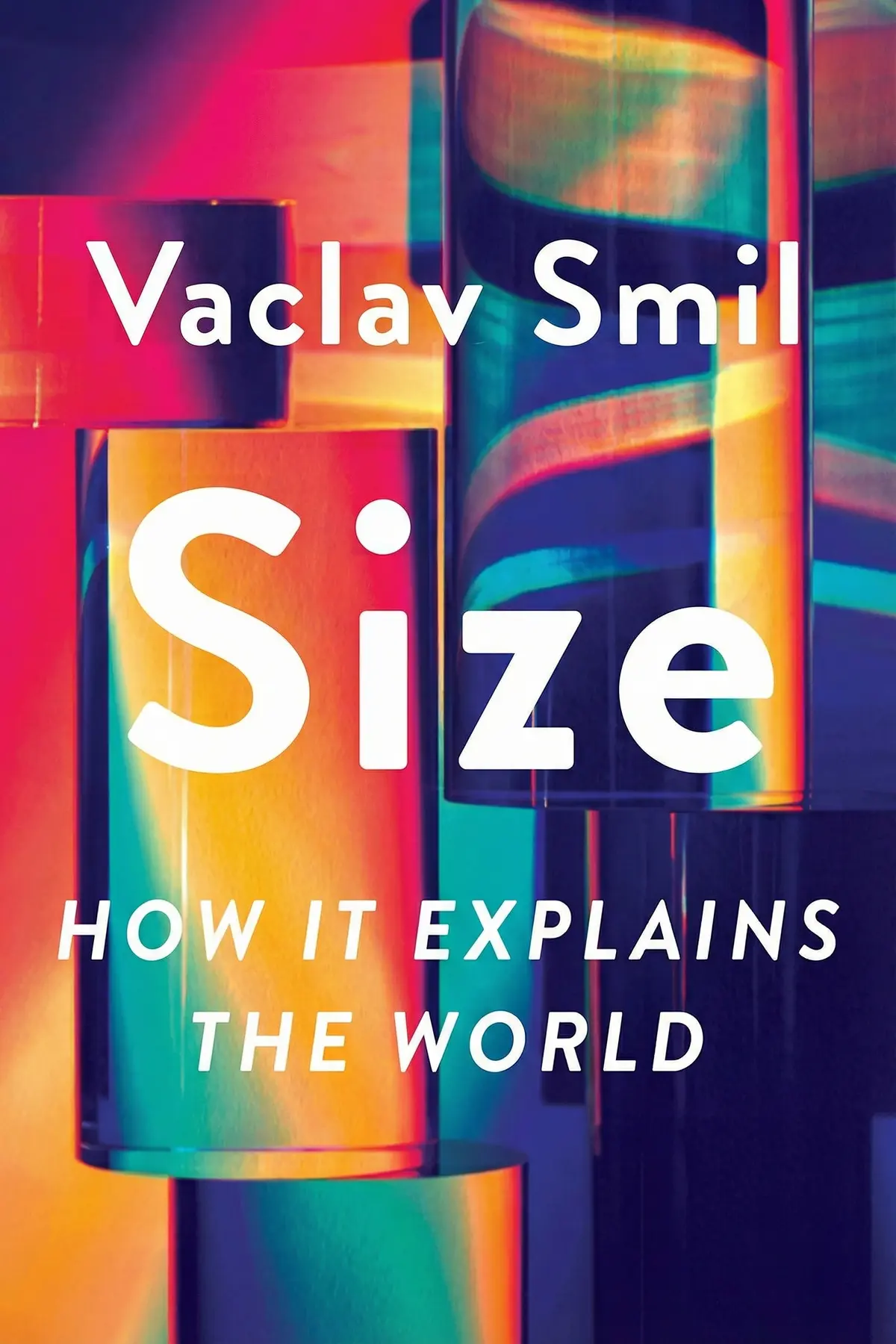
Shows how size shapes what we notice, how we judge people, what we find beautiful, how we design things and how much energy bodies, machines and cities use. It also explains why bigger rarely means simply better.
1 min 03 sec
If you have ever trusted your eye to judge a distance, a portion or a person, size has probably fooled you more often than you think. In Size, the geographer and energy scholar Vaclav Smil shows that the plain dimensions of things shape how we see, what we find beautiful, how we design and how much energy we burn. One of his most surprising points comes from biology: a larger animal needs less food, relative to its size, than a smaller one.
Size, in Smil’s telling, is never only a number on a ruler. It is a hidden force behind perception, status, design and energy, and again and again it breaks our habit of assuming that bigger simply means better or more. The ideas ahead give you a sharper eye for the dimensions around you, from staircases and airplane seats to whole cities, and a healthy distrust of your first impression of how large something is.
1 min 48 sec
A single stair that is slightly too tall can make your whole body flinch. That small shock reveals how deeply dimensions have trained us, and how often we judge people by their shape before anything else.
1 min 39 sec
The moon, a glass of water and a distant shore all lie to us in small ways. Some of those lies are harmless. Others can put a swimmer in danger or send a court case the wrong way.
1 min 55 sec
A taller population usually signals a richer, healthier one. Yet the same trait carries a price for the individual, and economies chasing growth face a similar trade that few people stop to count.
1 min 59 sec
A famous number has been credited with the beauty of temples and pyramids for centuries. The evidence is more mixed than its fans admit, and two of the most loved paintings in history point somewhere else entirely.
1 min 57 sec
Airplane seats keep shrinking, and one enormous ship grew so heavy it could barely move. Both stories show what happens when design forgets the human body, and where the push for bigger runs out.
1 min 54 sec
An animal twice as heavy does not need twice the food, and a city twice as large is not twice as thrifty. One scientist’s finding from 1932 explains the first of these surprises, about how energy needs scale with body size.
1 min 15 sec
Smil’s book adds up to a warning against a lazy reflex. We tend to treat size as a simple fact and bigger as a simple good. Yet a taller step trips us, a low moon fools us, a coastline refuses to have one length, a tall body brings health risks and a large city emits in step with its growth. Size runs through perception, culture, design and biology, and in each it behaves with more surprises than intuition expects.
That makes size a lens worth carrying. When a person, a building or a plan impresses you, separate the dimensions from the substance. When you estimate a distance or a quantity by eye, treat it as a guess and ask at what scale it was measured. When you design or buy something, begin with the human body that will use it, and remember the Tessarakonteres, too heavy to move. And when growth is the goal, ask what it will cost and whether the gains rise in a straight line at all.
Gulliver was judged by his shape before anyone heard him think. Smil’s case is that we still judge much of the world the same way.
Most of us treat size as a plain fact: something is tall or short, big or small, and more of it is usually better. Vaclav Smil argues that this habit hides a lot. Size shapes how others see us, how our eyes trick us, what we find beautiful and how comfortable our chairs, seats and cities are. It even decides how much energy an animal, an engine or a city needs. Smil works across many fields to make his case. He draws on Gulliver's Travels and the puzzle of Britain's coastline, on Dürer's studies of human proportion and the golden ratio, on shrinking airplane seats and an ancient ship too heavy to move, and on Max Kleiber's 1932 finding about metabolism. The book gives readers a sharper eye for the dimensions around them. They learn to doubt size estimates made by eye, to design around the human body, to stop hunting for one perfect ratio of beauty, and to ask what growth costs before chasing it.
Curious professionals who want a fresh lens on everyday objects, from staircases to cities.
Designers, planners and founders deciding how big to build and when growth stops paying.
Readers of popular science who enjoy links between biology, engineering and art.
Vaclav Smil was born in Plzeň in 1943 and earned a doctorate in geography at Pennsylvania State University. He joined the University of Manitoba in 1972 and is now Distinguished Professor Emeritus there. His research spans energy, environment, food, population, economics and history, in more than 400 papers and 35 books. A Fellow of the Royal Society of Canada, he was the first person from outside the US to win the AAAS Award for Public Understanding of Science and Technology.

Listeners find that perspectives differ regarding the book's central theme, as some feel the storytelling can be a bit fragmented or saturated with statistics. On the other hand, many value the writer’s thorough investigations and cross-functional look at the way scaling principles dictate everything from living organisms to city systems. Furthermore, they consider the scientific observations captivating; specifically, one listener mentions the striking contrast drawn between the power output of mosquito wings and jet engines. They also highlight the distinct final summaries that effectively condense the extensive data into manageable key points.
The sheer breadth of knowledge Smil manages to compress into these pages is nothing short of breathtaking. From the structural limitations of wood versus steel to the way cities scale like biological organisms, the interdisciplinary connections are brilliant. I particularly loved the debunking of the Golden Ratio—it’s refreshing to see someone use cold, hard data to challenge popular myths about aesthetics. The section on BMI and the increasing scale of modern homes provides a sobering look at our societal obsession with 'bigger is better.' It is a challenging read that demands your full attention, but the reward is a much deeper understanding of the physical constraints that govern life and technology. This is Smil at his most encyclopedic and observant.
Show moreWait until you get to the section comparing the power output of insects to industrial machinery—it’s mind-blowing. This is the kind of multidisciplinary thinking that we desperately need more of. Smil connects biology, physics, and history into a comprehensive look at how scale defines what is possible. He doesn't shy away from complex math or statistics, which I found refreshing in an era of oversimplified pop-science. Whether he's discussing the height of the world's tallest buildings or the caloric needs of a Lilliputian, his focus remains on the measurable truth. It is a dense, data-rich masterpiece that will change the way you look at the world around you. Absolutely fascinating stuff from a true polymath.
Show moreEver wonder if a mosquito's wing operates on the same physical principles as a Boeing 747? Smil’s exploration of scaling laws is an absolute treasure trove for anyone obsessed with how the physical world actually functions. He manages to link the power-to-mass ratio of tiny insects directly to jet engines in a way that feels like a revelation. To be fair, the book is incredibly dense and occasionally feels like a data dump, but the insights into metabolic rates and urban infrastructure are worth the effort. It is not exactly a light beach read. However, for those who enjoy seeing the hidden mathematical scaffolding of our universe, this is a must-have. The unique summaries at the end, especially the ten-word distillation, provide a clever capstone to a massive amount of information.
Show moreSmil’s 'Size' is less of a narrative and more of a masterclass in how physical constraints shape our entire reality. The way he explains the difference between linear growth and non-linear scaling helped me understand why simply doubling the size of a machine often leads to unforeseen failures. Personally, I found the deep dive into metabolic rates and animal sizes to be the strongest part of the book. While the tone is undeniably academic and the data can be overwhelming, the breadth of the research is undeniably impressive. Some readers might find the debunking of Gulliver's Travels petty, but it perfectly illustrates his point about the biological impossibility of certain scales. It’s an enlightening, if dense, read.
Show moreYou might think you understand the golden ratio, but Smil is here to dismantle your assumptions with cold, hard numbers. His approach is clinical and thorough, which is exactly what makes his work so reliable. The book is an exhaustive look at how size dictates everything from the efficiency of our hearts to the power output of our largest industrial engines. I appreciated the effort to categorize different types of distributions, even if the math got a little heavy toward the end. My only real complaint is that the book feels a bit like a collection of separate essays rather than a unified journey. Still, the insights regarding urban density and energy use are classic Smil and highly relevant.
Show moreSmil is back with his signature deluge of data, though this time the focus feels a bit more scattered than his energy-centric works. The book covers everything from the size of the known universe down to the submicroscopic level, touching on Kleiber’s Law and the complexities of metabolic scaling along the way. While the information is fascinating, the middle section on the 'Statisticians Hall of Fame' was a difficult hurdle to clear. It’s hard to stay engaged when the author pivots into a lengthy tutorial on standard deviation and normal distributions. Truth is, the book is a bit of a crazy quilt of trivia. It's a decent reference for those curious about allometry, but it lacks the narrative drive I’ve come to expect from Smil.
Show moreFinally got around to reading Smil's take on size and, gotta say, it’s a bit of a mixed bag. On one hand, the comparison between the smallest model airplane motors and massive marine diesels is the kind of nerdy content I live for. On the other hand, the book often gets bogged down in technical minutiae that seems to go nowhere. Not gonna lie, I found myself skipping through parts of the statistics chapter just to get back to the biological scaling stuff. The ten-word summary at the end—'Size, an omnipresent scalar, is the measure of all things'—is clever, but it almost confirms that the book is just a long-winded way of stating the obvious. It’s okay, just not his best.
Show moreThis felt more like a random collection of Wikipedia entries than a cohesive argument. I have enjoyed Smil’s previous work on energy transitions, but this volume seems to lack a clear destination or a punchy thesis. He spends far too much time critiquing the physics of Jonathan Swift’s Gulliver’s Travels, which felt like an unnecessary distraction from more modern scaling concerns. Look, I appreciate the depth of research, but the narrative is so disjointed that I found my mind wandering every few pages. The layout didn't help either; the long line lengths and tight margins made the technical data even harder to digest. Frankly, it is a bit of a slog that fails to deliver a satisfying conclusion despite the author's obvious brilliance.
Show moreAs someone who generally enjoys technical non-fiction, I found the lack of a central thesis here deeply frustrating. Smil seems determined to connect everything to size, but the result is a narrative that feels forced and frequently repetitive. One moment you're reading about the history of the meter, and the next you're buried in a critique of fictional giants' bone density. The transition between topics is jarring. To be fair, there are some great nuggets of information about how SUVs are ruining our efficiency gains, but they are buried under mountains of dry academic prose. It’s essentially a randomized Guinness Book of Records for people with PhDs. I expected more from such a renowned thinker.
Show moreWhy did the author feel the need to spend dozens of pages debunking the mathematics of Lilliputians? It is honestly baffling. This book is a massive disappointment because it never moves beyond simple observations that size is important. We already know that. The writing is incredibly dry and the 'Four Conclusions' at the end felt like a lazy way to avoid actually synthesizing the material into something useful. I almost didn't finish it because the tone felt so pedantic and the structure was nonexistent. If you want a book about scaling, read 'Scale' by Geoffrey West instead. This one is just an overpriced collection of facts that doesn't add up to a coherent point.
Show moreSmil argues that size is far more than a measurement. It shapes how others see us, how our senses mislead us, what we find beautiful, how we design objects and cities, and how much energy living things and machines need. Across all these areas, he shows that bigger is rarely simply better, and that growth often brings costs or limits we fail to expect.
He acknowledges that the golden ratio, roughly 1.618, has influenced designs from the Parthenon’s front to the Egyptian pyramids. But he notes that many studies find plenty of things people consider attractive do not follow it. In his view, beauty comes from size, proportion and symmetry working together, and asymmetry can be appealing too, as in the Mona Lisa and Dürer’s Self-Portrait.
Human scale means shaping objects and spaces around our physical dimensions, senses and mental capacities. Smil points to the computer mouse, which moved from wooden blocks to ergonomic shapes, as a success. Shrinking airplane seats show the opposite. He argues city design is the hardest case, because comfort must be balanced against population density and limited space.
In 1932, Kleiber found that energy needs rise more slowly than body mass, so larger animals need less food relative to their size. Smil adds that age, sex, lifestyle and species also matter: an Arctic fox burns energy 2.1 times faster than a sloth of the same weight. He extends the idea to engines, whose power output and mass scale almost identically, and to cities, whose carbon dioxide emissions grow in proportion to their size.
Treat any size estimate made by eye as a guess, and ask at what scale a number was measured before comparing it. When choosing furniture, tools or workspaces, start from the body that will use them. And before pushing for growth in a team or company, name the costs that usually come with it, since Smil shows that bigger brings trade-offs and eventually limits.

Carl Zimmer

Bill Bryson

Jeff Hawkins




Lisa Kaltenegger


AUDIO SUMMARY AVAILABLE
Get the key ideas from Size by Vaclav Smil, plus 5,000+ more nonfiction titles.