Energy: A Beginner's Guide
Vaclav Smil
 English
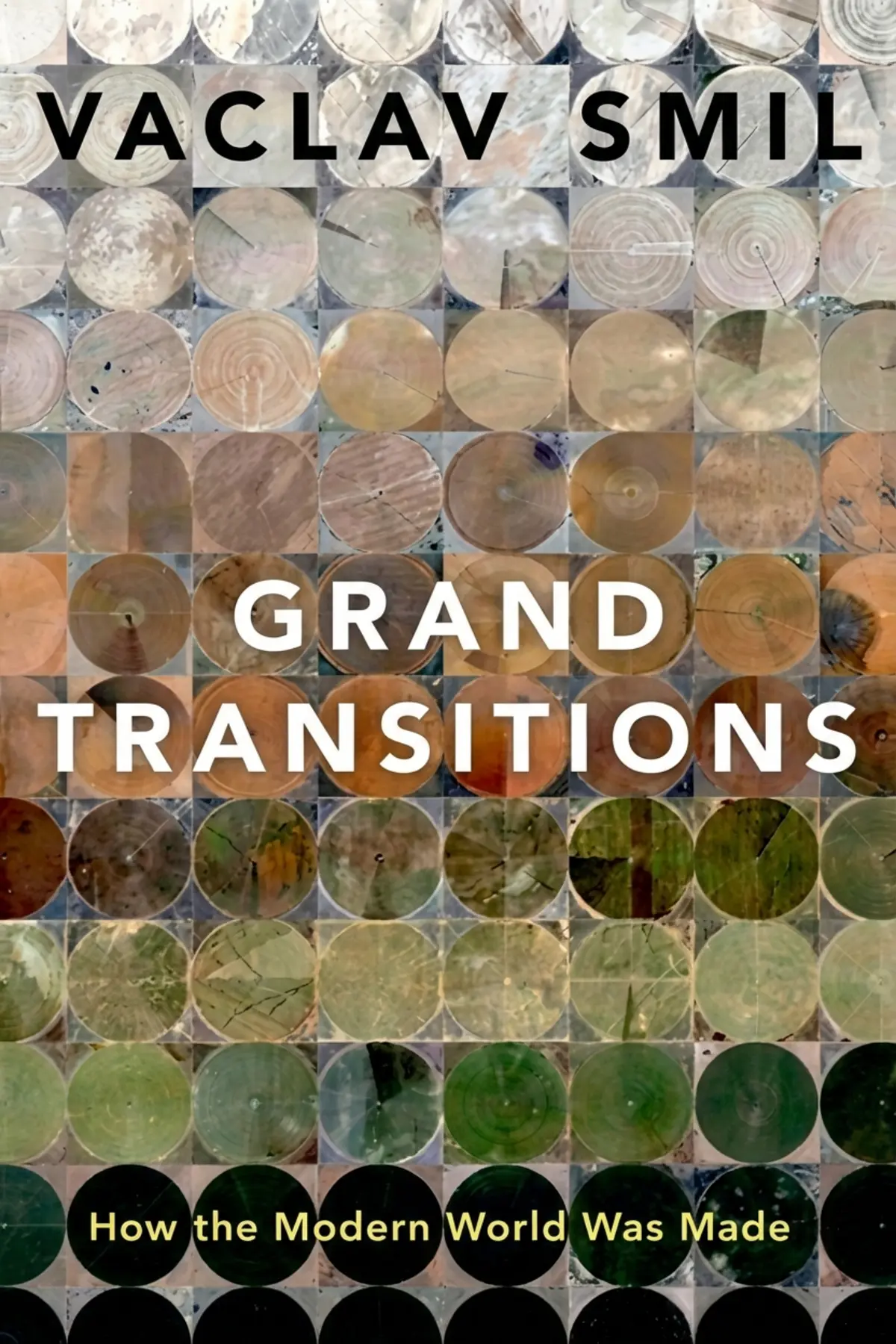
Shows how shifts in population, food, energy, wealth and the environment built the modern world, why each brought real gains and real costs, and how to judge the future without doom or blind optimism.
1 min 01 sec
The news makes the world look either better every year or close to collapse, and it rarely helps you decide which. In Grand Transitions, the geographer and energy scholar Vaclav Smil gives a sharper answer: nearly every great change of the past two centuries has been both. Modern farming ended famine across most of the world and then fed an obesity problem. Growth lifted incomes and widened the gap between rich and poor.
Smil traces five linked shifts, in population, food, energy, the economy and the environment, and finds gains and costs arriving together each time. That mixed record is the thread running through everything here, and it leads to a practical stance: judge the future as you should judge the past, with neither doom nor blind faith. Expect to learn why poorer Guatemala outranked wealthy South Korea on happiness, why clean energy will take decades, and how to question a dazzling statistic.
1 min 46 sec
A girl who survived famine in rural China has a grandson who drives a sports car. Her family looks like a perfect success story, but Smil asks what such fast change leaves off the balance sheet.
1 min 56 sec
Japan is about to lose a population the size of Spain and gain hundreds of thousands of centenarians. What happens there first may soon happen to most of the world, with costs few people plan for.
1 min 56 sec
For centuries most people ate the same dull food at every meal. Modern farming fixed that so well that it created an opposite problem, one that shows up on our plates, our scales and the planet.
1 min 59 sec
A modern jet burns far less fuel than its 1958 ancestor, and China’s energy numbers look stunning. Smil explains why such progress is real, why it is slow, and why one celebrated statistic misleads.
1 min 52 sec
Families once spent most of their income on food; now we upgrade phones every couple of years. A happiness ranking that puts Guatemala above South Korea hints at what all that growth has failed to buy.
2 min 00 sec
Habitat loss did not begin with factories. A philosopher’s walk into a remote Alpine ravine in 1782 ended with a discovery that shows how long people have been reshaping every corner of the planet.
2 min 21 sec
A famous biologist once forecast mass starvation within a decade, and a famous futurist promises millennia of progress in a century. Smil explains why both camps go wrong and what a sensible plan looks like.
1 min 07 sec
Someone from 1940 dropped into the world of 2020 would be astonished, Smil observes: a planet remade by technology and standing at the edge of a climate crisis. Both halves of that picture are true at once, and learning to hold them together is what the book trains. The grandmother who outlived a famine and the grandson in the sports car share a story with the 4,000-calorie food supply, the 20-month smartphone and the mill Rousseau found in the Alps.
That habit of mind changes how you read the news. When a number looks spectacular, like China’s two-thirds fall in energy intensity, ask what it is measured against. When a prophet promises collapse or endless escalators, remember the mass starvation Ehrlich predicted that never came, and the biosphere the optimists forget. When one fix is sold as the answer to a global problem, treat it as one tool among several.
Smil’s history of slow, mixed change is no excuse for waiting. Another grand transition has already begun, and its shape depends on choices made while it is still young.
Life expectancy, incomes and food supplies have improved beyond anything our ancestors knew. The same modern world also faces aging societies, obesity, inequality and a damaged biosphere. Vaclav Smil sets out to explain how both outcomes grew from the same changes. He follows a set of linked shifts he calls grand transitions. Populations boomed and are now shrinking and aging, with Japan as the leading case. Farming ended famine across most of the world and then overshot into surplus, waste and rising body weight. Energy moved from wood and dung to fossil fuels and is starting toward renewables, far more slowly than many hope. Economic growth built consumer societies while widening inequality, and human activity has reshaped most of the planet's ice-free land. Smil ends with a call for balance. Gloomy forecasts such as Paul Ehrlich's 1968 famine prediction have failed, and techno-optimist visions forget our dependence on the biosphere. Readers get a clear frame for weighing progress against its costs, a habit of questioning striking statistics, and a sober case for patient, flexible action on inequality and the environment.
Professionals who follow climate, energy or development news and want a calm way to weigh the headlines.
Students of economics, geography or environmental studies looking for one frame linking population, food and energy.
Founders and planners betting on aging markets, energy costs and slow-moving global change.
Vaclav Smil was born in Plzeň in 1943, studied in Prague and earned a doctorate in geography at Pennsylvania State University. He moved to the United States in 1969, joined the University of Manitoba in 1972 and is now Distinguished Professor Emeritus in its Faculty of Environment. His research spans energy, environment, food, population, economics, history and public policy, across more than 400 papers and 35 books, including Making the Modern World. A Fellow of the Royal Society of Canada, he was the first person from outside the US to win the American Association for the Advancement of Science's award for public understanding of science and technology.

Listeners find the work highly educational, with one individual highlighting its extensive supporting evidence and another pointing out the comprehensive look at significant shifts. The material is also well-regarded for being accessible and easy to read.
Vaclav Smil's 'Grand Transitions' is a masterclass in quantitative history that puts almost every other contemporary analyst to shame. By focusing on the material substrate of our civilization—population, agriculture, energy, and economics—Smil provides a rigorous framework for understanding how we actually got here. I found it impossible to look at a simple light switch or a loaf of bread the same way after reading his breakdowns of electrification and cereal production. The depth of evidence is staggering, and his refusal to lean into doomsday narratives or over-optimistic tech-utopianism is refreshing. Truth is, the world is complex, and Smil is one of the few authors who respects that complexity enough to avoid easy answers. It is a dense read, and you might find yourself rereading chapters just to absorb the sheer volume of data, but the clarity it provides regarding our global trajectory is worth every second of effort.
Show moreThis book is a stellar contribution to the field of material history. Smil is astonishingly prolific, and 'Grand Transitions' feels like a summation of his life’s work, synthesizing decades of research into a single, cohesive volume. The chapter on population was particularly striking, especially the revelation that life expectancy is likely closing in on its peak. It’s fascinating to see the data on how mortality rates and fertility choices are linked to urban development and economic survival. Personally, I loved the 'complexifying minimalist' approach he advocates for in the conclusion. We shouldn't be looking for single, perfect solutions to global problems, but rather a multitude of flexible approaches. The sheer scale of the research—ranging from the history of shipping to the environmental impact of single-use plastics—is mind-boggling. It is an essential read for anyone who wants to understand the physical reality of the 21st century.
Show moreWow, the sheer volume of research here is staggering. Smil tracks numerous transition trajectories, ranging from those unfolding across centuries to those accomplished within a single generation, and the result is a beautifully laid out map of human progress. I found his thoughts on the 'war on plastics' vs 'single-use plastics' to be particularly insightful, as it moves the conversation toward more practical solutions. The book is definitely not for the faint of heart; the density of information is high, and you need to be in the right headspace to tackle it. But for those willing to put in the work, it offers a grander view of the world that feels both fresh and grounded in reality. He avoids the ideological purity that plagues so much modern writing about the environment and energy. It’s a 5-star achievement for anyone interested in the technical history of humanity.
Show moreHonestly, Smil is the only author I know who can compete with Bill Bryson for sheer volume of citations, but he keeps the focus much more on the material facts of our existence. 'Grand Transitions' is an essential guide to the five pillars that built our modern world. I was particularly impressed by his realism regarding renewables and the Paris agreements; he points out the futility of certain forecasts by showing how the realities have consistently shifted in the opposite direction. He doesn't sugarcoat the challenges of deforestation or the acidity levels of our land masses, but he also doesn't fall into doomsday hysteria. It’s a book about 'complexifying' our understanding rather than simplifying it. If you want a book that will make you think harder and deeper about the energy that powers your life and the food that sustains it, this is it.
Show moreIf you are coming into this expecting a narrative-driven journey like 'Sapiens,' you might find yourself struggling with the sheer density of data presented here. Smil is a realist who prioritizes hard numbers over storytelling, which makes for a book that is phenomenally thorough but occasionally dry. I was particularly fascinated by the section on energy transitions, specifically how long it actually takes for a new technology like electricity to reach 99% penetration—spoiler: it’s decades, not years. My only real gripe is that I sorely missed Smil's own take on some of these shifts; he provides the 'what' in incredible detail, but sometimes leaves the 'why' and 'how' as secondary concerns. Still, as a piece of big history writing, it is incredibly solid and eye-opening. It definitely changes the way you view global growth and the massive energy requirements of modern society.
Show moreTo be fair, the level of detail Smil provides regarding the shift from animate labor to machine-driven industry is unparalleled. He illustrates beautifully how our modern high-energy societies have revolutionized food production, allowing us to employ fewer people in the fields while producing more than ever before. The interconnectedness of these transitions—how energy leads to better machines, which leads to better agriculture, which shifts population dynamics—is the book's strongest point. I did feel that some sections meandered a bit, and the author occasionally falls into the trap of 'reading you a chart' rather than synthesizing the information for the reader. However, the realism here is a breath of fresh air. He doesn't give you unproven scenarios; he just gives you the cold hard facts about things like nitrogen fertilizer and the reality of the Paris agreements. It’s a 4-star read for anyone who values data over dogma.
Show moreNot many authors can make the history of nitrogen fertilizer and phosphorus depletion feel like a high-stakes drama, but Smil manages it through sheer empirical weight. The agricultural section was a standout for me, specifically how it highlights that even with fewer farmers, our capacity is higher than ever due to energy transitions. I also appreciated his take on China—he’s a bit of a hater, perhaps, but his points about the 'floating population' and the inequality of the hukou system are well-researched and hard to argue with. The book is very informative and will completely change your perspective on what 'growth' actually means for a planet with finite resources. It is a bit dense, and the author's tendency to cite himself can be a little much at times, but the information is too valuable to ignore. Solid 4 stars for a deep, realistic look at our material world.
Show moreThe section on global urbanization and China's 'floating population' offered some of the most eye-opening insights I’ve encountered this year. Smil explains how the household registration system ties families to their birthplaces, creating a massive class of second-class citizens who built the very cities they are technically outsiders in. This kind of hard-hitting, fact-based analysis is where the book shines. I also found the discussion on life expectancy hitting a peak by 2050 to be a fascinating counter-point to the usual 'immortality' talk we hear from tech moguls. While the book is certainly a bit of an 'overdose of statistics' at times, the reality it paints is far more useful than a hopeful but unproven scenario. It’s a bit of a challenge to get through, but the information is so dense that it feels like reading three books at once.
Show moreFinally got around to reading Smil after hearing so much about him, but I have mixed feelings about this one. On one hand, the information is top-tier; you won't find a more thorough account of how energy and population dynamics have shaped our world. On the other hand, the writing style is incredibly dense and he often avoids making a hard stand on the implications of his data. He tells you 'what' happened in great detail, but the 'how' and 'why' often feel secondary. This makes it a bit harder to establish if his conclusions are right unless you already have a broad knowledge base in these areas. There were moments, like his discussion on urbanization in China, where I felt he missed some of the more complex social mechanisms at play. It's a decent read, but it didn't quite hit the 5-star mark for me because of the lack of analytical engagement.
Show moreFrankly, this felt less like a book and more like a massive, 400-page spreadsheet without the convenient sorting features. I picked this up hoping for a grand view of the modern world, but I found myself drowning in an overdose of statistics that often lacked a clear narrative purpose. Smil is clearly a genius with numbers, but he underemphasizes analysis in favor of listing eye-opening but ultimately dull numeric breakdowns. There are sections where he just lists facts about coal consumption or tractor efficiency for pages on end without providing the 'why' that makes history actually interesting to read. I found it very difficult to stay engaged, and the meandering style made it hard to track his overall point. It’s informative, sure, but it lacks the 'engagement' factor that writers like Bill Bryson bring to similar topics. If you love raw data, you'll love this, but for the average reader, it’s a slog.
Show moreVaclav Smil argues that the modern world was built by linked transitions in population, food, energy, the economy and the environment, and that each brought real gains alongside real costs. Famine largely disappeared, but obesity and food waste rose. Growth raised incomes and widened inequality. Because the record is mixed, he says forecasts should be balanced too, avoiding both apocalyptic gloom and the belief that progress will continue forever.
Japan shows the next stage of the population transition. Its population is expected to drop by 45 million over 50 years, close to 40 percent of its people will be 65 or older by 2040, and more than 400,000 will be at least 100 by 2050. It also shows megacity growth: Tokyo has nearly 40 million residents facing high housing costs and crowding.
Slowly. Smil sees the new energy transition as positive but expects it to take decades, because energy shifts always do. Fossil fuels still supply almost 85 percent of primary energy, and changing the global system would cost about $30 trillion. He also urges care with statistics: China’s two-thirds fall in energy intensity between 1990 and 2015 mostly reflected catching up with other countries.
Use Smil’s balance as a filter. When a statistic impresses you, ask what it is compared with. When someone predicts collapse, recall Paul Ehrlich’s 1968 forecast of mass starvation that never came; when someone promises endless progress, remember our dependence on the biosphere. For big problems, back several solutions, as Smil does with nuclear power, which he says should be neither boycotted nor treated as the answer.
It suits readers who follow news on climate, energy, food or demographics and want a sober way to weigh it, students who need one frame linking those fields, and planners or founders betting on long-term trends such as aging populations and slow energy change. Smil writes from decades of research across energy, environment, food and population at the University of Manitoba.



Yanis Varoufakis

Ben Macintyre




James Shapiro
Pankaj Mishra
Charles C. Mann
AUDIO SUMMARY AVAILABLE
Get the key ideas from Grand Transitions by Vaclav Smil, plus 5,000+ more nonfiction titles.