
15 min 33 sec
Available in: English
 ไทย
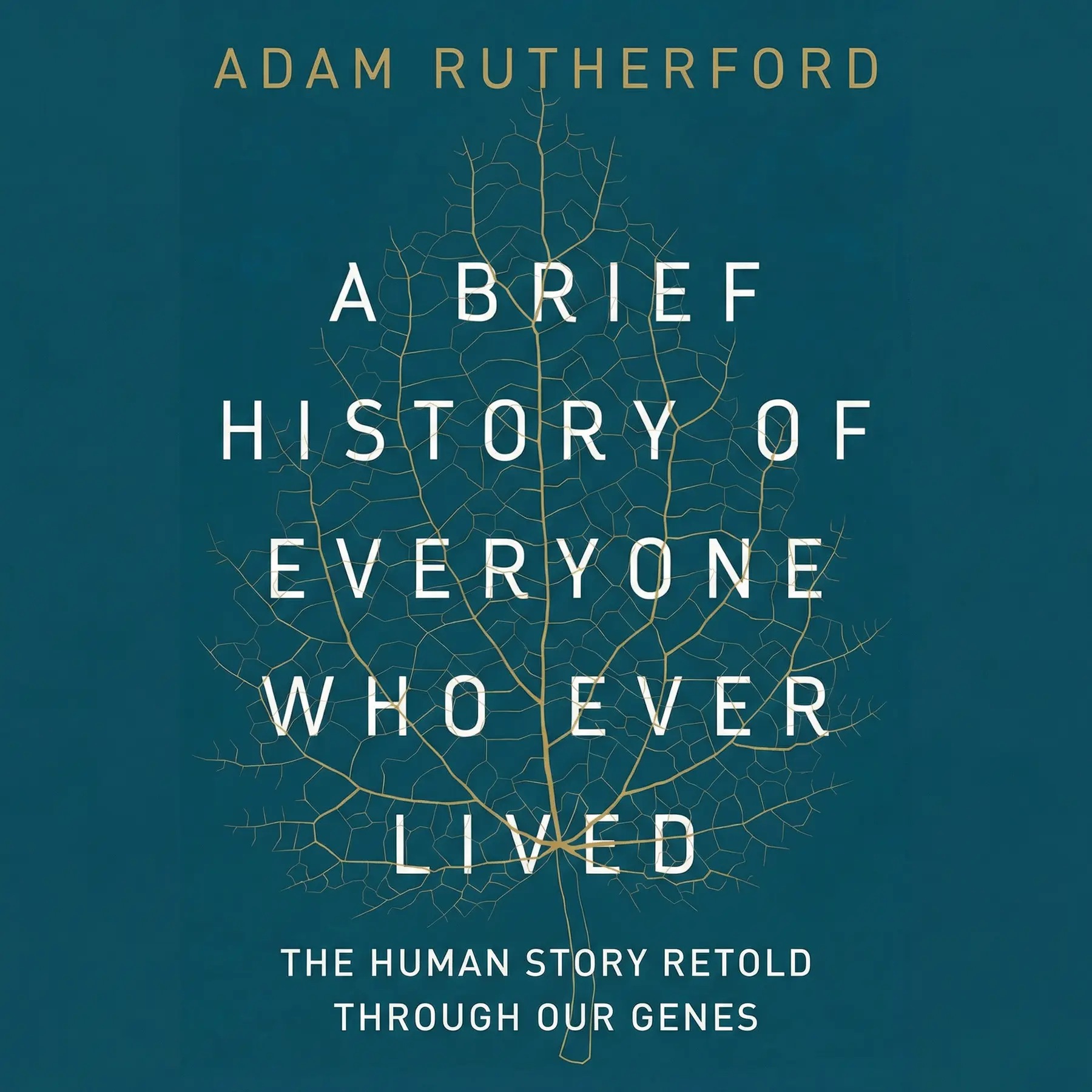
EnglishไทยA Brief History of Everyone Who Ever Lived: The Human Story Retold Through Our Genes
Shows how DNA from living people and ancient bones is rewriting human history, and why it reveals a species far more mixed and alike than race theories, ancestry kits and gene headlines suggest.

Table of Content
1. Introduction
1 min 04 sec
Most of us carry a picture of the human past that stops where written records stop, and that sorts people into tidy tribes, nations and races. In A Brief History of Everyone Who Ever Lived, geneticist and broadcaster Adam Rutherford shows that a deeper record sits in our cells, and it is far messier: the average European carries about 2.7 percent Neanderthal DNA, because our species did not simply replace its cousins but had children with them.
Rutherford’s case is that genes, read properly, reveal a human family more mixed, more connected and more alike than our old categories allow. That one idea takes apart a run of popular beliefs, from tribal ancestry kits to race science to stories about a gene that explains a killer. By the end, you can explain why everyone has a royal ancestor, why race has no genetic definition, and how to spot a DNA claim that promises more than biology can give.
2. Read the deep past in living DNA
1 min 47 sec
Before writing, human history turns to rumor and guesswork. A new kind of science reads bones the way historians read letters, and its first big finding changes what the word extinct really means.
3. See how milk and sunshine rewrote our genes
2 min 00 sec
Most adults on Earth cannot comfortably digest a glass of milk. The minority who can are carrying a record of an ancient farming decision, and pale skin hides a similar story about climate.
4. Spot the ancestry test that cannot deliver
1 min 57 sec
For under a hundred dollars, a company will tell you whether you belong to one particular Native American nation. The story of how people first reached the Americas explains why no laboratory can honestly answer that.
5. Every one of us descends from royalty
1 min 55 sec
Many families treasure a story about a noble ancestor. A Yale statistician’s numbers suggest the story is true for nearly everyone, which is exactly why it means so little, and why real royals often paid a price.
6. Learn how genetics shows race is not a scientific category
1 min 59 sec
A computer sorted DNA from over a thousand people into groups, and the old racial categories appeared. Then the researcher changed a single setting, and the whole idea of race began to look like a matter of choice.
7. Expect many genes behind every disease
1 min 44 sec
Scientists expected the human genome to hold a vast number of genes. The real count came in lower than a banana’s, and what the project found next should change how you read every health headline.
8. Your genes nudge you but never sentence you
1 min 48 sec
A gene variant helped a convicted killer escape execution, while a wartime famine left marks on children born years later. Between those two cases lies a sensible view of how much our DNA really decides.
9. Conclusion
1 min 19 sec
Rutherford’s answer is yes, and it gives his story an unexpected ending. Humans keep evolving with every baby born, because each child’s genome differs a little from its parents’. In that sense every living person is transitional, a bridge between the DNA of one generation and the next. Evolution has simply stopped working in the old straightforward way. Josh Akey, a researcher at the University of Washington in Seattle, reported in 2013 that numerous recent alterations in human DNA left proteins functioning poorly or not at all, and modern medicine has eased natural selection by rescuing people from conditions that used to be fatal. Our real superpowers, Rutherford jokes, are airplanes and night-vision goggles.
What the book leaves behind is a picture of constant mixing and change, with no pure lines anywhere. That picture is useful. The next time an ancestry kit, a theory about race or a headline about a single gene crosses your path, ask whether the group being named has any genetic border, and whether one gene could possibly carry the weight placed on it.
Then remember Joseph Chang’s arithmetic. Go back only a few centuries, and the family trees of strangers start running into each other.
About this book
What is this book about?
Written history goes foggy a few thousand years back, and much of what people believe about ancestry, race and heredity rests on guesswork or prejudice. Geneticist Adam Rutherford argues that a better record has been sitting inside our cells all along, and that science can now read it. Drawing on paleogenetics, the study of DNA taken from ancient remains, Rutherford shows how genes record interbreeding with Neanderthals, the spread of dairy farming, the first migration into the Americas and the surprising arithmetic of family trees. He then turns the same evidence on popular beliefs: tribal ancestry tests, racial categories, the idea of a single gene for a disease or a crime, and the hope that humans have stopped evolving. Readers get a clear, evidence-based way to answer the claims they meet in advertisements, headlines and arguments about identity, along with a humbling picture of how closely related every living person is.
Book Information
Who it's for
Curious what DNA reveals
Curious readers who want to understand what DNA really says about ancestry, migration and identity.
Considering an ancestry test
People considering a genetic ancestry test who want to know what it can and cannot show.
Educators, writers and professionals
Teachers, writers and professionals who need clear answers when arguments about race or genetic destiny come up.
About the Author
Adam Rutherford
Adam Rutherford studied genetics at University College London, where his PhD research on the developing eye was part of the first work to trace a form of childhood blindness to a genetic cause. He spent a decade as an audio-visual content editor at the journal Nature, writes often for The Guardian, and has presented BBC Radio 4's Inside Science and The Curious Cases of Rutherford and Fry. He also advises films on science and became President of Humanists UK in 2022.
Ratings & Reviews
Ratings at a glance
What people think
Listeners find this work fascinating and simple to follow, noting that the high-quality writing breaks down difficult scientific concepts into accessible language. While providing an outstanding history of humanity, one listener highlights how the narrative clarifies genetic testing myths, and listeners generally value the author’s wit and passion. Although many listeners feel the explanations are clear, some mention that the content can occasionally become burdensome.
Top reviews
Rania
Few science books manage to balance rigorous evolutionary biology with genuine wit, but Rutherford pulls it off brilliantly. His explanations of how ancient genomes are extracted from Neanderthal and Denisovan remains read like top-tier detective fiction. The statistical breakdown showing why virtually everyone of European descent is related to Charlemagne completely blew my mind. What really sets this apart is his refusal to oversimplify; he respects the reader enough to admit that genetics is messy, interconnected, and rarely produces tidy headlines. Don't skip the footnotes either, as some of the funniest historical trivia is hidden down there. A thoroughly illuminating chronicle of our shared roots.
Show moreDarawan
As someone with zero background in molecular biology, I was braced for a dense wall of impenetrable academic jargon. Thankfully, Rutherford is a gifted communicator who translates mind-boggling concepts into wonderfully digestible prose. Learning that modern humans carry Neanderthal DNA—and realizing how recent our common ancestors actually are—fundamentally shifted my perspective on human history. The book feels remarkably timely in how it uses empirical genetics to dismantle racist pseudoscience. Truth is, our biology is far stranger and more beautiful than any simplistic pedigree chart suggests. An essential read for curious minds.
Show morePensuda
What an absolute blast. Rutherford writes with the effortless charm and wry humor of Bill Bryson, but backs it up with the authority of an active geneticist. From debunking the absurd claims of mail-in genealogy tests to explaining how hemophilia shaped European monarchy, every chapter provided at least three facts I immediately annoyed my partner with. It dismantles bigoted myths while celebrating the intricate, chaotic tapestry of human evolution. I zipped through this in three sittings and haven't stopped thinking about it since. Highly recommended!
Show moreRose
Picked this up after hearing endless praise from a friend, and it mostly delivered on the hype. The forensic breakdown of King Richard III's exhumation under a Leicester car park was absolutely captivating. Rutherford writes with a dry British humor that keeps the dense chromosomal discussions from feeling like a dry university lecture. My only minor gripe is how UK-centric many of the cultural touchstones and social references are, which occasionally pulled me out of the flow. Still, if you want an accessible guide to what your DNA actually means without the corporate marketing spin of direct-to-consumer ancestry kits, this is well worth your time.
Show moreAkosua
Ever wonder why commercial ancestry kits give you such wildly contradictory percentages? Rutherford explains it here with total clarity: genetics is a fluid, probabilistic spectrum, not a binary switchboard. He systematically torches the idea that there is a singular gene for complex traits like intelligence, criminality, or sexual preference. The way he frames the ongoing dance between nature and environmental pressures was genuinely eye-opening for me. The prose can admittedly get slightly technical in the middle chapters when discussing genome mapping, but the author's enthusiasm keeps things afloat. You will walk away viewing your own family tree through a completely different lens.
Show moreKevin
Rutherford’s primary mission is myth-busting, and he goes about it with infectious delight. He makes a compelling case that our cultural obsession with discrete racial categories and royal lineages is totally detached from biological reality. We don't possess a neat little gene for musical genius or athletic speed, no matter what Sunday supplement tabloids claim. While certain sections regarding gene expression require careful, slow reading to digest, the author's clear analogies keep you from getting lost. Personally, I found his grounded, skeptical approach refreshing in a market overcrowded with overhyped pop-science books promising easy answers.
Show moreRohan
Finally got around to tackling my non-fiction backlog, and this was an eye-opener. The central thesis is humbling: our family trees don't branch outward into infinity; they fold back in on themselves until everyone is connected. It completely shatters romantic delusions of biological purity or noble ancestry. Rutherford does occasionally wander down technical rabbit holes that feel a bit burdensome for casual reading, but his passion for empirical truth shines through every page. A sharp, witty, and necessary reality check on what modern genetics actually reveals about our species.
Show morePatchara
The chapter breaking down the myth of race as a biological concept is undoubtedly the strongest, most coherent part of this volume. Rutherford dismantles the pseudo-science with surgical precision, showing how superficial traits like skin pigmentation completely mask the deeper genetic variation within populations. That said, the second half of the book drags noticeably. He spends an awful lot of ink complaining about lazy media journalists and sensationalist headlines. To be fair, bad science reporting is frustrating, but reading multiple chapters dedicated to the author's professional pet peeves felt a bit self-indulgent. It's solid pop-science, though unevenly paced.
Show moreLars
Part one is an exhilarating ride through deep evolutionary time, but part two loses steam rapidly. The discussions surrounding ancient Denisovans and early human dispersal across the globe are fascinating, highlighting just how revolutionary modern DNA extraction methods have become. However, once the book shifts into contemporary genetics, the narrative bogs down in legal minutiae, forensics, and repetitive warnings about genetic determinism. I also found the author's snarky footnotes hit-or-miss; sometimes they offered charming levity, but other times they felt forced. It's an informative overview for laypeople, just be prepared for a noticeable dip in momentum after the midway mark.
Show moreSuda
A misleading title attached to what is essentially an extended rebuttal of sensationalist news stories. Look, I wanted an expansive narrative chronicling ancient human migrations and evolutionary milestones across continents. Instead, huge chunks of this book devolve into Rutherford lecturing the audience about what DNA cannot tell us. It becomes deeply repetitive. His tone frequently drifts into condescension, particularly whenever he addresses commercial saliva testing kits or public misconceptions about inheritance. There are occasional flashes of brilliant storytelling, particularly regarding ancient hominins, but the burdensome complaining ultimately drowned out the actual science for me. Very disappointing.
Show moreQuestions about this book
What is the main idea of A Brief History of Everyone Who Ever Lived?
Adam Rutherford argues that genetics now lets us read human history beyond written records, and that the story it tells is one of constant mixing. Humans bred with Neanderthals, adapted to new foods and climates, and spread across continents. Read properly, this evidence shows people are far more related and alike than ideas about tribal purity, race or single genes for behavior suggest.
Does Adam Rutherford say race is real?
He says racism is real but race is not a scientific category. Noah Rosenberg’s 2002 study of 1,056 people from 52 regions produced different groupings depending on how many clusters the computer was asked for, including a tiny Pakistani tribe as a separate group. Richard Lewontin found in 1975 that most genetic difference lies within so-called racial groups, not between them.
Can a DNA test tell you which Native American tribe you belong to?
No, according to Rutherford. Genes show that Native Americans share ancestry, for example through Inuit-linked FADS gene variants found across the Americas. But tribes mixed with each other before and after colonization, and with European settlers, so no tribe has its own genetic signature. He calls products such as a $99 Cherokee test sold by DNA Consultants scientifically baseless.
Why does the book say everyone is descended from royalty?
Yale statistician Joseph Chang’s model found that all Europeans share a common ancestor only about 600 years back. Because the same people fill many places in each family tree, every European today descends from everyone alive in the ninth century, including Charlemagne. Rutherford adds that Genghis Khan plays the same role for Asians and Nefertiti for Africans.
How can I apply the ideas in A Brief History of Everyone Who Ever Lived?
Use the book as a filter for genetic claims. Distrust headlines about a single gene for a disease or behavior, since studies find tens to hundreds of genes involved in any condition. Question ancestry tests that claim to confirm membership in a specific group. And when someone links a social group to genetic destiny, ask how that group was defined in the first place.
Featured in
Readers also enjoyed

A Life Decoded: My Genome: My Life
J. Craig Venter
1491: New Revelations of the Americas Before Columbus
Charles C. Mann
Age of Anger: A History of the Present
Pankaj Mishra

A Planet of Viruses
Carl Zimmer

1929: Inside the Greatest Crash in Wall Street History--and How It
Andrew Ross Sorkin

Agent Sonya: The Spy Next Door
Ben Macintyre

A Short History of Nearly Everything
Bill Bryson

A Biography of Loneliness: The History of an Emotion
Fay Bound Alberti
Alexander Hamilton
Ron Chernow

A Thousand Brains: A New Theory of Intelligence
Jeff Hawkins
AUDIO SUMMARY AVAILABLE
Listen to A Brief History of Everyone Who Ever Lived in 15 minutes
Get the key ideas from A Brief History of Everyone Who Ever Lived by Adam Rutherford, plus 5,000+ more nonfiction titles.
- 5,000+ titles
- Listen as much as you want
- 7-day free trial
- Cancel anytime









