
13 min 43 sec
Available in: English
 ไทย
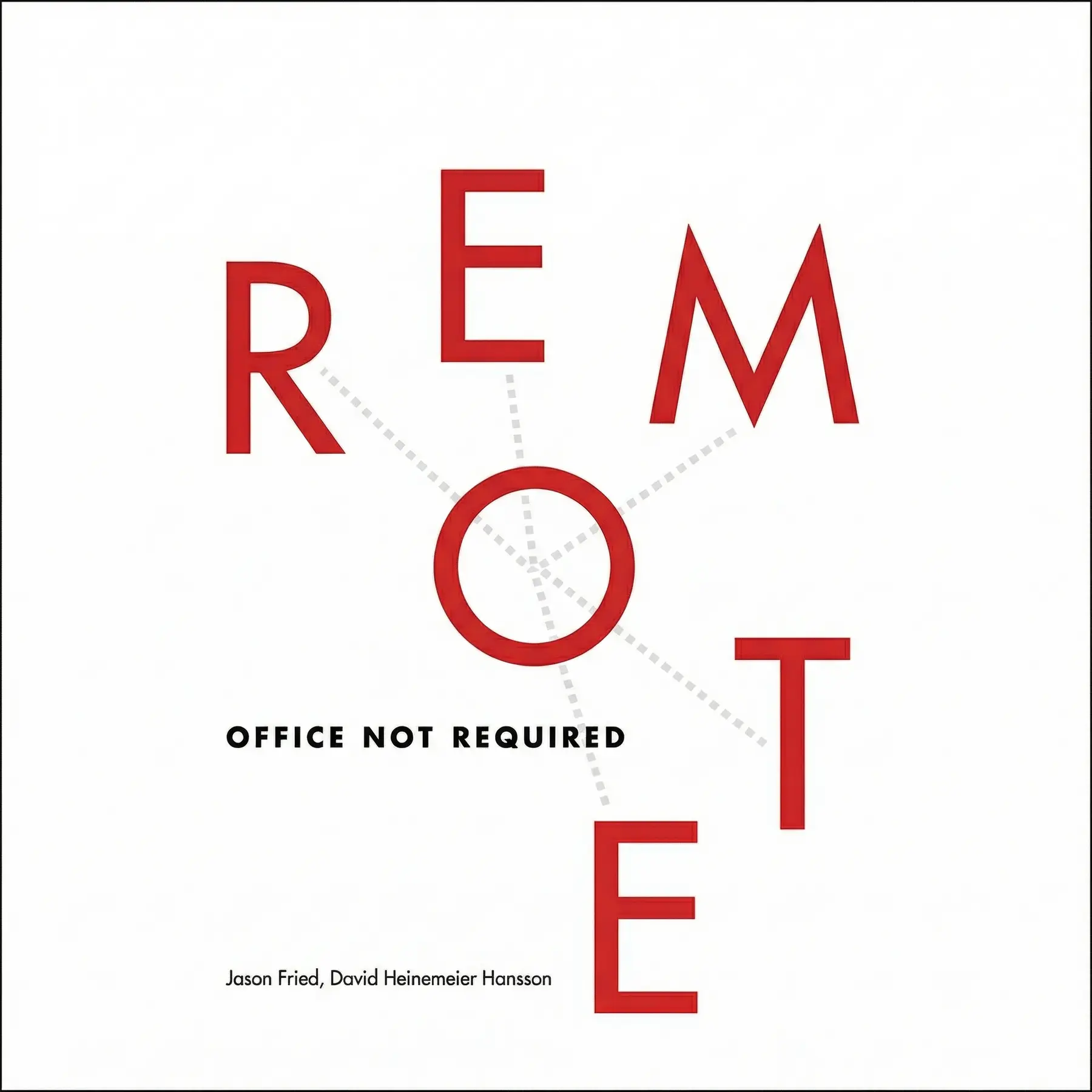
EnglishไทยRemote: Office Not Required
Shows why letting people work away from the office helps both companies and staff, and lays out simple ground rules for shared hours, real connection and protecting remote workers from burnout.
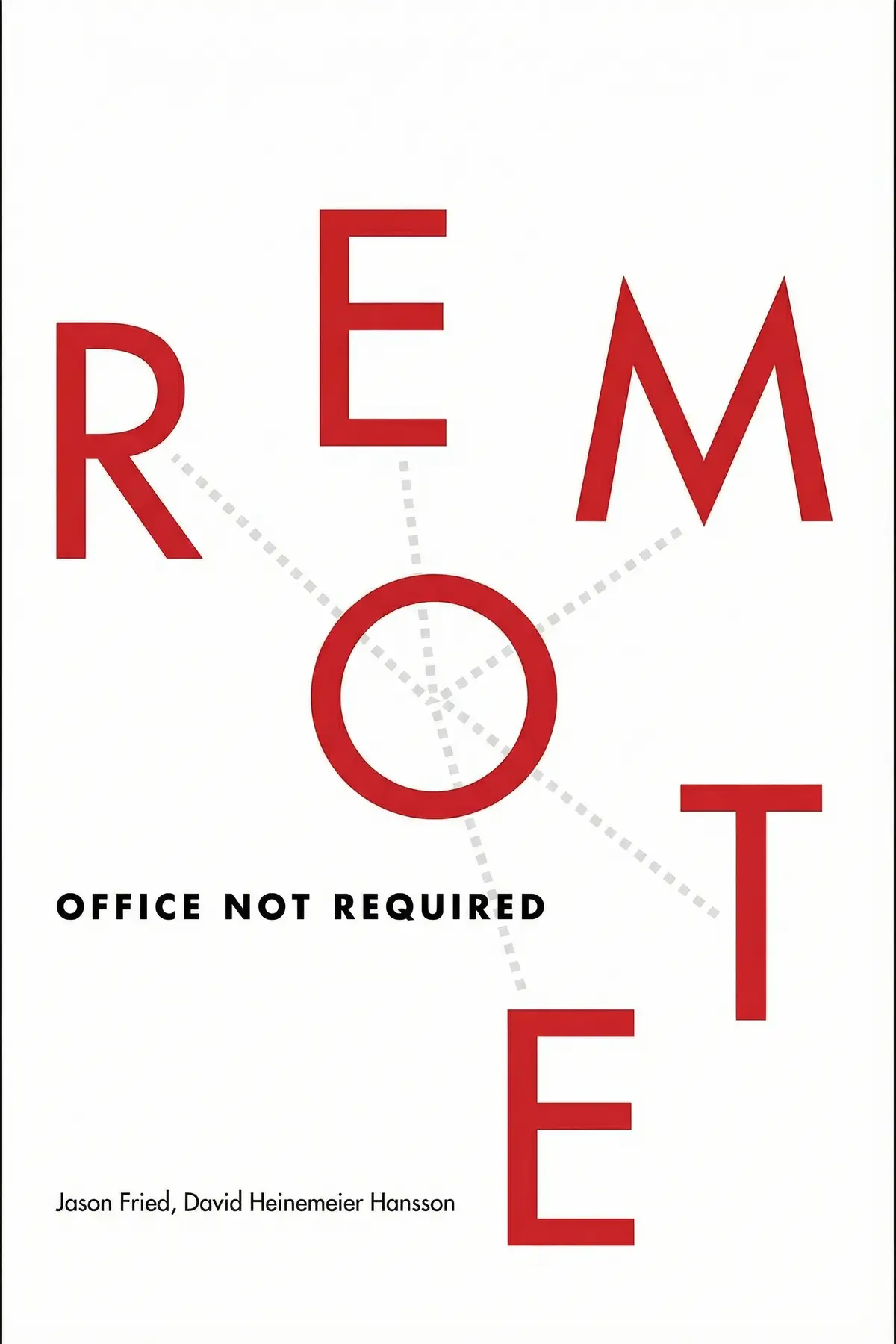
Table of Content
1. Introduction
58 sec
If you manage a team or work on one, you probably assume real work happens where people can see each other. In Remote, Jason Fried and David Heinemeier Hansson of the software firm 37signals argue that a person at a desk proves very little. At the headquarters of J.C. Penney, they report, about 30 percent of internet bandwidth went to watching YouTube videos.
Their case is that remote work pays off for employers and employees alike, as long as managers stop measuring presence and start building deliberate habits for collaboration, connection and rest. The argument runs from why companies should care, through the objections bosses raise, to the ground rules that hold a scattered team together. Along the way you get a way to pitch a remote trial to a skeptical boss, a few plain rules for shared hours and shared information, and the warning signs of burnout in people you can no longer see.
2. Keep good people even when they have to move
1 min 20 sec
A strong employee announces a move to another state, and most companies quietly start recruiting a replacement. One media company tried something else, and the result changed its policy for everyone on staff.
3. Work in the hours your mind is sharpest
1 min 25 sec
The standard workday assumes everyone thinks best between nine and five. The authors see three costs in that assumption, and the largest one has nothing to do with productivity at all.
4. Protect your focus and judge work by results
1 min 26 sec
Bosses worry that people working from home will slack off. The authors point to where the workday really disappears, and to a side benefit for managers that most of them never expect.
5. Judge people by their results, not desk time
1 min 36 sec
Culture, innovation and control are the three reasons bosses give for keeping everyone in the building. One retailer’s internet traffic suggests the third reason may be the weakest of all.
6. Test remote work with one team first
1 min 25 sec
Companies tend to judge remote work on one person’s week at home and then declare it a failure. The authors describe a fairer test, and a habit most firms already have that is riskier.
7. Shared hours and open information keep projects moving
1 min 28 sec
Remote teams do not need to be online around the clock, but they cannot drift apart either. A simple rule about overlapping hours at 37signals shows where the balance sits.
8. Give remote colleagues a face and a friendly tone
1 min 31 sec
A message without a smile behind it can sour a working relationship in a single line. The authors explain why remote teams still need a break room, careful words and a reason to meet.
9. Keep your remote team from burning out
1 min 26 sec
The common fear is that remote workers do too little. The authors worry about the reverse, and they describe a set of perks, from summer days off to fruit money, meant to pull people away from the laptop.
10. Conclusion
1 min 08 sec
The office made a quiet promise: if you can see people working, work is getting done. Fried and Heinemeier Hansson spend the book showing how little that promise was worth, from YouTube traffic at a corporate headquarters to good employees lost because a spouse found a job elsewhere. What they offer instead is more deliberate management. Judge the work, build in shared time, and look after people you can no longer watch.
Each side gets something real. The company keeps its talent and can hire from anywhere. The worker gets back hours, focus and room for a life outside the job. Both gains last only when someone takes over what the office used to handle by accident: coordination, friendship and rest.
A sensible first step is a two-month trial for one team, with four hours of overlap and a calendar everyone can see. Put the first in-person gathering on that calendar early, and ask at least one manager to work remotely too.
The office was never the work itself. It was only the place where the work used to happen.
About this book
What is this book about?
Many companies still treat the office as the place where work happens and a person at a desk as proof that it is happening. Jason Fried and David Heinemeier Hansson, the pair behind the software firm 37signals, argue that this belief costs companies talent and costs workers focus, time and a life outside the job. They make the case from both sides. Employers can hire beyond their own city and keep good people who need to move. Employees get to work during their best hours, escape constant office interruptions and stop postponing their plans until retirement. The authors then take on the usual objections about culture, innovation and control, and suggest companies test remote work slowly with a whole team rather than deciding after one person's week at home. The second half is practical. Drawing on how 37signals runs, the authors describe a four-hour overlap rule, shared calendars, an online break room, twice-yearly company meetups and perks meant to stop remote staff from working themselves to exhaustion. Readers get an argument to bring to a skeptical boss and a set of habits that keep a scattered team working as one.
Book Information
Who it's for
Bosses weighing remote work
Managers and founders weighing whether to let their team work away from the office.
Hoping to convince bosses
Employees who want to make the case for remote work to a skeptical boss.
Finding remote work hard
Remote workers who struggle with interruptions, isolation or never switching off.
About the Author
Jason Fried
Jason Fried co-founded 37signals in 1999, a Chicago company that started in web design and from 2004 built web applications, beginning with Basecamp. He speaks to audiences around the world on entrepreneurship, design, management and software. David Heinemeier Hansson, a Danish programmer, writer and racing driver, created Ruby on Rails, cofounded Basecamp and is a partner and chief technology officer at 37signals. Together they also wrote ReWork and It Doesn't Have to Be Crazy at Work.
Ratings & Reviews
Ratings at a glance
What people think
Listeners find the book worthwhile and simple to follow, full of useful details rooted in firsthand experience. They also value its thorough exploration of remote work elements and its no-nonsense approach. The writing is described as motivating and clear, offering solid pointers throughout. However, listeners are divided on the work's length, as some find it brief while others think it's too lengthy.
Top reviews
Pla
Finally got around to reading this manifesto on the future of employment. Fried and Hansson have crafted a compelling argument that challenges every traditional notion of the nine-to-five grind. While some might find the short, punchy chapters a bit disjointed, I found the pace refreshing and incredibly easy to digest during my commute. The authors draw deeply from their own journey at Basecamp, offering a blueprint that feels both revolutionary and grounded in real-world success. My only gripe is that it feels a bit light on technical implementation, but as a source of inspiration, it's unmatched. It truly changed how I view my daily output versus my physical presence in an office.
Show moreGabriel
This book is a masterclass in modern work philosophy that every manager should be required to read immediately. Jason Fried and DHH have a way of cutting through the corporate fluff to address the core of what makes people productive and happy. The layout is clean, the tone is punchy, and the insights are based on years of successful experimentation rather than academic theory. I loved the emphasis on deep work and the protection of an employee's time from unnecessary interruptions. It’s rare to find a business book that is this inspiring while remaining so easy to read in a single sitting. It completely reframes the office as a place of interruption rather than a place of work.
Show moreMaria
Wow, it’s refreshing to see authors who actually practice what they preach in such a transparent and successful way. Fried and Hansson dismantle the 'collaboration' myth that requires everyone to be physically huddled in a conference room to get things done. The book is comprehensive in its coverage of the remote lifestyle, touching on everything from ergonomic setups to the psychological shift required for managers. I found the writing style to be incredibly engaging and direct, avoiding the jargon that usually bogs down business literature. It provides a roadmap for a more humane way of working that respects individual autonomy and focuses on results. This should be standard reading for the digital age, regardless of your current office situation.
Show moreCamila
As someone who has spent a decade in a cubicle, this book felt like a breath of fresh air. The truth is, most of our office time is wasted on 'meetings about meetings' and water-cooler gossip that doesn't move the needle. Fried and Hansson provide a straightforward approach to reclaiming your productivity by embracing the remote model. I particularly appreciated the sections on trust and how to manage a team you can't physically see every hour. Some of the arguments feel a bit like a sales pitch for their own software, but the core philosophy is sound. If you are struggling to find a better work-life balance, this might just be the push you need.
Show moreDarius
Look, if you need a manifesto to convince your boss to let you work from home, this is your bible. The book is packed with ammunition to counter every old-school objection management might throw your way about productivity or team bonding. It’s beautifully designed and the illustrations make the concepts stick, even if the text itself is somewhat thin on data. I found the advice on prioritizing 'meaningful work' over 'physical presence' to be particularly impactful for my current role. Even if you don't agree with every point, it forces you to question why we still follow industrial-age rules in a digital world. It is short, but the impact of its message lingers long after you close the back cover.
Show moreTantipat
Picked this up during my transition to a distributed team and found it to be a very objective guide to the pitfalls of the transition. The authors don't hide the fact that remote work is hard, but they argue convincingly that the benefits of freedom and global talent far outweigh the costs. I particularly liked the discussion on time zones and how a few hours of overlap can actually be a productivity superpower. Some critics say it’s biased, but in my experience, you need this kind of strong opinion to break through old habits. The book provides decent tips on everything from security to fighting off the loneliness that can sometimes creep in. It’s a solid four-star read.
Show moreNarong
The chapter on company culture really missed the mark for me because it felt far too simplistic for a complex corporate environment. Frankly, the writing style reminds me of a series of loosely connected blog posts rather than a cohesive, deep-dive business manual. While the authors are clearly pioneers in the virtual space, their advice often ignores the regulatory hurdles of industries like healthcare or finance where privacy is paramount. It’s a quick read, and there are certainly some nuggets of wisdom regarding asynchronous communication that I’ve started using. However, I was left wanting more 'how-to' and a lot less 'why-you-should.' It's a decent primer, but don't expect a comprehensive roadmap for every niche.
Show moreOscar
Ever wonder why some remote teams thrive while others crumble into a mess of missed emails and toxic chat threads? This book touches on those issues but frequently offers 'just trust people' as the primary solution, which feels a bit naive in a large organization. To be fair, the authors have built a massive company on these principles, so their perspective carries significant weight. I enjoyed the sections on how to hire when your talent pool is the entire world instead of a thirty-mile radius. Yet, the pacing felt uneven, and some chapters ended so abruptly that I had to check if I’d accidentally skipped a page. It’s a fine introduction for the uninitiated, but seasoned remote workers might find it repetitive.
Show moreHiroshi
Personally, I found this to be a tricky book to review because while the sentiment is great, the execution feels a bit like a sales pitch. It is quite short, and the large font and numerous illustrations make it feel even thinner than its page count suggests. The truth is, many of the 'practical solutions' are things most tech-savvy professionals have already figured out through trial and error over the last few years. I was hoping for more rigorous strategies for maintaining long-term team cohesion without the benefit of physical proximity. It’s a good tool for persuasion if you have a skeptical boss, but it lacks the depth of a true 'how-to' manual. Still, it’s a quick and enjoyable read with decent tips.
Show moreWatchara
Not what I expected after hearing so much hype about the 37signals guys and their revolutionary work culture. The book relies heavily on strawman arguments, often comparing the best-case remote scenario to the worst-case office environment imaginable. In my experience, remote work introduces massive hurdles in collaboration and spontaneous innovation that the authors simply gloss over with breezy anecdotes. They suggest that a few hours of overlap is enough for global teams, yet they ignore the reality of burnout for those working graveyard shifts to make it happen. It felt more like a promotional pamphlet for their brand than a serious study on organizational behavior. I finished it feeling more frustrated by the gaps in logic than empowered.
Show moreQuestions about this book
What is the main idea of Remote by Jason Fried and David Heinemeier Hansson?
The authors argue that technology has made the daily office optional and that remote work benefits both sides. Companies can hire beyond their city and keep good people who move away, while employees gain focus, flexible hours and time for a life outside work. The catch is that managers must rethink how they lead, building in shared hours, personal connection and protection against overwork.
How do the authors answer the claim that remote work hurts company culture?
They say the claim confuses culture with team building. In their view, culture is how a company’s values show up in its people’s behavior, such as care for customers and attention to long-term goals. Employees can understand and act on those values without meeting every day, although the authors still recommend meeting in person, as 37signals does twice a year.
How should a company start with remote work?
Slowly. The authors suggest letting a few employees work remotely a few days a week, then running a fairer test with a whole team over a couple of months. They warn against judging the idea on one person’s single week at home. They also note that most firms already trust outside lawyers, accountants and agencies, which they consider riskier than trusting their own staff.
What practical rules does 37signals use for remote teams?
People working on the same project overlap by at least four hours a day. A shared calendar shows who is available and when, and non-secret company information is kept where anyone can reach it. An online chat room serves as a break room, and the whole company meets twice a year. To guard against burnout, the authors recommend giving everyone one additional day of leave somewhere from May to October, and 37signals also helps cover the cost of gym memberships and fresh fruit and vegetables.
Is Remote useful for employees or only for managers?
Both. Employees learn how to protect their focus, work during their most productive hours and pursue goals like travel without quitting their job. They also learn the risks: misread messages, isolation and the pull to keep working late. Managers get arguments for a trial, rules for collaboration and ways to keep remote staff from feeling like second-class workers.
Readers also enjoyed





AUDIO SUMMARY AVAILABLE
Listen to Remote in 15 minutes
Get the key ideas from Remote by Jason Fried, plus 5,000+ more nonfiction titles.
- 5,000+ titles
- Listen as much as you want
- 7-day free trial
- Cancel anytime









