

14 min 57 sec
Available in: English
Back to Human: How Great Leaders Create Connection in the Age of Isolation
By Dan Schawbel
Shows leaders how to rebuild the human contact that screens have worn away at work, using friendship, empathy, protected focus, open collaboration and personal praise to build teams that stay longer and perform better.
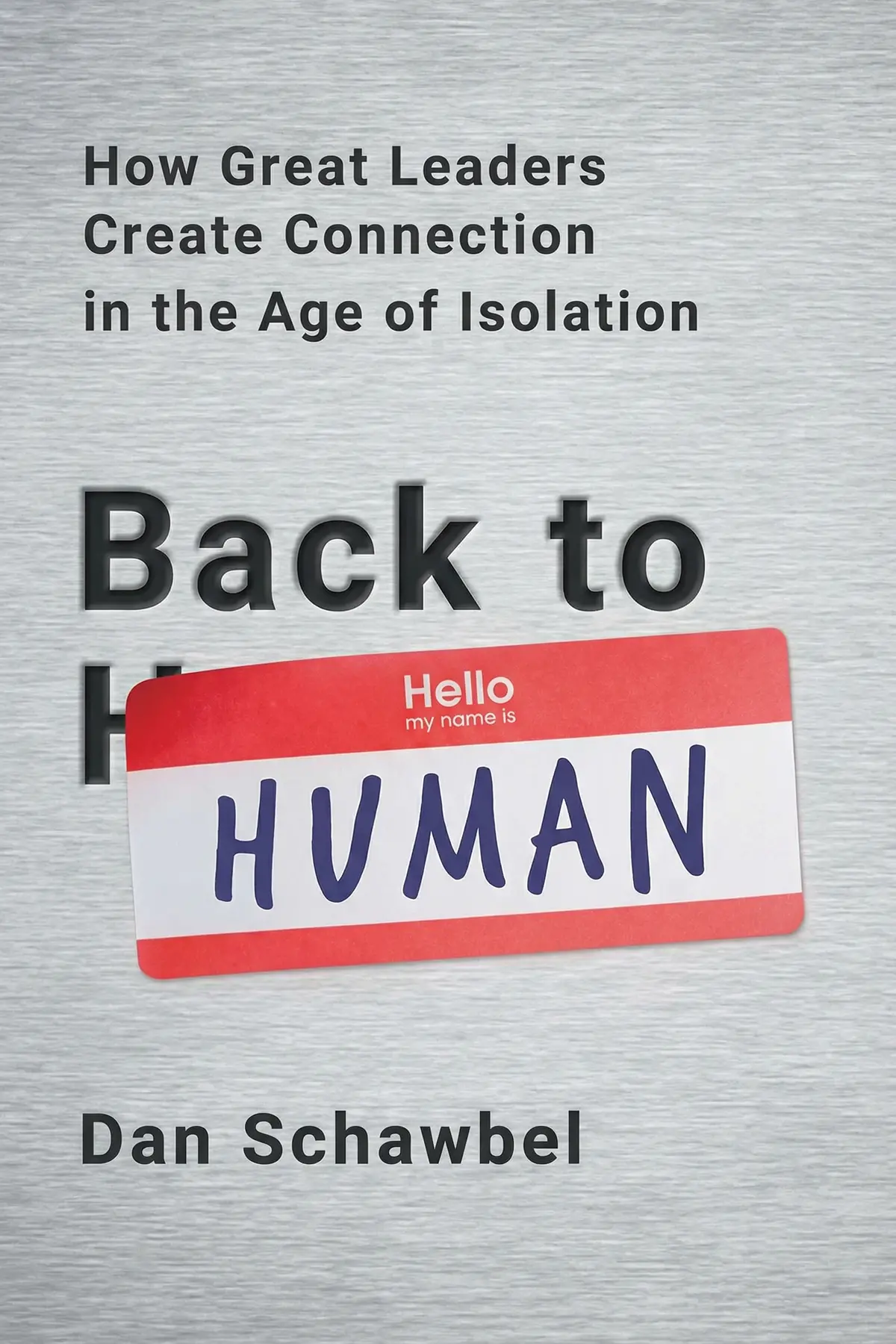
Table of Content
1. Introduction
1 min 01 sec
If your team is in touch all day on chat yet rarely really talks, that loneliness is probably costing you results. In Back to Human, workplace researcher Dan Schawbel cites a 2017 Wharton study of more than 700 employees and managers that linked loneliness on the job to poor performance. His argument is that the tools built to connect us are wearing down the relationships that make work satisfying and effective.
Schawbel is not asking anyone to give up their devices. He wants leaders to see where technology helps, where it gets in the way, and how to restore the human contact it has pushed aside. Every idea that follows serves one claim: the leader who rebuilds real connection gets people who are more fulfilled, focused, creative and loyal.
What you get are moves you can try next week: a better question for one-to-ones, a ritual for sharing wins and struggles, and a way of saying thanks that beat cash in a factory test.
2. Constant online contact can leave teams lonelier
1 min 48 sec
People today can reach almost anyone in seconds, and still many feel cut off. Research spanning seven decades suggests that what we lose in the trade affects both how satisfied we are and how well we work.
3. Give your team a real reason to belong
1 min 50 sec
A raise can keep someone in a job for a while, but it rarely explains why they love it. One old theory and one large poll point to a far cheaper source of engagement.
4. Ask about feelings to earn real trust
1 min 51 sec
A third of employees suspect their bosses care only about profit. One training director changed a single type of question and saw his team open up, while a phone on the table can undo the effect.
5. Win back your focus from the inbox
1 min 55 sec
A researcher with a stopwatch followed office workers for a decade and timed how long they stayed on one task. The trend she found should worry anyone whose important work needs more than a minute of thought.
6. Seat people close enough to spark ideas
1 min 50 sec
The companies that made remote work possible still spend fortunes bringing their own people together. An engineering study from the 1970s suggests why a few dozen meters can decide whether colleagues ever talk.
7. Hire and listen for the ideas you lack
1 min 48 sec
Most large companies praise diversity, yet the numbers in tech and in senior roles tell a different story. Two simple exercises, one in interviews and one in meetings, reveal who brings new thinking and who stays silent.
8. A sincere compliment can outperform a cash bonus
1 min 44 sec
An experiment in a chip factory offered three groups of workers three different rewards for hitting their targets. By the end of the week, the outcome was not what most people would guess, since the cash-bonus group’s productivity had actually declined.
9. Conclusion
1 min 10 sec
What Schawbel describes is a leader’s job that technology has made harder and more important at once. The devices stay. What a leader has to notice is what they took: the work friendships, the hallway conversations, the long stretches of focus, the sense of being seen by the person you report to. Each of these can be won back, and the Gallup, Maritz and Intel findings suggest the reward is people who stay longer and work better.
The changes are small enough to begin this week. Swap one message for a conversation, and keep your phone in your pocket while you have it. Ask a team member how they feel about their workload, then listen to the whole answer. Turn your notifications off for a morning after writing your priorities on paper. When someone does good work, say so in front of the team.
Schawbel closes with one more idea: ask your people what they want from the space they work in, from the layout of the desks to the plants and the snacks in the kitchen, and act on what they say. Giving them a voice over the room where they spend their days tells them, more clearly than any bonus, that someone is listening.
About this book
What is this book about?
Most teams have never been more connected, and yet many people at work feel more alone than ever. Messages replace conversations, notifications break up the working day, and remote setups make it harder to form the friendships that keep people engaged. Dan Schawbel argues that this loss of human contact carries a real price for wellbeing and for business results. Drawing on studies from Gallup, Wharton, MIT and the University of California, Irvine, and on experiments such as Dan Ariely's test at an Intel factory, Schawbel makes the case that relationships sit at the heart of fulfillment at work. He does not ask leaders to abandon technology. He asks them to see its limits and to put people back at the center. Readers get practical moves for each part of that shift: questions that open up honest one-to-one talks, a weekly ritual for sharing wins and struggles, anonymous brainstorms that reveal who stays silent, interview exercises that surface fresh thinking, and simple ways to say thank you that motivate more than a bonus.
Book Information
Who it's for
Remote and hybrid managers
Managers of hybrid or remote teams who sense people drifting apart behind their screens.
First-time team leads
New team leads who want cheap, practical ways to raise engagement, trust and retention.
HR and learning professionals
HR and learning professionals looking for research-backed arguments for more human leadership.
About the Author
Dan Schawbel
Dan Schawbel is a New York Times bestselling author and Managing Partner of Workplace Intelligence, a research and advisory firm that supports human resources teams. He also founded Millennial Branding and workplacetrends.com. Through his companies he has run dozens of research studies and worked with brands such as American Express, GE, Microsoft, IBM and Oracle. He hosts the 5 Questions podcast, has written for Forbes, Fortune and TIME, and is also the author of Promote Yourself and Me 2.0.
Ratings & Reviews
Ratings at a glance

What people think
Listeners find this to be an exceptional read, with one mentioning it is especially helpful for team managers. The book stresses the necessity of connection, with one listener observing that building relationships is vital for a successful life. Listeners value the high caliber of research, with one noting how it is filled with illustrative examples from major organizations.
Top reviews
Pracha
Wow, this really hit home for me as someone who has felt increasingly isolated while working in a digital-heavy role. Schawbel articulates the paradox of our era perfectly: we are more connected than ever via social media, yet lonelier in our actual professional lives. The focus on authenticity and vulnerability in leadership is exactly what is missing from most standard business manuals. I loved the examples from leading companies that have successfully fostered a culture of belonging through genuine recognition. It is an essential guide for anyone who wants to lead with their heart as well as their head, emphasizing that human relationships are the true key to a successful life.
Show moreZoe
As a team manager, I found this to be a refreshing reminder of what actually matters in the modern workplace. We get so bogged down in Slack messages and KPIs that we often forget the human element is what truly drives long-term productivity. Schawbel does a great job of blending actionable frameworks with case studies from top-tier organizations to show that empathy isn't just a soft skill. I particularly liked the sections on building psychological safety within a team. My only minor gripe is that some of the work-life integration talk feels like a subtle excuse for being always-on, but the core message about prioritizing relationships is solid and well-researched.
Show moreDuang
Finally got around to finishing this one, and the timing is interesting as we navigate new hybrid work models. Schawbel’s argument that technology is weakening our professional relationships is hard to argue with, even if he is a bit conservative about remote setups. The book is packed with practical strategies—like asking for feedback on physical workspaces—that you can implement immediately without needing a massive budget. It is well-researched and the prose flows nicely, making it a quick weekend read for anyone looking to boost team engagement. Truth be told, it serves as a necessary wake-up call for leaders who have spent too long hiding behind their screens.
Show moreOlivia
Picked this up during a commute and found myself nodding along to most of the chapters. The book is a good basic read about leadership that focuses on building and maintaining effective relationships with your employees in a fast-paced world. Schawbel’s writing style is accessible, and he avoids the overly dense jargon that usually ruins business books. I found the distinction between work-life balance and work-life integration to be particularly thought-provoking for my own career. While some points are a bit platitudinous, the actionable advice on fostering collaboration makes it worth the purchase for any aspiring supervisor looking to improve their team's morale.
Show morePornpimon
After hearing Dan speak at a professional development event, I wanted to see if his book held up to the hype. It mostly does, offering a clear-eyed look at how technology can act as a barrier to true fulfillment and productivity in the workplace. The emphasis on empathy as a cornerstone of leadership is well-supported by both research findings and real-world anecdotes. I appreciated the specific tips on how to improve team dynamics through prioritization instead of multitasking. Even if you already consider yourself a people person, this book provides a solid framework to ensure you are actually putting those connection-building values into practice every single day.
Show morePing
Is it really that revolutionary to tell leaders they should actually talk to their employees? This book falls into that category of common sense that somehow isn't common practice, which makes it helpful but occasionally tedious. The author's tone is earnest, and he collects a lot of recent articles to back up his claims about isolation in the digital age. However, the section on hiring for personality was frustratingly vague and didn't define what specific traits actually look like for different roles. It is a fine primer for brand-new managers who need a nudge toward empathy, but veterans might find the advice a bit repetitive and simplistic.
Show moreSiraporn
The chapter on hiring for personality left me with more questions than answers, which is a shame because the rest of the book is quite decent. Schawbel suggests we should hire high energy people with positive attitudes, but that is such a broad recommendation it feels almost meaningless in a professional context. Beyond that, the book is a helpful collection of modern workplace wisdom that emphasizes the importance of shared learning and genuine connection. It is a fun, light read that does not demand too much of the reader's time. Just do not expect deep, systemic solutions to the massive, complex problem of corporate isolation and burnout.
Show moreGame
Not what I expected given the buzz surrounding this title. While Schawbel is clearly well-intentioned, much of the research feels incredibly US-centric and some of the advice is so generic it borders on being useless for a seasoned leader. He argues for more face-to-face time, but his dismissal of remote work feels hopelessly out of touch with how global teams actually operate today. Frankly, telling a manager to wait for a phone call during a client crisis instead of using modern tools is just impractical advice in a fast-paced environment. It is an easy read, but I would suggest looking elsewhere for truly modern leadership strategies that reflect the nuances of our current world.
Show moreSureerat
To be fair, the author's stance on remote work hasn't aged particularly well since this was written. He claims that pure remote work is unsustainable in general, a take that feels quite conservative and perhaps a bit defensive of traditional office cultures. The book also relies heavily on a US-centric perspective that might not translate well to international teams or different cultural expectations of leadership. While the core message about the value of human connection is undeniably true, the specific methods suggested for achieving it feel a bit dated and simplistic. It is a collection of good vibes advice that lacks the grit needed for complex organizational change.
Show moreKae
This feels like it was written for a different century, or at least for a version of the corporate world that no longer exists. The author suggests disconnecting from technology to the point where it becomes a hindrance to actual business needs. If there is a crisis, he seemingly expects a phone call or a handwritten note, which sounds romantic until you realize he is advocating for a retreat from the tools that make modern collaboration possible. The research cited feels pseudo-scientific at times, and the focus is so narrow that it ignores the realities of global, diverse workforces. Read this only if you want to understand how not to lead in the 2020s.
Show moreQuestions about this book
What is the main idea of Back to Human by Dan Schawbel?
Schawbel argues that digital technology, for all its benefits, is weakening the relationships that make people satisfied and effective at work. Studies he cites link heavy social media use to isolation and depression, and loneliness at work to poor performance. His answer is for leaders to rebuild human contact deliberately, through face-to-face conversation, empathy, protected focus, physical closeness, open idea sharing and personal recognition.
Is a compliment really better than a cash bonus?
In an experiment Dan Ariely ran at an Intel semiconductor factory in 2016, one group was promised a pizza voucher, one a cash bonus and one a rare compliment from their boss for hitting daily targets. By the end of the week the cash group’s productivity had dropped and the compliment group did best. Schawbel concludes that personal recognition motivates more than a small payment.
How can a manager show more empathy, according to Back to Human?
Schawbel suggests face-to-face talks that explore how people feel, not just what they are working on. Chipotle training director Sam Worobec began asking how employees felt about their workload and family pressures, and his team grew more open and effective. Schawbel also advises putting your phone away, since Virginia Tech research found a phone on the table weakens the sense of connection.
Who should read Back to Human?
It suits team leads, managers and HR professionals who see their people communicating mostly through screens and want to rebuild engagement and loyalty. Its advice is concrete and inexpensive: a weekly ritual for sharing successes and struggles, anonymous brainstorms, idea-based interview exercises, turning off notifications, and thanking people in person or with a written note.
Readers also enjoyed

A Bigger Prize: How We Can Do Better Than the Competition
Margaret Heffernan





A Year with Peter Drucker: 52 Weeks of Coaching for Leadership Effectiveness
Joseph A. Maciariello



AUDIO SUMMARY AVAILABLE
Listen to Back to Human in 15 minutes
Get the key ideas from Back to Human by Dan Schawbel, plus 5,000+ more nonfiction titles.
- 5,000+ titles
- Listen as much as you want
- 7-day free trial
- Cancel anytime









