

15 min 40 sec
Available in: English
All You Have to Do Is Ask: How to Master the Most Important Skill for Success
By Wayne Baker
Shows why most help at work arrives only when someone asks, and how to make clear, well-aimed requests while building teams where asking for help is normal and rewarded.
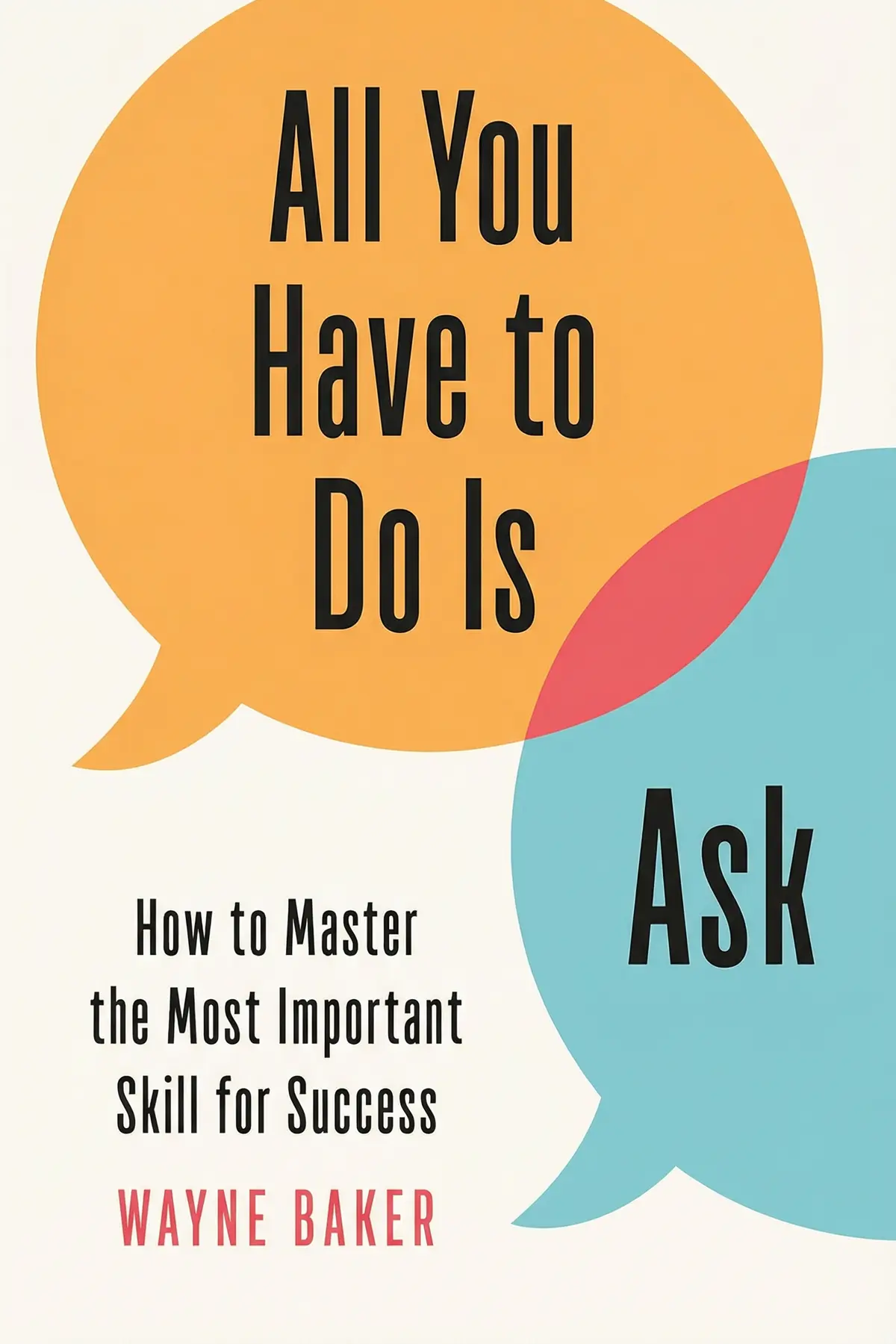
Table of Content
1. Introduction
1 min 00 sec
Most people would rather struggle alone than ask, and the help they need rarely shows up on its own. In All You Have to Do Is Ask, University of Michigan sociologist Wayne Baker cites studies suggesting that as much as 90 percent of help at work is given only after someone requests it. Talent, money and luck all play a part in success, he argues, but the ability to ask decides how much of other people’s knowledge and goodwill you can actually reach.
That is the thread through everything that follows: asking is a learnable skill, for individuals and for whole organizations. Baker shows why we misjudge how willing others are, which style of giving and asking pays off best, and how to shape a request so it gets a yes. He then turns to teams, with rituals and rewards that make asking normal. The method is short enough to remember, and the first request can go out this afternoon.
2. Find the help hiding in your network
1 min 46 sec
A baby in Romania needed a surgeon her family could not find, and an engineer at a car company was stuck for a long time. Both answers came from unexpected people, once one simple thing happened.
3. Trust that strangers and old friends will say yes
1 min 51 sec
Ask most people whether a stranger in New York would lend a phone, and they will predict a refusal. A Columbia experiment and a worldwide survey suggest our instincts about other people are badly off.
4. Become the colleague who both gives and asks
1 min 52 sec
Some colleagues help everyone and burn out; others never ask and drift into isolation. Of four ways people handle giving and asking, one produced the most productive and respected employees at a telecoms firm.
5. Turn a vague need into a request people grant
2 min 03 sec
Wanting help and getting it are separated by a few choices about wording, timing and channel. One of them made requests dozens of times more effective, and a famous author’s rejections put refusals in perspective.
6. Build a team where asking feels safe
2 min 14 sec
Google’s researchers looked for the single most important quality of a team’s culture. Their finding, and a fourth question one software firm adds to its daily meeting, explain why some teams hide mistakes and others don’t.
7. Reach the help sitting in other departments
1 min 56 sec
At one power company, executives and field superintendents had stopped talking altogether. The fix was a three-month game with an odd rule, and it hints at how help can travel between departments that never meet.
8. Reward asking and watch shy people speak up
1 min 50 sec
A literary agency wrote asking for help into its staff guidelines, yet one shy assistant still stayed silent. What changed her behavior cost nothing and took a few seconds in each team meeting.
9. Conclusion
1 min 08 sec
Baker’s book describes a loop. One clear request lets someone put what they know to use; that person, thanked in public, asks more freely next time; and the team becomes a place where needs are said out loud. Cristina’s surgery and the engineer’s solved problem began the same way, with one person stating exactly what they needed to a wider circle than usual. The payoff Baker names is broad: better work, new job openings, faster adjustment to change and stronger team performance and creativity.
The place to begin is the problem you are carrying right now. Turn it into a request that is specific and has a deadline, explain why it matters, and bring it to someone in person, or to an old friend you have not spoken with in years. If you lead others, give asking a daily slot and public credit. Baker also suggests a gratitude wall of blank thank-you cards, where anyone can write a note to a colleague who helped or to one who asked.
Help seldom arrives uninvited. It comes when someone says what they need.
About this book
What is this book about?
Most people would rather struggle than ask for help. They fear looking incompetent or being turned down, so the knowledge and contacts that could solve their problem stay out of reach. Sociologist Wayne Baker argues that asking is a learnable skill, and one that often decides who succeeds. Baker draws on studies and workplace stories: strangers in New York lending their phones, a Gallup survey across 140 countries, a newly hired assistant whose retired father solved an engineer's problem. He sorts people into four styles of giving and asking and shows why the giver-requester comes out ahead. He then explains how to build a request with SMART criteria, pick the right person and channel, and treat rejection as an opinion. For leaders, the book offers concrete tools from Google, Menlo Innovations, Atlassian, Hopelab and others: daily stand-ups that include a question about help, the Reciprocity Ring, cross-team games and recognition that rewards people who ask as well as people who give.
Book Information
Who it's for
Professionals afraid to ask
Professionals who stay stuck on problems because asking for help feels like admitting weakness.
Wanting mistakes raised early
Team leads and learning staff who want people to raise mistakes and needs early.
Early in their careers
Early-career workers who want to reach acquaintances and old contacts without feeling awkward.
About the Author
Wayne Baker
Wayne Baker is an American sociologist, author, consultant and speaker. He holds the Robert P. Thome professorship in Business Administration at the University of Michigan's Ross School of Business and is Faculty Director of its Center for Positive Organizations, after earlier teaching at the University of Chicago business school. His research covers social capital, social networks and American values, and he is known for showing that financial markets work as social networks. He earned a doctorate in sociology at Northwestern, did postdoctoral research at Harvard, and co-founded Give and Take, Inc., which offers tools based on this book.
Ratings & Reviews
Ratings at a glance

What people think
Listeners view Wayne Baker’s strategy for collaboration as a functional and perceptive guide for professional growth. Even though perspectives differ on whether the primary message could have been more briefly summarized, listeners value the hands-on resources offered, including the SMART criteria for formulating requests. They also find great worth in the group activities and the "Reciprocity Ring" method for encouraging team openness and psychological safety. Furthermore, they highlight how the content clarifies individual giving patterns, with one listener commenting that it provided a "shot in the arm" to help them get past their reluctance to ask for help.
Top reviews
Emily
Ever wonder why some people seem to get everything they want while you are stuck grinding away in silence? Baker’s book provides the blueprint for breaking that cycle of isolation and silence. For me, the standout was the discussion on creating a culture where admitting mistakes and asking for resources is encouraged rather than punished. The inclusion of statistics to back up the benefits of the Reciprocity Ring made the arguments feel academically grounded rather than just self-help fluff. I have already started using the SMART criteria for my emails, and the response rate has been noticeably better. Frankly, this should be required reading for every new hire in a corporate setting. It turns a soft skill into a measurable, repeatable process for success.
Show moreLucia
This book is a game-changer for anyone who thinks they have to do everything themselves to be successful in life. Wayne Baker demystifies the art of the ask and shows that it is a skill that can be mastered, not a personality trait. I was surprised to learn that people help strangers much more often than we think, a fact backed up by his research. The Reciprocity Ring is a brilliant concept for fostering a culture where everyone feels safe to admit they do not have all the answers. Personally, I found the breakdown of the four types of givers and requesters to be the most helpful part of the text. It gave me the vocabulary to understand my own hesitation and the tools to overcome it. Highly recommended.
Show moreKrisada
Look, we all know we should ask for help, but Baker explains exactly why we don't and how to fix that behavior. This was a much-needed shot in the arm for my professional development this quarter. I have always been an overly generous giver, often to the point of burnout, while never wanting to "bother" others with my needs. The author reframes asking as an act of generosity itself, because it allows others to contribute and feel valued. I particularly liked the concept of the fifteen-minute stand-up and the specific questions to ask: what did I work on, what is blocking me, and what help do I need? Some of the anecdotes felt a bit like monumental outliers, but the core strategy is very sound.
Show moreLuke
The chapter on the "lone wolf" versus the "giver" really hit home for me during my morning commute reading. I have always prided myself on my independence, but Baker’s data suggests that lone wolves are actually the weakest link in a collaborative chain. That realization was a bit of a wake-up call for my current management style. The book is less about begging and more about creating a strategy for collective intelligence. Using the Reciprocity Ring in our last department meeting actually led to three immediate solutions for problems we had been sitting on for months. In my experience, the fifteen-minute stand-up format is the most low-friction way to implement these ideas. Even though some parts of the text are dry, the practical tools are worth the price.
Show moreTod
Picked this up on a recommendation from a colleague who noticed I was drowning in my current project. I was hesitant at first because I did not want to feel like a burden to my busy team. However, Baker argues that asking for help is as important as giving it because it builds psychological safety. The book provides a very clear framework to ensure your requests are specific and action-oriented, which helps reduce the guilt of asking. I especially liked the story about the baby in Romania; it was a touching way to illustrate how broad a network can truly be. While the vocabulary occasionally feels a bit academic, the overall message is incredibly empowering. It has definitely changed how I approach my daily interactions with my colleagues.
Show moreChan
Finally got around to finishing this, and I have to say, the practical application is where it truly shines. Most business books are heavy on theory and light on how-to, but Baker flips that script. He provides specific group exercises that can be used to increase the efficiency and effectiveness of teams immediately. I have already implemented the "daily ask" in my personal life, and it is surprising how much people want to help when you give them a path. To be fair, the writing style is a bit utilitarian and lacks a certain poetic flair, but that is to be expected from a workbook hybrid. If you are looking for a strategy on asking questions that yields results, this is a great place to start.
Show morePruet
After hearing a lot of buzz about the Reciprocity Ring, I finally decided to pick this up for my team. It is a solid, well-written guide that emphasizes the importance of psychological safety in the workplace. I found the section on different giving styles particularly illuminating; I realized I am a "lone wolf" who usually struggles to reach out. However, the book often feels more like a workbook or a classroom syllabus than a narrative-driven business book. The "SMART" acronym for requests is practical, though it is certainly nothing groundbreaking for anyone who has set goals before. Truth is, the most valuable parts are the specific group exercises suggested for teams. It is a useful tool for HR managers, but it is not exactly a page-turner.
Show moreFord
As someone who has always felt a bit guilty asking for favors, I went into this with a healthy dose of skepticism. While the book contains many cozy examples that highlight the benefits of reaching out, I still struggle with the idea of presuming upon relationships. Baker does a decent job addressing this mental block by focusing on the meaningful part of the SMART request. However, I am not entirely convinced everyone won't eventually resent the constant asking for help. The writing is clear, reminding me of a college textbook—informative but lacking that hook that keeps you reading late into the night. It is a well-rounded book that offers relevant lessons for those just starting their careers, but seasoned pros might find it repetitive.
Show moreChamlong
This book could have easily been condensed into a long-form blog post or a single magazine article. While Wayne Baker provides some decent framework for collaboration, the central thesis—that you should just ask for what you need—is repeated ad nauseam. I appreciated the SMART criteria for making requests, yet it felt like a rehashing of basic management training I received years ago. We all know that closed mouths don't get fed in this professional world. To be fair, the examples of the "Reciprocity Ring" were interesting from a sociological perspective, but they didn't justify the two hundred pages. It felt like a chore to push through the fluff to find the actionable nuggets. If you have a few hours to kill, maybe skim it, but do not expect a revolutionary breakthrough.
Show moreSaranya
Not what I expected given the high praise I saw online recently. I found myself struggling to stay engaged because the narrative flow is constantly interrupted by workbook-style exercises. I appreciate the effort to make it practical, but it lacks the compelling storytelling found in modern business classics. The author suggests that if we do not ask, others will not understand our needs, which is quite obvious. Does that really require an entire book to explain? Not gonna lie, I felt annoyed by the repetition of the SMART acronym throughout almost every single chapter. It is a good example of a business book that probably should have remained a short podcast episode. Unless you have zero experience with team collaboration, you can safely skip this one.
Show moreQuestions about this book
What is the main idea of All You Have to Do Is Ask?
Wayne Baker argues that asking for help is an overlooked skill that often decides who succeeds. People underestimate how willing and able others are to help, yet studies he cites suggest up to 90 percent of help at work is given only after someone asks. The book teaches individuals how to make effective requests and shows organizations how to make asking normal, safe and rewarded.
What are the four giving and asking styles in Wayne Baker's book?
Baker describes overly generous givers, who help constantly but hide their own needs and risk burnout; selfish takers, who rarely repay but give more in public to protect their reputations; lone wolves, who neither ask nor give and become isolated, the worst style; and giver-requesters, who help generously and ask for what they need. In a telecoms firm study, giver-requesters were the most productive and respected.
How do you make an effective request for help?
Baker suggests starting with a written goal, then shaping the request with SMART criteria: specific, meaningful, action-oriented, realistic and timebound. Explain why you need it and what the person should do, with a clear deadline. Think about who knows whom, not only who knows what. Ask in person where possible, since research he cites found face-to-face requests 34 times more effective than email, and treat a refusal as an opinion.
How can managers encourage employees to ask for help?
Baker recommends leaders ask for help themselves, as Salvador Salort-Pons did at the Detroit Institute of Arts. Hire people who give and request, and build psychological safety. Daily stand-ups that include the question what help do I need, used at Menlo Innovations, make asking routine. Reciprocity Rings, cross-team contact and recognition that publicly thanks people for asking, as Jim Levine began doing at his agency, reinforce the habit.
Readers also enjoyed








AUDIO SUMMARY AVAILABLE
Listen to All You Have to Do Is Ask in 15 minutes
Get the key ideas from All You Have to Do Is Ask by Wayne Baker, plus 5,000+ more nonfiction titles.
- 5,000+ titles
- Listen as much as you want
- 7-day free trial
- Cancel anytime









