

A Return to Love: Reflections on the Principles of a Course in Miracles
Marianne Williamson
 English
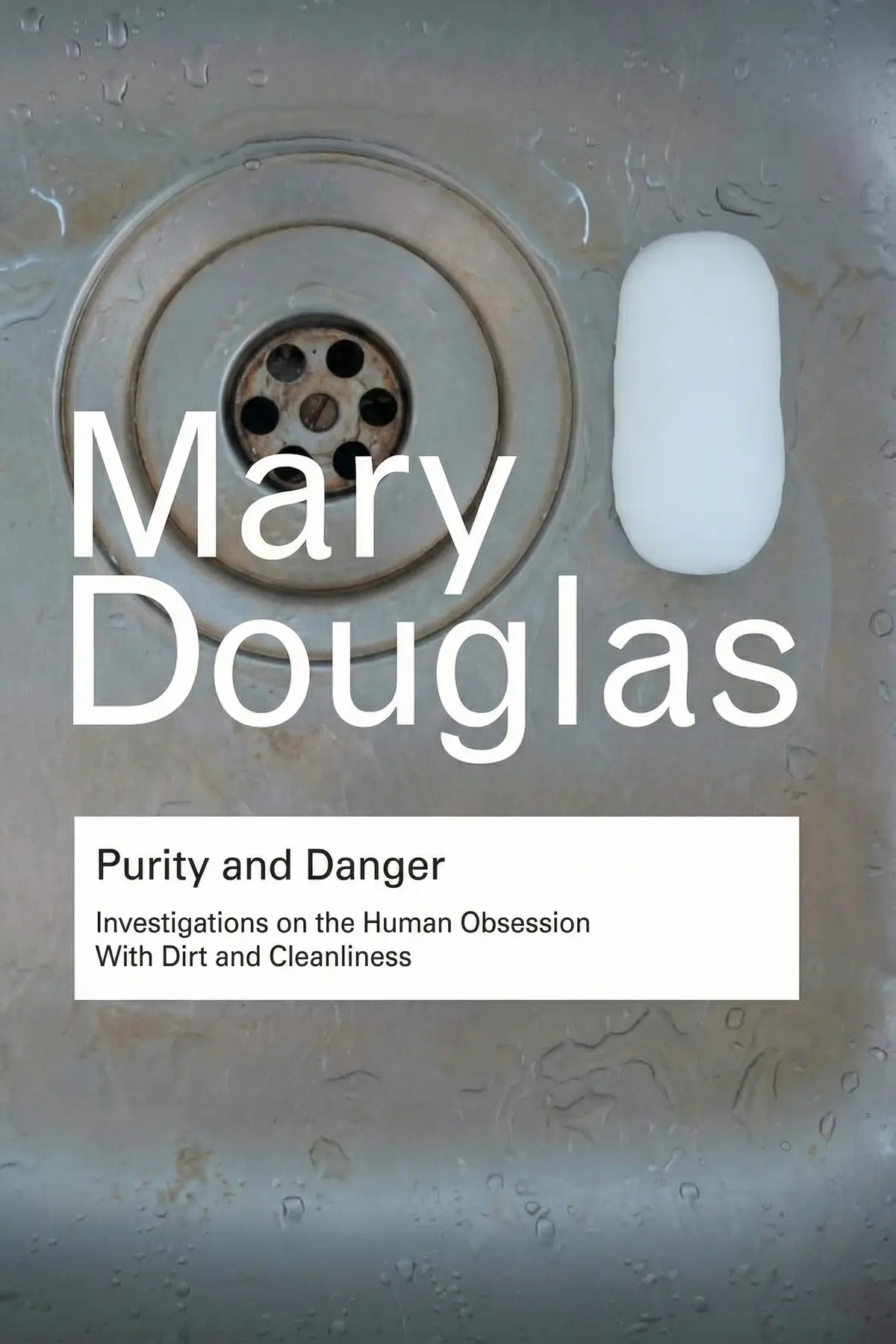
Mary Douglas shows that nothing is dirty in itself. Societies call things unclean to keep their categories in order, and they treat whatever breaks those categories, animal or person, as dangerous or as sacred.
1 min 06 sec
If other people’s customs strike you as strange and your own rules feel simply natural, Mary Douglas offers a sharper way to see both. In Purity and Danger, her 1966 classic, the British anthropologist argues that nothing is dirty in itself: dirt is matter sitting in the wrong place. Mud on a pair of garden boots feeds the flowers outside. The same mud on a dinner table makes people recoil.
Douglas builds a whole theory on that small observation. Every society, she argues, sorts experience into clean and unclean, pure and polluted, and those categories turn a chaotic world into an orderly one. Whatever threatens the order is treated as dangerous, and sometimes as sacred. Her evidence runs from the food laws of Leviticus to the forests of the Congo, where a scaly anteater is eaten in ceremony. Follow her argument and any taboo, from a banned food to a shunned neighbor, becomes a clue to what a group is trying to protect.
1 min 43 sec
A pair of muddy boots on a dinner table produces instant disgust, yet nobody minds that same mud in a flowerbed. The difference points to something every culture carries around without noticing it.
1 min 47 sec
Eat your greens or you won’t grow. Go to bed or something terrible will happen. Those small childhood threats do more work than any parent intends, and the same mechanism runs through a society’s deepest rules.
2 min 01 sec
For decades, scholars ranked the world’s faiths as advanced or backward, and the ranking always seemed to favor the scholars’ own. Douglas proposed a different test, and a hunting ritual about the weather shows how it works.
2 min 14 sec
For centuries, people explained the ancient ban on pork as a matter of disease and hot weather. Douglas thought they were missing the point entirely, and decades later she found flaws in her own answer too.
2 min 03 sec
In one Congolese community, an animal that fits no category is avoided, while another that fits even fewer is eaten in a ceremony. The difference shows that being out of place can mean danger or power.
2 min 10 sec
Accused witches, a peasant girl in armor and people walking out of prison have something in common. Douglas explains why communities fear those they cannot classify, and why that fear often has nothing to do with harm.
1 min 04 sec
Douglas left behind one sentence that travels well: dirt is matter out of place. Behind it sits a larger claim. Every group builds order by sorting the world into clean and unclean, and it guards that order with warnings, rituals and taboos. A pig, a pangolin and a woman in armor tell the same story. Each one strained a set of categories, and each society had to decide whether the strain was a threat or a source of power.
The idea reaches well beyond anthropology. When something disgusts or alarms you, look for the boundary it crossed before you judge it. When another culture’s custom seems strange, read it from inside its own rules before you place it on any ladder of progress. And when someone in your workplace or neighborhood is treated as dangerous, ask whether they have done harm or simply fail to fit a familiar box.
Even Douglas went back to her famous pig and admitted she had misread it, and her method still held. The boots were never the problem. They were just on the table.
Why does mud on a dinner table disgust us when the same mud in a garden seems perfectly fine? In her 1966 classic, the British anthropologist Mary Douglas answers with a short definition that has outlived its era: dirt is matter out of place. In her view, ideas of dirt and purity are how a culture sorts a confusing world into order, and taboos are how it keeps that order standing. Douglas tests the idea on the food laws of Leviticus and the ban on pork. She also looks at the !Kung of Botswana, who link hunting to the weather, and at the Lele of the Congo, who avoid the flying squirrel but eat the scaly pangolin in a fertility ritual. She attacks the old scholarly habit of ranking cultures as advanced or backward. In its place she asks readers to understand each culture's rules from the inside. Readers come away with a lens for any rule or reaction that seems strange, including their own. They also get a clear account of why communities fear people who don't fit their categories, from accused witches and Joan of Arc to people leaving prison today.
Curious readers who want to understand why taboos, food rules and rituals differ so much across cultures.
Managers, teachers and newcomers to any group who want to read its unwritten rules.
Students of anthropology, religion or sociology looking for a classic that is still widely debated.
Dame Mary Douglas (1921 to 2007) was a British social anthropologist, born in Sanremo, Italy. She was seen as a follower of Émile Durkheim, drew on structuralist analysis and took a keen interest in comparative religion. She taught anthropology at University College London and Princeton University, and her fieldwork among the Lele people of Kasai-Occidental was central to her career. Her other books include Natural Symbols, Risk and Culture and How Institutions Think.

Listeners find the work insightful, with one listener specifically noting its importance for grasping religious purity. They describe the content as informative, and one individual mentioned that it successfully addressed their questions.
Picked this up after a friend mentioned it in a discussion about religious taboos, and it was a total revelation. I expected a dry, dusty tome, but Douglas has a sharp wit that keeps the pages turning and the ideas flowing. She brilliantly dismantles the idea that 'primitive' people were just superstitious while we are 'rational.' Instead, she shows that our own obsession with hygiene is just as symbolic as any ancient ritual. Gotta say, the way she explains the dietary laws in Leviticus through the lens of animal classification is pure genius. This isn't just for anthropologists; it's for anyone curious about the human psyche.
Show moreEver wonder why we find certain things 'gross' even when they aren't actually harmful? This book provides the answer by looking at how we impose system and order on an inherently messy world. Douglas posits that purity is a way of protecting social structures from the danger of the unclassifiable. Personally, I found her analysis of 'marginal' people as sources of both power and pollution to be the most compelling part of the work. It’s a short book, but it packs a heavy intellectual punch that will stay with you long after you finish it. Essential reading for understanding culture.
Show moreWow, I didn't think a book about 'pollution' would be this relevant to my own life, but here we are. Not gonna lie, I was captivated by the idea that disorder isn't just something to be feared, but also a source of incredible power and potential. Douglas looks at how rituals of purification are actually tools for maintaining the status quo and defending the boundaries of a community. The way she links the physical body to the 'social body' is a stroke of brilliance that explains so much about modern politics. It’s a deep, rich text that deserves a slow, careful reading to really absorb everything.
Show moreThis book completely rewired how I think about the mundane act of cleaning. Douglas argues that dirt isn't about biology or germs, but rather 'matter out of place' that disrupts our social order. It’s a fascinating deep dive into how societies create boundaries to keep the chaos at bay. Truth is, her critique of early modernist anthropology feels just as relevant today when looking at how we categorize 'outsiders' in political discourse. While some of the structuralist framework feels a bit rigid for a modern reader, the core insights are undeniable. It is a dense read but the prose is surprisingly lively for an academic text.
Show moreThe chapter on Leviticus and the dietary laws of the Israelites is easily the highlight of this entire volume. Douglas masterfully debunks 'medical materialism'—the idea that ancient people avoided pork just because of trichinosis—and replaces it with a fascinating theory of symbolic logic. Look, if an animal doesn't fit into a clear-cut category, it becomes 'unclean' because it threatens the conceptual map of the world. While I think she overextends the structuralist argument in some of the later chapters, her ability to make sense of seemingly bizarre ancient rules is impressive. The writing is clear, concise, and remarkably free of unnecessary jargon.
Show moreMary Douglas manages to take the concept of 'dirt' and turn it into a profound meditation on the human condition. In my experience, most people assume our rules about purity are based on objective facts, but Douglas shows they are almost entirely cultural. She explores how anything that exists in the margins—the 'in-between' spaces of society—is viewed as inherently dangerous or even magical. This explains so much about how we treat people who don't fit into traditional gender or social roles. The book is intellectually stimulating and surprisingly accessible, though you do need to concentrate to follow her logic. A true classic.
Show moreFinally got around to reading this for a graduate seminar, and it definitely lived up to the hype surrounding its reputation. Douglas has a way of defamiliarizing the familiar, making you question why you wash your hands or why certain words are considered 'dirty.' Truth is, the structuralist approach can feel a bit like a magic trick where the answer is always 'it's about classification,' but she performs it with such mastery that you can't help but be impressed. It’s a landmark text that bridged the gap between religious studies and social science. Definitely a must-read for anyone interested in the sociology of the sacred.
Show moreAfter hearing about Douglas's work in a podcast, I decided to see if the actual book was as insightful as the summary. It is. The central idea—that purity is about maintaining logical categories—is one of those 'aha' moments that changes how you see the world. Basically, we create taboos to protect the integrity of our systems, whether those systems are religious, social, or scientific. While the book's 'English Protestant' bias occasionally peeks through, her effort to treat all cultures with equal intellectual respect was ahead of its time. It’s a fascinating, if sometimes challenging, exploration of why we fear the untidy.
Show moreAs someone who appreciates classic social theory, I found Douglas's insights into the nature of taboo to be incredibly thought-provoking. However, to be fair, the book is very much a product of 1966. Her use of terms like 'primitive' and her heavy reliance on structuralism can feel quite dated and occasionally reductive to a contemporary ear. She spends a lot of time arguing against other anthropologists from her era, which might lose readers who aren't familiar with James George Frazer or the history of the discipline. Still, her central thesis regarding how we handle anomalies is foundational. It’s a solid three stars for the historical value alone.
Show moreNot what I expected, and frankly, quite a struggle to get through compared to more modern sociology. While I understand why this is considered a classic, the constant referencing of obscure 19th-century theories made it feel like I was reading a transcript of an old academic debate. The prose is okay, but the 'us versus them' mentality regarding 'technologically advanced' societies is hard to ignore. It feels like she’s trying to force complex human behaviors into these tiny, neat boxes that don't always fit. If you're a student of anthropology, you probably have to read it, but for a casual reader, it’s a bit of a slog.
Show moreDouglas argues that nothing is dirty in itself: dirt is matter out of place. Societies sort experience into clean and unclean to create order, and taboos keep those categories apart. Whatever threatens the order, an animal, an act or a person, is treated as dangerous. Sometimes, as with the Lele and the pangolin, it is treated as sacred instead.
Douglas rejects the health explanation, which she calls medical materialism, and also the view that ritual rules are random. She reads the food laws as an outward sign of the aim to be holy, which Leviticus repeats again and again. The Hebrew and Latin words for holy carry ideas of separation and restriction. In a 2002 preface, she admitted mistakes in her reading of the pig.
A marginal state is the position of people who do not fit a society’s usual categories, so the community cannot decide whether they belong or whether they are unclean or pure. That uncertainty makes them seem dangerous. Examples in the book include accused witches and sorcerers, unborn children and Joan of Arc. Douglas also names people leaving prison or psychiatric hospitals today.
When something disgusts you, ask which boundary it crossed instead of assuming it is dirty in itself. When a foreign custom looks irrational, interpret it within its own culture before ranking it, as Douglas urges. And when a group treats someone with suspicion, ask whether that person has done harm or simply doesn’t fit an expected category.
It suits readers interested in religion, culture and social rules, and students of anthropology or sociology who want a foundational text. It also helps anyone who leads or joins groups, because it explains why communities enforce some rules fiercely and why they distrust people who fall between their categories.
Marianne Williamson

Deepak Chopra

Pico Iyer


Alcoholics Anonymous World Services

Fay Bound Alberti


Virginia Woolf

Tracy Rosenthal

Jessica Valenti
AUDIO SUMMARY AVAILABLE
Get the key ideas from Purity and Danger by Mary Douglas, plus 5,000+ more nonfiction titles.









