

15 min 35 sec
Available in: English
Mindreader: Find Out What People Really Think, What They Really Want, and Who They Really Are
Shows how the words people choose, from pronouns to passive verbs, reveal what they think, whether their story is true and how emotionally healthy they are, so you can read colleagues, dates and strangers more accurately.
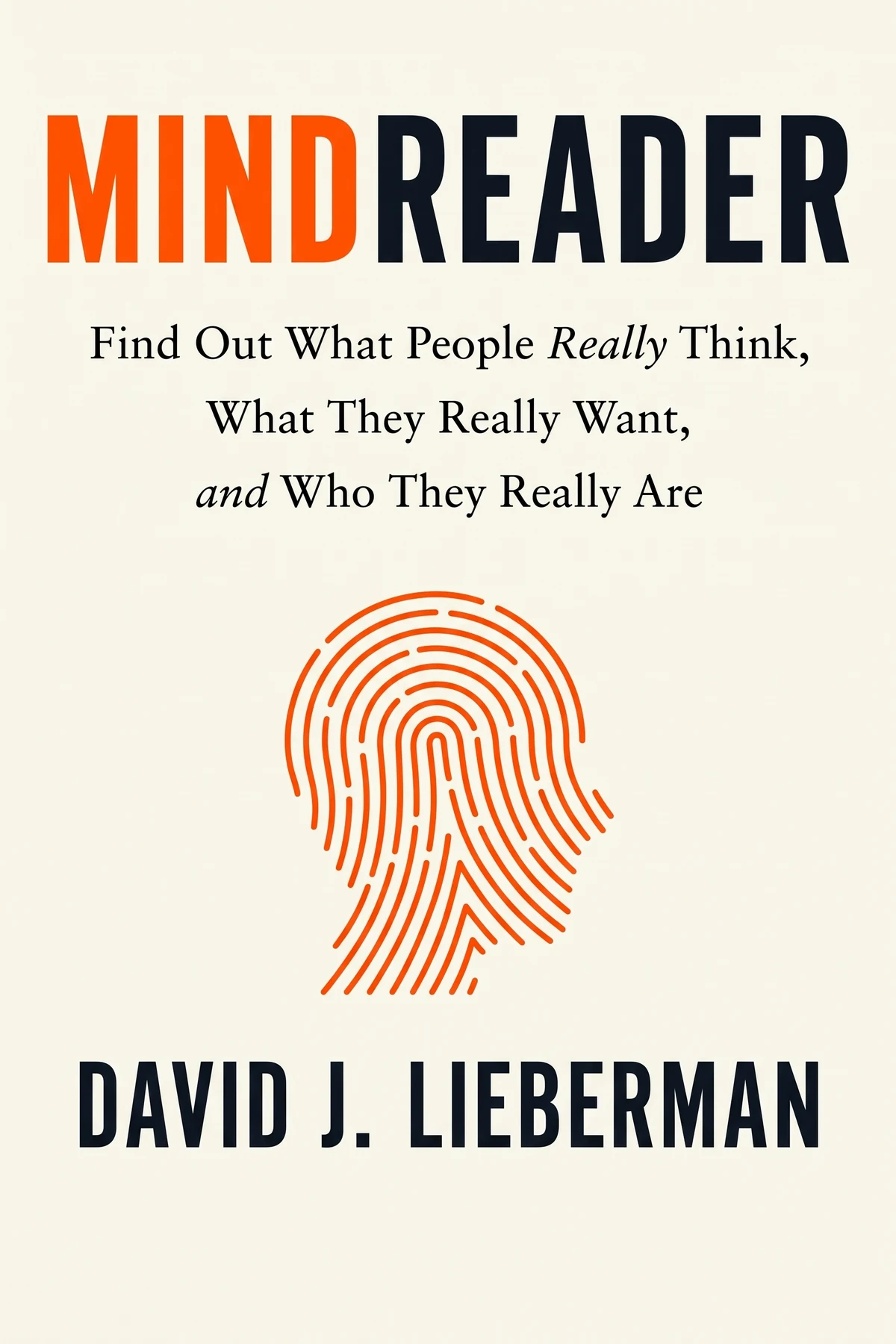
Table of Content
1. Introduction
1 min 01 sec
Most of us learned to read people by watching their arms, eyes and hands, and most of those signals tell us very little. In Mindreader, psychotherapist David J. Lieberman, who has trained staff at the FBI, the CIA and the NSA, argues that the better evidence sits in the words people choose. A dropped pronoun, a slide into the passive voice or a borrowed cliché can show what someone really thinks, what they want and how healthy they are underneath.
His method rests on psycholinguistics, the study of cues hidden in spoken and written language, so it works across a desk, on a video call or in an email. The idea running through every part of the book is that fear and ego leak into grammar, and anyone who learns to hear that leak reads people more accurately, and more kindly. Along the way come a test for sincere praise, a way to check a story without accusing anyone, and the everyday signs of low self-esteem.
2. Read people through their words, not crossed arms
1 min 36 sec
The classic body-language tells most of us learned can mislead a careful observer again and again. Lieberman points to a richer source of evidence, one that works even through a phone screen and with a total stranger.
3. Spot empty praise in a missing pronoun
1 min 56 sec
Two compliments can say almost the same thing, yet one is meant and one is not. A tiny grammatical difference separates them, and police and hiring managers can use the same difference to sort truth from performance.
4. Tell genuine feeling from a polished performance
1 min 51 sec
A grateful husband speaks to the press after his wife is rescued, and something in his statement rings hollow. The reason has less to do with what he says than with how much effort the saying takes.
5. Test a story without accusing anyone
1 min 58 sec
Accusing someone of lying rarely produces the truth and can ruin a relationship if you are wrong. Lieberman offers a calmer approach, including one invented detail that tends to trip up anyone who was not really there.
6. Map someone's priorities from what they say first
1 min 55 sec
An ancient king settled a bitter dispute over a baby by noticing something most listeners would miss. The same clue, along with a handful of small words, can show what a partner, colleague or rival really cares about.
7. Look past a big ego to the pain underneath
2 min 08 sec
Arrogance, constant people-pleasing and a refusal to ever admit fault look like separate problems. Lieberman traces them to one hidden source, and seeing it changes how you might react to the difficult people in your life.
8. Hear resilience in how someone tells a setback
1 min 58 sec
A little rain at a picnic ruins the day for one person and barely registers for another. The difference shows up in the stories people tell, and in a few small words that give their level of fear away.
9. Conclusion
1 min 12 sec
Mindreader adds up to an argument about attention. Fear, pride and pain shape the words people choose, so a pronoun, a passive verb or a borrowed cliché can say more than any folded arm. Lieberman then turns the lens on the reader. Our own wants and insecurities distort what we see, he argues, and the less ego we bring, the more clearly other people come into view. Even the brain’s habit of filing people into ready categories, the confirmation bias the book describes, pushes us to notice only what we already believe.
The practice that follows is modest and immediate. In the next email or interview, listen for who owns the sentence and whether the feeling sounds lived or assembled. When a story seems off, test it with a believable false detail before reaching for an accusation. And when someone is arrogant, rude to a waiter or quick to anger, treat it as a sign of pain rather than a verdict on their worth, then watch whether the pattern repeats.
Heard this way, the people who frustrate you most become easier to understand, and much harder to be fooled by.
About this book
What is this book about?
Most advice on reading people focuses on the body: folded arms, wandering eyes, a hand at the nose. David J. Lieberman argues that those signals mislead more than they help, especially now that so many people know the rules and so much contact happens through email, texts and video. His alternative is psycholinguistics, the study of clues hidden in spoken and written language. A missing pronoun can expose an insincere compliment or a false police report. A switch to the passive voice can soften responsibility. Polished phrasing and borrowed clichés can mark a manufactured feeling, and the shape of a story can show whether it was lived or invented. Lieberman adds tests for checking an account without accusing anyone, and ways to profile priorities, status and outlook from what people mention and how. The book then turns to emotional health, reading ego, anxiety, low self-esteem and resilience through behavior and speech. Readers get practical cues they can use in interviews, negotiations, dating and family life, plus a reason to meet difficult people with more understanding than anger.
Book Information
Who it's for
Managers and recruiters
Managers and recruiters who want to judge candidates and colleagues by more than a confident handshake.
Reading others through text
People dating online, hiring a babysitter or checking a story who need cues that work in writing.
Understanding arrogance or volatility
Anyone dealing with an arrogant or volatile person who wants to understand what drives them.
About the Author
David J. Lieberman
David J. Lieberman is a psychotherapist with a PhD whose New York Times bestsellers include Get Anyone to Do Anything and Never Be Lied to Again. He has trained personnel in the US military, the FBI, the CIA and the National Security Agency, and has taught government negotiators, mental health professionals and executives at Fortune 100 companies. He has appeared as a guest on more than 300 television and radio shows.
Ratings & Reviews
Ratings at a glance

What people think
Listeners find this work deeply insightful, as it improves their ability to interpret and understand people. Beyond being clear and straightforward, the material is accessible enough that one listener suggested it warrants several read-throughs. The guide is also viewed as highly practical, with one person pointing out its immediate use in everyday situations. Finally, listeners enjoy the entertaining delivery, including one listener who pointed to the poker insights as a particularly fun feature.
Top reviews
Art
Ever wonder why certain people just rub you the wrong way for no apparent reason? This book offers a piercing insight into how low self-esteem and ego drive almost every unpleasant interaction we have with others. Instead of just teaching you how to "catch" people, Lieberman explains the underlying emotional pain that causes someone to be manipulative or arrogant. I found the distinction between confidence and self-esteem to be a massive lightbulb moment for my personal relationships. Using these techniques helped me respond with empathy rather than anger when dealing with a difficult coworker last week. It’s rare to find a book that functions as both a tactical manual for lie detection and a profound tool for self-reflection. I've already recommended it to several friends who work in high-stakes management roles.
Show moreChatchai
After hearing about Lieberman's work with the FBI and NSA, I had high hopes for this, and it did not disappoint. The way he breaks down how anxiety narrows our perspective is something I’ve seen happen in real-time during stressful interviews. This book teaches you to look for the hidden clues of low self-esteem that manifest as arrogance or controlling behavior. It has fundamentally changed the way I interact with my family and colleagues because I can now see the fear behind their anger. The writing is incredibly clear and easy to understand, making complex psychological concepts accessible to a general audience. Not gonna lie, I’ve already read certain chapters twice just to make sure the tactics stick. It is easily one of the most useful self-help books I have picked up in years.
Show moreIvan
As someone who has always struggled to read between the lines, this book felt like a legitimate roadmap for social navigation. David Lieberman breaks down how we use language to hide our true intentions, particularly regarding the use of personal pronouns like "I" or "my." It is fascinating to see how someone filing a false police report might distance themselves from a "stolen" car by calling it "the vehicle" instead of their own. While I enjoyed the FBI-level insights into deceit, some of the technical sections made my eyes glaze over a bit. Truth is, you probably won't become a literal psychic after one read, but you will definitely start paying closer attention to how people frame their sentences. It's a solid, actionable guide for anyone looking to sharpen their social intuition without diving into outdated body language myths.
Show moreIsaiah
The chapter on pronoun usage was a total game-changer for how I listen to people during meetings and negotiations. I never realized how much we subconsciously reveal about our level of commitment or honesty just by how we structure our basic sentences. In my experience, the advice on spotting "absolutist" language—words like always, never, or totally—is incredibly accurate for identifying high-anxiety individuals. The writing style is clear and moves at a brisk pace, which I appreciated since I can't stand books that drone on forever. My only real gripe is that some of the scenarios felt a bit too focused on criminal investigations rather than everyday office politics. Still, the core principles are easy to implement in daily life if you're willing to practice. It’s a fascinating look at the subtext of human communication.
Show morePooja
Picked this up after seeing a recommendation on a poker forum, and it actually provided some fun insights into reading bluffs. While the book isn't specifically about gambling, the principles of game theory and emotional resilience are totally applicable to the table. Lieberman’s take on how people react under pressure helped me spot a few tells in my last home game, leading to some very satisfying wins. Beyond the fun stuff, the book dives into how we handle anxiety through escapism or values, which was unexpectedly deep. I did feel that the promise of "near-telepathic abilities" in the intro was a bit hyperbolic and over-the-top marketing. Regardless, it’s a highly entertaining read that offers a unique lens on human behavior. I’ll likely revisit a few chapters before my next big social event.
Show morePatcharaporn
To be fair, there is some very solid advice buried in here if you have the patience to dig through the occasionally dense terminology. The distinction between "contamination narratives" and "redemption narratives" was particularly helpful for understanding the chronic complainers in my life. It explains why some people see catastrophe everywhere while others find a silver lining even in traumatic events. I think this book is a must-read for anyone in a leadership position who needs to build a cohesive, healthy team environment. Some critics call this kind of profiling pseudoscience, but I found the observations on self-absorption and emotional health to be spot on. It’s a great tool for developing a more balanced perspective on why people do what they do. Just don't expect to master it all in a single afternoon.
Show moreWoravit
Look, this isn't going to turn you into a literal psychic overnight, despite what the title might suggest to some readers. What it does do, however, is provide a very effective framework for understanding the "why" behind human behavior. I particularly liked the section on how people with healthy self-esteem treat service workers versus how those with fragile egos behave. It's a great litmus test for character that I've started using in my own life when meeting new people. The book is short enough to hold your attention, and the audio version is particularly well-narrated if you prefer listening. While I found a few of the "game theory" examples a bit abstract, the overall message is incredibly valuable. It’s a smart, well-written guide that provides a lot of food for thought for the observant reader.
Show moreHenry
Lieberman clearly knows his stuff given his extensive FBI and military background, but the book feels a little uneven in its execution. I found the parts about pronoun usage and criminal profiling absolutely gripping, yet other chapters felt like a lot of filler that could have been summarized in a simple PowerPoint deck. Frankly, if you've read Talking to Strangers by Malcolm Gladwell, you might find some of these methods a bit problematic or overly simplistic for complex human interactions. Humans don't always fit into neat little boxes, and some of the "tells" mentioned here might lead to false positives if you're not careful. It’s worth a read for the psychological nuggets, but don't expect it to work perfectly in every casual conversation. It is a decent resource but requires a healthy dose of skepticism.
Show morePita
Mindreader serves as both a window into others and a mirror for yourself, but I struggled with the tone at times. There were sections that felt like they were written for a sociopath trying to learn how to fake empathy, which felt a bit icky. However, the information on how ego acts as a defense mechanism to hide our shortcomings was genuinely enlightening and gave me a lot to think about. I wish there were more practical exercises included rather than just lists of what different behaviors might signify. It is a bit too much "telling" and not enough "doing" for a book that markets itself as a manual for daily life. I'd give it a solid three stars because the insights are there, but the delivery could have been more engaging. It’s okay, just not the life-changing experience I was hoping for.
Show moreAraya
Not what I expected, unfortunately, and it felt more like a collection of anecdotes than a scientific study. I was looking for deep body language analysis, but instead, I got a lot of talk about pronouns and criminal profiling that didn't feel relevant to my life. The author makes some very lofty promises in the beginning that the rest of the book simply doesn't deliver on. Much of the content felt repetitive, and I honestly felt like I was reading the same three points over and over again. It’s very boring in parts, and I struggled to stay focused through the more "technical" descriptions of mental shortcuts. If you're looking for something quick and punchy, this isn't it. I’d suggest skipping this one and sticking to more modern, data-driven psychology books.
Show moreQuestions about this book
What is the main idea of Mindreader by David J. Lieberman?
Lieberman argues that the language people use reveals what they think, want and feel more reliably than body language. Drawing on psycholinguistics, he shows how pronouns, active or passive voice, level of detail and emotional phrasing expose sincerity, deception, priorities and emotional health. Because the cues live in words, the method works in person, on video and in writing, and it does not require knowing how someone normally behaves.
Does Mindreader teach body language?
Mostly no. Lieberman says classic signs like crossed arms, looking away or scratching a nose mean little on their own and produce many false positives, since someone may just be cold or sitting in a chair without armrests. Body language keeps a limited role: checking whether gestures match the words and reading mood when people are off guard. His main tool is language.
How does Mindreader say to tell if someone is lying?
Listen for formal or evasive denials such as I deny these allegations, lectures about fairness, and relief when the subject changes. Invented stories pile detail before the main event and rush the rest, while true ones include things that did not happen. A direct test: confirm two known facts, then add a plausible false detail. Someone who was really there corrects it quickly; a liar hesitates.
How can I use Mindreader in job interviews?
Lieberman cites a study of hundreds of thousands of real candidates in which strong performers used about 60 percent more first-person pronouns, while weak ones relied far more on you and they. Strong candidates describe concrete things they did, such as making two hundred calls a day, while weaker ones give abstract or hypothetical answers. Listen for I attached to a specific action.
What does Mindreader say about low self-esteem and ego?
Lieberman argues that an inflated ego grows from self-loathing, not healthy self-esteem. Low self-esteem works like a headache, making people self-absorbed, which can show as arrogance, self-pity, rudeness to waiters or trouble accepting no. He separates self-esteem from confidence and suggests reading such behavior as a sign of pain, judged over a repeated pattern rather than one bad moment.
Readers also enjoyed

A Liberated Mind: How to Pivot Toward What Matters
Steven C. Hayes


Acting with Power: Why We Are More Powerful Than We Believe
Deborah Gruenfeld


Age of Propaganda: The Everyday Use and Abuse of Persuasion
Anthony Pratkanis




AUDIO SUMMARY AVAILABLE
Listen to Mindreader in 15 minutes
Get the key ideas from Mindreader by David J. Lieberman, plus 5,000+ more nonfiction titles.
- 5,000+ titles
- Listen as much as you want
- 7-day free trial
- Cancel anytime









