

12 min 35 sec
Available in: English
Material World: The Six Raw Materials That Shape Modern Civilization
By Ed Conway
Explains how lithium, crude oil, copper, iron, saltpeter and sand built the modern world, and why each brings both power and an environmental cost that clean energy cannot avoid.
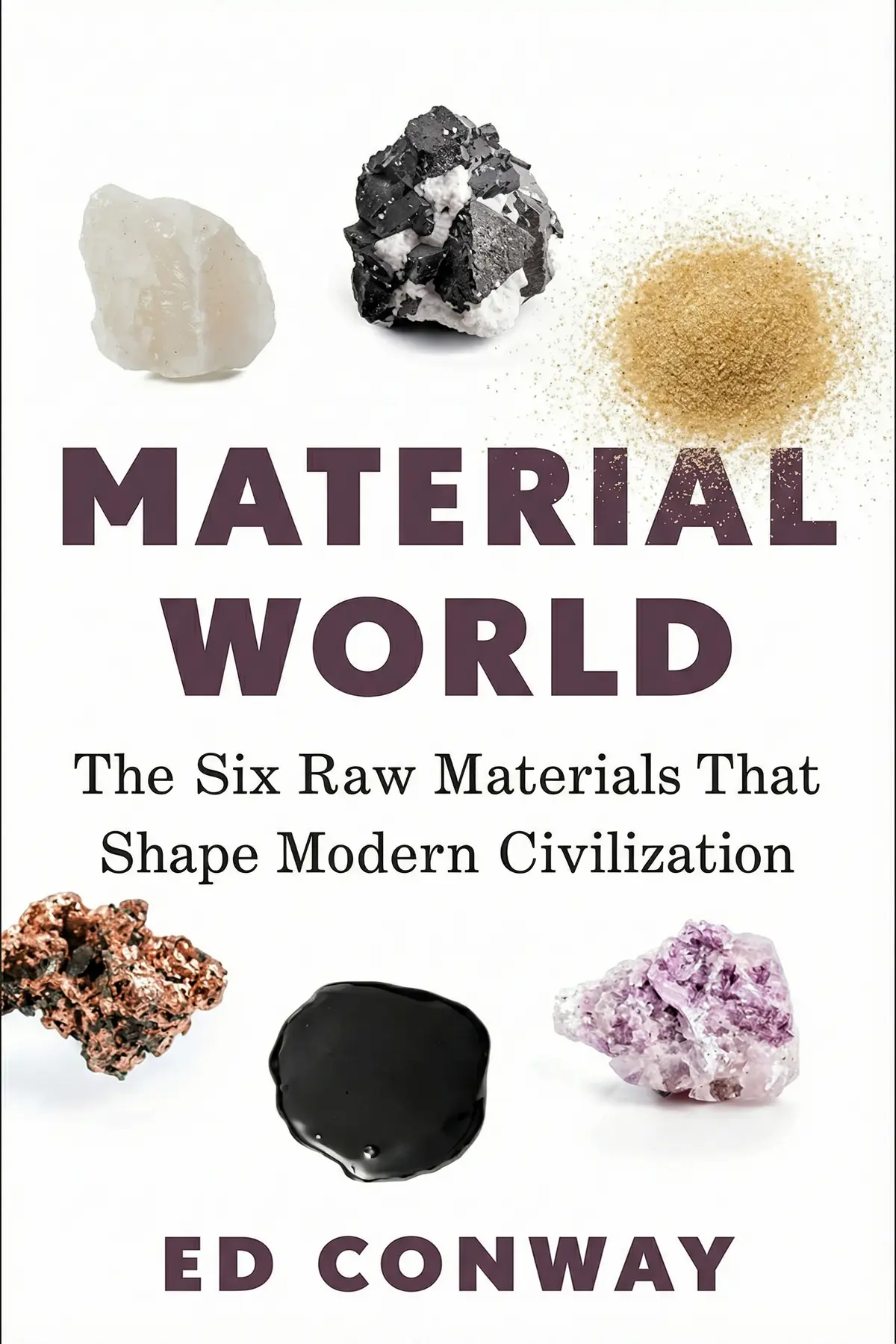
Table of Content
1. Introduction
1 min 03 sec
Most of us can name every app on our phone but not one thing the phone is made of, and that blind spot hides where modern power and modern damage both begin. In Material World, economics journalist Ed Conway argues that civilization is quietly held up by six humble raw substances: sand, saltpeter, iron, copper, lithium and crude oil. A phone, in his telling, is a bundle of countless technologies, and a house is a mix of metal, wood and wiring that traveled a long way to get there.
His throughline is a double edge. Every one of these materials has handed people enormous power, and every one carries a cost to the land, water and climate it comes from. Follow the six in turn and the objects around you stop looking simple. A news story about chips, fertilizer, oil prices or electric cars becomes readable at a deeper level, because you can see the material, and the trade-off, underneath it.
2. See the sand inside every screen and chip
1 min 38 sec
The cheapest-looking substance on Earth sits at the center of the digital economy. It is also running into a limit that almost nobody thinks about when they use a phone or pour a foundation.
3. Spot the materials that decide wars and harvests
1 min 41 sec
One plain-looking salt served two very different ends, feeding crops as a fertilizer and powering armies as a key part of gunpowder. Conway shows why a resource with two uses like that never stays a simple commodity for long.
4. Weigh progress and harm in the same metal
1 min 43 sec
The metal that turned fields and raised skyscrapers was also hammered into swords. Conway reads that split as a mirror of the people who made it, and asks who pays for heavy industry today.
5. See how oil made nations rich and the climate hotter
1 min 48 sec
A geologist with sharp eyes and simple tools walked into the desert and helped redraw the balance of world power. The wealth that followed came with a cost the world is only starting to count.
6. Plan for the copper behind every green promise
1 min 41 sec
Cleaner energy is supposed to mean less digging. Conway shows why the opposite is true for one metal, and why that awkward fact belongs in every serious plan for electric cars and renewable power.
7. Count the real cost of a lithium battery
1 min 40 sec
In one of the driest places on the planet, huge ponds slowly bake under the sun to feed the world’s batteries. Conway asks whether this hope for a cleaner future is also a new kind of damage.
8. Conclusion
1 min 21 sec
Material World adds up to a different way of looking at an ordinary room. The phone is sand turned into silicon, the walls hold iron and copper, the plastic began as oil, and the battery may have started as brine in a Chilean desert. Conway’s case is that these six substances are no mere background. They decided wars, built economies, fed growing populations and now sit at the center of the effort to slow climate change.
What links them is the trade he keeps returning to. Material after material that gave people power also took something from the land, the water or the air, and copper and lithium, both central to the shift toward renewable energy, carry that trade into the clean-energy future.
Living with that knowledge starts with a small habit. Pick one object you use daily and trace what it is made of and where those materials were dug, pumped or dredged. When a product is sold as green, ask what mine or salt flat stands behind it. And when the news turns to chip shortages, fertilizer or oil politics, look for the raw material underneath the headline.
The modern world feels weightless, all screens and signals. It still rests on sand, salt and stone, pulled from somewhere real.
About this book
What is this book about?
Phones, houses, cars and power grids feel like finished products, but each is a mix of materials pulled from the earth. Ed Conway, an economics journalist, argues that modern civilization rests on six of them: lithium, crude oil, copper, iron, saltpeter and sand. He follows each material from its natural origins to its role in history and daily life. Sand becomes the silicon in every chip. Saltpeter fed farms and armed empires. Iron built economies and weapons alike. Oil created petrostates and modern transport. Copper carried electricity to rural America and now carries the move to renewables. Lithium, pumped as brine from Chile's Salar de Atacama, powers the batteries of electric cars. Running through every story is the same tension. Each material has given people new power, and each has a cost in damaged rivers, mined landscapes, used water or a warming climate. Readers come out able to see the physical world behind the headlines on chips, fertilizer, oil and batteries, and to ask what any product, green or not, really takes from the ground.
Book Information
Who it's for
Tech, energy, policy professionals
Professionals in tech, energy or policy who want to see the physical supply behind their industry.
Curious news followers
Curious readers who follow news on chips, oil and electric cars and want the bigger picture.
Weighing green products
Anyone weighing green products who wants to ask what they really cost the planet.
About the Author
Ed Conway
Ed Conway, who also writes as Edmund Conway, is an economics journalist born in 1979. He worked at the Daily Mail and served as economics editor of The Daily Telegraph and the Sunday Telegraph before becoming the first Economics Editor at Sky News in 2011. He writes columns for the Times and the Sunday Times, and his books include the bestselling The Summit, which covers the 1944 Bretton Woods conference.
Ratings & Reviews
Ratings at a glance
What people think
Listeners find this work to be both thorough and well-researched, with one listener pointing out the surprising details provided about essential industries. The prose is expertly written, and listeners often describe the book as a captivating read driven by immersive storytelling. Additionally, listeners value the text’s clarity, with one listener praising its approachable vocabulary, and find the content enlightening, with one listener calling it an incredible story of the modern world. The substance is highly regarded, as one listener mentions how it successfully contextualizes material demand in modern society.
Top reviews
Arjun
Ed Conway has managed to turn the seemingly mundane history of dirt and grease into a gripping geopolitical thriller. Before reading this, I never gave a second thought to the ultrapure quartz required for our fiber optics or the terrifyingly concentrated supply chains for high-end silicon. The book brilliantly deconstructs our 'ethereal' digital existence by showing the massive, violent physical toil required to sustain it. Frankly, the scale of the machinery he describes—like the colossal mines in Nevada—is almost impossible to wrap one's head around without his vivid prose. While the level of detail is occasionally overwhelming, it serves to hammer home just how vulnerable our modern comforts truly are. It’s an eye-opening journey through the six substances that define our era. This is essential reading for anyone who wants to understand the physical reality of the 21st century.
Show morePooja
Picked this up on a whim and I’m reeling from how much I didn’t know about basic chemistry and trade. The chapter on salt alone—specifically how a single site in Runcorn keeps the UK’s water supply from collapsing—is worth the price of admission. Conway has a knack for taking these 'boring' commodities and showing how they are the literal bedrock of civilization. It’s not just a history book; it’s a warning about our fragile supply webs and the environmental cost of our 'green' transition. The way he connects 19th-century breakthroughs to modern-day chip manufacturing is seamless and deeply engaging. It's a rare book that makes you look at a glass of water or a concrete wall differently. Absolutely stellar reporting.
Show moreEarn
As a history buff, I was captivated by the way this book links ancient salt taxes to modern-day autocratic control. We like to think we’ve evolved past these primitive dependencies, but Conway proves we are more reliant on the 'Material World' than ever before. The discussion on how the US is aggressively restricting China’s access to high-end silicon was particularly timely and well-explained. It’s a comprehensive look at how minerals dictate the rise and fall of empires. The writing is accessible without being patronizing, which is a difficult balance to strike with such technical subject matter. If you want to understand the real forces shaping 21st-century conflict, read this book. It’s as much about power as it is about molecules.
Show moreNarongrit
The chapter on copper really hit home for me because it highlights the massive gap between our environmental goals and our physical capabilities. We are planning a massive energy transition that requires tearing up the earth on a scale we’ve never seen before. Conway’s reporting from the deep mines of Chile and the oil fields of Saudi Arabia provides a gritty, necessary perspective that is usually missing from policy debates. I appreciated his journalistic approach—he’s not preaching, he’s just showing us the receipts. The storytelling is top-notch, especially when he recounts the WWII-era trade of glass between enemies. It’s a fascinating, sobering, and ultimately brilliant piece of non-fiction that everyone should read.
Show morePatcharaporn
Few books actually change the way you perceive your surroundings, but this one managed it by the second chapter. I found myself staring at the bricks in my house and the salt on my table, thinking about the thousands of miles and massive amounts of energy required to put them there. Conway’s thesis about the 'ethereal' vs. the 'material' world is a perfect framework for understanding why our current supply chain issues feel so chaotic. He explains complex ideas like the fracking revolution and the nuances of high-grade silica with incredible clarity. It’s well-researched, deeply thoughtful, and surprisingly moving for a book about industrial resources. This is essential reading for anyone curious about how the world actually functions behind the scenes.
Show moreWatcharin
To be fair, I usually find books about industrial processes a bit dry, but Conway's enthusiasm is infectious. He turns the history of lithium and oil into a narrative that feels as urgent as a breaking news report. The way he traces our reliance on fossil fuels—not just for energy, but for the very fertilizers that feed billions—is a stark reminder of our vulnerability. He avoids the typical doom-and-gloom approach, opting instead for a pragmatic look at human ingenuity and its unintended consequences. It’s an incredible story of the modern world that manages to be both informative and genuinely entertaining. I’ve already recommended this to three different people this week; it's just that good.
Show moreFort
Ever wonder why your smartphone actually exists? Conway takes us on a deep dive into the physical reality of sand, salt, and lithium, proving that we are still very much tied to the earth despite our cloud-based lives. I found the sections on the 'sand mafias' and the extreme secrecy surrounding companies like Sibelco particularly fascinating. The truth is, we’ve become dangerously detached from the industrial processes that keep us fed and connected. My only gripe is that the author sometimes gets lost in the weeds of his own travelogues, which can make the pacing feel a bit uneven in the middle sections. Still, it’s a masterclass in making complex economic data feel human and urgent. It bridges the gap between material science and global politics perfectly.
Show moreGrace
Not what I expected at all, but in the best way possible. I went in looking for a science book and came out with a much better grasp of global economics and the sheer difficulty of reaching 'net zero.' Conway doesn’t shy away from the messy reality that electric vehicles require a staggering amount of copper and lithium, often mined in ecologically sensitive areas. He challenges the easy narrative that we can simply 'innovate' our way out of physical limits without making hard choices. Look, it’s a dense read and some chapters definitely flow better than others, but the overarching message is essential. We are living in a house of cards built on materials most of us can't even identify. It's eye-opening, even if it's a bit dry in the middle.
Show morePor
Finally got around to reading this and I’m mostly impressed, though the sheer volume of data can be exhausting. I loved the "cloak-and-dagger" stories about silicon manufacturing and the extreme security measures used to protect trade secrets. It’s wild to think that our entire digital economy rests on a handful of obscure factories and mines. My only minor complaint is the lack of visual aids; with Conway’s background in data journalism, a few more charts would have been a great addition to the text. However, his prose is descriptive enough that you can almost feel the heat of the blast furnaces. A very solid four-star read that will definitely spark some long dinner table conversations about where our stuff comes from.
Show moreSkylar
While the research is undeniable, I found myself struggling with the author’s tendency to wander off on lengthy tangents. The book starts strong at a gold mine in Nevada, but it frequently loses momentum when Conway describes every single flight and security gate he encounters. It felt a bit like a TV script that hadn't been fully converted into a tight narrative, which made the 500 pages feel much longer than necessary. To be fair, the information regarding the Haber-Bosch process and our dependence on salt for water purification is genuinely vital stuff. I just wish the editing had been sharper to keep the focus on the materials themselves rather than the author's travel itinerary. It's a bit of a slog, even if the 'factbites' are interesting.
Show moreQuestions about this book
What is Material World by Ed Conway about?
Ed Conway tells the story of six raw materials that underpin modern civilization: lithium, crude oil, copper, iron, saltpeter and sand. He follows each from its natural origins to its role in history and daily life, from silicon chips to electric car batteries. His central point is that every material has given people great power while carrying a real cost to the environment.
Why does Ed Conway include sand among the key materials?
Sand becomes silicon, refined from quartz, and silicon is the heart of the semiconductors inside smartphones and internet servers. Sand also goes into concrete, glass and some cosmetics. Conway stresses that demand is higher than ever and that sand is not endless: mining beaches and riverbeds harms ecosystems, changes river flows, erodes coastlines and can weaken bridges.
What does Material World say about lithium and electric cars?
Conway describes Chile’s Salar de Atacama, which he calls the largest source of lithium. Brine is pumped into vast ponds and left to evaporate, leaving lithium chloride. Lithium powers the best batteries for electric vehicles and renewable energy, yet extracting it draws on water in a place that ranks among the most arid on Earth and may disturb a fragile ecosystem, raising the question of whether one footprint is replacing another.
How can I apply the ideas in Material World?
The book encourages a habit of seeing materials. Pick an everyday object and trace what it is made of and where those materials came from. When a product is marketed as green, ask what mining or extraction stands behind it, since Conway shows renewables need more copper and lithium. And read news about chips, fertilizer or oil with the raw material in mind.
Readers also enjoyed

Adults in The Room: My Battle With Europe’s Deep Establishment
Yanis Varoufakis


1929: Inside the Greatest Crash in Wall Street History--and How It
Andrew Ross Sorkin

23 Things They Don’t Tell You About Capitalism
Ha-Joon Chang
A Little History of Economics
Niall Kishtainy


A Splendid Exchange: How Trade Shaped the World
William J. Bernstein

AUDIO SUMMARY AVAILABLE
Listen to Material World in 15 minutes
Get the key ideas from Material World by Ed Conway, plus 5,000+ more nonfiction titles.
- 5,000+ titles
- Listen as much as you want
- 7-day free trial
- Cancel anytime









