
14 min 11 sec
Available in: English
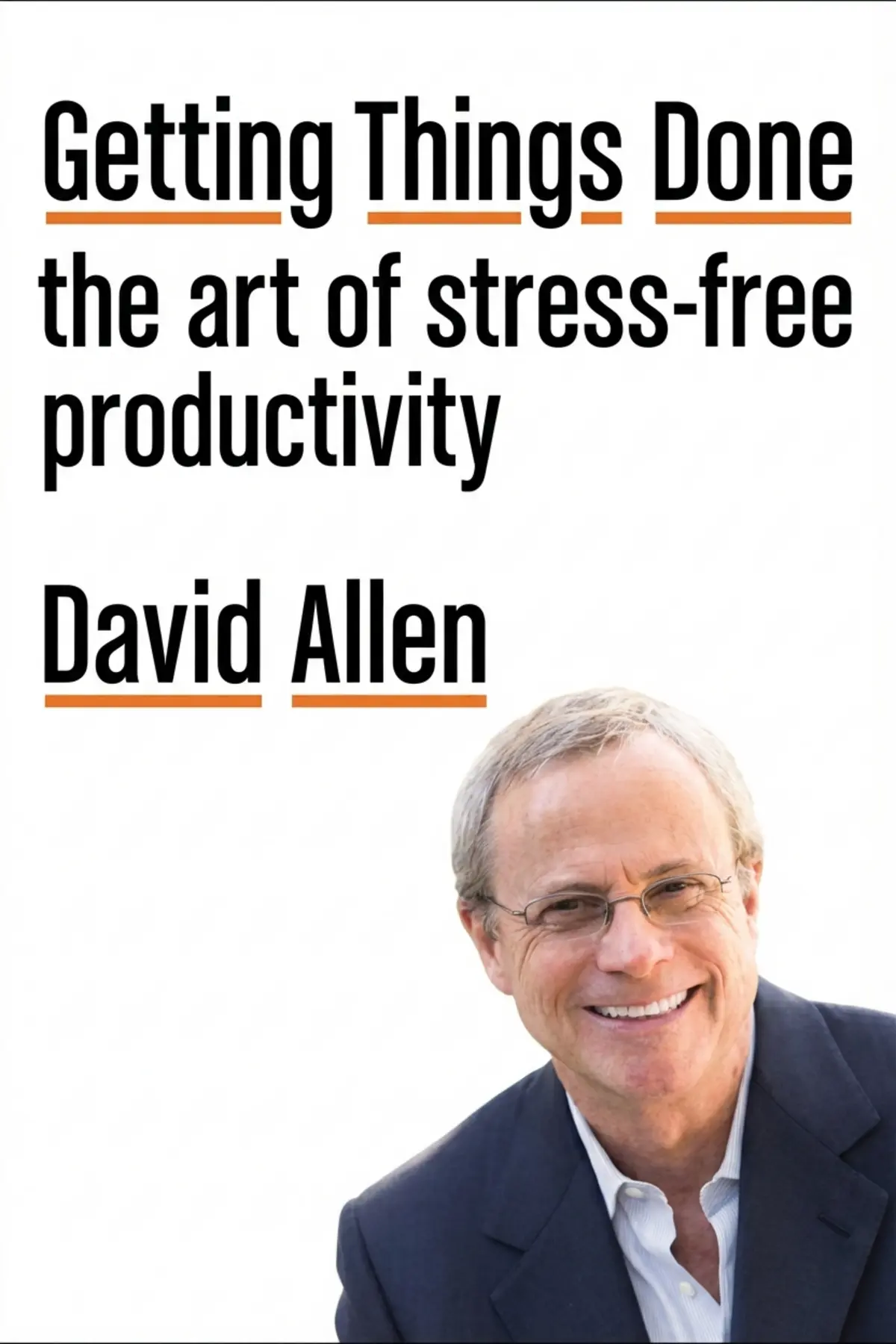
Making It All Work: Winning at the Game of Work and the Business of Life
By David Allen
A practical system for turning a scattered stream of tasks and ideas into concrete actions, organized lists and weekly reviews, all tied to projects, goals, a ten-year vision and personal values.
Table of Content
1. Introduction
59 sec
Plenty of busy days end with a full sent folder and nothing important moved forward. In Making It All Work, productivity consultant David Allen, who created the Getting Things Done method, says the fix has little to do with working harder. It takes two abilities he calls control and perspective. Control is managing the daily flood of obligations. Perspective is seeing the bigger picture they should serve.
His starting move is almost embarrassingly simple: write down every idea and task, so your memory stops doing a job it was never built for. From there Allen climbs one rung at a time, from the next phone call to projects, goals, a ten-year vision and personal values. Each level gives meaning to the one below it. What you get is a working system: a home for every commitment, a weekly habit that keeps it honest, and a clear way to tell whether today’s tasks lead anywhere you want to go.
2. Judge your day by the progress you made
1 min 23 sec
An inbox that pings all day can make you feel extremely productive. Allen argues that this feeling is often misleading, and he offers a different way to tell whether your work is actually going anywhere.
3. Pair big-picture thinking with daily control
1 min 34 sec
Some people overflow with ideas and finish nothing. Others keep everything tidy and invent nothing. Allen describes the lopsided types most of us fall into, and the surprising link between order and imagination.
4. Empty your head onto paper every day
1 min 22 sec
The forgotten item on a shopping trip and the lunchtime idea gone by evening look like harmless lapses. Allen treats them as warning signs, and his remedy starts with a cheap tool most people have stopped using.
5. Turn vague wishes into concrete next steps
1 min 28 sec
A note that says do something for Dad can sit on a list for months. Allen shows how to move it both downward and upward until it becomes impossible to ignore.
6. Sort every task by when, where and who
1 min 35 sec
Sticky notes, calendar alerts and paper scraps scattered everywhere are a system of a kind, just a bad one. Allen replaces them with a few simple lists, and a two-minute test for whatever interrupts you.
7. Keep your lists alive with a weekly review
1 min 21 sec
Every to-do list starts out clean and slowly turns into pages of guilt. Allen’s fix is a regular appointment with yourself, plus one drastic move most people would never consider.
8. Connect daily tasks to projects and goals
1 min 28 sec
A long day of small jobs can end with the uneasy sense that none of it mattered. Allen’s answer is a set of three layers that shows at once which tasks are earning their place.
9. A clear vision that settles hard decisions
1 min 55 sec
Should a company buy a rival or enter a new market? Should a person start a family? Allen argues that such questions become far easier once two things are written down.
10. Conclusion
1 min 06 sec
Allen’s book works like a single ladder. On the bottom rung sit small physical actions: the phone call, the cake order, the two-minute email. On the top rung sit a ten-year picture of your life and the values you refuse to trade away. Most people live at one end. The doers polish fonts and clear inboxes, while the dreamers sketch futures that never reach a calendar. Making It All Work asks you to climb in both directions until each errand points to a project, each project to a goal, and each goal to the person you are trying to become.
The first rungs cost almost nothing. Keep a paper journal within reach and let everything land in it. Turn your vaguest entry into one physical step with a time and a place, and do anything shorter than two minutes the moment it appears. Then protect a weekly review, because a list that is never pruned turns back into noise.
Go back to the forest path. The trail stays exactly as it was when you rise above it. The only change is that you stop guessing at the forks.
About this book
What is this book about?
Emails, messages and meetings fill the day, and at the end of it the work that matters has barely moved. David Allen, the productivity consultant behind Getting Things Done, says the problem is a missing balance between two abilities. Control is managing your obligations. Perspective is seeing the bigger picture those obligations should serve. Allen's method starts at ground level. You write down every idea and task on paper and turn each vague note into a specific physical action. Then you sort the actions into lists by when, where and who, and prune the lists in a weekly review. From there he works upward. Tasks are grouped into projects you can finish within a year, projects serve goals that take one to three years, and goals answer to a ten-year vision and a set of written values. He applies the same logic to companies, which need a clear vision and guiding principles to make hard decisions simple. You get a complete system for the desk and for life. Every commitment has a home, and you have a reliable way to check whether today's busy hours lead anywhere you chose to go.
Book Information
Who it's for
Professionals stuck in meetings
Professionals whose days fill with email and meetings while their important work stalls.
Side ambitions on hold
People with plenty of ideas and side ambitions who never seem to find time for them.
Leaders wanting clear direction
Managers and founders who want clear goals, a clear vision and clear principles for their teams.
About the Author
David Allen
David Allen is an American author and productivity consultant, born in 1945. He developed the Getting Things Done methodology, which he set out in his book of the same name, and Making It All Work builds on that system. His firm, the David Allen Company, runs seminars and coaching and produces educational materials. Its coaches have trained executives in his method.
Team: Getting Things Done with Others
David Allen
Ratings & Reviews
Ratings at a glance
What people think
Listeners find this guide beneficial for time management, offering actionable advice for maintaining organization. Furthermore, they value its productivity benefits, with one listener pointing out how the GTD system has enhanced their professional efficiency. The text also provides deep insights, with one listener emphasizing its connection to actual values, and listeners find it stimulating, with one noting its philosophical approach beyond simple mechanics. Listeners view the book as a good investment and appreciate the focus on one task at a time. However, one listener mentions it feels like a rehash of the author’s first book.
Top reviews
Grace
Picked this up during a period of total career burnout, and it was exactly the mental reset I needed. Allen moves past the basic mechanics of filing and list-making to address the underlying anxiety of modern work life. It works. The Control/Perspective model helped me realize that I was drowning in micro-tasks while ignoring my actual life goals. I finally feel like I can manage one task at a time without the nagging guilt of the 'everything else' pile. Some parts are definitely wordy, and the author loves his own terminology, but the productivity benefits are undeniable. My work efficiency has spiked because I'm no longer just 'busy'—I'm actually being productive. It’s a philosophical approach that manages to stay grounded in real-world application. Truly a life hack for anyone facing constant decision-overload.
Show moreAria
Wow, the level of clarity I gained after finishing this is hard to put into words. This isn't just a book about time management; it's a guide for total life management. I’ve been using the GTD system for years, yet this book still managed to provide a fresh perspective that improved my work efficiency almost overnight. The way it integrates real values into the daily grind is something most productivity books ignore. Allen’s advice on the 'next action' for every meeting has made my professional life so much smoother. It’s thought-provoking and surprisingly deep. It can be a bit of a dense read, but if you take it slow and actually apply the tips, the results are incredible. This is now my go-to productivity bible. I feel much more in control of my life.
Show moreMikael
Finally got around to reading this sequel and I actually prefer it over the original Getting Things Done. While the first book gave me the tools, this one gave me the blueprint for how to use them without burning out. It takes a much more philosophical approach than the mechanics-heavy original, which might bore some, but it resonated with me deeply. Seeing how the system integrates real values into daily time management changed my perspective. It isn't just about doing more; it is about doing the right things. The emphasis on staying organized at different 'horizons' is a game-changer for long-term planning. Definitely worth the price for anyone who felt the original GTD was a bit too cold or clinical. It’s an inspiring system that really makes it all work.
Show moreRin
After hearing so much buzz about the original GTD, I jumped into this follow-up expecting more of the same, but it actually goes much deeper into the 'why' behind the system. David Allen moves beyond simple mechanics to explore how the system interacts with our bigger-picture goals and personal principles. To be fair, some of the middle chapters get a bit bogged down in jargon, but the 'Horizons of Focus' section is a revelation for anyone feeling lost in their own to-do list. It’s less about the gadgets you use and more about the mental framework required to stay on top of a chaotic life. I found the practical tips for staying organized throughout the day to be immediately applicable. Even if you've mastered the basics, there's enough new perspective here to make it a worthwhile addition to your productivity shelf. It helped me reconnect with what I actually want to achieve.
Show moreMo
The chapter on the Horizons of Focus alone makes this worth the cover price if you've been struggling to connect your daily tasks to your life goals. While the first book was about clearing the decks, this one is about steering the ship. The presentation is much more streamlined this time around, focusing less on specific tools like folders or software and more on the overarching system. I particularly appreciated the deeper dive into how to handle a terrifying backlog of 'stuff' without losing your mind. It’s a bit wordy in places—Allen definitely likes to hear himself talk—but the core principles are rock solid. It has helped me bring a sense of order to my projects that I was missing before. Not a perfect book, but a very necessary one for the modern professional.
Show moreWorawit
As someone who has lived by the 'Next Action' rule for years, I found this to be a vital refresher for keeping the system from getting stale. This book introduces the concept of working ON the system rather than just IN the system, which was a major lightbulb moment for me. It addresses the decision-overload we all face and offers a way out through better perspective. While some critics say it’s a rehash, I think the nuances Allen adds here are crucial for long-term success. The writing style is typical Allen—lots of proprietary terms and repetitive phrases—but the content is undeniably worth it. It has helped me stay organized during a very chaotic transition at work. I appreciate the focus on one task at a time. It’s a solid four-star read for any GTD devotee.
Show moreWichai
Ever wonder why you can be totally organized but still feel like you're heading in the wrong direction? That is exactly what this book addresses. It’s less about the 'how' of productivity and more about the 'why.' I found the insights into dealing with the longer-term horizons to be particularly helpful for my career planning. The book provides practical tips for staying organized while also encouraging a more philosophical approach to your workload. It’s not a quick read, and you’ll likely want to take notes as you go. There is some redundancy if you’ve read his previous work, but the way he ties everything together into a unified model is very satisfying. It has definitely improved my work efficiency and given me a better sense of peace. Great for those who want to dig deeper.
Show moreChon
To be fair, this felt like a bit of a rehash of his previous work. I’m a huge fan of the original methodology, but this volume seems to repeat the basics for a hundred pages before getting to the fresh insights. It is essentially the 'Double-Stuf Oreo' of productivity books—it’s sweet and familiar, but maybe a bit more than you actually need. Look, the 2x2 matrix is explained in excruciating detail, which might be helpful if you’re a visual learner, but I found it a bit redundant. That said, I would still suggest picking it up just for the appendices. There is some serious value hidden in those last few pages that clarifies the 'tickler' system and longer-term planning better than the original did. It’s a decent refresher, but don't expect a total revolution if you already live by the GTD rules.
Show moreMoo
Frankly, I think you could skip the first 150 pages and just read the appendices at the library. The book has some great moments, particularly regarding the 2x2 matrix and the 'Control/Perspective' model, but it feels stretched thin. David Allen is a genius when it comes to organization, but he could have used a more aggressive editor for this sequel. It tends to be wordy and repetitive, often saying in ten pages what could have been said in two. To be fair, it’s a good follow-up if you need a refresher and want to hear more about the 'GTD way' from a philosophical angle. It just doesn't feel as essential as the first book. It’s a nice-to-have, not a must-have, unless you are a completionist. Some valuable insights are there, but you have to dig for them.
Show moreBae
Is it just me, or does David Allen seem to be overcomplicating his own simplicity here? I loved 'Getting Things Done,' but this sequel feels like a step backward into academic fluff. The tone is almost condescending, as if the author is telling me I just didn't understand the first two books well enough. He takes simple concepts and wraps them in layers of wordy explanations that make the system harder to implement, not easier. Honestly, it was a struggle to finish because of the repetitive catchphrases and redundant chapters. If you are looking for practical help, just stick to the first book and save your money. There are a few nuggets of wisdom in the back of the book, but they aren't worth the hours spent wading through the rest of the text. It lacks the punch of his earlier writing.
Show moreQuestions about this book
What is the main idea of Making It All Work by David Allen?
Allen argues that productivity needs two things: control, which means organizing and managing your obligations, and perspective, which means seeing the big picture they serve. His system captures every idea on paper and turns each one into concrete actions sorted into lists. Those lists are reviewed weekly, and every task is tied to projects, goals, a ten-year vision and personal values, so daily effort adds up to something you chose.
How is Making It All Work different from Getting Things Done?
It applies the Getting Things Done approach beyond the daily task list. It covers the habits of capturing everything, defining specific physical actions and reviewing your lists each week. It also works through the higher levels: areas of responsibility, projects you can finish within a year, goals that take one to three years, a ten-year vision and personal values. It also applies vision and guiding principles to organizations.
What is the two-minute rule in David Allen's method?
When a new task interrupts your work, estimate how long it will take. If it needs less than two minutes, such as a quick email, do it right away. If it needs longer, try to delegate it. Allen says these two rules go a long way toward keeping your inbox small and your attention on the important work.
How do I start applying Making It All Work?
Keep a paper journal close by and write down every idea, task and long-term wish without judging it. Then go through the notes, turn each actionable one into a specific physical step with a time and place, and sort the steps into lists for now, later and delegated. Set aside up to two hours each week to review the lists and cut anything stale.
Who should read Making It All Work?
It suits busy professionals who feel productive but see little progress on what matters. It also suits creative people with many ideas and little follow-through, and orderly people who manage details well but lose sight of the big picture. Managers and founders get a simple approach to company vision and guiding principles that makes hard decisions easier.
Readers also enjoyed




AUDIO SUMMARY AVAILABLE
Listen to Making It All Work in 15 minutes
Get the key ideas from Making It All Work by David Allen, plus 5,000+ more nonfiction titles.
- 5,000+ titles
- Listen as much as you want
- 7-day free trial
- Cancel anytime









