

A Return to Love: Reflections on the Principles of a Course in Miracles
Marianne Williamson
 English
Shows how to work with anger instead of swallowing it or exploding. Buddhist mindfulness practices trace anger back to the hurt underneath and turn it into self-care, clear boundaries and connection with others.
1 min 01 sec
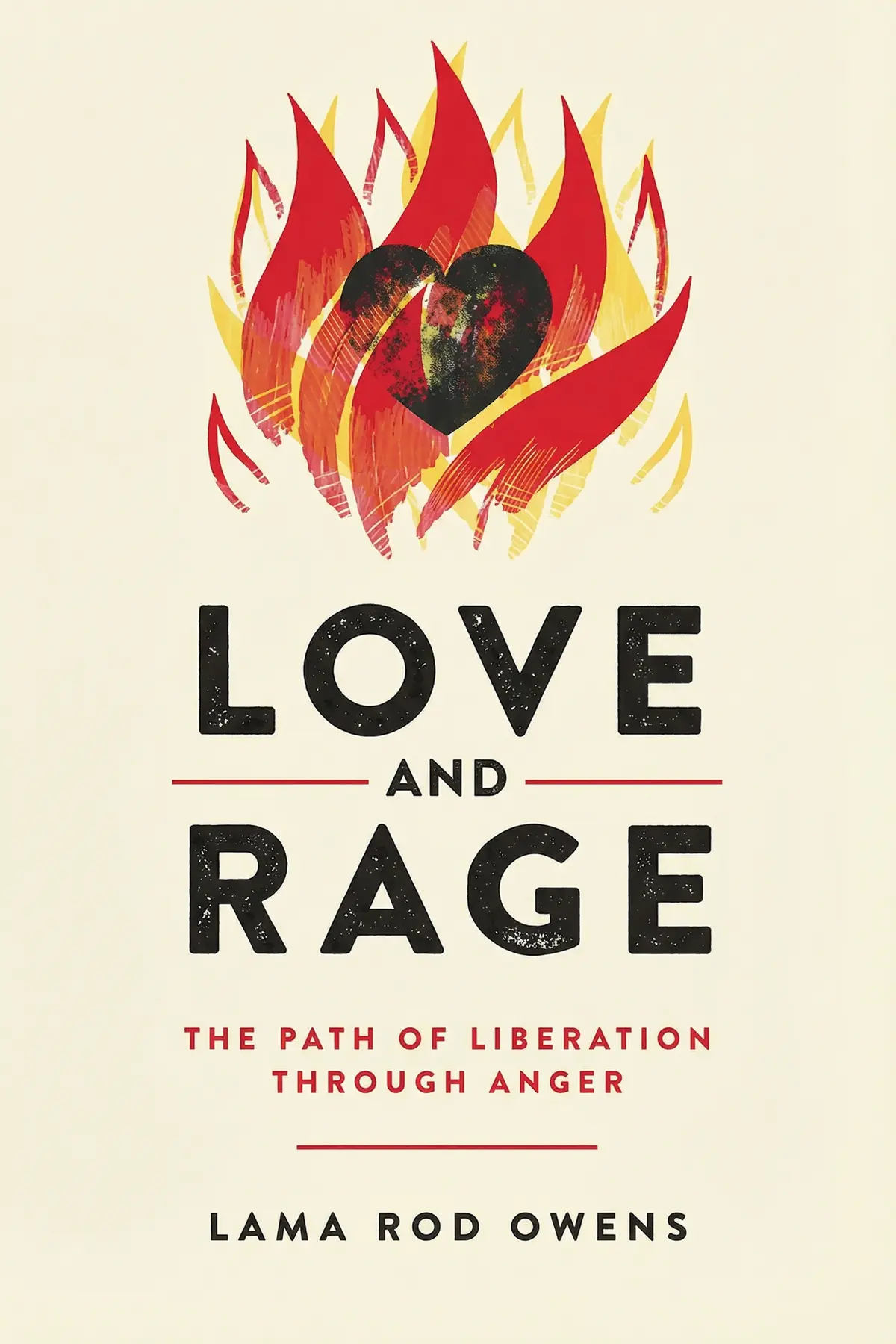
If your anger has been called too much, too loud or simply wrong, you have probably learned to either swallow it or let it explode. In Love and Rage, Lama Rod Owens, a Buddhist teacher in the Kagyu tradition of Tibetan Buddhism, offers a third option: treat anger as a sign pointing to a hurt that needs care.
For Owens, anger belongs to his identity as an activist, a gay man and an African American, and he will not treat it as something to suppress or conceal. His argument is that anger, met with awareness and love, stops being a wall around personal pain and becomes a source of healing and of solidarity with others.
To get there he offers a six-step practice for any hard emotion and simple ways to use ordinary moments of joy. He also offers a kind of self-care built on rest, compassion and silence, and a reason to stop fighting your anger and start listening to what it is trying to tell you.
2 min 11 sec
An argument ends, the other person leaves, and the anger is still there hours later. Owens reads that leftover heat as a clue about what anger is really doing for us, and what it keeps us from doing.
2 min 18 sec
Some people walk out of a tense room carrying feelings that were never theirs. Owens names what they are absorbing and offers a six-part method, including one step he calls especially vital for people facing oppression.
2 min 08 sec
A slowly warming room and a roaring fireplace give Owens a way to tell two good feelings apart. Then he asks for something much harder: celebrating the good fortune of people you envy.
2 min 16 sec
Taking time for yourself can feel selfish when others need you. Owens draws a hard line between indulgence and real self-care, and goes so far as to call the second a form of political warfare.
2 min 03 sec
Owens’s last practice sounds almost backward: love the very feeling you were told to fear. He admits it can break your heart repeatedly, and explains what you lose by avoiding it.
1 min 10 sec
Owens turns a familiar instruction upside down. Most of us were taught that a calm person is someone with little anger. In Love and Rage, the calm person is someone with enough inner space that anger can arrive, speak and leave without taking over. That space is built from honest attention to hurt, from noticing joy, and from rest, compassion and silence. What finally holds it together is love for the very feeling we were taught to fear.
For people whose anger has been dismissed, this is also a claim about dignity. Their anger carries information, and caring for themselves is how they keep going, both for their own sake and for the communities they belong to.
The practice can start small. When anger rises, find it in your body, name it exactly and admit it is yours. Ask what was hurt before you decide what to do. And when someone else’s good fortune stings, try wishing them more of it, and notice what happens to the sting.
In Owens’s hands, anger becomes a messenger you finally allow to finish speaking.
Anger usually gets one of two treatments: we push it down or we let it blow up. Both are especially common among people whose anger has long been dismissed or treated as dangerous. Lama Rod Owens, a Buddhist teacher and activist, argues for a third way. He describes anger as a tension that forms around emotional hurt, a shield that protects the wound and also keeps us from tending it. Owens draws on mindfulness practice to show how that shield can be lowered with care. He offers a six-step method for working with any difficult feeling, everyday practices built on noticing happiness and sharing in other people's joy, and a demanding version of self-care made of rest, compassion and silence, which he treats as a form of resistance inside oppressive systems. The book's last step is the boldest: learning to love your anger, so that it can show you where you are hurt, where you need boundaries and how your pain links you to others. Readers get concrete practices for the moment anger rises, and a way to see the emotion as information.
People whose anger has been dismissed or feared and who want a way to work with it.
Activists, caregivers and leaders close to burnout who need a self-care practice that sustains them.
Meditators and curious beginners looking for Buddhist tools for handling difficult emotions.
Lama Rod Owens is a Buddhist minister, writer, activist and yoga instructor, authorized to teach as a lama in the Kagyu tradition of Tibetan Buddhism. He holds a Master of Divinity in Buddhist Studies from Harvard Divinity School. He co-founded Bhumisparsha, a community for tantric Buddhist practice and study, and co-authored Radical Dharma: Talking Race, Love and Liberation. His writing has appeared in Buddhadharma, Lion's Roar, Tricycle and The Harvard Divinity Bulletin, and he leads talks, retreats and workshops in more than seven countries.

Listeners find the book’s meditation exercises beneficial, with one listener remarking on their usefulness for group sessions. Additionally, the work earns acclaim for its sincerity, as one listener portrays it as painfully honest. Listeners also consider the writing style quite immersive, with one calling it critical reading for our times.
Finally got around to finishing this, and I can say it is absolutely critical reading for our current political climate. Owens doesn't sugarcoat the experience of being a Black queer man in America, and his painful honesty about his own rage is what makes the book so resonant. He bridges the gap between ancient Buddhist philosophy and modern social justice activism without losing the core of the dharma. While some might find his language a bit informal, I found the vulnerability refreshing and necessary for true healing. The meditation practices are solid, though I found they worked best when I shared them with my weekly study group. We really need this kind of warrior spirit right now. It is a raw, unvarnished look at how we can actually use our anger instead of just letting it consume us from the inside out.
Show moreWow. This is the first spiritual book I’ve read that actually felt like it was written for the real world we live in today. Owens has this incredible way of stripping away the high and holy facade that so many teachers hide behind. He stays in the muck with us, admitting to his own trauma and his own rage, which makes his advice on compassion feel ten times more authentic. Some of the meditation exercises are quite intense, but they are incredibly helpful for processing the heavy emotions that come with social justice work. Frankly, it’s the kind of book you want to buy for everyone in your activist circle so you can discuss it together. It’s painful, honest, and absolutely vital for those looking for genuine transformation.
Show morePicked this up after seeing it all over my social media feed, and for once, the hype is actually justified. Most books on mindfulness tell you to just breathe through your anger, which often feels like a way to suppress legitimate grievances. Owens does the opposite by inviting the rage in, honoring it, and then showing you how to sit with it without being destroyed by it. His writing is sharp and modern, dispensing with the flowery language often found in the genre in favor of something much more direct and gritty. As someone who practices secular meditation, I appreciated that he kept the focus on the psychological and social impact of the work. This is a powerful tool for anyone feeling burnt out by the state of the world.
Show moreLama Rod Owens doesn't just teach the dharma; he lives it in a way that feels incredibly accessible to those of us outside the monastery. This book feels like a conversation with a wise, slightly foul-mouthed friend who isn't afraid to tell you the truth about how hard this path is. I found the meditation practices especially useful for my own personal practice, as they provide a way to hold both love and fury simultaneously. It’s a rare thing to find a spiritual teacher who is so open about their own PTSD and shit, and that vulnerability is exactly what makes the book so effective. It’s a masterclass in how to be a human being in an oppressive system without losing your soul or your mind.
Show moreAfter hearing so much about this book in my meditation group, I finally dove in and I’m so glad I did. It is a work of radical authenticity that challenges the spiritual bypassing so common in Western Buddhist circles. Owens’ analysis of how we internalize oppression and how that manifests as disembodiment was particularly revelatory for me. The book serves as a perfect guide for group sessions because it sparks such deep, necessary conversations about race, gender, and power. To be fair, it’s a challenging read that asks a lot of the reader, but the payoff is a much deeper understanding of one's own heart. This is truly critical reading for our times, especially for those looking to integrate their spiritual lives with their social values.
Show moreAs someone who has wrestled with how to be spiritual while also being rightfully angry about systemic injustice, this book was a massive relief. Owens acknowledges how the anger of marginalized people is constantly policed, which is a perspective often missing in mainstream mindfulness circles. The sections on reclaiming the body as a way to fight internalized oppression were particularly moving and gave me a lot to think about. I did wish the specific practice instructions at the end of the chapters were a bit more robust, as they sometimes felt like an afterthought. However, his transparency about his own failures and struggles makes the wisdom feel earned rather than preached. It’s an essential text for anyone trying to navigate the intersection of activism and internal peace.
Show moreNot what I expected when I picked up a book by a Lama, but in a really good way. I originally thought this would be a dry, academic treatise on Tibetan Buddhism, but it turned out to be a deeply personal manual for survival. Owens communicates complex ideas about transhistorical trauma and spaciousness in a way that is deceptively simple and easy to digest. I did find myself skipping some of the more technical meditation bits at first, but once I went back and actually tried them, I realized how much they ground the theory. My only real complaint is that some of the redefining of joy felt a bit confusing compared to traditional teachings. Still, the overall message of using rage as a fuel for love is something I will be thinking about for a long time.
Show moreIs it possible to stay embodied when the world feels like it’s falling apart? Owens argues that we have to, or we lose our agency and our ability to effect change. I loved his take on self-care—not as an indulgence, but as a necessary strategy for community survival. The chapter on boundary setting was a huge lightbulb moment for me because it linked my ability to say no directly to my sense of self-worth. I’ll admit, the tone gets a bit heavy at times, and the level of painful honesty can be a lot to process in one sitting. You have to take this one slow. It isn't a light read, but it is a rewarding one if you’re willing to do the internal work.
Show moreI wanted to love this because the premise of combining Buddhist practice with radical activism is so timely and important. Truth is, I struggled with the inconsistency of the Practice sections which were often just a few sentences long. I was looking for a more structured self-help approach and instead got a lot of personal stories that, while interesting, didn't always feel like they provided a clear path forward. Some of the talk about unseen beings or spirits was a bit too much woo-woo for my secular mindset to fully get behind. That said, the analysis of how Black people are expected to perform emotional labor for society was brilliant and eye-opening. It’s a valuable book, but maybe not the best fit if you’re looking for a traditional meditation manual.
Show moreThe chapter on happiness felt like a complete stretch where the author was just trying to redefine well-established terms to sound edgy or different. To be fair, I went in wanting a spiritual guide, but I was constantly pulled out of the moment by the frequent use of vulgar language and obscure mystical jargon. It felt like if you aren't already deeply embedded in a specific Buddhist lineage, half the concepts would fly right over your head. Additionally, the writing style felt disjointed, jumping between personal anecdotes and instructions that were too brief to actually follow. I appreciate the attempt to discuss social justice through a spiritual lens, but the execution felt messy and unnecessarily aggressive. I just couldn't connect with the tone he was going for here.
Show moreOwens argues that anger is a mental and physical tension that forms around emotional hurt and acts as a protective layer over it. Suppressing it or exploding with it leaves the hurt untouched. Met with awareness, compassion and finally love, anger can reveal where we are wounded, where we need boundaries and how our pain connects us to others, turning it into a source of healing and solidarity.
SNOELL is Owens’s mindfulness method for difficult emotions. Its six steps are seeing the emotion through its physical sensations, naming it precisely, owning it as real and yours, experiencing it without reacting, letting go of attachments that no longer help, and letting it float, which means staying non-reactive as feelings keep coming and going. He stresses that letting go comes only after the feeling is acknowledged.
Owens separates self-care from self-indulgence, which he sees as isolating and focused on your own needs at others’ expense. True self-care, in his view, is survival and resistance inside oppressive systems, even a form of political warfare. He builds it on three practices: rest as deep release rather than mere sleep, compassion that starts with yourself and extends outward, and silence for deep listening and reflection.
Start by noticing where the anger sits in your body, then give it an exact name and accept it as yours. Ask what was hurt before deciding how to respond. Owens also suggests noticing moments of joy and wishing them for others, sharing in other people’s happiness to counter envy, and treating anger as a teacher that shows you which boundary you need.
Marianne Williamson

Deepak Chopra

Pico Iyer


Alcoholics Anonymous World Services

Fay Bound Alberti


Virginia Woolf

Tracy Rosenthal

Jessica Valenti
AUDIO SUMMARY AVAILABLE
Get the key ideas from Love and Rage by Lama Rod Owens, plus 5,000+ more nonfiction titles.









