
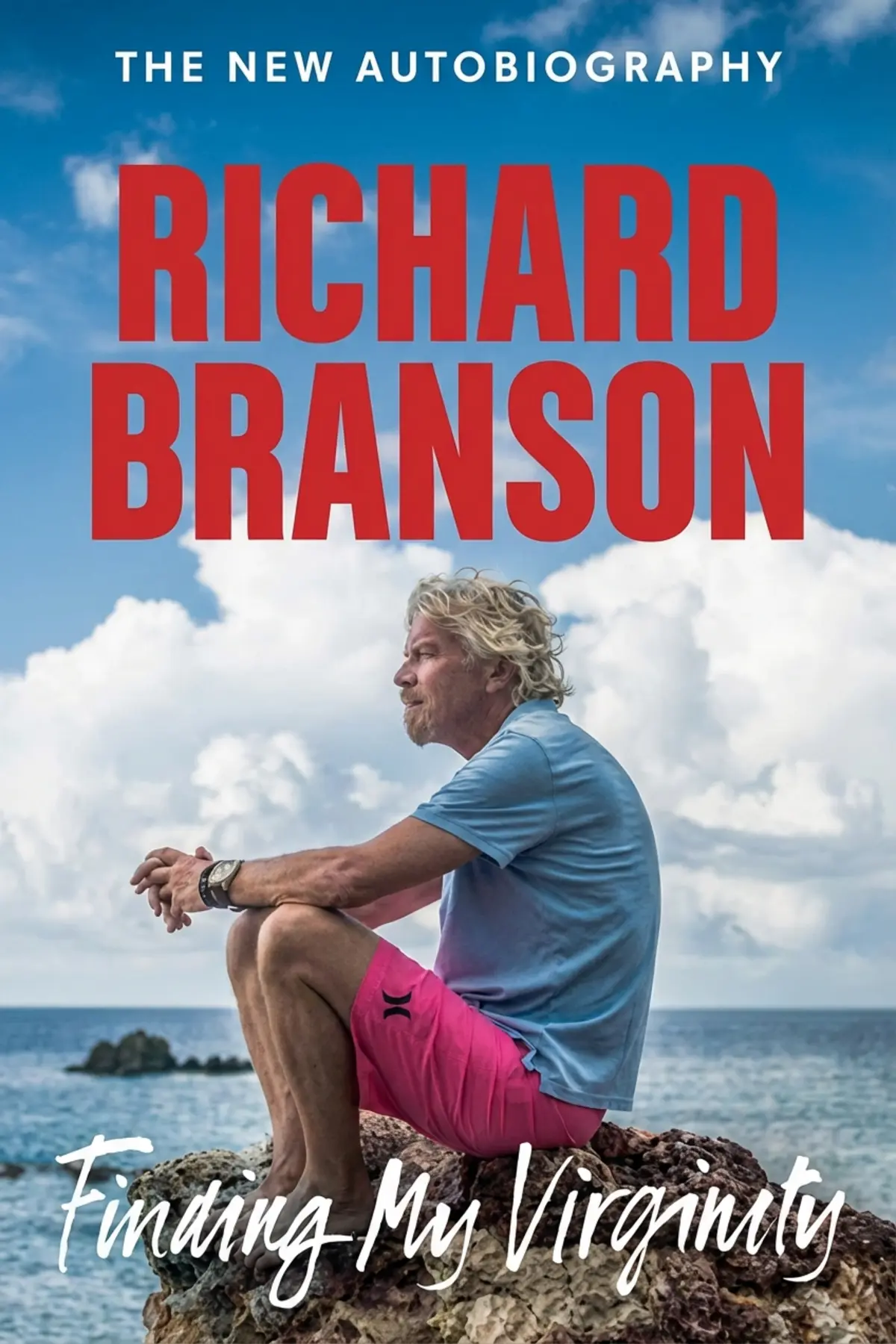
Finding My Virginity: The New Autobiography
Richard Branson
 English
 ไทย
Richard Branson's memoir shows how a dyslexic schoolboy with a taste for adventure built record shops, a label and an airline by treating crises as openings and leasing just one plane first.
48 sec
Most people with a business idea wait for money, permission and a plan. Richard Branson, in Losing My Virginity, describes doing it the opposite way: as a schoolboy he sold advertising in a magazine that did not exist yet, and later talked a shoe shop owner into handing over an empty floor rent free. From there came record shops, a record label, an airline, a private island and world records at sea and in the air.
The thread running through every story is that Branson treated each obstacle as a dare, then looked for the cheap, clever move that turned it into his next venture. Follow that thread, and a strike, a sinking boat and an exploding engine start to look like openings, with a few habits you can borrow for your own work.
1 min 19 sec
A four-year-old loses a bet on the last day of a beach holiday, then finds an unexpected second chance on the drive home. What his family did next explains a lifetime of risky choices.
1 min 28 sec
No advertiser wanted to pay for a magazine that had never been printed. One sentence about a rival bank changed that, and the same instinct later produced a business funded by its own customers.
1 min 20 sec
A national strike cut off the one channel the young company depended on. The fix created a hit, and then a crowd problem that no amount of popularity could solve.
1 min 40 sec
A 21-year-old with modest profits wanted a manor worth far more than he earned. How he paid for it, and what he built inside, changed the economics of every record he sold.
1 min 44 sec
A punk band signed to get itself fired, a court case about one rude word and a year of heavy losses. Survival came from places no one in the company expected.
1 min 50 sec
An offer so low it got a couple thrown out of their villa ended in a deal. The same thinking about limits later saved an airline from its first disaster.
1 min 43 sec
A boat sinks sixty miles from the finish. A balloon loses half its fuel on day one, then catches fire. Each time, the way out was something nobody had planned.
1 min 45 sec
A phone call from a queen sent a stripped jumbo jet toward a war zone. A campaign of hidden attacks from a bigger rival taught a different lesson about how fights are won.
52 sec
What the stories add up to is a way of reading trouble. Many of Branson’s ventures began with something going wrong, a postal strike, a canceled flight, a seller in a hurry, and with his refusal to treat that as the end. The boy who sank in a river on the drive home from Devon and kicked his way up is the same man who took a burning balloon to 40,000 feet.
The book also shows that his boldness was rarely blind. He capped the airline’s risk at one plane for one year, found out what the island’s owner needed before raising his bid, and beat British Airways only once he held proof.
So when something blocks you this week, ask what new opening it creates. Before any bet, name the most you can lose. Then make the offer that feels too bold, the way £150,000 opened the talks that won a £3 million island.
Richard Branson did badly at school and had no capital, yet he built record shops, a hit record label, an airline and a run of world records. In this memoir he tells how it happened, starting with a childhood in which his family pushed him to test his limits, from a river swim at four to a fifty-mile bike ride at eleven. The stories show a pattern. A postal strike becomes the first Virgin store. A rent-free floor on Oxford Street, a bank mortgage and an aunt's loan lead to a manor studio where Tubular Bells was recorded. A canceled flight sparks an airline idea, later tested with one leased plane for one year. Along the way come a court case over a Sex Pistols album, a £3 million island bought for £180,000, a sinking boat, a burning balloon, a rescue flight to Baghdad and a dirty tricks battle with British Airways. Readers get a lively account of how nerve, charm and a few firm limits on risk can turn setbacks into businesses, and habits they can try on their own obstacles.
Founders and would-be founders short on capital who want real stories of selling before the product exists.
Young professionals who freeze before risks and want to see how a bold bet can be sized.
Readers who enjoy business memoirs packed with adventure, from record shops to balloon flights.
Richard Branson was born on July 18, 1950, in Blackheath, South London. At sixteen he launched his first venture, a magazine called Student. He began selling records by mail order in 1970 and opened the Virgin Records shops, later Virgin Megastores, in 1972. In the 1980s he launched Virgin Atlantic and grew the Virgin Records label, then founded Virgin Rail Group in 1997 and the space tourism company Virgin Galactic in 2004. He was knighted in 2000 for his work as an entrepreneur, and in 2007 Time magazine named him one of the world's most influential people.
Richard Branson
Richard Branson

Listeners consider this life story essential reading for business owners, packed with intriguing anecdotes and excellent professional wisdom. Its captivating storytelling pulls people in, with one listener highlighting how especially motivating it is for those in leadership roles. Although the initial momentum is strong, some listeners feel the tempo drags as the book reaches its conclusion.
Richard Branson is the ultimate maverick, and this memoir captures that energy perfectly. From the early days of Student magazine to the high-stakes battles with British Airways, the narrative never stops moving. I was particularly struck by his 'screw it, let's do it' philosophy—it’s the kind of reckless optimism that makes you want to quit your job and start something today. While he doesn't give you a spreadsheet-level breakdown of his finances, he provides something better: a blueprint for a mindset. His ability to delegate and trust his team stands out as a core lesson for any leader. The ballooning adventures were a bit long, sure, but they show the man’s tolerance for risk. This is less a textbook and more an invitation to live a bigger, bolder life.
Show moreWow, what a wild ride through the history of one of the world's most recognizable brands. Branson is a master of the calculated bluff, and reading about how he played Boeing against Airbus to launch Virgin Atlantic was a masterclass in negotiation. He doesn't just play the game; he changes the rules entirely. The book is electric, pulsing with the kind of energy that reminds you why we get into business in the first place—to have fun and shake things up. It’s incredibly inspiring to see a dropout take on the global elite and win. Personally, I didn't mind the travel stories at all; they illustrate his philosophy that life and work shouldn't be separate boxes. Screw it, let's do it!
Show moreEver wonder how someone has the guts to start an airline just because their flight was cancelled? This book answers that and then some. Branson's life is a testament to the power of intuition over analysis. While the MBAs of the world are busy running models, he’s out there following his gut and making things happen. The story is fast-paced, funny, and deeply human. I was especially moved by the descriptions of his family life; his parents clearly played a huge role in shaping his fearless nature. It’s rare to find a business book that feels this authentic and unpolished. If you need a jolt of courage to finally take that big risk you've been contemplating, read this immediately.
Show morePicked this up because I wanted to understand the man behind the smile, and I wasn't disappointed by the personality on display. Branson’s voice is cheeky and sensationalist, exactly as you’d expect. What I found most valuable were the sections on branding and PR; he basically invented the idea of the 'founder as the brand.' The way he leveraged his own stunts to get free publicity for Virgin is genius, even if it feels a bit dated in the era of social media. The pacing starts strong but definitely slows down toward the end as he gets into his later humanitarian work. Still, the early chapters about Necker Island and the struggle to keep Virgin Records afloat are worth the price of admission alone. It’s a classic for a reason.
Show moreAs a struggling entrepreneur myself, seeing how Branson turned his dyslexia into a competitive advantage was incredibly eye-opening. He explains how his inability to process complex data forced him to simplify everything, leading to the famous one-page memo policy. It’s a great reminder that our perceived weaknesses can be our greatest strengths if we pivot correctly. The book is filled with heart-pounding moments where the whole company was one bank call away from collapse. To be fair, he makes it look easy, which might be a bit misleading for newcomers. The prose can be a bit disjointed, likely due to a ghostwriter, but the core message of grit and innovation shines through clearly. Definitely a must-read for anyone feeling stuck in the corporate grind.
Show moreFinally got around to reading this classic, and it’s easy to see why it’s recommended so often in startup circles. The core of Branson's success seems to be his 'people first' philosophy. He treats his employees like family, and in return, they’ve helped him build an empire of over 400 companies. The book provides a great look at the transition from a small record shop to a global conglomerate, though it does gloss over some of the more technical aspects of corporate management. I appreciated the honesty regarding his early legal troubles and the tax evasion scandal—it adds a layer of human fallibility that many CEO memoirs lack. It’s an engaging, motivational story that occasionally gets bogged down in the details of his trans-oceanic flights.
Show moreTo understand the Virgin Group, you have to understand Richard Branson’s fundamental need to disrupt stale industries. This memoir does a fantastic job of illustrating that 'challenger brand' mentality. Whether he was taking on the lottery system or the airline industry, his goal was always the same: make it better for the customer and have a blast doing it. The writing style is very conversational, which makes for an easy read, though it can feel a bit repetitive at times. Look, he isn't going to teach you how to read a balance sheet, but he will teach you how to spot an opportunity. It’s an essential addition to any entrepreneur's library, even if you have to wade through a few too many ballooning stories to get to the gems.
Show moreIf you’re looking for a step-by-step guide on how to build a global empire, you might want to look elsewhere. The truth is, this book is more of a high-octane travel diary than a business manual. Branson spends a massive amount of time detailing his near-death experiences in hot air balloons and boats, which, while thrilling, often felt like a distraction from the entrepreneurial insights I was actually seeking. I wanted more about the strategic 'how' and less about the 'where I crashed.' That said, his battle against British Airways and the 'dirty tricks' campaign was absolutely fascinating. It highlights the brutal reality of taking on a monopoly. It’s an engaging read for sure, but the lack of analytical depth makes it feel a bit light.
Show moreThe first half of this book is a 5-star masterclass in audacity, but the momentum definitely stalls in the final third. Branson’s early hustle—launching Student magazine out of a basement and navigating the chaotic music industry—is pure gold. However, as the book progresses, it becomes less about the business and more about his personal hobbies. I found myself skimming the later chapters about his environmental efforts and global diplomacy. While those things are important, they don’t have the same narrative weight as his David-vs-Goliath battle with British Airways. In my experience, the best part of these memoirs is the 'struggle' phase, and once he becomes a billionaire, the tension evaporates. A solid read, but it didn't keep me hooked until the very last page.
Show moreNot what I expected from a business autobiography, to be quite frank. I was hoping for deep strategic insights into the Virgin Group’s diversified model, but instead, I got page after page of ballooning logs and personal anecdotes that felt more like bragging than teaching. The last hundred pages or so were particularly rambling and hard to get through. It’s clearly a memoir written for the author's own enjoyment rather than for a student of business. Where are the failures? Where are the post-mortems on the companies that didn't make it? He brushes past the 'why' of his decisions and focuses entirely on the 'what.' It’s a fun enough story if you like adventure books, but as a resource for professional development, it falls quite short.
Show moreIt is Branson’s memoir of building Virgin, from a school magazine called Student to record shops, a record label and an airline, alongside record-breaking boat and balloon trips. Running through every episode is one habit: he treated obstacles as dares and looked for a bold, low-cost way past them, so a postal strike became his first store and a canceled flight sparked the idea for an airline.
Branson began with Student, selling ads before the first issue existed by telling one bank its rival had already bought space. He then sold discounted records by mail, choosing the name Virgin because the team were beginners at business. Customers paid in advance, which funded the stock. When a postal strike hit in January 1971, he opened a shop above a shoe store on Oxford Street, rent free.
The island was offered at £3 million. Branson bid £150,000, which got him and Joan thrown out of the agent’s villa. Back in London he discovered the owner, a British lord, needed £200,000 quickly for another building. Knowing that deadline, Branson raised his offer to £175,000, and the two sides agreed on £180,000, a small part of the asking price.
Several stand out from Branson’s stories. Look for who will pay before the product exists, as advertisers and mail order customers did. Cap the downside of any big bet, the way he leased a single plane for a single year before starting an airline. And when a stronger rival plays dirty, gather proof first: a hard drive of executive messages forced British Airways to settle and apologize.
Founders short on capital, young professionals who hesitate before risks and anyone who enjoys a business memoir full of adventure will find it useful. The stories range from the record trade and a punk band’s court case to an airline, a rescue flight to Baghdad and a burning hot-air balloon over the Pacific.


Ishmael Beah

James Herriot


Barack Obama


Masaji Ishikawa

Ben Macintyre


James Shapiro
AUDIO SUMMARY AVAILABLE
Get the key ideas from Losing My Virginity by Richard Branson, plus 5,000+ more nonfiction titles.









