

14 min 10 sec
Available in: English
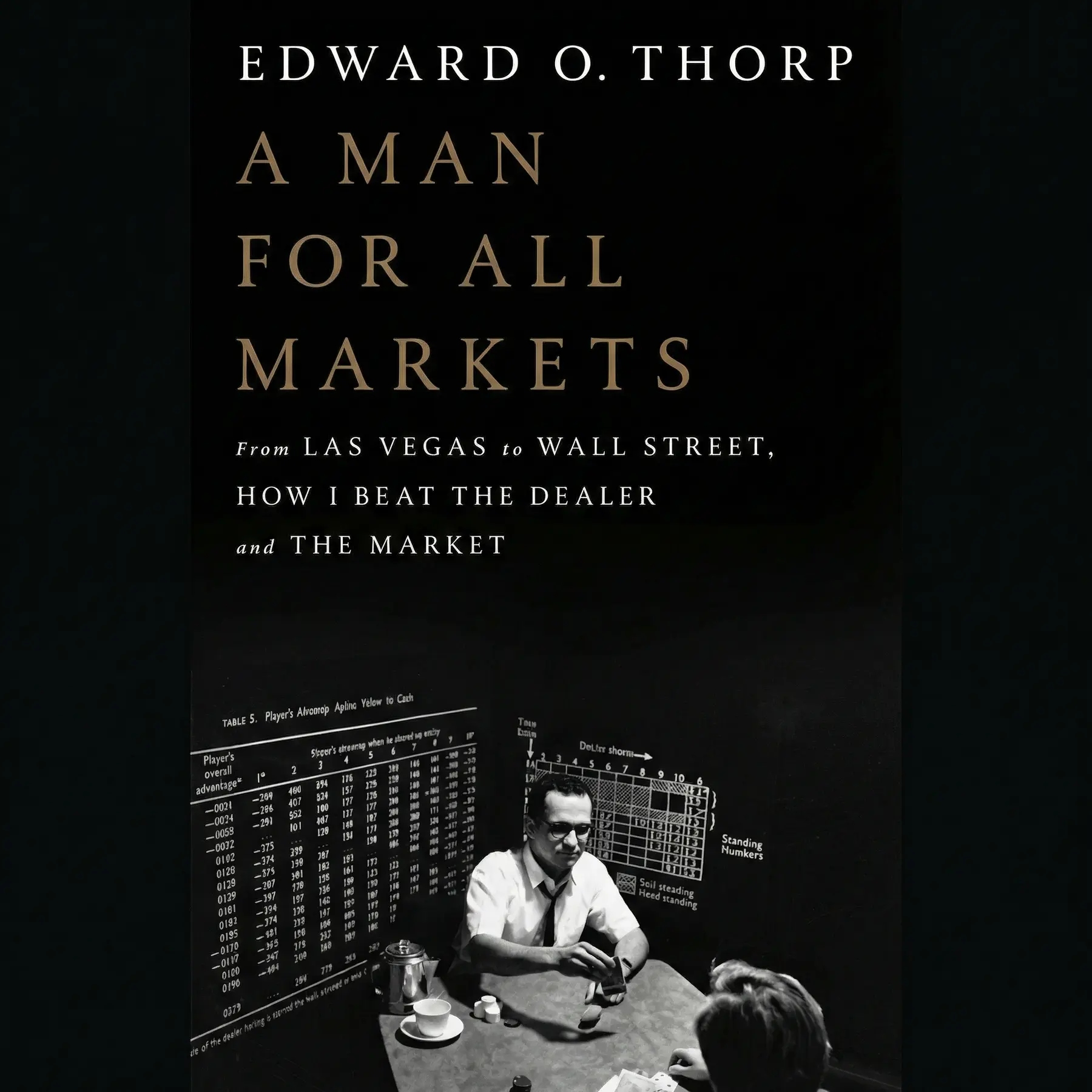
A Man for All Markets: From Las Vegas to Wall Street, How I Beat the Dealer and the Market
How a mathematician from a poor family beat blackjack and then the stock market by testing ideas, measuring his edge and sizing every bet so that one loss could never wipe him out.

Table of Content
1. Introduction
58 sec
Most people treat the odds as fixed, whether at a card table or in a retirement account, so they leave their results to luck or to experts. In A Man for All Markets, mathematician Edward O. Thorp tells how he rejected that assumption, first proving that blackjack could be beaten and then running a hedge fund that beat the market with far less risk. His first lesson is simple: a system that looks closed often has a weak point, and you find it by testing, not guessing.
Thorp grew up poor during the Great Depression, with no connections and a habit of checking everything. One method took him from a Reno casino to Wall Street. He measured his edge, limited the downside, sized each bet so he could never be wiped out, and let small advantages compound. Follow his path and you get a way of thinking about risk that works for a card game, a stock portfolio and the question of how much money is enough.
2. Test what you are told before believing it
1 min 29 sec
A five-year-old fell asleep partway through counting to a million and calmly picked up the next morning. That stubborn experiment holds the habit that later beat casinos and Wall Street.
3. Spot the moment when the odds turn your way
1 min 44 sec
Casinos were certain blackjack could not be beaten. A mathematician noticed one feature that set it apart from roulette and craps, and the dealers did not see what was happening until he was winning.
4. Profit from price gaps without guessing the market
1 min 47 sec
Most investors think making money means calling where prices go next. Thorp found trades that could pay off whether the market rose or fell, and the idea came straight from the blackjack table.
5. A fund that won by refusing to predict
1 min 33 sec
Through the 1970s, one of the best-performing funds was almost unknown to the financial press. Then a problem with no connection to its trades forced its founder to make a hard choice.
6. Stay in the game long enough to win
1 min 40 sec
Thorp made a small fortune while others panicked, yet the lesson he drew had little to do with bold bets. He came to believe most investors fail for a reason that has nothing to do with information.
7. Size every bet so you never go broke
1 min 47 sec
Bet too little and you fall behind; bet too much and one bad run ends everything. Thorp used a formula from an unlikely field to find the middle, then gave ordinary savers far simpler advice.
8. Choose freedom over a bigger fund
1 min 50 sec
After decades of beating the odds, Thorp gave up managing other people’s money. What he valued more than a billion-dollar fund, and how he chose to give, says a lot about what success meant to him.
9. Conclusion
1 min 22 sec
Thorp’s life plays like one experiment repeated in bigger and bigger rooms. A five-year-old checks whether a million can really be counted. A young mathematician checks whether a casino’s favorite game has a flaw. A fund manager checks whether two linked securities are priced honestly. Each time the question is the same: what can be proven, and how much should I risk on it?
That is what the book adds up to. Thorp had no family money and no inside connections. He had patience, logic and the nerve to act on what the numbers showed, even when dealers, experts and markets said otherwise.
You can borrow the method without a math degree. Before trusting a claim about money or your career, run a small test of your own. Size every commitment so that being wrong costs you a setback, never the whole bankroll. For long-term savings, take the edge most people can actually get: broad index funds, low fees and no attempts to time the market. And put a number on how much is enough, so the next promise of easy returns has something to measure against.
The odds are rarely as fixed as they look. They shift for the people willing to count.
About this book
What is this book about?
Most people treat the odds as fixed. The casino always wins, and markets reward luck or insiders. Edward O. Thorp refused to accept either idea. He was a mathematician who grew up in the Great Depression with no money and no connections, and he approached casino games and the stock market as systems open to testing, measurement and defeat. His memoir follows that method from a childhood attempt to count to a million, to a Reno blackjack table in 1961, to a math-driven hedge fund that outperformed the market while taking far less risk. Along the way he proves card counting works by simulating millions of hands, builds an early wearable computer with Claude Shannon, profits from mispriced securities without predicting prices, and walks away from his own fund. Readers come away with Thorp's habits rather than his formulas: check claims for yourself, look for a real and measurable edge, never risk more than you can survive losing, choose low-cost index funds over stock pickers, and decide how much money is enough.
Book Information
Who it's for
Investors wanting more discipline
Investors tired of hot tips who want a disciplined, numbers-first way to judge risk.
Founders and professionals
Professionals and founders who make bets with money, time or people and want to size them sensibly.
Love true math stories
Readers drawn to true stories of math beating casinos and Wall Street.
About the Author
Edward O. Thorp
Edward O. Thorp, born in 1932, earned his PhD in mathematics at UCLA in 1958, worked at MIT from 1959 to 1961, and taught at New Mexico State University and then the University of California, Irvine, where he taught mathematics and finance until 1982. His 1962 book Beat the Dealer was the first to prove mathematically that card counting could beat blackjack, and Beat the Market followed in 1967. He worked with Claude Shannon on the first wearable computer and launched the hedge fund Princeton/Newport Partners.
Ratings & Reviews
Ratings at a glance
What people think
Listeners find this book to be a compelling read that offers useful wisdom for investors, with one person highlighting it as the most entertaining book produced by a mathematician. This memoir tracks Thorp’s journey from youth to the present, and listeners admire his exceptional character and genius. The writing is expertly crafted, and listeners value the profound intellectual content, with one listener characterizing the work as a textbook in how to think and invest.
Top reviews
Sarocha
This book is effectively a masterclass in applying scientific rigor to the chaotic worlds of gambling and finance. Thorp takes us from his humble childhood beginnings to the heights of Wall Street with a precision that only a mathematician could manage. I found the sections on the Kelly Criterion and his collaboration with Claude Shannon particularly illuminating, as they show how a systematic edge can overcome pure luck. Frankly, it’s refreshing to read a finance memoir that prioritizes logic over gut feeling or insider tips. While some might find his tone a bit dry, the sheer intellectual weight of his life story makes it an essential read for anyone interested in quantitative approaches. It isn't just a biography; it’s a blueprint for how to think about risk and survival in any market.
Show moreCholada
As someone who usually finds financial memoirs incredibly dull, I was surprised by how much this one hooked me from the very first page. Thorp isn't just an investor; he's a polymath who views every challenge as a puzzle to be solved through experimentation and modeling. The way he describes his childhood and his path to becoming a professor provides great context for his later successes in the market. It’s basically a textbook on how to think about identify an edge and, more importantly, how to survive once you find it. Not gonna lie, I wish there was more about his specific algorithms, but I understand the need to keep it readable for a general audience. This is easily one of the most fascinating life stories I've encountered in years.
Show moreJoseph
The chapter on the Madoff discovery alone makes this entire book worth the price of admission. It reveals so much about Thorp's character—he wasn't just looking for profit; he was looking for the truth in a system full of noise and deception. His life is like a highlight reel of 20th-century quantitative finance, from early days at Berkshire to being a first-wave LP for Citadel. He writes with a straightforward, almost clinical clarity that makes complex derivative strategies understandable for the layperson. Some critics call him a braggart, but when you’ve actually done the things he’s done, I think a little pride is justified. It’s a remarkable journey of a self-taught man who decided to think for himself rather than follow the herd.
Show moreTun
Few memoirs manage to bridge the gap between academic theory and practical application as effectively as Thorp does here. He treats the stock market like a giant laboratory, testing theories on warrants and options long before the Black-Scholes model became the industry standard. This book is a fascinating exploration of how being self-taught can lead to a massive edge, provided you have the discipline to follow the math where it leads. I especially liked his focus on the Kelly Criterion—it’s a concept many people talk about but few truly understand in practice. The writing is clear, the anecdotes are memorable, and the lessons on emotional control are essential for any serious investor. A definitive 5-star account of a pioneer’s life.
Show moreSirichai
Wow, what a wild ride through the history of gambling and high finance! Thorp comes across as the Forrest Gump of the quantitative world, appearing at every major turning point and meeting everyone from Claude Shannon to Warren Buffett. From his early days as a chemistry-loving kid to his later years spotting the Madoff fraud, his story is nothing short of incredible. I loved how he explained complex ideas like hedging and probability in ways that felt intuitive rather than intimidating. The book serves as an excellent guide for how to move through the world with a scientific mindset. It’s easily the most entertaining book I’ve read that was written by a mathematician, and I can't recommend it enough.
Show moreAkira
Ever wonder how one man managed to break Las Vegas and then reinvent how we trade stocks? This autobiography provides the answer, mapping out Thorp’s journey from building primitive wearable computers to beat roulette to identifying Bernie Madoff as a fraud decades before anyone else. The narrative flows remarkably well through the first two-thirds, though the later chapters on general investment advice feel a bit tacked on. To be fair, his insights into the 2008 crash are still more valuable than most contemporary financial commentary I’ve seen. You get a real sense of his brilliant mind, even if he occasionally leans into his own legend a bit too much. It’s an incredibly entertaining look at a life lived at the intersection of math and money.
Show moreJulian
Picked this up after hearing Thorp’s name mentioned in countless other finance books, and it did not disappoint. The early chapters detailing his experiments with card counting were a high-speed thrill ride, making the technical math behind it feel accessible and exciting. He captures the tension of the casino floors perfectly, showing the reality of being a pioneer in a world that didn't want him to win. However, the book does lose some steam toward the end when he pivots to more pedantic advice on index funds. The truth is, the biographical parts are the real gold here, especially his encounters with figures like Buffett and Shannon. It’s a solid 4-star read that offers a unique perspective on how the modern market was shaped.
Show moreSara
Finally got around to reading this and I’m torn between being impressed and being slightly annoyed. On one hand, Thorp’s adventures with wearable computers and blackjack are legendary for a reason—they are genuinely exciting stories. On the other hand, the book is about 25% too long and the structure falls apart after he leaves the casinos behind. Personally, I found the 'how to think' aspect more valuable than the 'how to invest' advice, which felt a bit generic towards the end. It’s a capable delivery of a very unique life, but it definitely needs a more ruthless editor to trim the fluff. Still, his perspective on the efficient market hypothesis is priceless and makes the read worthwhile for anyone in the industry.
Show moreLeila
Not what I expected given the high praise it receives in most circles. While the first half of the book is an absolute page-turner about beating the house in Vegas, the second half feels like a different book entirely. Thorp starts jumping between various financial concepts and personal anecdotes with very little structure, which made the final 100 pages a bit of a slog for me. Look, he’s obviously a genius, but the way he presents his later achievements can come across as slightly self-aggrandizing. I appreciated the takeaways on risk management and avoiding ruin, but the delivery felt forced as the book dragged on. It’s worth reading for the history, but be prepared for the signal-to-noise ratio to drop significantly in the latter chapters.
Show moreKatya
To be blunt, the author seems to take an immense amount of pleasure in describing what a special snowflake he is throughout these pages. Thorp is clearly a brilliant mathematician, but his self-aggrandizing tone made this a very painful read for me. Every success is framed as a stroke of his own unmatched genius, while failures are glossed over or blamed on external factors. The second half of the book is particularly messy, filled with plebian investment advice that you can find in any basic blog post. I was hoping for deep insights into his mathematical models, but instead, I got a long-winded list of how many famous people he knows. If you want a history of quant trading, read 'The Quants' instead of this ego trip.
Show moreQuestions about this book
What is A Man for All Markets about?
It is Edward O. Thorp’s memoir of applying mathematics to games and money. He grew up poor during the Great Depression, proved that card counting could beat blackjack, built an early wearable computer with Claude Shannon, and ran the hedge fund Princeton/Newport Partners. The thread through all of it is a method: test ideas against real results, find a measurable edge, limit the downside and let small advantages compound.
How did Edward Thorp beat blackjack?
Thorp saw that blackjack, unlike roulette or craps, has a memory: the cards already played change the odds of the next hand. He built a card-counting system so players could bet more when the deck favored them, and proved it by simulating millions of hands on an IBM 704 computer. In 1961 he tested it in Nevada casinos and won, and his 1962 book Beat the Dealer spread the method.
What investing advice does Thorp give ordinary people?
Thorp argues that avoiding losses and letting compounding work beats chasing fast gains. His analysis showed that most active investors, even professionals, underperform the market, so for most people he favored broad market index funds with low fees over stock pickers or market timing. He also urged deciding with numbers how much money is enough and never risking more than you can survive losing.
What is the Kelly Criterion in A Man for All Markets?
The Kelly Criterion is a formula first developed to optimize telecom signals, which Thorp used to decide how much to bet or invest when he had an edge. It describes a balance: bet too little and you grow too slowly, bet too much and one bad run can wipe you out. Thorp kept to that balance rigorously when deciding how much of his own wealth to put at risk.
Why did Thorp close Princeton/Newport Partners?
The fund was very successful, but as it grew it faced more regulatory scrutiny, and one of Thorp’s business partners became caught up in criminal investigations unrelated to the fund. Thorp was never accused of wrongdoing, but the association became a burden, so he shut the firm down in the late 1980s. He later stopped managing outside money altogether to keep his independence.
Readers also enjoyed

A River in Darkness: One Man’s Escape from North Korea
Masaji Ishikawa

A Spy Among Friends: Philby and the Great Betrayal
Ben Macintyre



A Year in the Life of William Shakespeare: 1599
James Shapiro


AUDIO SUMMARY AVAILABLE
Listen to A Man for All Markets in 15 minutes
Get the key ideas from A Man for All Markets by Edward O. Thorp, plus 5,000+ more nonfiction titles.
- 5,000+ titles
- Listen as much as you want
- 7-day free trial
- Cancel anytime









