
13 min 59 sec
Available in: English
 ไทย
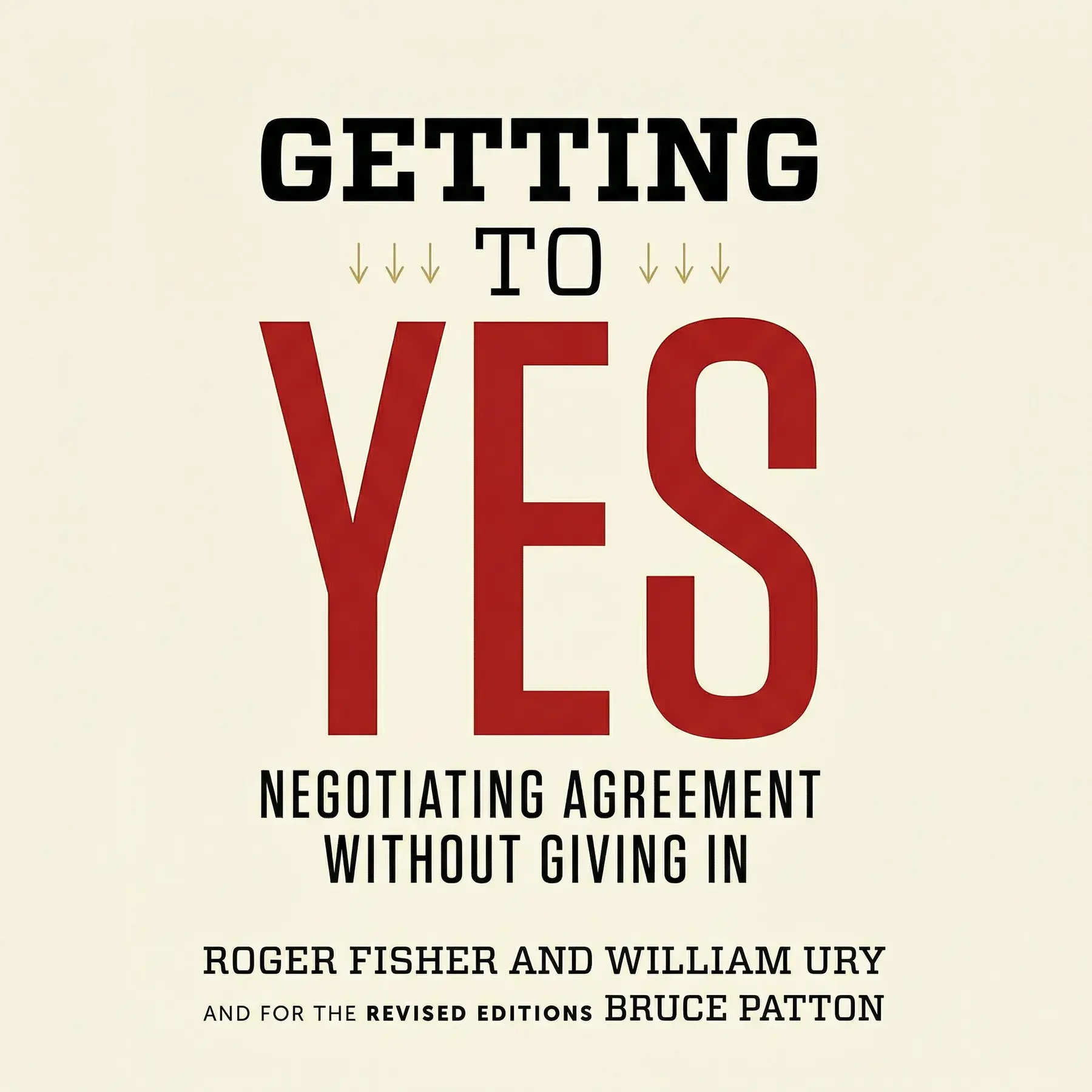
EnglishไทยGetting to Yes: Negotiating an Agreement Without Giving In
Shows how to reach agreements without bullying or caving: keep people and problems apart, look behind demands to real interests, invent options together and settle disagreements with fair standards both sides can check.
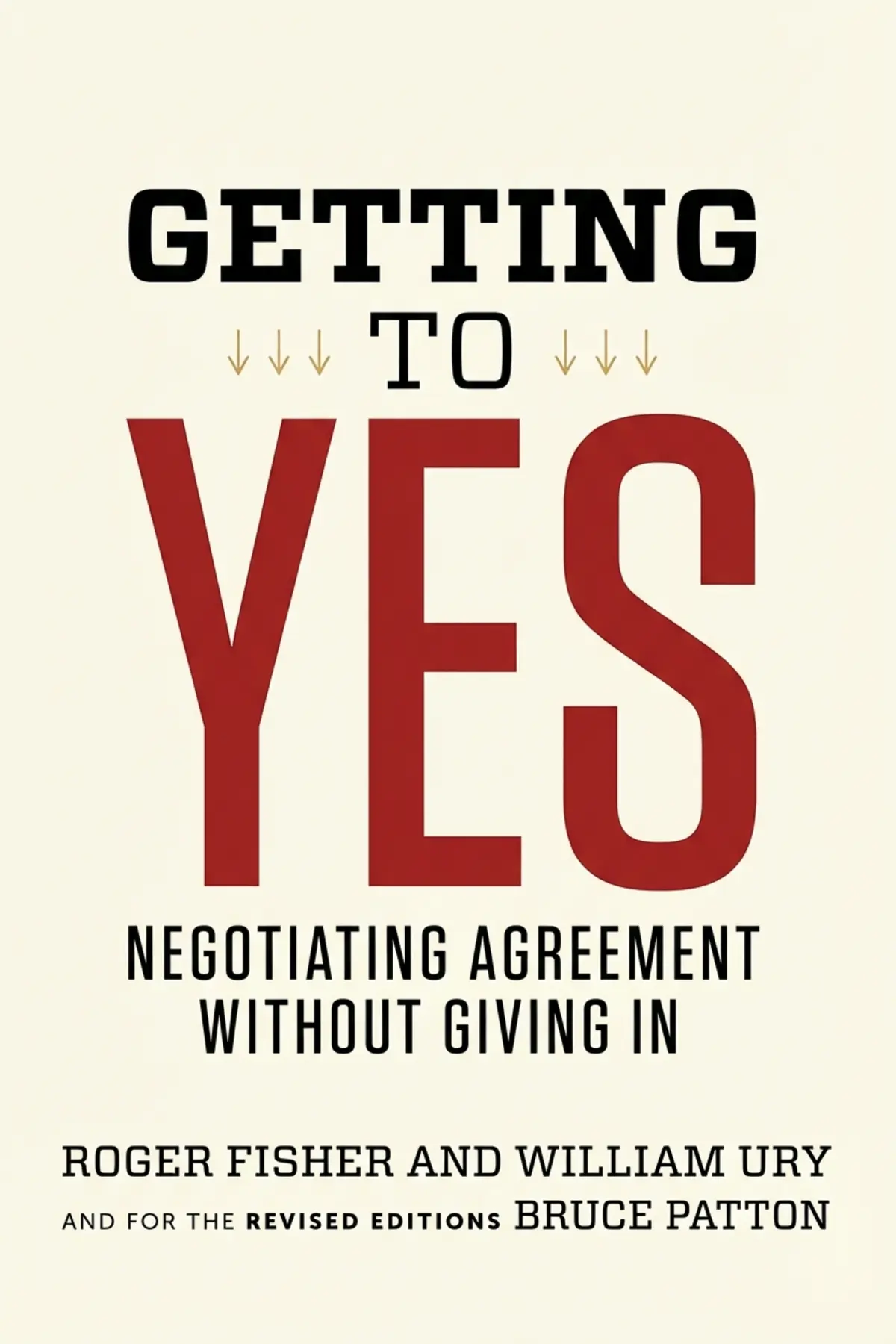
Table of Content
1. Introduction
1 min 04 sec
If every disagreement at work or at home turns into a test of who gives in first, you are probably paying too much for your agreements. In Getting to Yes, Roger Fisher, William Ury and Bruce Patton, who shaped the teaching of negotiation at Harvard, argue that dug-in bargaining wastes time, produces weak compromises and damages the very relationship it was meant to protect. Their alternative is to turn the other side into a partner working on a shared problem.
The book starts from a plain observation. Decisions that a father or a boss once made alone are now talked through, so almost everything, from choosing a film with friends to setting a supplier’s price, has become a negotiation. One method works across all of them: handle the people with care, look beneath stated demands, invent options before choosing, and settle on standards both sides can test. Learn it and the next final offer someone hands you becomes the start of a real conversation.
2. Stop losing deals to dug-in positions
1 min 33 sec
A buyer and a supplier can put years of business at risk over a discount almost too small to notice. The cause is a habit that takes hold the moment two sides start defending their opening demands.
3. Keep the person and the problem apart
1 min 46 sec
Two people can argue for an hour about entirely different things without realizing it. Better logic rarely rescues that conversation, and the fix the authors propose starts with where you put your chair.
4. Find the deal hiding under two opposing demands
1 min 48 sec
One partner wants the beach, the other wants the mountains, and someone seems bound to lose. The authors show why clashes like this are often less real than they sound, and which question exposes it.
5. Brainstorm many options before you pick one
1 min 40 sec
Bringing a ready-made contract to the table feels efficient and well prepared. The authors argue it usually backfires, and they borrow a lesson from guessing literary prize winners to show what works better.
6. Beat any final offer with a fair, objective standard
1 min 34 sec
When someone announces their last offer, most people either cave or walk away. The authors suggest a third response, built on a question so simple that a kindergarten teacher already uses its logic.
7. Prepare well, then listen until you understand
1 min 56 sec
Most conflicts start long before anyone raises their voice, in what one side failed to learn or failed to hear. The authors show how to close both gaps before and during the meeting.
8. Know what to do when the method stalls
1 min 32 sec
Some people refuse to play fair, and some negotiations are lopsided from the start. The authors are frank about what their approach cannot force, and about the moves still open to you when it meets resistance.
9. Conclusion
1 min 06 sec
What the three authors offer is a change of stance. A negotiation stops being a duel over who concedes first and becomes a shared problem that two sets of people, each with feelings and pressures of their own, are trying to solve. Seen that way, a 2 percent discount, a quarrel over the sea and the Alps, and two children with one cookie are the same puzzle in different clothes. Each time, the way out is to look past the demand to the need behind it, and to let something outside both parties settle the choice.
The habits this supports are small enough to start this week. When a talk tightens, ask the other person why their demand matters, and tell them plainly what matters to you. Reserve the first part of any hard meeting for options alone. And when someone announces a final offer, ask what makes it fair, then put forward a standard of your own, a market price or a fair way to split.
None of this guarantees a yes. A boss still makes the call, and the White House stays off the market. But the relationship you protect along the way is still there when the next negotiation begins.
About this book
What is this book about?
Most people bargain the same way. They name a demand, defend it and give ground only when they have to. Roger Fisher, William Ury and Bruce Patton call this trench warfare, and they argue it wastes time, produces weak compromises and harms the relationships it was supposed to serve. Because decisions once made by one person in charge are now talked through at home and at work, that cost is paid almost every day. The authors offer a different stance. A negotiation runs on two levels, the facts and the human layer of perception and emotion, so they show how to treat the other side as a partner while keeping the issue in focus. They explain how to uncover the interests hiding under incompatible demands, why options should be generated before anyone decides, and how objective criteria or a fair procedure can settle what willpower cannot. Readers also get practical tools for preparation, listening and handling pressure, from rephrasing what they hear to answering a final offer with a simple question about fairness, along with an honest account of where even good technique runs out.
Book Information
Who it's for
Managers and staff
Managers and employees who dread pay talks, contract renewals or tense team disagreements.
Bargaining with suppliers
Founders and buyers who haggle with suppliers and want deals that keep the relationship intact.
Couples, parents and friends
Couples, parents and friends tired of arguments that end with a winner and a loser.
About the Author
Roger Fisher
Roger Fisher held the Samuel Williston professorship of law at Harvard, where he taught negotiation and directed the Harvard Negotiation Project. William Ury, an anthropologist with a Harvard Ph.D., co-founded Harvard's Program on Negotiation and has worked as a mediator and adviser in conflicts worldwide, with past clients including the White House, the Pentagon and Fortune 500 companies. Bruce Patton, a co-founder of the Harvard Negotiation Project and of the consulting firm Vantage Partners, helped Fisher pioneer the teaching of negotiation at Harvard and co-wrote Difficult Conversations.
Ratings & Reviews
Ratings at a glance
What people think
Listeners find this negotiation guide both thorough and highly applicable, offering valuable insights and case studies that improve routine interactions. The material is accessible and clear, featuring direct concepts that are easy to recall. Listeners value its utility in numerous career paths and as an addition to formal negotiation training, highlighting how pertinent the advice is to daily circumstances.
Top reviews
Sing
The concept of the BATNA—Best Alternative to a Negotiated Agreement—is worth the price of admission alone. I picked this up while preparing for a difficult salary discussion and it completely shifted my mindset from 'winning' to 'problem-solving.' The authors argue that you should separate the people from the problem, which sounds easy but is remarkably difficult to execute in the heat of the moment. This book gives you the actual tools to do it. Not gonna lie, some of the scenarios involving international diplomacy felt a bit removed from my daily life, but the core principles are universal. I’ve already started using the 'interests vs. positions' framework when dealing with my kids and it actually works. It’s concise, packed with actionable insights, and manages to be influential without being overly long. If you want to stop feeling like you're getting steamrolled in conversations, you need to read this. It turns negotiation into a collaborative exercise rather than a battle of wills, and that is a powerful shift.
Show moreLucia
Wow, I wish I had read this before my last major lease negotiation. The authors do an incredible job of breaking down the thought process required for a truly principled agreement. One of my favorite tips was to involve the other party in the decision-making process early on, which makes them much more likely to support the final outcome. It’s about building a relationship, not just closing a deal. The book is remarkably concise, which I appreciate as a busy professional. It doesn't have the typical filler you find in modern business bestsellers. The examples, like the two people fighting over a window in a library, are simple but illustrate the 'mutual gain' concept perfectly. It teaches you how to remain calm and focused on the future instead of arguing about the past. I’ve found that even just applying the 'active listening' techniques has improved my interactions with my local mechanic and my spouse. This is essential reading for anyone who wants to navigate life with more grace and effectiveness.
Show moreEleanor
Negotiation is an art, but Fisher, Ury, and Patton provide the science behind it. This book is a masterclass in human psychology and strategic communication. I love the advice about sitting side-by-side instead of across from someone; it’s such a small physical change that completely alters the energy of a room. The authors remind us that we are all human beings with emotions and egos that need to be respected. By showing that you understand their interests, you open a door that positional bargaining usually slams shut. The writing is clear and the principles are simple enough to remember when you're under stress. I particularly enjoyed the section on 'Negotiation Ninjitsu' and using silence as a tool to get better answers. It’s a comprehensive guide that applies to everything from multi-million dollar business deals to deciding where to go for dinner with friends. This book genuinely changed how I view conflict—it's no longer something to avoid, but a problem to be solved together.
Show moreRod
As someone who deals with difficult clients daily, I found this remarkably grounding. The chapter on 'Negotiation Jujitsu' was a standout for me because it teaches you how to handle people who refuse to play by the rules. It’s all about redirecting their energy back toward the problem instead of defending yourself against personal attacks. In my experience, most business books are 90% fluff, but this one is surprisingly dense with real strategy. I particularly liked the advice to 'expand the pie' before trying to divide it, which helps move away from zero-sum thinking. My only real gripe is that the writing can feel a bit clinical at times, which makes the 'principled' approach seem easier than it actually is when emotions are high. Still, it’s a classic for a reason. It provides a shared language for teams to use when navigating internal friction. I’ve recommended it to several colleagues already because the framework is just so easy to remember and apply during a quick meeting.
Show moreOrm
Is it a bit dated? Perhaps, but the underlying logic remains incredibly robust for anyone looking to improve their interpersonal skills. Look, the 'objective criteria' section is much harder to implement in the real world than the book suggests—finding a 'gold standard' for fairness is often the very thing people are fighting about. However, the instruction to focus on interests rather than entrenched positions is a total game-changer. I recently used the technique of asking 'What's the theory behind this proposal?' during a contract dispute and it immediately cooled the room down. It forces the other side to justify their stance with logic instead of just digging in their heels. The book is easy to digest and doesn't waste your time with flowery prose. While I think some of the success stories are a bit too 'neat,' the fundamental shift toward mutual gain is something every professional should strive for. It’s a solid four-star read that I’ll likely revisit when I feel myself getting too defensive in my own negotiations.
Show moreWipada
Picked this up on a recommendation from a colleague and it actually lived up to the hype. The focus on 'reasons' over 'willpower' is a vital lesson for anyone in management. It’s not about who can yell the loudest or hold out the longest; it’s about what makes sense for both parties. I've started using the 'one-text' method for resolving team disputes and it has cut our meeting times in half. By focusing on a single evolving document, you eliminate the back-and-forth ego battles that usually stall progress. Personally, I found the book a bit dry in the middle sections where they go into case studies of international treaties, but the practical tips for daily life are gold. It’s a very helpful guide for organizing your thoughts before a high-pressure conversation. I'll definitely keep this on my shelf as a reference guide for when I need to remind myself to sit on the same side of the table as my 'opponent.'
Show moreJack
After hearing several podcasts mention the 'principled negotiation' style, I decided to dive into the source material. Not gonna lie, I expected it to be more complex, but the simplicity is actually its greatest strength. The authors don't try to teach you how to be a manipulator; they teach you how to be a fair and effective communicator. The 'Five Principles' provide a clear roadmap that takes the guesswork out of difficult conversations. I found the advice to 'insist on using objective criteria' to be particularly helpful for removing the emotion from financial discussions. While some of the language feels slightly dated, the core message of looking for mutual gain is timeless. It’s a quick read, but you’ll find yourself thinking about it for weeks afterward. My only minor complaint is that it can feel a little repetitive, but that might be intentional to ensure the principles stick. Overall, it’s a very practical addition to any professional’s library and a great tool for personal growth.
Show moreRuangrat
Finally got around to this 'classic' after hearing about it in every business seminar for a decade. The truth is, it's a bit of a mixed bag. On one hand, the core tenets like 'separate the people from the problem' are essential for any functioning adult. On the other hand, a lot of the strategies felt very intuitive, almost to the point of being redundant. If you’ve spent any time in a leadership role, you probably do half of this stuff by instinct. To be fair, it is a very quick read and does a great job of organizing those instincts into a repeatable system. I found the section on 'Taming the Hard Bargainer' to be the most useful part, as it gives you specific scripts to use when someone is trying to bully you into a bad deal. However, the tone is a bit too 'polite' for some of the cutthroat environments I've worked in. It’s a good foundational text, but it lacks the psychological depth of more recent books on the subject.
Show moreNina
This book occupies a weird space between a technical manual and a motivational speech. I appreciate the focus on ethics and fairness, which is often missing from negotiation tactics. However, I found the authors' optimism a bit taxing at times. In my experience, there are people who simply want to win at your expense, and 'principled negotiation' can sometimes make you look like an easy target for a shark. The section on BATNA is definitely the highlight, as it gives you the confidence to walk away from a bad deal. But I struggled with the 'objective criteria' part. In many industries, there are no agreed-upon standards, and everything is a battle of wills. The writing is okay, but it definitely feels like it was written by academics who might not spend much time in the trenches of high-stress industrial bargaining. It’s a useful framework for low-stakes life situations, but I’d take some of the 'win-win' rhetoric with a grain of salt.
Show moreJob
I'll be blunt: this felt like a relic from a different era. While I recognize its status as a foundational text, the writing style is incredibly dry and reads more like a tedious manual than a practical guide. To be fair, the authors do present some solid logic regarding principled negotiation, but I found the examples to be overly simplistic and rarely applicable to the messy, high-stakes conflicts I face at work. It carries that classic 'self-help' tone that I personally find grating, where complex human emotions are boiled down to neat little bullet points. Frankly, if you have any degree of social intuition, most of this will feel like common sense dressed up in academic jargon. It’s not that the advice is bad, it’s just that the presentation is so dull it becomes a chore to finish. I struggled to stay engaged past the first fifty pages because it felt like they were repeating the same three points ad nauseam. There are much more modern, engaging books on the market today that cover the same ground without the mid-century stiffness.
Show moreQuestions about this book
What is the main idea of Getting to Yes?
Fisher, Ury and Patton argue that negotiation should be treated as a shared problem rather than a battle of positions. They warn that trench warfare, where each side defends a demand and concedes only under pressure, wastes time, yields weak compromises and harms relationships. Their method separates the people from the issue, looks for the interests behind demands, generates options before deciding and relies on objective criteria or a fair procedure to settle differences.
What is the difference between positions and interests in Getting to Yes?
A position is what someone says they want; an interest is why they want it. The authors use a couple who disagree over holidays at the sea or in the Alps. If one wants to swim and the other to climb, a mountain lake satisfies both without any compromise. They note that people are often driven by needs for recognition, control, security and belonging, and recommend simply asking why a demand matters.
How do you respond to a final offer, according to Getting to Yes?
The authors advise never giving in to pressure or an ultimatum. Instead, ask what makes the figure fair, and steer the talk toward objective criteria both sides can check, such as prices for similar homes or the condition of a building when selling a house. When no clear standard exists, use a fair process, like the kindergarten rule where one child cuts the cookie and the other chooses a half.
Who should read Getting to Yes?
It suits anyone who negotiates regularly, which the authors argue is nearly everyone, since decisions at home and at work are now talked through rather than handed down. Managers facing pay discussions, founders dealing with suppliers, and couples or parents in recurring arguments will all find practical tools, from rephrasing what they hear to agreeing on the process before the substance.
Readers also enjoyed










AUDIO SUMMARY AVAILABLE
Listen to Getting to Yes in 15 minutes
Get the key ideas from Getting to Yes by Roger Fisher, plus 5,000+ more nonfiction titles.
- 5,000+ titles
- Listen as much as you want
- 7-day free trial
- Cancel anytime









