
14 min 41 sec
Available in: English
The Power of a Positive No: Save The Deal Save The Relationship and Still Say No
By William Ury
Shows how to turn down a demand from a boss, a client or a loved one without giving in, lashing out or hiding. The method is to ground the no in what you value and then offer a respectful way forward.
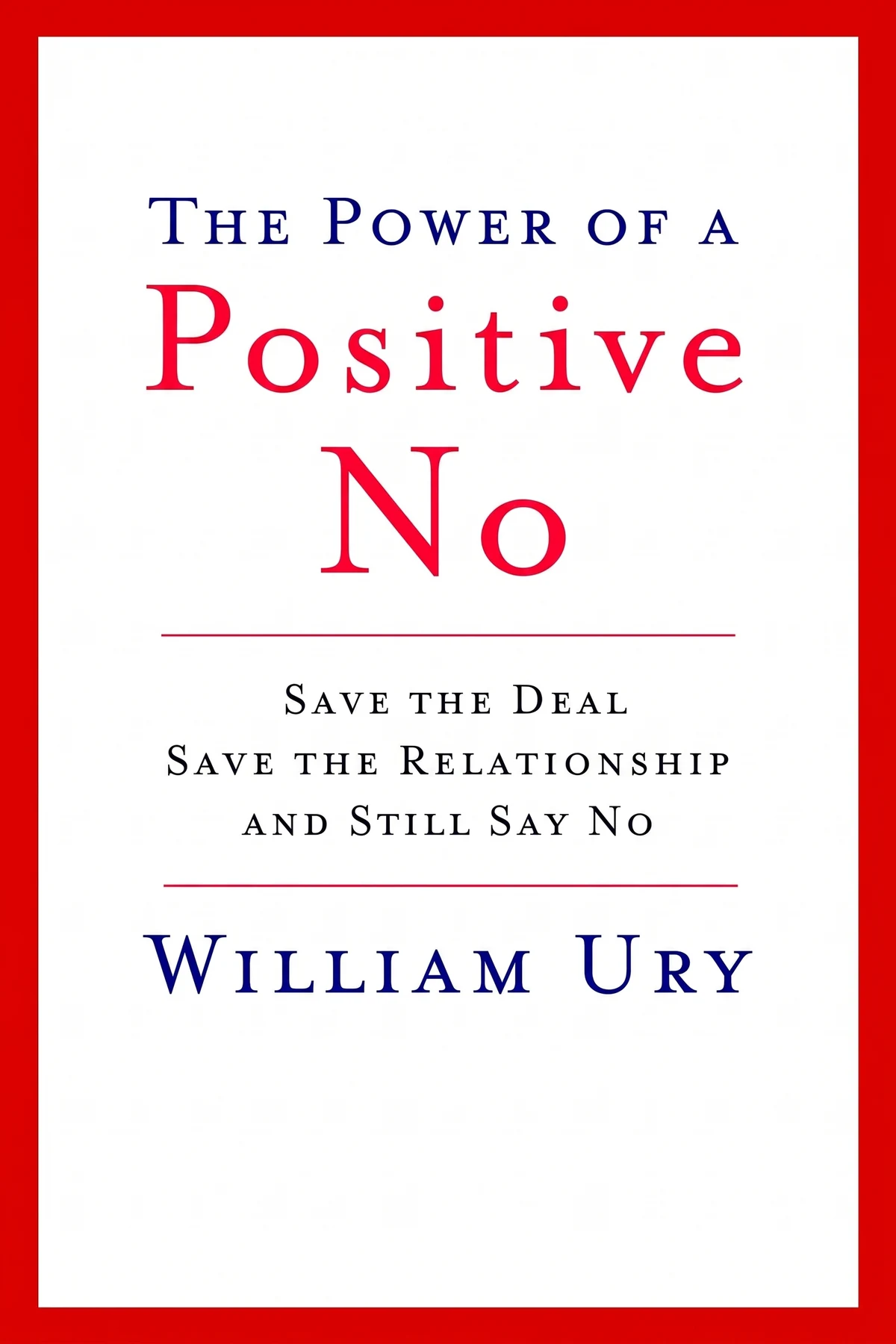
Table of Content
1. Introduction
1 min 04 sec
Most of us know when we should refuse, but we say yes anyway, or we say no so sharply that it lands like a blow. In The Power of a Positive No, negotiation expert William Ury, co-founder of Harvard’s Program on Negotiation, argues that a good no begins with a yes: a clear sense of what you are protecting. If you get that part right, you can turn down a demand and still keep both the deal and the person.
Ury’s method has a simple shape. You affirm what matters to you, you state the no plainly, and you offer the other person a way forward. Around that sit two more pieces: preparation that gives you nerve, and follow-through that makes a refusal stick. His examples run from a New York hostage negotiator to Rosa Parks refusing to give up her seat and a president who would not let his speechwriter quit. Once you see the shape, turning down overtime, a pushy friend or an unfair request becomes a skill you can practice every day.
2. Find the yes that makes your no hold
1 min 44 sec
Most refusals go wrong in one of three ways, and fear, guilt or anger drives all of them. One man’s long struggle with drinking points to where a steadier kind of no really comes from.
3. Back every refusal with a plan B
1 min 42 sec
People rarely take no for an answer the first time. Rosa Parks expected the world to reject her refusal, and she said it anyway. What she had in reserve explains why her no held.
4. Listen first so your no isn't taken personally
1 min 46 sec
Hostage negotiators can never give a hostage taker what he demands, yet lives depend on how they refuse. Their first move is one most of us skip, especially with people we dislike.
5. Explain your no without blaming anyone
1 min 47 sec
Two people can turn down the same invitation, and one damages the friendship while the other leaves it intact. The difference lies in what comes before the word no, and in a small change of grammar.
6. A calm no that draws a clear line
1 min 50 sec
A child refusing an itchy coat and a couple saying I do have something in common. Both use words to change reality, and the way they do it shows how to refuse without starting a fight.
7. Keep the relationship by offering another path
1 min 42 sec
A firm refusal can still leave a colleague or partner stuck and resentful. Closing one door is only half the move, and the other half also gives the other person some of their power back.
8. Outlast pushback and turn resistance into acceptance
1 min 58 sec
A president used flattery, bribery and threats to stop his own speechwriter from resigning, and it worked. Most people won’t push that hard, but nearly everyone pushes a little, and the first minutes decide what happens.
9. Conclusion
1 min 08 sec
The refusal Ury teaches is held between two yeses. At the start is what you care about. At the end is an offer that respects what the other person cares about. In the middle, stated calmly, is the no. The plan B and the respectful listening exist so that this middle word can be firm without being cruel. Seen this way, a no can be a beginning: Ury argues that saying it clearly builds your self-esteem and your relationships at the same time.
His own suggested practice is small. Give one Positive No each day: to a request at work, to a pushy friend, or to an extra commitment you would once have accepted with a sigh. Pay attention to the yes at each end, and ask whether naming your intention first and offering a path afterward made the no easier to say and easier to hear. Notice, too, which of the three traps you fall into most often, and with whom.
The grandfather who finally put down the drink did not win by hating alcohol. He won by wanting something more.
About this book
What is this book about?
Most people find no one of the hardest words to say. We give in and resent it later, we refuse so harshly that it feels like an attack, or we dodge the conversation and let the problem grow. As work and home blur together, the cost of each habit keeps rising. William Ury, a negotiation expert who co-founded Harvard's Program on Negotiation, offers a different approach. In his view, a strong no always rests on a deeper yes, meaning a clear sense of what you want to create, protect or change. From there he builds a sequence. Prepare a plan B so pressure can't break you. Listen with respect so the other person doesn't hear rejection. State your values first, then the no, then propose a path that works for both sides. The examples range from a hostage negotiator in New York and Rosa Parks to a president who refused to let his speechwriter resign. Readers get the reasoning plus practical wording: statements that focus on facts rather than blame, personal policies that present a refusal as a sign of resolve, and ways to help someone accept a no without losing face.
Book Information
Who it's for
Professionals afraid to refuse
Professionals who take on extra work because refusing a boss or client feels too risky.
Team leads fielding requests
Team leads who need to turn down requests without damaging trust.
Pleasing friends and family
People pleasers who say yes to friends and family, then quietly resent it.
About the Author
William Ury
William Ury is an American author and anthropologist who specializes in negotiation. He studied at Yale and earned a Ph.D. in anthropology at Harvard. He co-founded Harvard's Program on Negotiation, directed its Project on Preventing War, and was a founder of the International Negotiation Network alongside Jimmy Carter. As a mediator and adviser he has worked on conflicts from corporate boardrooms to international wars, with clients including Fortune 500 companies, the White House and the Pentagon. He co-wrote Getting to Yes with Roger Fisher.
Ratings & Reviews
Ratings at a glance

What people think
Listeners consider this work an essential tool for daily living, commending the straightforward and useful advice that easily integrates into routine situations. Furthermore, the insights are highly valued, with one listener remarking that it offers a deeply pertinent structure for balancing one's goals. The material is also lauded for being user-friendly; one listener points out that it outlines a specific, sequential method for getting ready. Listeners appreciate the advice on raising children, as one review notes it aligns well with top-tier parenting literature, and the included anecdotes are seen as beneficial for clarifying the core ideas.
Top reviews
Mai
Finally got around to reading this staple of negotiation literature, and it completely shifted my perspective on conflict resolution. William Ury manages to distill complex diplomatic strategies into a simple, three-stage framework that anyone can apply to their personal life. The core idea is that every 'no' should be rooted in a deeper 'yes'—an affirmation of your own values and priorities. I found the 'Yes-No-Yes' formula to be remarkably effective when dealing with demanding clients who don't respect my time. Instead of feeling guilty or aggressive, I now feel empowered to protect my boundaries while still offering a 'golden bridge' for the other party to save face. It’s not just about being assertive; it's about being respectful and constructive. This is a must-read for anyone who feels drained by the constant demands of others.
Show moreClaire
Ever wonder why saying 'no' feels like a personal attack even when it isn't? William Ury answers this by showing that our problem isn't the word itself, but the lack of preparation behind it. This book is a masterclass in emotional intelligence and negotiation. I’ve started applying the 'Yes-No-Yes' sequence in my office, and the results are night and day. People actually seem to respect me more when I turn down their requests using this method because they understand the 'why' behind my decision. It turns a potential conflict into a conversation about priorities. The stories about international mediation are fascinating and help illustrate how these principles work even in high-stakes environments. It’s easy to use, deeply wise, and provides a clear path toward a more authentic life. I wish I had read this ten years ago.
Show moreKenji
Picked this up on a whim, but it’s honestly one of the most practical guides to boundaries I’ve ever encountered. The author makes a compelling case that saying 'no' is the only way to truly protect your 'yes.' If you say yes to everything, your commitments become meaningless and your quality of life suffers. This book gives you the actual scripts and mindset shifts needed to take back your time. I love how it encourages you to stay calm and 'go to the balcony' when things get heated. It's not just about talking; it's about listening and ensuring the other person feels heard even when they don't get what they want. It’s consistent with the best parenting books I’ve read, focusing on firm limits and warm connections. Truly a must-have for everyday use.
Show moreAstrid
As someone who has always been a chronic people-pleaser, Ury’s framework felt like a much-needed lifeline. The book provides a step-by-step process for preparation that helps you identify what you are actually protecting when you say 'no.' I used to think that declining an invitation or a project was an act of hostility, but this book teaches you that it's actually an act of integrity. The sections on parenting were surprisingly relevant too, offering ways to set firm limits for children without damaging the emotional bond. My only minor complaint is that some of the international examples felt a bit detached from my everyday reality. However, the underlying wisdom is undeniable. It’s a very practical guide for managing your aspirations and your schedule without becoming a hermit or a jerk.
Show moreZoe
The chapter on building a 'golden bridge' for your opponent is worth the price of the book alone. Frankly, most of us are terrible at saying 'no' because we focus too much on the rejection rather than the relationship. Ury shows how to shift the focus toward a solution that respects everyone's dignity. I particularly appreciated the advice on using 'I' statements to describe your own needs instead of accusing the other person of being unreasonable. This subtle shift in language makes a massive difference in how the message is received. While the book can feel a bit repetitive at times, the repetition helps drill in the methodology. It’s a solid, highly relevant framework for anyone working in a high-pressure environment where trade-offs are inevitable. Definitely worth keeping on the shelf for a refresh every few months.
Show morePrim
Ury brings his immense experience from international peace talks down to a level that works for a simple office dispute or a disagreement with a spouse. In my experience, the most valuable part of the book is the emphasis on respect. He argues that you can be firm on the issue while remaining soft on the person. This distinction is vital for maintaining long-term relationships. I’ve used the techniques to navigate some tricky family dynamics lately, and it has helped keep the peace without me having to cave on my own needs. The writing is accessible, though a bit wordy in places. If you can get past the somewhat dated anecdotes, the actual 'how-to' of the negotiation process is incredibly sound. It’s a very relevant manual for anyone trying to navigate the complexities of modern social interactions.
Show moreAlice
Look, the 'Yes-No-Yes' formula sounds a bit like corporate jargon at first until you actually try it in a high-stakes meeting. The truth is that most of us either 'accommodate' (say yes when we want to say no) or 'attack' (say no too harshly). This book offers a third way that is much more sustainable. I found the section on creating a 'Plan B' (BATNA) particularly helpful for building the internal confidence needed to stand my ground. It's a step-by-step process that removes the fear of the unknown. While I did find the author's tone a bit self-congratulatory at times regarding his past negotiations, the actual advice is top-tier. It provides a highly relevant framework for anyone looking to manage their professional aspirations while keeping their sanity intact.
Show moreSukit
After hearing about Ury’s work at the Harvard Negotiation Project, I expected something academic, but this is surprisingly accessible and down-to-earth. The book is filled with stories that make the concepts clearer, showing how these techniques work in real-world scenarios. It taught me that a 'No' is not just a wall, but a gate that protects what matters most to me. I appreciated the ease of use; you can start applying the basic principles almost immediately after finishing the first few chapters. My only gripe is that it feels a little repetitive in the final third, as if the author was trying to hit a certain page count. Regardless, the wisdom contained here is substantial. It’s a great teacher for anyone who wants to be more assertive without losing their kindness or their friends.
Show moreJackson
To be fair, the core message is brilliant, but the book itself is a bit of a slog to get through. I loved the concept of the 'Positive No'—starting with your values, setting the limit, and then proposing a way forward. That part is pure gold. However, the author tends to circle back to the same points over and over again with different anonymous examples that don't always add value. Look, if you want to be more assertive, you’ll find some great tools here, especially the part about having a 'Plan B' that exists independently of the other person's approval. But be prepared to skim the middle sections where the pacing really drops off. It's a 5-star concept trapped in a 3-star execution. It’s helpful, but it requires some patience to extract the practical gems from the fluff.
Show morePrasarn
This was so poorly written and repetitive that I genuinely struggled to make it through the second half. To be fair, the central premise—finding a positive way to decline requests—is useful, but it could have been summarized in a single blog post. Instead, we are subjected to hundreds of pages of 'John and Mary' style anecdotes and a fair amount of bragging about international peace negotiations. It feels like the worst kind of self-help fluff that repeats the same three points until you're bored to tears. The advice to 'have a Plan B' is common sense, and I didn't need a 250-page book to tell me that. If you are looking for deep insights, you might find this frustratingly thin on actual substance. I'm trying to improve my communication, but this kind of structureless writing actually sets me back.
Show moreQuestions about this book
What is a Positive No according to William Ury?
A Positive No is a refusal shaped as yes, no, yes. You open by affirming the value or intention behind your refusal, then you state the no clearly as a boundary, and you close by proposing a way forward that respects the other person’s needs. Ury contrasts it with the three-A trap of accommodating, attacking or avoiding, which are reactions driven by fear, guilt or anger.
Why is it so hard to say no?
Ury points out that a no has consequences. People worry that refusing overtime will cost them a promotion, or that refusing a partner will hurt their feelings. So they give in and resent it later, refuse so harshly that it feels like an attack, or avoid the conversation altogether. Each response makes things worse, which is why he starts with finding the deeper yes that gives a refusal its strength.
How do you say no without damaging a relationship?
Ury suggests listening respectfully first, so the other person doesn’t hear rejection. Then explain your no with The statements and I statements, which focus on facts and your own needs and avoid blame. Finish with a proposal, such as an alternative or a suggestion for different behavior. If they resist, stay calm and help them save face, following Sun Tzu’s advice to build a golden bridge.
What is a plan B in The Power of a Positive No?
A plan B is your next step in case the other person refuses to take your no as an answer. It lets you refuse without sounding desperate. It may be unpleasant, such as asking for a transfer from an abusive boss or leaving a partner who won’t communicate. Ury suggests brainstorming freely, testing how each option would work, and considering third parties such as a marriage counselor.
How can I practice the ideas in this book?
Ury’s suggested exercise is to give one Positive No every day and notice whether the opening yes and the closing proposal make the no easier to deliver. He also suggests watching how you currently refuse, whether you accommodate, attack or avoid, noticing who you find it hardest to refuse, and rehearsing difficult refusals with a friend beforehand.
Featured in
Readers also enjoyed






AUDIO SUMMARY AVAILABLE
Listen to The Power of a Positive No in 15 minutes
Get the key ideas from The Power of a Positive No by William Ury, plus 5,000+ more nonfiction titles.
- 5,000+ titles
- Listen as much as you want
- 7-day free trial
- Cancel anytime









