
13 min 45 sec
Available in: English
Possible: How We Survive (and Thrive) in an Age of Conflict
By William Ury
Shows how to turn a heated conflict, at home, at work or between nations, into a workable agreement by steadying yourself first, building a solution the other side can accept and drawing in the people around the dispute.
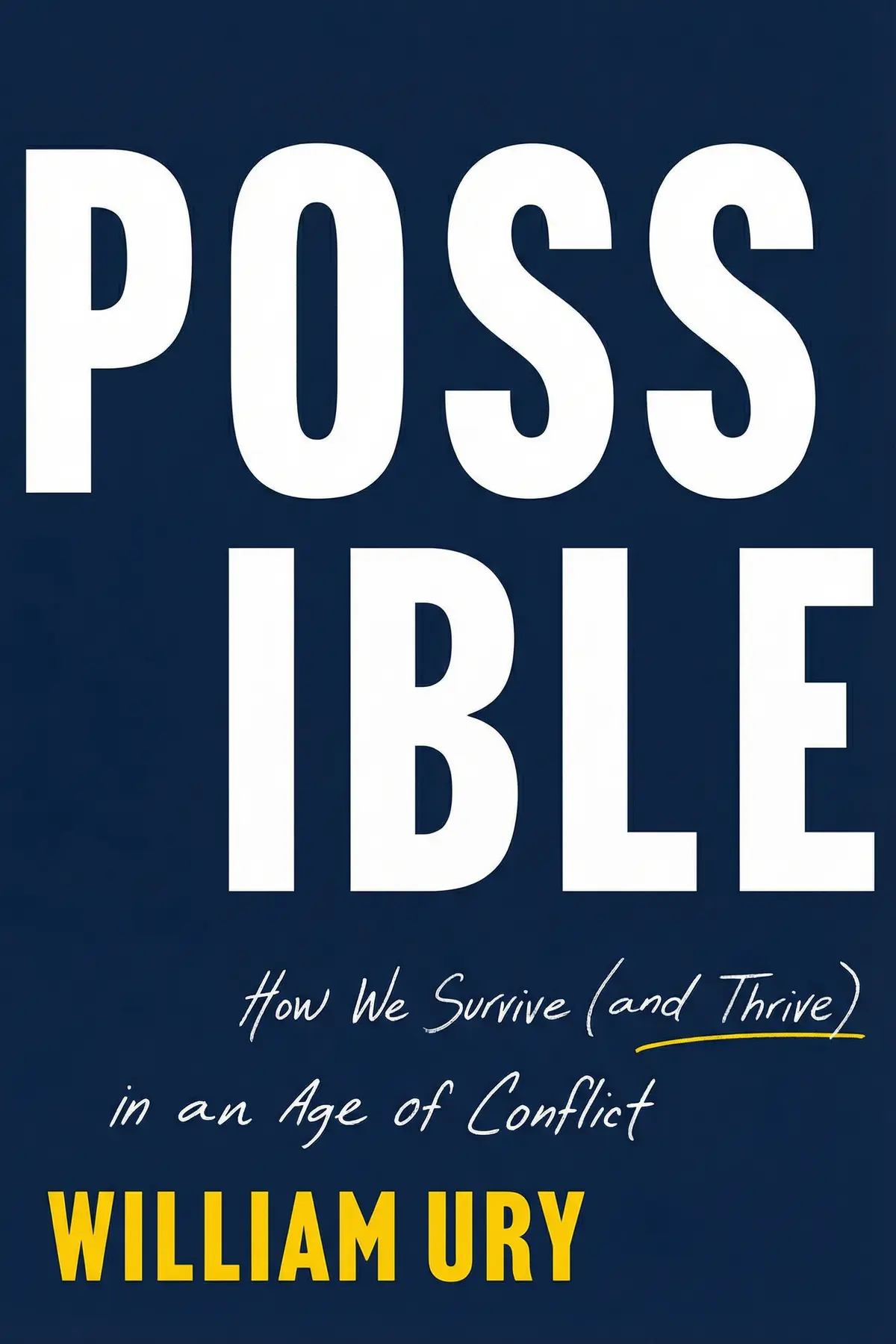
Table of Content
1. Introduction
1 min 05 sec
Most people meet a hard argument, at work or at home, in one of two ways: they dig in or they back off. In Possible, negotiator and anthropologist William Ury argues for a third way. Conflict, he says, is a normal result of people seeing the world differently, and it can be turned toward growth and better ideas instead of damage. He calls this belief possibilism: trust in our own power to make even a bitter dispute constructive.
Ury has worked as a mediator from company boardrooms to international wars, and he condenses that experience into three moves he calls victories. First you step back and take charge of yourself. Then you build a way across for the other side. Finally you bring in the community surrounding the dispute. His case is that these three, used together, make outcomes reachable that looked impossible.
Learn them and your next clash with a colleague, a partner or a neighbor comes with a plan: when to stop, what to ask yourself, how to listen and whom to call in.
2. See the opening hidden inside any conflict
1 min 43 sec
A teenage boy fled an empire and ended up shaping steel companies. His grandson, a veteran mediator, turned that boy’s way of seeing into a single sentence about handling every fight.
3. Buy time before you react under pressure
1 min 23 sec
Explosions shook a submarine while one officer held the power to start a nuclear war. What he did in that moment is the first skill Ury asks of anyone in a fight.
4. Find what you really need, and your fallback
1 min 33 sec
Two parents nearly rejected the surgeon who would care for their daughter for ten years. Their change of mind shows why the first thing you want in a fight is rarely the thing that matters.
5. Listen first, starting with yourself
1 min 32 sec
Most people think they listen well until the other side is someone they dislike. Ury describes a harder kind of listening, and it begins before the other person says a word.
6. Win agreement with small gestures of trust
1 min 44 sec
Pressure tends to harden the other side, yet tiny signals of goodwill can soften a frozen negotiation. Ury calls them little kisses, and he suggests drawing up a menu of them.
7. Make a tense room safe for everyone
1 min 44 sec
Organizers in a divided city planned for a few hundred people and got more than a thousand. How they handled that crowd shows what bystanders can do when others are locked in conflict.
8. Surround a stuck problem with many minds
1 min 44 sec
Twelve volunteers with no special knowledge of North Korea spent two weeks in a rented house trying to prevent a nuclear war. Their method can be borrowed for any problem that has stopped moving.
9. Conclusion
1 min 17 sec
Possible makes a hopeful claim with a practical edge: conflict is a normal part of life, and what comes of it depends on how people choose to engage. Ury’s three victories move outward in rings. The first happens inside you, in the pause and the honest look at what you need. The second happens between you and the other side, through listening, invention and small acts of trust. The third pulls in everyone around the dispute, from the hosts of a packed hall in Caracas to twelve volunteers in a rented house.
What ties the rings together is Eddie’s habit of looking for the door in the wall. Ury asks for all three at once because each makes the others easier.
Start where the method starts. The next time an argument heats up, stop before you answer and ask what you really need, and know your fallback if no deal comes. When you speak, listen until you understand the other side’s interests, then offer one small gesture of good faith. And when you see others in conflict, remember that you are part of their third side.
A naval officer under exploding depth charges chose to wait. Our fights are smaller, and the same choice is ours to make.
About this book
What is this book about?
Arguments at work, rifts in families and bitter political splits can feel like dead ends. William Ury, a mediator who has worked from corporate boardrooms to international wars, sees them differently. In his view, conflict is a natural result of people holding different views and interests, and it can push people toward growth and fresh ideas instead of damage. He calls this outlook possibilism, the belief that human agency can make even a hard dispute constructive. Ury condenses decades of practice into three victories. On the balcony you pause, clarify what you really need and see the wider picture, including your best alternative if no deal is reached. With the golden bridge you listen deeply, invent options together and build trust through small gestures. With the third side, the surrounding community hosts open dialogue, helps the parties and swarms a stuck problem with many minds. The stories range from a naval officer under depth charges during the Cuban Missile Crisis to a crowded public dialogue in Caracas and twelve volunteers tackling the North Korea standoff. Readers get a method they can use in the next tense conversation.
Book Information
Who it's for
Managers pulled into disputes
Managers and team leads who keep getting pulled into disputes between colleagues and want a calmer, repeatable method.
Facing tense negotiations
Professionals heading into tense negotiations who tend to react first and think later.
Hoping to bridge divides
People worn down by family rifts or political splits who want to help instead of taking sides.
About the Author
William Ury
William Ury is an American author and anthropologist who specializes in negotiation. He holds a Ph.D. in Anthropology from Harvard, co-founded Harvard's Program on Negotiation and directed its Project on Preventing War. With former President Jimmy Carter he helped found the International Negotiation Network. He has advised Fortune 500 companies, the White House and the Pentagon, and he co-wrote Getting to Yes with Roger Fisher. Getting to Yes and Getting Past No have sold more than five million copies.
Ratings & Reviews
Ratings at a glance

What people think
Listeners find the book insightful, and one individual points out how it offers a productive way to handle problem-solving through cooperation. The work is also quite useful, with one listener highlighting its practical techniques. Additionally, listeners enjoy the entertainment factor, as one person describes it as a joyful read.
Top reviews
Kiattisak
Wow, this book hit me much harder than I expected from a standard negotiation guide. Ury's storytelling is masterful, weaving his professional experiences in places like Colombia and the Middle East with deeply personal narratives about his family. The sections mentioning his daughter, Gabi, were particularly moving and brought a tear to my eye while I was reading on the plane. He moves past the cold tactics of 'Getting to Yes' to something much more human and spiritual. By focusing on 'the balcony' and 'the third side,' he shows us how to navigate the messy reality of modern polarization without losing our souls. It’s an incredibly joyful read despite the heavy subject matter of global conflict. Truly, this feels like a capstone to a legendary career that has changed the world.
Show moreKrisada
Picked this up after a recommendation from a mentor, and I am so glad I did. Ury addresses the current state of political polarization with a sense of urgent optimism that we rarely see these days. His four-step process for moving toward bipartisanship might seem idealistic to some, but his examples from Venezuela and North Korea prove these methods have real teeth. I loved the story of his grandfather, Eddie, and how he turned barriers into pathways; it sets a beautiful tone for the rest of the book. The idea of 'swarming' a problem with a diversity of thought is exactly what our current systems are missing. It’s rare to find a book that is both intellectually stimulating and practically applicable in the boardroom. Definitely a top-tier resource for anyone leading teams through uncertainty.
Show moreTom
Finally got around to reading this, and the timing couldn't be better for my own mental health. The world feels so chaotic, but Ury offers a message of profound hope through his philosophy of possibilism. The story about the public dialogue in Caracas was genuinely inspiring and showed the power of 'hosting' a space for others. I love how he breaks down the 'third side' as a communal responsibility rather than an individual burden. The prose is deeply compelling, making complex geopolitical conflicts feel accessible and understandable to the average person. It’s more than just a negotiation book; it’s a manual for being a better human in an age of conflict. Personally, I think this should be required reading for every local government official.
Show moreNang
The chapter on the 'golden bridge' changed how I view my marriage and my professional relationships. Ury emphasizes that before you can listen to others, you have to listen to yourself and your own biases. That internal work is often the hardest part of any conflict, and he guides you through it with grace. Truth is, I found the story of his grandfather Eddie’s journey from Warsaw to be the perfect anchor for the book's themes. It illustrates how we can choose to see pathways where others only see walls. This is such an insightful and collaborative approach to problem-solving that everyone should read. It’s not just a book; it’s a way of being in the world that prioritizes respect over victory.
Show moreArthit
As someone who deals with HR disputes daily, I found the practical techniques in this book to be a breath of fresh air. Ury moves beyond the typical corporate jargon to offer a constructive approach to problem-solving that feels genuinely achievable. The concept of 'building a golden bridge' is especially useful when dealing with stubborn personalities who refuse to budge. While some chapters felt a bit like a sanitized resume of his greatest hits, the core message of 'possibilism' is infectious. I appreciated the step-by-step breakdown of pausing, zooming in, and zooming out to gain clarity. It’s not just for world leaders; it’s for anyone trying to survive the friction of everyday life. To be fair, you have to be willing to do the internal work first.
Show moreWyatt
After hearing Ury speak on a podcast, I had high expectations for this latest installment. The writing style is incredibly distinct—you can practically hear his calm, measured voice through the prose. Look, he does repeat his core steps quite often, almost as if he’s trying to hammer them into your subconscious. However, the anecdotes from the Cuban Missile Crisis and his work in Palestine kept me turning the pages. I found the 'balcony' concept to be a great mental model for emotional regulation during heated arguments. It’s a compelling mix of memoir and guidebook that feels more personal than his earlier works. Even though it skims over some systemic failures, it provides a great toolkit for individual agency in an era of unrest.
Show moreBo
Ever wonder how peace negotiators keep their cool when the stakes are literally nuclear? Ury reveals the secret is strategic empathy and the discipline to go to the balcony. I found the distinction between 'listening' and 'strategic empathy' to be a game-changer for my own difficult conversations. The book is filled with what he calls 'besitos'—small actions that build rapport—which I’ve already started using at home with my teenagers. Not gonna lie, the narrative can get a bit flowery at times, but the underlying logic is sound. It’s a very constructive approach to problem-solving that focuses on collaboration rather than just 'winning' the argument. If you're tired of the constant shouting matches in our culture, this offers a much-needed exit ramp.
Show morePensri
In my experience, books on conflict resolution are usually dry, but this was a joy to get through. Ury’s voice is so unique and presence-filled that it feels like you're having a long conversation with a wise mentor. I particularly enjoyed the section on 'swarming' and the social experiment in Boulder with the North Korea scenario. It reminded me of design thinking principles applied to the hardest problems on earth. My only minor gripe is that some of the real-world examples felt a bit oversimplified for the sake of the narrative. Still, the practical advice on pausing and zooming out is worth the price of admission alone. It’s a useful guide for anyone who wants to turn disputes into opportunities for growth.
Show moreNiramai
Direct and meaningful, this is exactly what the author of 'Getting to Yes' should be writing now. While his previous work was about the 'how' of negotiation, Possible is about the 'why' and the spirit behind it. He tackles the failures of systems and the departure from democratic principles by focusing on human connection. We aren't going to solve global warming or political unrest without the tools he outlines here. The 'third side' concept provides a brilliant framework for community involvement in disputes. I did find the repetition of the steps a bit much, but I suppose that’s necessary for learning. Overall, a very solid read that offers a way to thrive through uncertainty and create lasting change.
Show moreSupaporn
Not what I expected given the hype surrounding it. While Ury is clearly a legend in the field, this felt more like a sanitized victory lap than a rigorous new framework for the 21st century. He relies heavily on sweeping generalizations that don't always translate to the complexities of modern ideological warfare. Frankly, I get the 'golden bridge' metaphor, but sometimes people just don't want to cross, no matter how much you listen. The prose is beautiful, but the repetition of the 'three victories' felt like filler after the hundredth time. It ignores how systems often fail even when people are acting in good faith. It’s a nice sentiment, but it feels a bit out of touch with the grit of today's political reality.
Show moreQuestions about this book
What is the main idea of Possible by William Ury?
Ury argues that conflict is a natural result of people holding different views and interests, and that it can become constructive instead of destructive. He calls this belief possibilism. His method rests on three victories used together: going to the balcony to gain self-control and perspective, building a golden bridge that meets both sides’ needs, and engaging the third side, the community around the dispute.
What does going to the balcony mean in Possible?
It means stepping back from a conflict to see it clearly. Ury breaks it into three moves. Pause before reacting, as naval officer Vasili Arkhipov did when he declined to fire a nuclear torpedo during the Cuban Missile Crisis. Zoom in to find what you truly need beneath your demands. Zoom out to see the wider context and work out your best alternative if no agreement is reached.
What is the third side in conflict resolution?
The third side is the community surrounding a dispute. Ury argues that when a conflict affects everyone, resolving it is a shared job. The third side plays three roles: hosting open, inclusive dialogue, as organizers did at a crowded meeting in Caracas in 2003; helping the parties through listening and good questions; and swarming a stuck problem with many people and ideas.
How can I apply Possible at work?
Before a tense meeting, pause and write down what you need underneath your position and what you will do if no deal is reached. In the meeting, listen until you could explain the other side’s needs yourself, then offer one small gesture of goodwill, which Ury calls a besito. When colleagues clash, act as a host or helper, and for stuck problems gather a varied team to swarm them.
Who should read Possible by William Ury?
It suits anyone who faces recurring conflict and wants a method instead of a reflex: managers handling team disputes, professionals in negotiations, and people dealing with family tension or divided communities. Ury draws on cases from a submarine in the Cuban Missile Crisis to a peace experiment on North Korea, but each step is scaled down so it works in an ordinary disagreement.
Readers also enjoyed










AUDIO SUMMARY AVAILABLE
Listen to Possible in 15 minutes
Get the key ideas from Possible by William Ury, plus 5,000+ more nonfiction titles.
- 5,000+ titles
- Listen as much as you want
- 7-day free trial
- Cancel anytime









