

11 min 07 sec
Available in: English
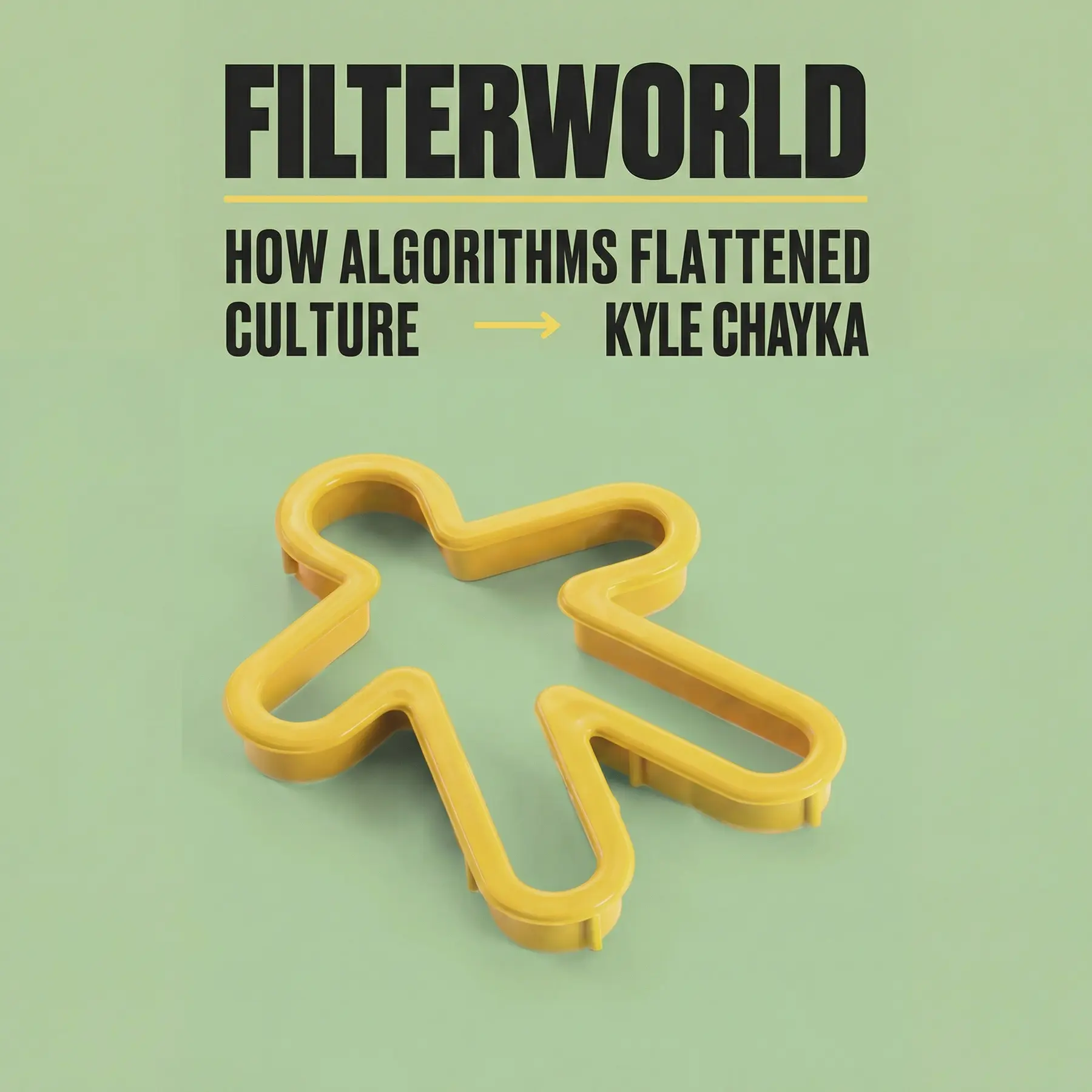
Filterworld: How Algorithms Flattened Culture
By Kyle Chayka
Shows how recommendation algorithms, built to maximize engagement, push music, books, cafés and art toward the same popular formulas. It also explains how to notice that pull and start choosing culture on purpose again.

Table of Content
1. Introduction
1 min 09 sec
If your playlists, your feeds and even your favorite cafés feel strangely interchangeable, the cause may have little to do with your taste. In Filterworld, journalist and cultural critic Kyle Chayka points out that coffee shops in major cities around the world now share the same minimalist furniture, the same potted succulents and nearly the same playlist.
Chayka’s name for this condition is Filterworld: a world where what we watch, read, hear and even where we drink coffee passes first through automated feeds on platforms like Instagram, Twitter, Yelp and Foursquare. His argument is that these systems, built to hold attention, reward whatever spreads most easily, and that over time they leave both culture and our curiosity thinner.
A filter you can see, though, is a filter you can step around. What follows covers what these systems are optimizing for, how they rearrange real rooms and creative work, where they turn dangerous, and how a few weeks away from his feeds helped Chayka find his own taste again.
2. Know what your feed is built to reward
1 min 46 sec
A playlist that seems to understand you better than your friends do feels like a gift. Chayka asks a simpler question about it: what was the system designed to get from you in return?
3. See how algorithms make shops and cafés look identical
1 min 47 sec
A bookstore where the shelves ignore author and genre sounds like a mistake. Chayka sees it as a preview of something much larger, and it reaches all the way to the café where you buy your morning coffee.
4. Treat every like as an instruction to the machine
1 min 49 sec
Tapping a small heart feels harmless, even generous. Chayka shows how that tiny gesture became the currency of the internet, and why a famous filmmaker thinks it is draining the life out of art.
5. Demand to see how your feed decides
1 min 38 sec
The same machinery that serves a teenager harmless songs can serve her something devastating, and it cannot tell the difference. Chayka uses one tragic case to ask who should be watching the watchers.
6. Take a break from feeds to rebuild your taste
1 min 46 sec
Chayka expected logging out to leave him lonely and out of touch. What actually happened during his weeks away from the feeds surprised him, and it points to a test anyone can run.
7. Conclusion
1 min 12 sec
Chayka’s book adds up to a warning about attention and a case for effort. Feeds were sold as personal, yet by chasing engagement they push millions of people toward the same songs, the same shelves and the same café with its succulents and minimalist chairs. The cost is variety in culture, and something harder to measure: the habit of curiosity, of looking for what nobody has served you yet.
His answer is balance. He does not ask anyone to give up the conveniences of the internet, only to stop letting them decide what they love. That begins with noticing. When a recommendation fits too neatly, ask who benefits from your click. When you like something, check whether it moved you or merely held you for a second. And at least once, try a cleanse of your own: log out of one feed, seek out a long article, a newsletter or an album by name, and see what your taste does when it is left alone.
In a world built to hand you the familiar, the unexpected rarely arrives by itself. You have to go and find it, and that search is where your own taste begins.
About this book
What is this book about?
Cafés in very different cities now look almost the same, with minimalist furniture, potted succulents and a playlist that could have been copied from the shop down the road. Kyle Chayka calls this condition Filterworld: a culture shaped by the automated feeds on platforms such as Instagram, Twitter, Yelp and Foursquare, which decide what we see, hear, read and buy. Chayka argues that these systems, tuned to capture attention, reward whatever is easiest to absorb and most likely to spread. The result is a flattening of culture. One online retail giant's bookstores arrange books by online popularity, creators bend their work toward likes, and a handful of giant platforms have overshadowed the scattered, personal early internet. In the worst cases, as the death of British teenager Molly Russell shows, unchecked feeds can do real harm. The book closes on a personal test. Chayka logged out of his feeds for several weeks and rediscovered long articles, handwritten notes and photography for its own sake. Readers come away understanding what their feeds are optimizing for, why so much culture feels interchangeable, and how to start choosing what they consume with intention again.
Book Information
Who it's for
Users doubting their feeds
Heavy social media users who suspect their feeds are choosing their music, books and opinions for them.
Feeling pushed toward likes
Writers, artists and creators who feel pushed to shape their work around likes.
Worried about youth feeds
Parents and teachers worried about what algorithms show young people online.
About the Author
Kyle Chayka
Kyle Chayka is an American journalist and cultural critic who writes about where technology, art and modern culture meet. His work has appeared in The New Yorker, The New York Times Magazine and Vox. He has also written The Longing for Less: Living with Minimalism.
Ratings & Reviews
Ratings at a glance
What people think
Listeners find the book offers excellent insights and makes for a truly compelling experience. Opinions vary among listeners regarding the level of emotional depth.
Top reviews
Fang
Filterworld offers a profound look at how we’ve outsourced our personal taste to the machine. Chayka’s analysis of “AirSpace”—that uncanny valley of minimalist coffee shops with white-tiled walls—is terrifyingly accurate. He explains how global aesthetics have converged because business owners are terrified of being ignored by the Yelp or Instagram feedback loop. This isn't just about coffee; it’s about the very soul of our cultural production. While the author occasionally drifts into personal nostalgia for the early internet, his core thesis remains essential for anyone feeling "flattened" by their feed. I found the section on human curation versus algorithmic gatekeeping to be the most compelling part of the book. It’s a necessary read for anyone trying to reclaim their autonomy in a world designed to keep them scrolling. The depth of research here is truly impressive.
Show moreFord
Wow, this book completely altered my relationship with my smartphone and how I consume media. I never realized how much my "taste" was actually just a reflection of what was easiest for an algorithm to serve me. Chayka’s writing is sharp and he makes complex technological concepts feel very personal. The way he describes the "flattening" of music and literature into featureless slop really hit home for me. I’ve started being much more intentional about seeking out human-curated newsletters because of this book. It’s a rare piece of non-fiction that actually changes your behavior after you put it down. Gotta say, the analysis of how we quantify our lives into numbers—like these star ratings—was particularly meta and thought-provoking. Highly recommend it.
Show moreDavid
As someone who spends way too much time on TikTok, this was a massive wake-up call. Chayka dives deep into how the "algo" has rounded off the sharp edges of art to make it more "consumable." He uses great examples, like the rise of Lil Nas X and how songs are now engineered for virality rather than longevity. To be fair, the book gets a bit repetitive in the middle chapters. It felt like he was making the same point about "engagement" over and over again. However, the chapter on his "algorithm cleanse" was actually quite touching. It made me realize how much of my daily mood is dictated by a black box in Silicon Valley. It’s not a perfect book, but it’s a vital one for the current moment and provides great analysis.
Show moreMontri
Finally got around to reading this cultural critique, and it’s a deeply informative look at the invisible forces shaping our world. Chayka explains how we’ve moved from human gatekeepers—like DJs and editors—to math-based systems that prize "flatness" above all else. I loved the specific details about how artists have to "game" the system, like the author himself using fake wedding references to boost Facebook visibility. It’s a bit of a dense read at times, and some of the chapters could have been trimmed. The emotional depth of the later chapters, where he discusses the psychological toll of being perpetually online, really resonated with me. Despite some of the author's overconfidence, the research here is top-notch and very eye-opening. Truly a great read for anyone interested in modern tech.
Show moreMax
After hearing so much buzz, I found the analysis of 'engagement' metrics fascinating, particularly how they’ve infected physical spaces like Airbnbs. The book describes how hosts feel forced to follow specific rituals to stay relevant in the search results, which is a perfect metaphor for our modern lives. Chayka’s prose is elegant, though he does occasionally lean into a "kids these days" vibe that feels a bit dated. Personally, I didn't mind the personal anecdotes as much as other reviewers did; they provided a necessary human element to a book about machines. The discussion of "whiteness" and "marginalized groups" felt a bit shoehorned in for some, but I found it added a layer of necessary sociopolitical context. It’s a thoughtful, if occasionally flawed, look at our digital ecosystem.
Show moreNora
The first half is brilliant, providing a technical yet accessible breakdown of how recommendation engines actually function, but then the narrative meanders into vague moralizing. Chayka is at his best when describing the history of the Mechanical Turk or the weird "cargo cult" rituals of Airbnb hosts who log in specific amounts of times to boost their ranking. Unfortunately, he eventually veers into a tone that feels somewhat elitist. His description of tourists at Gullfoss Falls in Iceland felt unnecessarily judgmental; why assume they aren't experiencing beauty just because they want a photo? He seems to pine for a version of the past that only existed for a specific type of Brooklyn-based intellectual. In my experience, the insights into cultural "flattening" are worth the price of admission, but the author's snootiness is hard to ignore.
Show moreSombat
Ever wonder why every new cafe from Seoul to Seattle looks exactly the same? This book provides the answer, attributing the rise of the minimalist, plant-filled aesthetic to the relentless pressure of engagement-based algorithms. Chayka calls it "Filterworld," a space where we only see what the machine thinks we already like. It’s a fascinating concept, yet the book feels stretched thin. I found myself skimming through the parts where he laments the loss of Kazaa or judges the "app-rotted brains" of people who watch Emily in Paris. He has a tendency to mistake his own nostalgia for objective cultural decay. Still, it’s a solid introduction for people who haven't thought much about how their Spotify Discover Weekly is actually constructed. Frankly, it's a bit of a mixed bag.
Show moreGrace
Picked this up for a book club and it sparked a massive debate about whether we've lost our ability to be original. Some members loved Chayka's take on the "homogeneity" of modern culture, while others found him insufferably pretentious. I fall somewhere in the middle. The history of how these algorithms were developed is genuinely interesting, and I’ll never look at a minimalist cafe the same way again. However, the author’s tendency to treat his own high school experiences with music as superior to modern fans is just annoying. The "algorithm cleanse" chapter felt like Sydney Carton going to the guillotine—dramatic and a bit much. It’s a mix of great tech reporting and some very questionable cultural gatekeeping. Take the moralizing with a grain of salt.
Show moreSirinat
Look, I wanted to like this, but Chayka's narrative voice is incredibly grating to the point of distraction. I came for a cultural critique and ended up reading about his "timely trip to Provence" and his specific preferences for high school anime. It’s hard to take a lecture on authenticity seriously from someone who admits to taking photos of his cappuccino in Kyoto while complaining about "Instagram culture" in the same breath. The book also suffers from some strange ideological tangents about "whiteness" that don't always feel connected to the tech analysis. There are interesting nuggets here about how Spotify's UI changes our listening habits, but they are buried under layers of self-indulgent fluff. It felt like reading a series of blog posts that needed a much firmer editor. Not gonna lie, I was disappointed.
Show moreSaowalak
Truth is, this should have been a long-form article rather than a three-hundred-page book. The core message is simple: algorithms make culture boring. While the first few chapters on the "hipster coffee shop" effect are engaging, the book quickly descends into repetition. Chayka spends far too much time talking about his own lifestyle, which feels like the exact "generic elite" aesthetic he claims to despise. He criticizes Billie Eilish and TikTok trends with a level of condescension that is honestly hard to stomach. Why can't we just enjoy things without being told our brains are "rotting"? The technical bits about how equations prioritize certain data points are good, but they are far and few between. Save yourself some time and just read his New Yorker articles instead. Life is too short.
Show moreQuestions about this book
What is the main idea of Filterworld by Kyle Chayka?
Chayka argues that recommendation algorithms, designed to maximize engagement, have flattened culture. Because feeds reward what is easy to absorb and quick to spread, music, books, art and even the look of cafés drift toward the same popular formulas. He calls this condition Filterworld and argues it also makes people more passive, weakening their capacity for deep engagement and real curiosity.
Why do coffee shops all look the same, according to Filterworld?
Chayka links the sameness to algorithms leaving the screen and shaping physical spaces. What wins online is whatever gets the most engagement, so cafés and shops converge on the styles that already perform well, such as minimalist furniture and succulents. He compares this to Amazon Books stores, where shelves are arranged by online popularity rather than by author or genre.
What is an algorithm cleanse in Filterworld?
It is Chayka’s own experiment in stepping away from feeds. He deleted apps and logged out of accounts for several weeks. Instead of feeling cut off, he found mental quiet and clarity. He returned to newsletters and long articles, wrote his thoughts by hand instead of tweeting them, and rediscovered photography as a hobby rather than a way to collect likes.
Does Filterworld call for regulating social media?
Yes. Chayka points to the death of British teenager Molly Russell, who had been exposed to material idealizing self-harm, as a sign of what unchecked feeds can do. He argues for transparency from large tech companies, better public understanding of how feeds decide what we see, and more user control, so that the internet supports variety, new ideas and personal safety.
How can I apply the ideas in Filterworld?
Start by asking what a platform gains when you accept its recommendation. Before liking something, check whether it actually moved you. Notice whether the spaces you visit are arranged by human judgment or by online popularity. Then try a small cleanse: log out of one feed for a few weeks and seek out writers, artists and music directly, by choice.
Readers also enjoyed





A Biography of Loneliness: The History of an Emotion
Fay Bound Alberti


A Force for Good: The Dalai Lama's Vision for Our World
Daniel Goleman


A Room of One’s Own
Virginia Woolf
AUDIO SUMMARY AVAILABLE
Listen to Filterworld in 15 minutes
Get the key ideas from Filterworld by Kyle Chayka, plus 5,000+ more nonfiction titles.
- 5,000+ titles
- Listen as much as you want
- 7-day free trial
- Cancel anytime









