
Extra Life: A Short History of Living Longer
Steven Johnson
 English
Shows why big decisions go wrong through hidden biases and poor forecasting. Then it offers ways to choose better: diverse voices, red teams, weighted options, cost-benefit thinking and time to reflect.
1 min 00 sec
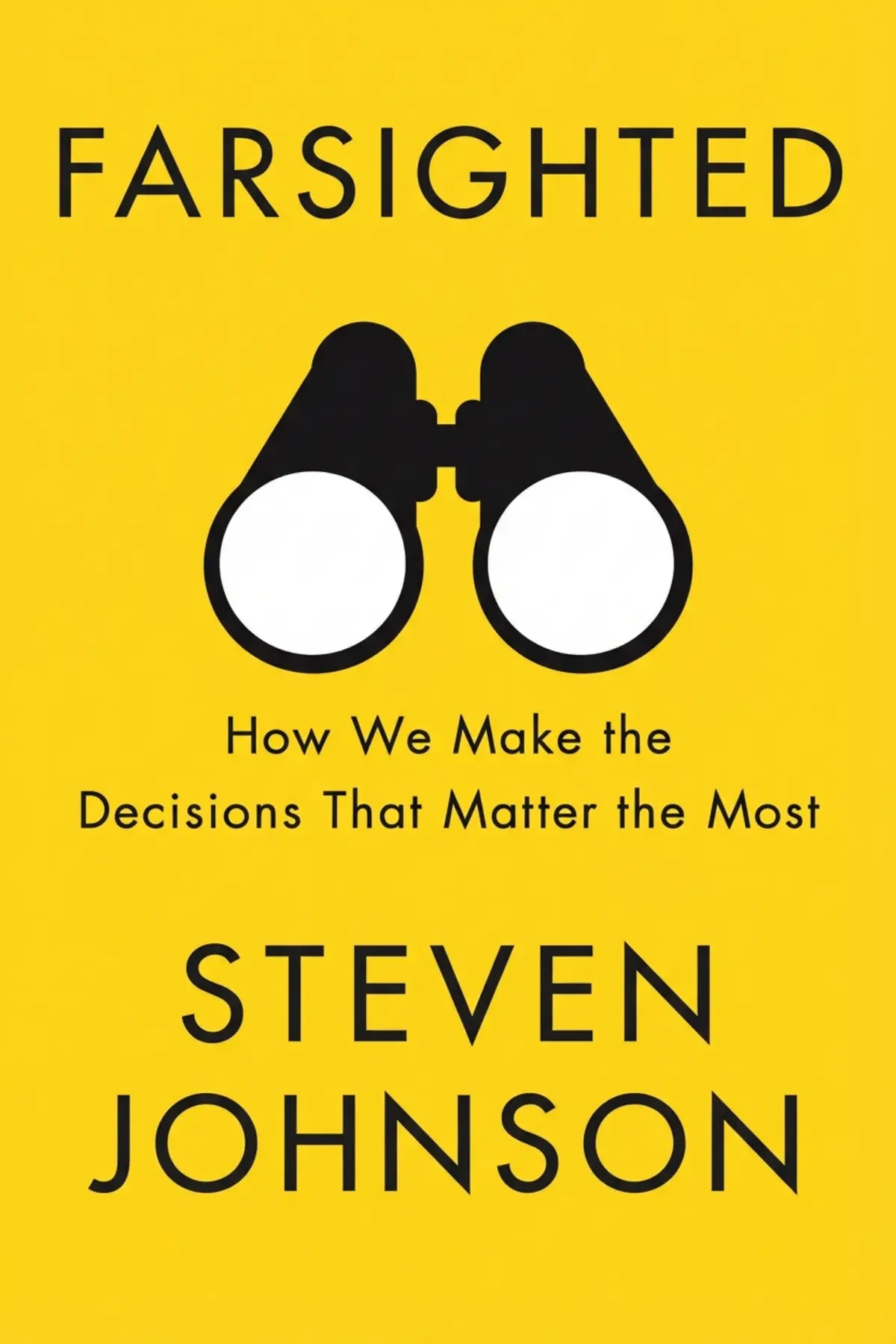
Big choices, about a career move, a marriage or a costly project, can freeze sensible people, and the usual escape is to delay or trust a hunch. In Farsighted, science and history writer Steven Johnson argues that the freeze has causes we can work around. Our minds have predictable blind spots, and even George Washington lost New York partly to one of them.
Johnson’s case is that the decisions that matter most improve when you widen your view on purpose before you narrow it. That means bringing in people unlike you, asking someone to attack your plan, putting weights and prices on what you care about, and then giving your mind time to settle. The stories range from a water project in Vancouver and mock juries to the raid on Osama bin Laden’s compound. They add up to a set of habits for your next hard call, at work or at home.
1 min 40 sec
A British fleet gathered off New York in 1776, and the American commander faced a choice with dozens of moving parts. His first error came from a tendency nearly everyone shares and almost no one notices.
1 min 43 sec
A city running short of fresh water had three very different options and plenty of people with something to lose. The way its planners chose, and a set of mock trials, challenge how most organizations make their biggest calls.
1 min 45 sec
A political scientist collected tens of thousands of predictions about politics and the economy, then waited years to score them. The people with the most specialized knowledge did not come out where anyone expected.
1 min 31 sec
A famous novelist looked at the world of 1944 and imagined where it was heading. He was wrong for a reason that also explains why almost nobody saw the personal computer coming.
1 min 32 sec
Before American forces moved on a compound in Pakistan, a small group was told to think like the other side. Their odds were sobering, but their most useful contribution had nothing to do with the target.
1 min 41 sec
A president known for cutting taxes signed an order that later helped the case for environmental protection. The tool behind it can change how you judge any choice with hidden costs.
1 min 39 sec
Whether to marry seems like the last question anyone would answer with arithmetic. A method from statistics suggests otherwise, and the same logic may soon guide a driverless car facing a pedestrian in its path.
1 min 24 sec
Even with a red team and careful estimates, the question of who was inside the Abbottabad compound came down to a coin flip. What carried the decision from there is something anyone can practice.
1 min 09 sec
Farsighted comes down to one discipline for the choices that matter: widen the view before you narrow it. Washington’s first mistake, Tetlock’s confident experts and Orwell’s imagined dictatorships all failed by seeing too little. The Vancouver pipeline and the Abbottabad raid went well because someone went looking for what the deciders could not see alone. Johnson does not ask you to become a statistician. He asks you to give hard decisions the time and breadth they deserve, and he shows that careful numbers and patient reflection can both get you there.
The habits that follow are modest. When you assemble people for a decision, include some whose backgrounds and stakes differ from yours. Before you commit, hand the plan to someone whose task is to break it. Write down the factors you care about, weight them honestly, and give a value to the costs that never show up on a bill. Then walk away for a while and let your mind finish the work.
Washington’s best move in New York was the moment he stopped defending ground he could not hold. The same choice to step back and see more is open before any hard decision.
Big choices tend to freeze even practical people. There are too many options, the future is unclear, and our minds come with blind spots we rarely notice. Steven Johnson argues that this paralysis can be worked around, and that the tools for doing it range from a careful set of numbers to a long walk. Johnson draws on history, psychology and government. George Washington misjudges the defense of New York. Vancouver's water planners consult everyone from indigenous tribes to water-security specialists. Philip Tetlock's forecasting tournaments show experts losing to generalists. A red team prepares for surprises before the raid on Osama bin Laden's compound. Washington agencies put a price on carbon, and a self-driving car weighs which way to swerve. Readers learn why loss aversion and narrow expertise mislead us, how to build groups that see more, how to test a plan by attacking it, and how to weigh personal values with a simple model. Johnson's last argument is that patient reflection still matters, especially once the math has run out.
Managers and team leads who make high-stakes calls and want more than a hunch.
Founders weighing launches, hires and risks who need a way to test plans before reality does.
Anyone facing a personal crossroads, such as a move or a marriage, who keeps putting the decision off.
Steven Johnson is a bestselling American author of popular science and history, and also a TV and podcast host and a software creator. He hosts the podcast American Innovations and presented How We Got to Now on PBS and BBC, a series he co-created. His books include Where Good Ideas Come From, The Ghost Map, Emergence and Wonderland. He has written for The New York Times and The Wall Street Journal.
Steven Johnson
Steven Johnson

Listeners find this book thought-provoking, especially valuing the unique perspectives it offers on navigating complex choices. They commend how easy it is to digest, with one listener describing it as an enjoyable experience driven by its storytelling. Listeners appreciate the practical value, as one mentions its relevance to both private affairs and career development. The work is packed with captivating narratives, and one listener points out the effective use of these tales to explain data.
Steven Johnson has a knack for taking dense, multi-variable concepts and spinning them into a narrative that actually sticks. I found the breakdown of the bin Laden raid particularly gripping, as it serves as a perfect lens for seeing how high-stakes choices are orchestrated through a mix of data and intuition. Truth is, we often ignore the long-view in favor of immediate gratification, but this book provides a solid framework for resisting that impulse. The way he weaves in the 'default network' of the brain explains so much about why we daydream about the future. It’s an entertaining read that doesn't just dump data on you but uses storytelling to illustrate complex points. While some might find the military history sections a bit dense, I thought they were essential for understanding how to map out variables. This is a must-read for anyone facing a major life transition.
Show moreFinally got around to reading this, and it’s easily one of the most insightful books on my shelf this year. Johnson takes us beyond the simple pros and cons list into the world of full-spectrum mapping. I loved the idea that we should make decisions when we hit the 70% rule of certainty rather than waiting for 100% clarity. It’s a practical way to avoid the paralysis that usually comes with big life changes. The discussion on how diverse groups are more likely to be right because they embrace uncertainty was especially relevant to my work in management. Personally, I think the section on George Eliot's Middlemarch was a masterclass in how fiction acts as a simulator for the soul. It’s rare to find a science book that respects literature this much.
Show morePicked this up during a major life transition and found the framework for 'farsighted' thinking incredibly helpful. The idea that we need to intentionally calculate decisions for future outcomes sounds obvious, but Johnson shows how rarely we actually do it. I was particularly struck by the discussion on how daydreaming is actually a neurologically active state of 'prospecting.' It changed how I view my own downtime. The writing is top-notch, moving effortlessly between historical biography and cutting-edge neuroscience. It’s a wonderful popular book that stands up well against other behavioral economics titles. If you’re looking for a way to sharpen your long-term thinking, this is a great place to start. Every big decision I make from now on will involve a much more diverse set of perspectives.
Show moreEver wonder why we struggle so much with big life choices like who to marry or where to live? Picked this up during a period of personal uncertainty and found the concept of 'moral-mental algebra' surprisingly grounding. The book highlights Darwin’s famous pro-and-con list about marriage, which makes a world-renowned scientist feel incredibly human. Johnson argues that diversity of perspective improves our judgment, and honestly, the 'diversity trumps ability' theory was a total lightbulb moment for me. Not gonna lie, some of the science regarding randomized control trials felt a bit simplified, but the overall message about simulation is powerful. We use novels and stories to rehearse life before we live it. It’s a fascinating perspective on behavioral science that is helpful for both professional and personal spheres.
Show moreThis book is essentially a deep dive into the 'default network' of our brains and why we are wired to look ahead. Johnson is a skilled communicator who makes neuroscience feel accessible rather than intimidating. I especially appreciated the 'impact pathways' concept, which shows how decisions rarely move in a straight line. In my experience, most people rush into choices without considering the third option—the 'Option C' that Obama used to look for. The book is packed with these kinds of small, useful frameworks. While it does get a little bogged down in the military case studies, the payoff in the final chapters is worth the effort. It’s an engaging read that uses stories to make data feel much more visceral.
Show moreThe chapter on the RCT method and smoking was a bit of a head-scratcher for me. Claiming that Sir Austin Bradford Hill used a randomized control trial to prove smoking causes cancer is just factually off, and for a book about 'reality-based' decisions, that's a tough pill to swallow. To be fair, the rest of the book is quite engaging if you can look past the occasional scientific stumble. I enjoyed the sections on 'knowable unknowns' and how we can map out the rippling effects of our actions. The writing style is fluid and the anecdotes are fun, even if they sometimes feel like they're padding the page count. It’s a decent introduction to behavioral economics if you’re new to the genre, but seasoned readers might find it a bit repetitive.
Show moreAs someone who works in strategic policy, I found that this book didn't offer many new insights for sound, farsighted decision-making. Coming from a background where Shell’s scenario planning and Philips' technological forecasting are standard, most of these concepts felt like a rumination on well-known theory. The book touches on the role of values in decision-making—a point Popper famously made—but it never dives deep enough into the 'how.' It deals more with the difficulty of complex decisions than with the actual tools needed to navigate complex situations. Got to say, the writing is pleasant and the stories are well-told, but it lacks the conceptual complexity I expected. It’s fine as a popular science primer, but experts in the field will likely find it a bit elementary.
Show moreThe analysis of Middlemarch was surprisingly the highlight for me, which says a lot about the rest of the book. Johnson’s main thesis—that realist fiction helps us simulate complex choices—is fascinating and persuasively argued. However, the rest of the book felt a bit disjointed. One chapter focuses on the minute details of the Iraq war, while another dwells on Darwin's personal life. It’s hard work to keep all these threads together. I didn't gain a lot of new insight into the actual 'science' of decision-making, as most of it was covered in Superforecasting. Still, the prose is elegant and the anecdotes are interesting enough to keep you turning the pages. It’s a solid 3-star read: good for the stories, but maybe not the definitive guide it wants to be.
Show moreI really wanted to love this, but frankly, it feels like a bit of a mess. It's like Johnson tried to stuff ten pounds of research into a five-pound bag, and the result is a tossed salad of ideas that never quite gelled. I've been a fan since The Ghost Map, but the focus on the military history of Long Island felt disconnected from the central thesis of personal decision-making. Look, the analysis of Middlemarch was actually quite brilliant, but I shouldn't have to slog through hundred-page anecdotes to get to the point. The book touches on the role of ideology and futurology without ever fully elaborating on how to apply them. It lacked the actionable tools I was looking for. If you want a clear manual on how to decide, this isn't it.
Show moreNot what I expected based on the glowing recommendations. The book is an entertaining read if you like anecdotes, but it fails to offer the deep insights promised by the subtitle. It felt like a collection of interesting facts that didn't quite build to a cohesive conclusion. One minute we're talking about the hunt for bin Laden, and the next we're doing a literary analysis of a 19th-century novel. I struggled to finish it because the narrative just didn't gel. Frankly, it felt more like a series of long-form magazine articles than a structured book. There are better resources out there for learning the actual science of forecasting. It’s fine for a casual reader, but it didn't provide the 'how-to' I was hoping for.
Show moreJohnson argues that important decisions go wrong mainly because our view is too narrow, shaped by biases like loss aversion and by forecasts that just extend current trends. He shows how to widen that view: involve diverse perspectives, use a red team to attack the plan, weigh costs and values explicitly, and give yourself time to mull the choice before deciding.
Drawing on Philip Tetlock’s forecasting tournaments, which gathered 28,000 predictions, Johnson reports that people usually did worse than a simple formula assuming current trends would continue. Experts in economics and politics did worse than non-experts, because they stayed inside their own field, while generalists considered technology, education, farming, population and more.
A red team is a group inside an organization that plays the enemy, studying a plan and mapping every way it could be countered. Before the 2011 raid on Osama bin Laden’s compound, the red team flagged the risk of flying through Pakistani airspace, which led the government to prepare a second route in and out through diplomatic work with Russia and Baltic shipping.
You list the factors that matter, estimate how likely each choice is to satisfy them, and weight each factor from 0 to 1 by importance. In Johnson’s marriage example, the chance of having children might be 30 percent single and 70 percent married, weighted 0.75 if children matter a lot. Multiply, add up each option, and compare the totals.
Build decision groups with people whose backgrounds differ from yours. Ask a colleague to argue against your plan before you commit. List costs and benefits beyond money, and weight what matters to you. Then take time away from the problem, such as a long walk, so your mind can sort the information into an informed intuition.


Deborah Gruenfeld


Anthony Pratkanis




Richard Wiseman


AUDIO SUMMARY AVAILABLE
Get the key ideas from Farsighted by Steven Johnson, plus 5,000+ more nonfiction titles.









